
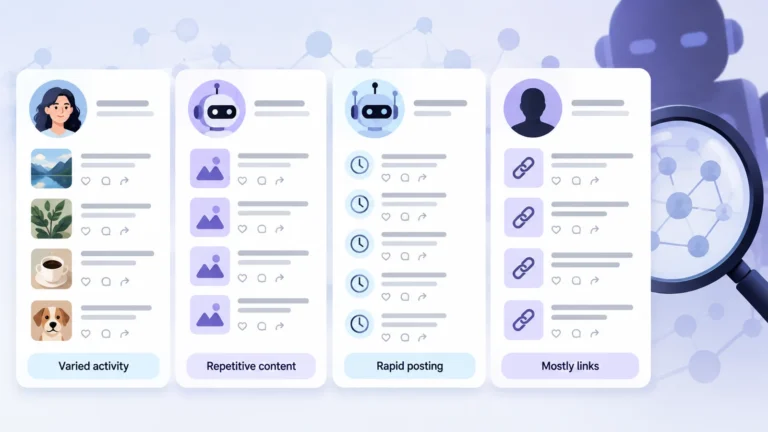
Social media bots are accounts or programs that automate parts of social interaction, such as posting, replying or sharing. Some provide useful, clearly disclosed services; others support spam or deceptive amplification. To assess an account, examine its stated purpose, public behavior and source relationships together. One repetitive phrase, unusual avatar or busy posting schedule is not proof that a person is a bot.
This guide provides a defensive account-check workflow. It helps you decide what to trust, what to verify independently and what behavior to report. It does not identify private operators, build automated accounts or supply a blacklist. You can protect yourself from a suspicious request without proving how the account is operated.
Automation is a behavior, not an identity verdict
An account can combine human and automated activity. A person may schedule announcements, use a support assistant or share material through an approved service. Another account may be largely automated but clearly describe its purpose. “Bot” is therefore too broad to stand in for fake identity, dishonest claim and harmful behavior at the same time.
Separate three questions. What activity appears automated? What does the account claim about itself? What action does it ask you to take? An automated weather notification and a false emergency-fundraising request differ primarily in purpose, transparency and claim support, not just in how regularly they post.
The FTC’s Social Media Bots and Deceptive Advertising report distinguishes legitimate uses of automated programs from harmful or deceptive uses. This is a conceptual distinction, not a claim that every automated account is permitted by every platform or that a public profile supplies its complete operating history.
Use precise descriptions while you investigate. “The account repeats this message across several threads” is inspectable. “This person is a bot” may turn an uncertain behavioral observation into an unsupported identity claim. Keeping the question narrow makes your next step clearer and reduces the chance of accusing an ordinary user.
Distinguish useful automation from deceptive influence
Useful automation has a purpose a reader can understand: a service update, a clearly described alert or a routine announcement. Look for an accountable source and a route for checking the underlying information. A schedule by itself does not make the content trustworthy, but a transparent purpose helps explain the behavior.
A deceptive use may imitate independent people, exaggerate support or direct users toward a harmful request. The important problem is what the behavior makes viewers believe or do. You do not need to infer the exact technology to notice that a supposed public notice has no support from the organization it names.
X’s current Authenticity policy distinguishes legitimate account purposes from prohibited inauthentic coordination and misuse. Consult the actual platform’s current reporting rules for your case; do not assume one site’s rules apply everywhere. This article does not turn a platform policy into a universal legal classification.
Read the account’s disclosure alongside its behavior. A profile saying “automated alerts” does not validate every link it shares. A profile without that phrase does not necessarily hide a bot. Your task is to check the relevant claim and behavior, using transparency as one piece of evidence rather than a magic pass or fail.
Review the account’s public history in context
Start with information the account makes public. Record its stated purpose, profile URL, the relevant posts and the time you reviewed them. If the case matters, preserve enough context to explain what you observed. A cropped screenshot of one sentence can lose the thread that makes a normal reply understandable.
Look for continuity of purpose. Does the account link to an established publisher or organization that independently recognizes it? Does its recent activity make sense in that role? A change in topic or appearance can be a reason to verify a claim, but accounts also change owners, purposes or communication styles legitimately.
Account age and follower totals are context, not certificates. A new local volunteer account can be genuine; an older account can be compromised or repurposed. Avoid inventing an age threshold that turns every account on one side into a suspect. Ask whether the history supports the specific identity or request at hand.
The existing synthetic identity fraud guide addresses fabricated identity records and claims. That is a separate investigation from recognizing automation. Do not ask ordinary social users to reveal private documents or personal details just because their public profile gives you limited information.
Posting patterns can identify a question, not settle it
Regular timing, rapid bursts or repeated content may indicate automation, coordinated promotion or ordinary scheduled communication. They are useful observations when you can describe the actual pattern. Record the span you examined rather than saying an account “posts nonstop” from a few visible examples.
A burst during a public event may have a mundane explanation. A support account might answer many similar requests. A community may share a common statement. Your interpretation should consider the purpose and available context instead of treating activity level as a personality test.
Carnegie Mellon research describes account, content and interaction characteristics as related dimensions of studying social bots. The researcher’s explanation of the study is useful for understanding why a single profile feature is insufficient. Its event-specific findings do not provide a universal percentage of bots on the internet or a reliable verdict for one account.
For a personal check, use patterns to choose a next question: “Does the same link appear in many unrelated replies?” or “Is this announcement recognized by the named source?” You are investigating a relationship you can verify, not reverse-engineering private software from a posting cadence.
Language and profile appearance are weak clues alone
Generic praise, awkward wording or a repeated phrase can come from automation, templates, translation, limited time or a person’s communication style. Do not treat fluency as proof of humanity or poor grammar as proof of a bot. People use multiple languages and assistive tools for ordinary reasons.
A stock-looking avatar, illustrated character or empty profile does not automatically mean a false identity. Some users deliberately avoid personal photographs. An account representing a service may use a symbol. Focus on whether it makes a consequential identity claim and whether that claim is supported.
Similarly, polished text can be copied, assisted or written by a person. A screenshot of an apparent generated reply might be a joke, a quotation or an isolated mistake. Keep the surrounding thread and avoid turning a surprising sentence into a universal detector.
When appearance raises a concern, choose the relevant verification task. The existing AI impersonation guide covers false identity and authorization claims. This guide does not ask you to expose a user’s real name, location or face. A pseudonymous account can be operated honestly without disclosing its private identity.
Coordination and shared content need careful interpretation
Several accounts posting similar material may share a source, campaign, organization or automated operation. Similarity alone does not tell you which. Start by identifying the public relationship: identical links, recurring phrasing or a visible pattern of mutual amplification. Record examples with their context.
Distinguish independent confirmation from repeated distribution. Ten accounts sharing the same unsupported video do not provide ten separate witnesses to the event. Their posts may trace back to one source. That remains true whether the accounts are human-operated, automated or mixed.
Look for the source of the claim rather than trying to identify an entire network from your feed. Can the relevant organization confirm the announcement? Is there a primary document or full clip? A public behavior pattern may justify a platform report while the private operator remains unknown.
The existing AI slop article covers low-value and repetitive content. Automation, content quality and factual truth overlap but are different questions. A repetitive post may contain correct information; an individually written post may spread a falsehood. Evaluate the actual claim instead of substituting a label for verification.
Bots, sockpuppets and impersonators are not synonyms
A bot describes automation. A sockpuppet describes an account used to present a misleadingly separate identity or voice, which may be operated manually. An impersonator falsely represents a particular person or organization. Those behaviors can coexist, but none automatically establishes the others.
For example, a single person can manually operate accounts that appear to provide independent testimonials. A disclosed automated account can simply distribute service notices. An impersonation account can send entirely human-written messages. The relevant defense depends on the claim and request, not on using the broadest possible threat word.
A suspected sockpuppet relationship is not permission to investigate private identities. Avoid publishing speculative connections between accounts or inferring ownership from a shared opinion. If you have evidence of coordinated inauthentic behavior, document the public activity for the platform rather than organizing a public accusation campaign.
Platform-specific impersonation and identity problems belong in their dedicated guides. Here the task is to recognize what is supported about operation and behavior. You can say “these accounts amplify the same source” without claiming that one person controls them or that the messages were written by a language model.
Do not convert a bot score into a personal accusation
A classifier may analyze a profile or activity and return a score. Its label and scale require interpretation. The output is not automatically a probability that the operator is dishonest, nor proof that a particular post is false. Tools can be useful for bounded research while still being inappropriate for a casual public accusation.
The original PLOS ONE study by Rauchfleisch and Kaiser examined false positives and variation in a specific Botometer setting. Its results warn against uncritical use of classifier thresholds. They do not establish that every current tool has the same failure rate or that all automated analysis is useless.
Ask what population, language and behavior the system was evaluated on, and whether your account fits that context. Keep unsupported or unavailable answers visible. A numerical result may look more objective than your notes, but it cannot supply evidence about private ownership or intent that the method did not test.
Do not conduct provocation tests, harassment or attempts to access an account. You also do not need to force a conversational system into revealing itself. A defensive review should use appropriate public evidence and independent claim checks. If serious action depends on the classification, seek competent review rather than relying on a single screen capture.
An original three-account review exercise
The following accounts are fictional. No real handles, measured platform sample or detector result is implied. Imagine three accounts appearing in a discussion about a local service interruption. Your decision is whether to rely on their information or interact with their requests.
Account A says it distributes automated service alerts and links to an independently found official information page. Its recent posts follow that narrow purpose. You can verify the current notice at the official source. This supports using that notice, while the account’s disclosure explains its regular posting. It does not make every future post automatically trustworthy.
Account B replies to many unrelated discussions with the same urgent request to send money through a new link. It has not supplied verifiable support from the organization it names. The repeated request and unsupported identity justify caution and possibly reporting the observed behavior. You do not have to determine whether the operator is a bot before declining the request.
Account C has little public history and asks a brief question about the interruption. There is not enough information to classify its operation. A sparse profile and unfamiliar language are not grounds to label it malicious. You can respond with the official public notice without demanding personal information.
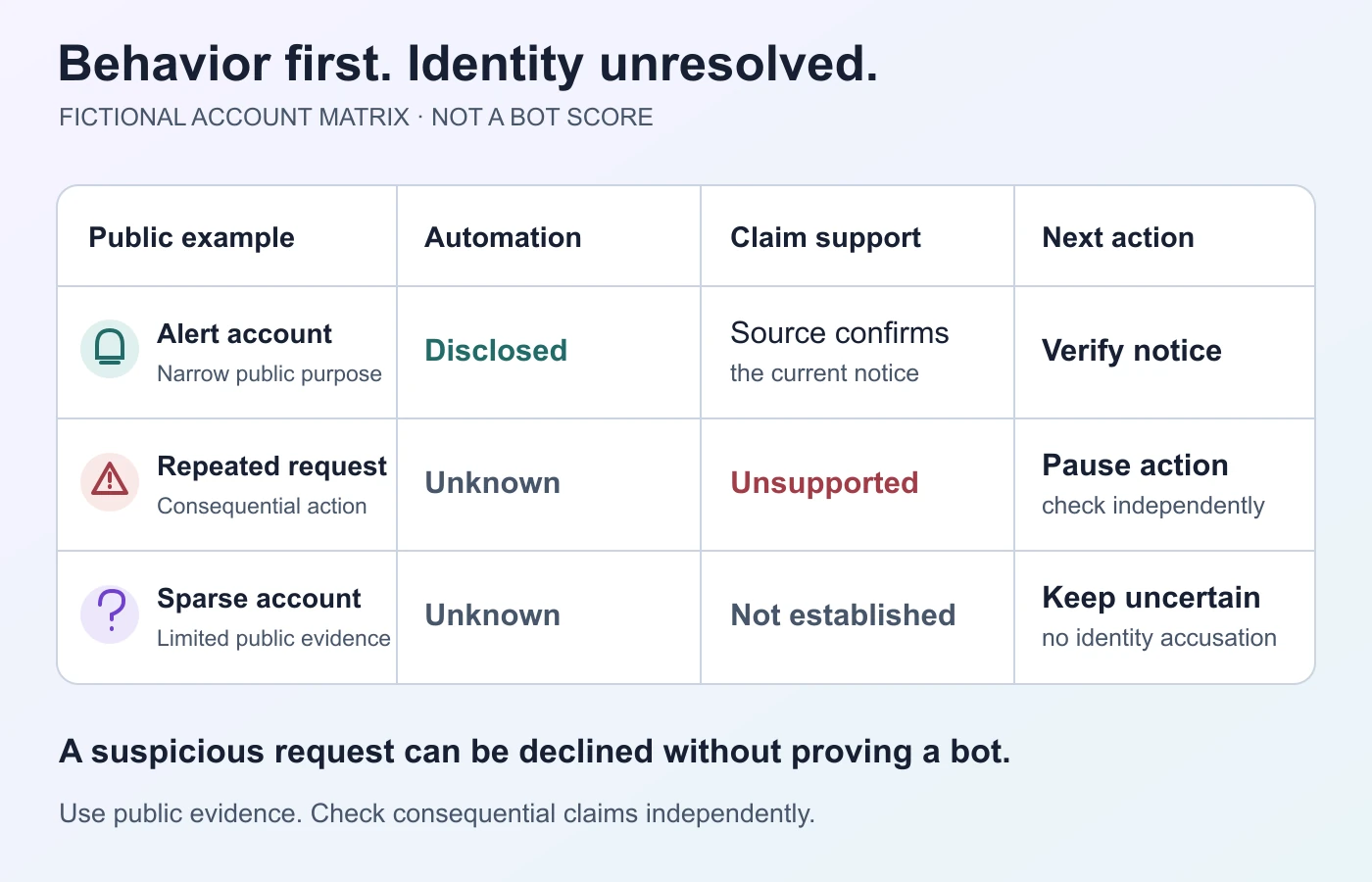
The exercise separates helpful automation, suspicious behavior and uncertainty. It never turns the second account into a confirmed bot or the third into a confirmed human. Your immediate decision is based on support for the claim and the safety of the requested action, while the private operating mechanism remains unresolved.
Keep a public-evidence notebook
Use a small notebook rather than accumulating a dossier on a person. Record only what is needed to assess the relevant public behavior. A URL, a quoted claim, a review date and a concise observation may be sufficient. Avoid collecting unrelated personal information or republishing private contact details.
The following original table makes each observation lead to a defensible next step. It is a review aid, not a validated classification score or a list of features that bot operators should imitate.
| Observation | Question to clarify | Proportionate action |
|---|---|---|
| Regular disclosed alerts | Does the stated source independently support the notice? | Check the official source before relying on it. |
| Repeated urgent requests | Is the identity and requested destination verifiable? | Decline the request while checking independently. |
| Many copies of one claim | Do they all originate from the same unsupported source? | Trace the primary evidence rather than count reposts. |
| Little public history | Is there actually a consequential claim to assess? | Keep operation unresolved; avoid identity accusations. |
| A classifier alert | Does the evaluated context fit this account? | Seek corroboration before consequential conclusions. |
Add an alternative explanation when one is plausible. Repetition could reflect an authorized announcement system; similar replies might be a public campaign. Document the concern without deleting the ordinary possibilities. If another reviewer cannot understand your reasoning from the notes, narrow the claim or obtain better evidence.
Verify the requested action through an independent route
The highest-impact question is often whether you should click, pay, disclose information or believe a consequential announcement. Use a route you find independently, such as a known organizational site or established contact method. Do not let the suspicious message supply every part of your verification loop.
If a clip is used as evidence, separate account and media questions. A video can be authentic but reposted by a misleading account. An established account can publish an incorrect caption. An automated account can distribute genuine footage. Verify the source and context of the clip rather than inferring its authenticity from the profile.
The existing video verification guide covers that broader workflow. Technical video analysis can contribute evidence about supported media, but it cannot prove who operates an account or whether a payment request is authorized. Keep those identity and transaction checks separate.
If the request remains unverified, choose a cautious action without making a larger accusation. You may ignore the message, consult the relevant organization or report visible misconduct. Do not continue interacting merely to satisfy curiosity about whether a human or program wrote it.
Report behavior accurately and preserve uncertainty
Use the platform’s current report process for the specific issue: spam, impersonation, harmful content or inauthentic behavior. Include relevant public examples when the process permits. A clear report about repeated unsolicited requests is stronger than an unsupported claim about hidden software.
Avoid mass-reporting campaigns or calls for harassment. Other users may disagree with you, communicate unusually or remain anonymous for legitimate reasons. A disputed opinion is not evidence of automation. Keep the moderation question tied to observable behavior and the applicable policy.
Finish with a scoped record. “The account discloses automation and this notice is independently supported” is a useful conclusion. So is “the money request remains unsupported” or “there is insufficient public evidence to classify operation.” None requires guessing a private operator’s identity.
- Separate automation, identity and factual claim questions.
- Review public context instead of one screenshot.
- Consider ordinary explanations for activity patterns.
- Verify consequential requests independently.
- Use tools within their evaluated limits.
- Report observable conduct without personal speculation.
Recognizing social media bots is therefore part of account literacy, not a competition to label strangers. The practical win is knowing when the evidence supports a notice, when a request needs independent confirmation and when you should leave an account’s operation unresolved.
Questions about social media bots
Are all bot accounts deceptive?
No. Automation can support disclosed alerts or routine services. Assess the purpose, source and behavior, and consult the relevant platform’s rules.
Can a regular posting schedule prove an account is automated?
No. Scheduling, human teams and ordinary event activity can create patterns. Treat timing as one observation, not a verdict about identity or intent.
Is a sockpuppet always a bot?
No. A misleadingly separate identity can be operated manually. Automation and false representation are different questions even when they coexist.
Should I trust a bot-detection score?
Use it only with an understanding of the method and its evaluated context. Seek corroboration before consequential conclusions or public accusations.
Can video analysis prove who runs an account?
No. A supported video check concerns the media. Account ownership and authorization require independent source and identity evidence.