
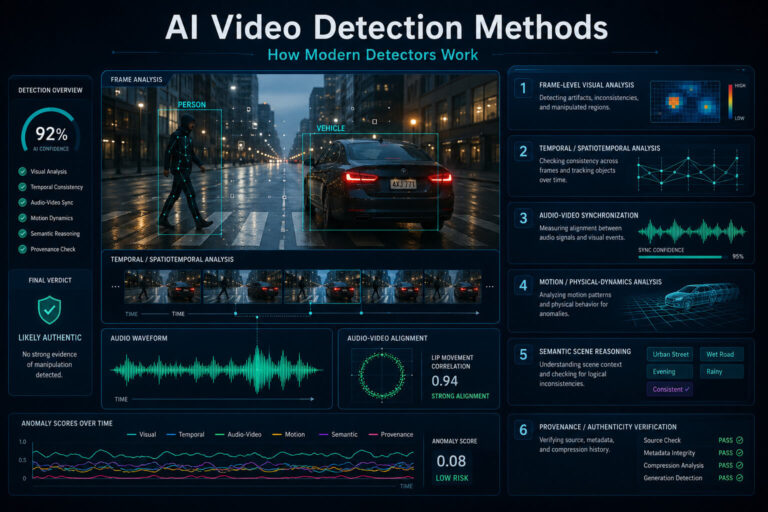
AI video detection methods are changing because AI-generated video is changing. Early detectors could often rely on obvious facial artifacts, unstable textures, or generator-specific fingerprints. That approach is no longer enough. Modern synthetic video can preserve realistic faces, lighting, camera motion, and speech for long sequences, while fully generated scenes may contain no manipulated face at all.
The strongest detection systems now treat a video as a collection of evidence across space, time, sound, semantics, and provenance. Instead of asking whether one frame “looks AI,” they ask whether the entire recording behaves like captured reality.
Quick answer: the main AI-generated video detection methods include frame-level visual and frequency analysis, spatiotemporal consistency modeling, motion and physical-dynamics analysis, audio-video consistency checks, high-level semantic reasoning, and provenance or source verification. No single method is reliable across every generator, video type, and post-processing condition, so modern systems increasingly combine several evidence layers.
| Detection method | What it analyzes | Main strength | Main weakness |
|---|---|---|---|
| Visual and frequency cues | Individual frames, textures, residuals, spectral patterns | Fast and effective when generator traces survive | Can fail after compression or on unseen generators |
| Spatiotemporal analysis | Changes across frames, identity, geometry, motion | Uses information unique to video | More computationally expensive |
| Physical and motion consistency | Dynamics, trajectories, acceleration, interactions | Less dependent on one visual artifact | Not every clip contains useful motion |
| Audio-video analysis | Speech, lip movement, acoustics, cross-modal timing | Can expose hybrid manipulations | Requires usable audio and visible speech |
| Semantic reasoning | Objects, events, relationships, scene logic | Targets higher-level inconsistencies | Reasoning models can also make mistakes |
| Provenance and authentication | Source history, signed credentials, recorded actions | Provides evidence independent of visual artifacts | Often unavailable on reposted or unsupported media |
What AI Video Detection Methods Are Trying to Detect
There is no single technical definition of “AI video” that covers every threat. A detector may need to recognize several very different forms of synthetic media:
- a face swap applied to authentic footage
- AI-generated speech synchronized to a real person’s mouth
- a synthetic voice over genuine video
- AI-edited objects or backgrounds
- image-to-video animation created from a still image
- text-to-video or image-to-video footage generated almost entirely by a model
- hybrid videos that combine conventional editing with several AI-generated regions
This matters because a method optimized for facial deepfakes may perform well on a manipulated interview but poorly on a synthetic landscape or product video. Research is therefore moving from narrow face detection toward more general synthetic video detection.
A CVPR 2025 study on the UNITE detector highlighted this shift directly. The researchers argued that face-centric deepfake methods are insufficient for modern text-to-video, image-to-video, and background manipulation, and proposed full-frame analysis that can operate even when no face is present. The paper is available through the CVPR 2025 Open Access repository.
For identity-focused manipulation specifically, the separate deepfake detection guide covers the narrower face and identity problem.
Method 1: Visual and Frequency-Based Detection
The simplest AI video detection method treats video as a sequence of images and analyzes individual frames.
Models can learn subtle differences between camera-captured and generated imagery, including texture statistics, local image residuals, edge behavior, color correlations, or frequency-domain patterns that are difficult for people to see.
Frame-level visual cues
A visual detector may examine:
- unnatural local texture statistics
- repeated or oversmoothed details
- inconsistent fine structure around objects
- generator-specific spatial patterns
- unusual relationships between high-frequency and low-frequency image information
The advantage is efficiency. A strong image model can sample selected frames without processing every moment of the video.
Frequency and residual analysis
Generation pipelines can leave statistical patterns that are more visible in transformed representations than in normal RGB pixels. Some detectors therefore analyze frequency components, noise residuals, reconstruction traces, or higher-order feature distributions.
This can work well when the detector has learned a signal that remains stable across generation methods. The problem is that generator updates, resizing, denoising, compression, or platform re-encoding can weaken those traces.
That is the central limitation of artifact-based detection: if the detector learns the fingerprint of yesterday’s generator, it may not recognize tomorrow’s.
Method 2: Spatiotemporal Consistency Detection
Video contains something a still image does not: time.
Even when every individual frame looks convincing, a generated sequence may struggle to preserve identity, geometry, motion, or object relationships consistently from one frame to the next.
Spatial evidence plus temporal evidence
Spatiotemporal models jointly analyze what appears inside a frame and how those features evolve over time.
They may track:
- facial identity through head movement
- object shape across scene changes
- lighting behavior over time
- texture persistence
- motion trajectories
- background and foreground consistency
CVPR 2025 research on generalizable deepfake video detection identified temporal generalization as one of the core challenges in the field and proposed combining video-level blending with spatiotemporal adaptation rather than relying only on static image artifacts. See the CVPR 2025 spatiotemporal detection study.
Why temporal evidence can generalize better
A generator can learn to create realistic skin texture or correct a common facial artifact. It is harder to maintain every relationship correctly across a long sequence, especially through occlusion, rotation, camera movement, or interacting objects.
This is why temporal analysis has become one of the most important areas of modern AI video detection.
Method 3: Motion and Physical-Dynamics Analysis
Some approaches go further than frame-to-frame appearance. They ask whether motion itself behaves like physical motion.
Real video records objects moving through time under constraints imposed by the physical world. Generated video predicts plausible-looking future frames, but that prediction can produce subtle inconsistencies in acceleration, momentum, deformation, or interaction.
An ICCV 2025 method called D3 analyzed second-order temporal features derived from motion dynamics. The researchers reported measurable differences between real and AI-generated video in these higher-order temporal patterns. The work is available in the ICCV 2025 Open Access repository.
Physical-dynamics analysis is attractive because it is less tied to a single generator’s visual fingerprint. Instead, it tests whether motion follows patterns associated with captured reality.
It also has limits. A static talking-head clip may provide little useful physical motion, while fast camera movement or editing can complicate the signal.
Method 4: Full-Frame Semantic Consistency
As generators improve, low-level artifacts can become weak or disappear. Detection then moves upward from pixels to meaning.
A semantic detector asks whether the scene makes sense as a coherent event.
Examples of semantic inconsistency include:
- an object changing identity while remaining in the same scene
- a reflection that no longer corresponds to the visible object
- text changing meaning between frames
- a person’s clothing or accessories changing unexpectedly
- an action whose cause and effect do not remain consistent
- background geometry changing even though the camera movement cannot explain it
This represents a major shift. Instead of asking “Is there an AI texture?” the detector asks “Does the video maintain a coherent world?”
A 2026 Neurocomputing paper proposed this kind of approach by combining global semantic awareness with inter-frame semantic consistency. Its central argument is that increasingly realistic generation makes low-level artifact detection less dependable, while semantic anomalies can remain useful. See the 2026 SemaDet study.
Method 5: Audio-Video and Multimodal Detection
A video is more than its frames. When speech, music, environmental sound, or narration is available, audio becomes an independent evidence channel.
Multimodal detection compares what the viewer sees with what the microphone appears to have recorded.
Speech and lip synchronization
Models can analyze whether phonemes align with visible mouth movement, whether facial motion matches speech timing, and whether the speaker’s identity is consistent across audio and video.
Acoustic consistency
The audio should also fit the physical scene. Room reverberation, background noise, microphone distance, and changes in speaker orientation can provide evidence that a synthetic or replaced voice does not belong naturally to the visible recording.
Why multimodal systems matter
A hybrid fake may contain a completely authentic image sequence with synthetic audio. A purely visual detector could miss it. The opposite is also possible: the audio may be genuine while the face is replaced.
Multimodal systems reduce dependence on one evidence source by checking whether multiple channels tell the same story.
Method 6: Language-Guided and World-Level Reasoning
The newest direction in AI video detection uses multimodal language models to reason about the video rather than only classify hidden features.
These systems can potentially ask higher-level questions:
- Does the sequence violate ordinary cause and effect?
- Does an object behave inconsistently with its identity?
- Does the scene contradict basic physical expectations?
- Do multiple parts of the clip describe incompatible events?
- Can the model explain which moment makes the sequence suspicious?
This approach is promising because it may generalize beyond specific generator fingerprints. It also supports explanations, which are valuable when users need to understand why a clip was flagged.
However, reasoning models introduce a different risk: they can produce plausible explanations that are not actually supported by the media. A detector therefore needs grounded evidence, not just fluent language.
Recent 2026 research surveys increasingly describe AI-generated video detection as moving from low-level artifact recognition toward spatiotemporal, cross-modal, and world-level reasoning. That transition reflects a broader change in the field: detection is becoming an evidence-integration problem rather than a single-classifier problem.
Detection Is Not the Same as Provenance
Not every method for identifying synthetic media is a detector.
NIST separates synthetic-content detection from provenance, authentication, watermarking, and labeling because they answer different questions. Its current technical overview describes these approaches as complementary rather than interchangeable. See NIST AI 100-4.
Detection asks whether the media contains patterns associated with synthetic generation or manipulation.
Provenance asks where the media came from and what happened to it in a recorded workflow.
Watermarking attempts to embed or associate a signal that identifies generation, source, or provenance.
Authentication tests whether available origin and integrity evidence is valid.
When Content Credentials are available, they can provide a provenance layer that does not depend on finding visual artifacts. The Content Credentials guide explains how that evidence is inspected in practice, while the video provenance guide covers the broader source-history problem.
Why Modern Detectors Combine Several Methods
Every detection method has blind spots. The practical response is not to find one perfect model. It is to combine methods that fail for different reasons.
| System design | How it works | Why it helps |
|---|---|---|
| Frame ensemble | Runs image-based analysis across selected frames | Reduces dependence on one frame |
| Spatial + temporal model | Combines visual features with motion across time | Finds both static and sequence-level evidence |
| Audio-video model | Compares visual, speech, and acoustic evidence | Helps detect hybrid manipulation |
| Multi-detector ensemble | Combines several independent classifiers or forensic models | Reduces dependence on one learned artifact family |
| Provenance-aware system | Combines media analysis with source and credential evidence | Separates inferred evidence from recorded origin evidence |
| Reasoning-based system | Explains semantic or physical inconsistencies | Can surface high-level evidence missed by artifact detectors |
This layered architecture is becoming more important as generated video becomes more diverse. A face detector, for example, cannot analyze a synthetic landscape. A temporal detector may struggle with a two-second clip. Provenance may be missing. Audio may not exist.
A robust system therefore has to know not only what evidence it found, but also which evidence was unavailable.
Why AI Video Detection Accuracy Is Hard to Compare
Accuracy numbers can look impressive while saying very little about real-world performance.
A detector may score highly when the test set contains the same generators, compression settings, or content styles seen during training. The harder question is whether it still works on new generators and real social-media video.
Benchmarks can become outdated quickly
CVPR 2026 introduced AIGVDBench specifically because older datasets often cover too few generation models or lack representative diversity. The benchmark contains more than 440,000 videos from 31 generation models and evaluates 33 existing detectors across more than 1,500 experiments. See the AIGVDBench paper.
In-the-wild performance can be much worse
Deepfake-Eval-2024 collected contemporary manipulated media from real online sources rather than relying only on established academic datasets. The authors reported an average AUC drop of about 50% for open-source video detectors compared with the academic benchmarks on which those models were originally evaluated. See the Deepfake-Eval-2024 paper.
The lesson is not that detection is useless. It is that generalization matters more than one headline accuracy number.
What Makes an AI Video Detection Method Generalize?
A method has stronger real-world value when it relies on evidence that is difficult for generators to eliminate and that remains meaningful across new models.
Useful properties include:
- Generator diversity: training and testing across many synthesis systems
- Content diversity: faces, objects, landscapes, animation, text, products, and complex scenes
- Temporal modeling: using the sequence rather than treating frames independently
- Robustness testing: compression, resizing, cropping, filtering, frame-rate changes, and reposting
- Open-set evaluation: testing on generators not seen during training
- Explainability: showing which evidence contributed to the result
- Evidence coverage: distinguishing unavailable evidence from clean evidence
The goal is not to recognize a specific generator logo hidden in the pixels. It is to learn properties that separate generated video from captured or conventionally edited media more generally.
Which Detection Method Works Best for Which Video?
| Video type | Most useful methods | Why |
|---|---|---|
| Talking-head deepfake | Face analysis, spatiotemporal consistency, audio-video sync | Identity and speech provide several correlated evidence channels |
| Fully AI-generated scene | Full-frame visual analysis, temporal consistency, semantic reasoning | There may be no face or original base video |
| Very short social clip | Visual ensemble, source evidence, provenance if available | Temporal evidence may be limited |
| AI voice over real video | Audio forensics, audio-video consistency, source comparison | Visual evidence may look completely authentic |
| Heavy social-media repost | Robust temporal signals, semantic reasoning, source analysis | Compression can destroy low-level generator traces |
| Original file with Content Credentials | Provenance plus media analysis | Recorded origin evidence can complement detector inference |
This is also why “the best AI detector” is not a meaningful technical category without knowing the input. The useful question is: which evidence channels are appropriate for this video?
How DetectVideo AI Fits Into the Detection Stack
DetectVideo AI is designed around the same principle: one signal is not enough.
The current DetectVideo AI analysis platform can use available visual, temporal, audio, compression, metadata, codec, and source evidence depending on the media and how it is submitted. An original uploaded file generally provides broader technical evidence than a heavily recompressed repost or a social page where the original stream cannot be retrieved.
The important distinction is between evidence generation and final interpretation. A detector can identify patterns associated with synthesis or manipulation. It cannot independently establish whether a real video has been falsely captioned or whether an event actually occurred.
That broader decision belongs to video authenticity, where source, provenance, manipulation, and real-world context are considered together.
How to Evaluate an AI Video Detection Platform
If you are comparing detection technology, do not judge a platform only by whether it produces a percentage score.
Look for these characteristics:
Multiple evidence families
A detector that relies entirely on one face classifier or one visual fingerprint is more vulnerable to generator changes.
Clear evidence coverage
The system should distinguish between “no suspicious evidence found” and “this evidence could not be measured.”
Robustness to real distribution
Social media changes bitrate, resolution, frame rate, metadata, and audio. Detection claims should account for those transformations.
Results that expose uncertainty
A useful detector should not present probabilistic evidence as absolute fact. Short, low-quality, or heavily processed media should produce appropriately cautious conclusions.
Separation of detection and provenance
Recorded source evidence and model inference should not be silently merged into one unexplained score.
Up-to-date evaluation
The generator landscape changes quickly. A detection model that was effective against 2023 or 2024 generators may not generalize to current systems without continued testing and adaptation.
Where AI Video Detection Technology Is Heading
The direction of the field is becoming clear.
First, detection is moving beyond faces. Full-frame models are needed for synthetic scenes, product videos, environments, and object manipulation.
Second, time is becoming central. Motion, physical dynamics, identity persistence, and inter-frame semantics provide signals that single-frame classifiers cannot see.
Third, detectors are becoming multimodal. Video, audio, metadata, provenance, and source evidence increasingly need to be interpreted together.
Fourth, semantic reasoning is growing. As low-level artifacts disappear, detectors must identify contradictions in objects, actions, physics, and event logic.
Finally, evaluation is becoming as important as architecture. A detector is only useful if it survives unseen generators, compression, platform processing, and real-world content diversity.
This is why the future of AI video detection is unlikely to be one perfect classifier. It is more likely to be an evidence system that combines specialized models, provenance, source analysis, and explainable reasoning.
Key Takeaway
AI video detection methods are evolving from artifact matching into layered evidence analysis.
Frame-level visual and frequency methods remain useful, but modern detection increasingly depends on temporal consistency, physical motion, audio-video relationships, semantic coherence, and provenance. Each method answers a different question and fails under different conditions.
The most reliable systems therefore do not ask whether one feature looks synthetic. They ask whether multiple independent forms of evidence agree that the video behaves like generated media rather than captured reality.
For users who want to understand the content itself rather than the detection technology, the separate AI-generated video guide explains what synthetic video is and how it differs from conventional editing and deepfake manipulation.
FAQ About AI Video Detection Methods
What are AI video detection methods?
AI video detection methods are technical approaches used to identify synthetic or AI-manipulated video. They can analyze individual frames, temporal behavior, physical motion, audio-video consistency, semantic coherence, model fingerprints, provenance, or several evidence types together.
What are the main AI-generated video detection methods?
The main families include visual and frequency analysis, spatiotemporal modeling, motion and physics analysis, audio-video detection, semantic or multimodal reasoning, and provenance-based authentication.
How does temporal AI video detection work?
Temporal detection analyzes how visual features evolve across frames. It can look for unstable identity, inconsistent object geometry, unnatural motion, changing textures, or other sequence-level problems that may not be visible in a single frame.
Why are frequency-based methods used?
Generation models can leave statistical or spectral patterns that are easier to detect in frequency or residual representations than in normal pixels. These methods can be effective but may weaken after compression or when generators change.
What is spatiotemporal AI video detection?
Spatiotemporal detection combines spatial information inside frames with temporal information across the sequence. It is designed to capture both static generation traces and inconsistencies that emerge through motion.
Can audio help detect AI-generated video?
Yes. Audio can reveal synthetic speech, inconsistent room acoustics, voice replacement, or disagreement between visible speech and the soundtrack. Multimodal systems compare audio and video evidence rather than treating them independently.
Can an AI video detector identify every generator?
No. Generalization to unseen generators remains one of the hardest problems in AI video detection. Performance can fall when a model encounters new generation methods, heavy compression, or content outside its training distribution.
Why do benchmark accuracy and real-world accuracy differ?
Academic benchmarks may contain familiar generators, clean files, or narrow content distributions. Real online video includes unseen models, compression, edits, reposts, multiple languages, and mixed manipulation types, which can significantly reduce detector performance.
Is provenance an AI video detection method?
Not in the same sense as a classifier. Provenance records where media came from and what happened to it in a supported workflow. It complements synthetic-content detection by providing origin and history evidence rather than inferring generation from the pixels alone.
What is the best AI video detection method?
There is no single best method for every video. Talking-head deepfakes benefit from face, temporal, and audio analysis, while fully generated scenes need full-frame, temporal, semantic, and provenance approaches. Combining independent methods is generally more robust.
How are AI video detection methods improving in 2026?
Current research is moving toward full-frame detection, stronger temporal modeling, physical-dynamics analysis, multimodal reasoning, semantic consistency, and larger benchmarks that include many modern generators and real-world transformations.
What should a good video detection platform show?
A useful platform should show which evidence was analyzed, which evidence was unavailable, how uncertain the result is, and whether several independent signal families support the conclusion. A single unexplained percentage is less informative.