
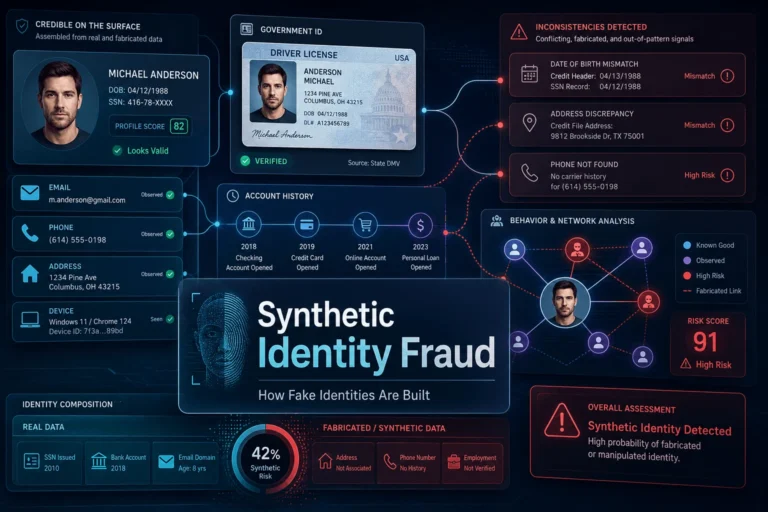
Synthetic identity fraud is the use of a fabricated identity built from real, invented, or mixed personal information to commit fraud. Unlike traditional identity theft, the attacker is not always pretending to be one existing person. Instead, the fraud relies on an identity record that appears internally plausible even though the person represented by that record may not exist at all.
Generative AI makes the problem more convincing by helping fraud operations create realistic profile images, documents, voices, digital histories, and supporting content at scale. But synthetic identity fraud is still an identity consistency problem before it is an AI problem. Strong defenses validate whether the attributes, evidence, person, device, history, and behavior belong to one real identity rather than trusting any single document or biometric check.
A synthetic identity is assembled from identity elements that appear plausible together but do not reliably map to one real person. The identity may combine genuine data with fabricated names, addresses, contact details, documents, or synthetic media. Detection works best when organizations cross-check identity evidence against authoritative sources, verify that the applicant is genuinely linked to that evidence, inspect device and account history, monitor fraud signals over time, and use liveness or injection defenses where biometric proofing is involved.
What Is Synthetic Identity Fraud?
NIST defines synthetic identity fraud as using a combination of personal information to fabricate a person or entity for dishonest personal or financial gain.
In identity-proofing terms, NIST distinguishes this from ordinary identity theft. With identity theft, an attacker fraudulently uses another real person’s identity or identity evidence. With synthetic identity fraud, the attacker creates evidence for an identity that is not reliably associated with a real person.
See the NIST definition of synthetic identity fraud.
Synthetic identity fraud vs identity theft
| Fraud type | Core deception | Example pattern |
|---|---|---|
| Synthetic identity fraud | A fabricated identity is assembled from real and/or invented attributes | The application looks like one person, but the combined identity does not reliably correspond to a real individual |
| Traditional identity theft | A criminal uses the identity of a real person without authorization | Stolen documents or credentials are used to impersonate the victim |
| AI impersonation | Media or accounts make the attacker appear to be a specific real person | A cloned voice or face is used to impersonate an executive or consumer |
| False attribute claim | A real person supplies materially false information about themselves | A genuine applicant falsely claims an address, credential, or other attribute |
The categories can overlap. A synthetic identity may include some stolen personal data, while an impersonation attack may use a synthetic face or voice to support a stolen real identity.
For fraud centered on pretending to be one specific real person, see the AI impersonation guide.
How Are Synthetic Identities Built?
From a defender’s perspective, a synthetic identity is best understood as a bundle of identity layers that have been made to appear as though they describe one real person.
This is not a single fake document. A convincing synthetic identity can involve several mutually reinforcing layers.
Real data and fabricated data can coexist
The Federal Reserve describes synthetic identities as combinations of real and fictitious information. A real identifier may be paired with invented or unrelated identity attributes, making the overall record look more plausible than a completely fictional application.
The Federal Reserve’s Synthetic Identity Fraud Mitigation Toolkit provides industry education on how these identities differ from ordinary identity theft and why cross-record consistency matters.
The identity can accumulate apparent legitimacy over time
A synthetic identity may not be exploited immediately. Fraud operations can allow accounts, records, contact details, or other history to accumulate so the identity appears less new and more trustworthy.
The classic financial form of the fraud can culminate in a bust-out, where the identity has accumulated enough apparent credibility to obtain larger financial exposure before defaulting. The important defensive lesson is that a long-lived account is not automatically a real identity.
The public footprint can be manufactured too
Websites, social profiles, reviews, profile images, contact pages, employment claims, or other online traces can make a synthetic identity look established.
That means an organization should distinguish:
“I found this information online.”
from:
“This information is independently anchored to a credible source.”
The Synthetic Identity Consistency Graph
A robust identity check should ask whether multiple data relationships make sense together.
The fraud becomes easier to detect when systems test relationships instead of validating fields independently.
How Generative AI Changes Synthetic Identity Fraud
Generative AI does not create the concept of synthetic identity fraud, but it lowers the cost of creating realistic supporting material.
The Federal Reserve Bank of Boston warns that GenAI can make synthetic identities faster to create and harder to detect, especially because stolen data can be combined with fabricated media and documents that look increasingly convincing. See the Boston Fed analysis of GenAI and synthetic identity fraud.
AI can strengthen the presentation layer
Generative systems can produce or alter:
- profile images
- supporting documents
- voice samples
- video or selfie material
- web content and biographies
- communication history
This can make several weak identity elements look mutually consistent even when the underlying identity is not real.
Deepfakes are one layer, not the whole identity
A synthetic identity can exist without any deepfake. Conversely, a deepfake can impersonate a real person without creating a synthetic identity.
The two threats intersect when a fabricated identity needs a convincing biometric presentation. A generated face, face swap, replayed video, or injected synthetic stream can become the media layer attached to the false identity record.
If the unresolved problem is whether a remote applicant is physically present rather than replayed or synthetically injected, the liveness detection guide explains that separate defense layer.
Why Single-Signal KYC Fails Against Synthetic Identities
A single check can validate one component while the overall identity remains false.
| Single check | What it may establish | What can remain unresolved |
|---|---|---|
| Document looks valid | The evidence has plausible or valid characteristics | Whether the applicant is the rightful person associated with it |
| Face matches document portrait | Visual similarity between presented person and evidence | Whether the evidence itself belongs to a coherent real identity |
| Liveness passes | A responsive presentation may be present | Whether the live person owns the claimed identity |
| Phone receives OTP | The applicant controls that channel at that moment | Whether the phone has meaningful history with the identity |
| Credit or account history exists | The identity has accumulated records | Whether those records originated from a real human identity |
NIST’s current identity-proofing guidance therefore treats synthetic identity fraud as one of several threats requiring layered controls rather than one universal test. See the NIST identity-proofing threats and security considerations.
Synthetic Identity Fraud Warning Signals
No single red flag proves synthetic identity fraud. The useful signal is usually a pattern of inconsistencies, reuse, or implausible history.
Identity attributes do not age together
Examples include a mature identity claim attached to contact channels, addresses, devices, or accounts with almost no history.
Independent records disagree
Names, dates, addresses, document data, phone ownership, public records, or other attributes may each look plausible but fail to form one coherent person when compared across trusted sources.
Devices or contact details connect unrelated applicants
Repeated device, address, phone, email, or network relationships can reveal that multiple apparently independent identities share infrastructure.
Enrollment velocity is unusual
Scaled fraud can create patterns such as repeated applications, rapid retries, or many identities emerging from related technical infrastructure.
The profile changes after onboarding
Address, phone, payment information, devices, geolocation, or account behavior may shift in ways that do not match the original identity story.
NIST recommends fraud-management programs consider signals such as device or account tenure, mailing-address characteristics, device fingerprinting, transaction analytics, fraud indicators, and high-risk network conditions as part of layered identity proofing. See the NIST fraud-management requirements for identity proofing.
A Layered Defense Against Synthetic Identity Fraud
-
Resolve the claimed identity.
Determine whether the core attributes describe a real-world identity that can be supported by credible or authoritative records.
-
Validate the evidence.
Check identity documents and attributes against trusted sources rather than relying only on visual document appearance.
-
Verify the applicant to the evidence.
Confirm that the person undergoing proofing is genuinely associated with the validated identity evidence.
-
Use liveness and injection defenses where biometric proofing is involved.
Presentation attack detection and injection controls solve different problems and should not be treated as interchangeable.
-
Check account and device tenure.
Newly created contact channels or repeated infrastructure can add risk even when individual identity fields look valid.
-
Analyze cross-account relationships.
Look for identities that share devices, contact points, payment instruments, addresses, or behavioral patterns unexpectedly.
-
Continue monitoring after onboarding.
Synthetic fraud can develop over time, so unusual post-enrollment changes and transaction behavior should feed back into risk decisions.
-
Provide review and redress.
Fraud systems can make mistakes. Legitimate applicants need a documented way to resolve false positives or inconsistent records.
Identity proofing should verify relationships, not only fields
The strongest defensive question is not:
“Is every field individually plausible?”
It is:
“Do the fields, evidence, person, device, and history consistently describe the same real subject?”
How Big Is the Problem?
Synthetic identity fraud is no longer treated as a niche U.S. credit problem.
The 2026 LexisNexis Risk Solutions Cybercrime Report, based on more than 116 billion transactions analyzed across its Digital Identity Network in 2025, reports synthetic identity theft at 11% of client-classified fraud, up from 9.9% in the previous reporting period. The report describes the threat as increasingly global and notes that generative AI is making fabricated identities more sophisticated.
See the LexisNexis Risk Solutions 2026 Cybercrime Report.
One data set does not measure all global synthetic identity fraud, but the trend supports the broader shift toward fabricated identities that combine digital, document, and behavioral evidence.
Synthetic Identity Fraud Can Affect Real People
Calling the identity “synthetic” does not mean the fraud is victimless.
Real personal information can be embedded inside the fabricated identity. The Federal Reserve has highlighted cases where misuse can damage a real person’s credit, interfere with benefits or records, and remain unnoticed for years.
Children can be especially vulnerable
Children may have identifiers that are valid but have little or no credit activity, so misuse can remain hidden until the child is older.
The FTC recommends parents and guardians protect children’s sensitive information and, in the United States, consider a free child credit freeze to make it harder to open new credit accounts using the child’s identity. See the FTC guidance on protecting children from identity theft.
What to Do If Your Information Is Part of a Synthetic Identity
The exact recovery process depends on the country and the type of data involved, but several principles are broadly useful.
- Preserve evidence. Keep notices, account statements, credit-report entries, application details, and messages connected to the misuse.
- Contact the organization where the fraudulent activity appeared. Use its fraud or identity-theft process to dispute accounts or records you did not create.
- Review relevant credit or financial records. Look for accounts, addresses, or inquiries that do not belong to you.
- Use available fraud alerts, freezes, or identity-protection controls. The right tool depends on your jurisdiction and situation.
- Report the identity misuse through the appropriate government or law-enforcement channel.
- Keep monitoring after the first correction. A stolen identifier can be reused in more than one synthetic identity.
This article provides general fraud-awareness and identity-verification information, not legal, financial, or compliance advice.
Synthetic Business Fraud Is a Related Threat
The same logic can be extended from fabricated people to fabricated or manipulated business identities.
Federal Reserve Financial Services describes synthetic business fraud as the use of stolen, manipulated, or manufactured business information to create a company identity that appears legitimate enough to access accounts, credit, loans, or payment services.
This is related to synthetic identity fraud but deserves separate entity-level due diligence because business registration, ownership, transaction behavior, revenue claims, and operational history create a different evidence graph.
How Synthetic Identity Fraud Relates to Deepfake Job Interviews
Remote hiring provides a useful example of how multiple fraud layers can converge.
A fabricated or stolen professional identity may be supported by a synthetic photo, altered resume, false work history, proxy applicant, cloned voice, or face-swapped interview. The deepfake is only one piece of the identity system.
The deepfake interview guide focuses specifically on candidate identity, onboarding, device delivery, and post-hire continuity.
Where DetectVideo AI Fits
DetectVideo AI can contribute technical media evidence when an identity workflow includes a suspicious video that needs analysis for possible AI generation, face manipulation, temporal inconsistency, audio-video mismatch, compression, metadata, or related forensic signals.
It does not verify an entire synthetic identity.
A video detector can help answer:
“Does this media contain evidence consistent with AI generation or manipulation?”
Identity proofing must separately answer:
“Does this applicant, evidence, history, device, and behavior belong to one real identity?”
For a broader evidence process involving source, context, provenance, and media integrity, use the video verification guide.
Use Precise Synthetic Identity Fraud Verdicts
| Verdict | Meaning |
|---|---|
| Identity independently supported | Core attributes, evidence, applicant, and trusted records consistently support one real identity |
| Synthetic identity indicators detected | Multiple identity elements appear plausible individually but fail to resolve into one coherent real subject |
| Identity evidence inconsistent | Documents, attributes, contact channels, or external records materially conflict |
| Biometric presentation risk | The media layer may involve replay, injection, generated content, or other presentation manipulation |
| Identity real, attribute claim unverified | The person appears real but one or more asserted attributes remain unsupported |
| Identity unresolved | Available evidence is insufficient to establish a reliable identity conclusion |
Key Takeaway
Synthetic identity fraud succeeds when individually plausible identity elements are mistaken for one verified person.
The defensive shift is from field validation to relationship validation. Check whether the person, document, core attributes, contact history, device, public footprint, and behavior all belong together. Generative AI can make the presentation more convincing, but it does not eliminate the inconsistencies that appear when an identity is tested across independent evidence layers.
For organizations, use layered proofing and lifecycle fraud monitoring. For individuals, protect sensitive identifiers, review unexplained records, and respond quickly when information appears in accounts or credit activity you did not create.