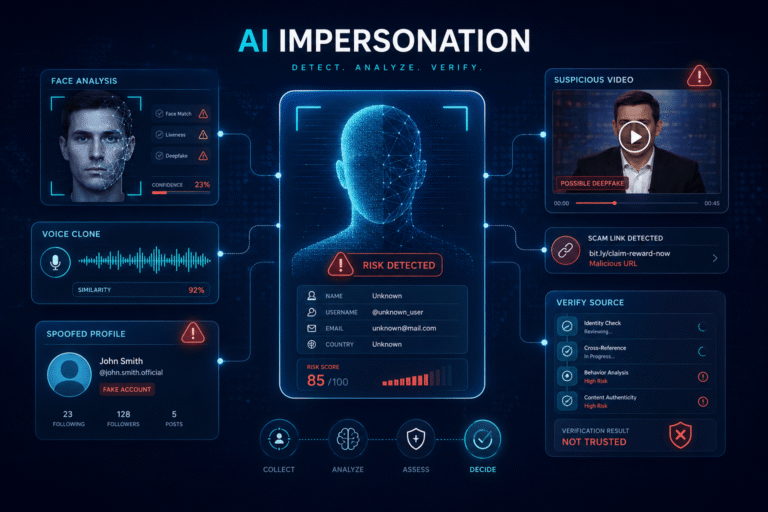
AI impersonation is an identity attack, not a single type of deepfake. A scammer can copy a person’s face, clone their voice, imitate their writing style, create a fake account, reuse authentic video, or combine several of these elements until the target believes the message comes from someone they trust.
That is why the strongest defense is not memorizing visual artifacts. A fake identity can look technically perfect and still fail a basic verification test: the real person, organization, channel, payment destination, or source does not confirm the request.
What Is AI Impersonation?
AI impersonation is the use of artificial intelligence to imitate or falsely represent a real person, organization, public figure, employee, family member, creator, or trusted identity.
The impersonation may involve media, communication, or both. A fake celebrity endorsement can use authentic interview footage with cloned audio. A CEO scam can use a synthetic voice note and a copied profile picture. A fake support agent can use generated text, a familiar logo, and a spoofed account without any video at all.
The common thread is not the technology. It is the false claim of identity or authorization.
AI Impersonation vs Deepfake: What Is the Difference?
A deepfake is a media-manipulation technique or category. AI impersonation is the broader identity problem.
| Term | Main focus | Example |
|---|---|---|
| Deepfake video | Synthetic or AI-altered media | A public figure appears to make a statement they never made |
| Voice deepfake | Synthetic or altered speech | A cloned executive voice gives a fake instruction |
| AI impersonation | False identity or authorization | A fake executive account uses cloned voice, copied branding, and a malicious request |
| Account impersonation | False profile or channel identity | A fake creator account copies a name, image, and channel design |
| Conventional impersonation | False identity without AI | A scammer pretends to be a bank employee using only text or phone calls |
If your main question is how manipulated identity media is created and verified, see the deepfake video guide. This page focuses on how identity itself is borrowed and abused.
The AI Impersonation Chain
Most effective impersonation attacks are built in layers. The synthetic face or voice is only one part.
This model is useful because it shows where verification should happen. You do not need to prove which AI model generated a face if the supposed celebrity’s official channel never published the offer and the payment destination belongs to an unrelated website.
Why AI Impersonation Works So Well
People do not evaluate every message from zero. We use identity as a shortcut.
Recognition creates borrowed trust
A familiar face, voice, logo, or writing style can make a claim feel verified before any evidence has been checked.
AI fills the gaps in the impersonation
Older scams often failed because the language felt wrong, the profile was empty, or the caller did not sound right. Generative AI can now create more convincing messages, voices, profile content, and media at low cost.
The request usually arrives before doubt
The attacker wants the target to move quickly. Common triggers include urgency, secrecy, investment opportunity, fear, emotional attachment, authority, or a limited-time offer.
The FBI has documented campaigns in which malicious actors used AI-generated voice messages while impersonating senior U.S. officials. The goal was not merely to produce believable audio. The impersonation was used to build rapport, move targets to another messaging platform, and potentially gain access to accounts, contacts, information, or funds. See the FBI warning on AI-assisted impersonation.
Celebrity AI Impersonation: Why Famous Faces Are High-Value Targets
The Search Console queries around fake celebrity AI and celebrity fake videos reflect one of the most visible forms of impersonation.
Celebrities, creators, athletes, executives, and public figures offer scammers three advantages:
- large amounts of public face and voice material
- instant recognition
- existing trust, fandom, authority, or influence
Common fake celebrity formats include:
This page treats those clips as an identity and scam problem. For detailed celebrity-specific deepfake patterns and verification, use the celebrity deepfake guide.
Not Every Fake Celebrity Video Is a Deepfake
This distinction is important for both users and search engines.
A misleading celebrity video can be created without synthesizing the face at all. Common examples include:
- real interview footage with cloned audio
- real video with false subtitles
- an authentic clip cut before or after important context
- a real reaction attached to an unrelated event
- a copied video embedded in a fake account or scam ad
- a genuine endorsement reused to promote a different product
If you search only for face artifacts, you can miss the actual deception.
The First Verification Question: Is the Identity Real?
Before analyzing pixels, verify the identity behind the content.
| Claimed identity | Best independent check |
|---|---|
| Celebrity or creator | Official website, established verified account, management or known publisher |
| Executive or colleague | Internal directory, established company chat, known phone number, second approver |
| Bank or business | Official website, app, card number, previous verified correspondence |
| Government or agency | Official government domain and published contact information |
| Family member | Known phone number or another trusted relative |
The suspicious message should not supply the only path to verification. If it tells you which number to call, which profile to message, and which website to use, the attacker may control the entire verification loop.
Then Verify the Claim, Not Just the Face
A real identity can be attached to a false claim.
Ask exactly what the content wants you to believe:
- Did this person actually make this statement?
- Did they endorse this product or investment?
- Did they contact this account directly?
- Did they authorize this payment destination?
- Did they ask viewers to move to a private messaging app?
Search for the original statement, full interview, campaign page, product partnership, press release, or official post. If the claim matters, there should be a source beyond the viral clip itself.
How to Check a Fake Celebrity Video Without Artifact Hunting
If the video is the main evidence, use a source-first process.
Find the full or original clip
Look for the complete interview, stream, advertisement, speech, or upload. A scammer may reuse authentic footage and change only the voice, subtitles, or call to action.
Compare the claim with official channels
A major endorsement, announcement, giveaway, or public statement should normally have a traceable publication history. One isolated repost is weak evidence.
Check the audio separately
If the face is clearly authentic but the words are suspicious, do not waste time inspecting the hairline. The manipulation may be entirely in the voice.
The voice deepfake guide explains synthetic speech attribution and audio verification separately.
Use technical detection only when the media question remains
Visual, temporal, audio-video, and forensic analysis can add evidence, but it should answer a specific media question rather than replace identity and source verification.
The Link Can Be Fake Even When the Video Is Real
The Search Console query “detect scam link” belongs here only when it is connected to impersonation.
A scam can use a completely authentic celebrity clip and place a malicious link underneath it. The viewer trusts the destination because they trust the person in the video.
Before opening or using a link attached to an endorsement or urgent message:
- compare the domain with the official brand or creator website
- watch for misspellings, extra words, unusual subdomains, and lookalike domains
- do not trust a link because it appears in a video caption or QR code
- navigate to the official site independently instead of using the supplied link
- treat requests for cryptocurrency, gift cards, recovery codes, or remote access as high risk
A “real video” verdict does not make the attached destination safe.
Voice Impersonation Needs a Different Defense
A synthetic voice does not need video at all. It can arrive in a call, voicemail, voice note, or video conference.
The safest response is process-based: do not authorize a sensitive action by voice alone.
If money, account access, credentials, or urgent instructions are involved, end the suspicious interaction and recontact the person through a known route. The dedicated voice clone scam guide covers family and business response procedures in detail.
How Big Is the Impersonation Scam Problem?
AI is not responsible for every impersonation scam, so loss figures need to be described carefully.
FTC data released in June 2026 show that consumers reported losing $3.5 billion to imposter scams in 2025. Nearly one in three fraud reports involved impersonation. The FTC also reported nearly $1 billion in losses to business impersonators and about $920 million to government impersonators.
Those figures measure the wider impersonation market, not AI impersonation alone. They still show why adding a more believable face, voice, message, or account can be valuable to scammers. See the FTC’s 2026 imposter scam data.
Platform Identity Is Not the Same as Content Authenticity
A verified account can publish manipulated content. A fake account can repost authentic content. A real person’s face can appear inside a video uploaded by an impersonator.
Keep these questions separate:
An impersonation attack often succeeds by making only one of these layers look genuine.
YouTube AI Impersonation and Likeness Detection in 2026
YouTube now treats AI-based identity misuse as more than a normal content-moderation problem.
YouTube’s impersonation policy prohibits unauthorized impersonation that can mislead viewers, including using AI to copy a person’s voice or likeness in a way that falsely implies the channel is owned or authorized by that person.
YouTube also provides an experimental Likeness Detection feature for eligible creators. Enrolled creators can submit identity verification and a reference video so YouTube can surface videos where their face may be altered or generated by AI. Creators can review matches and, where appropriate, request removal through the privacy process.
As of August 2026, YouTube’s help documentation says the feature currently focuses on facial likeness. Audio likeness detection is still being extended, so a cloned voice may need to be reported through the normal privacy complaint process.
This is useful protection for creators, but it is not a universal public “is this person real?” search engine. It works for enrolled likenesses and can surface genuine reuploads as well as altered media.
AI Disclosure Does Not Give Permission to Impersonate
A content label can improve transparency, but it does not automatically make identity misuse acceptable.
YouTube explicitly notes that disclosing AI use is not a free pass to impersonate a person, entity, or channel. A creator can disclose synthetic media and still violate other policies if the account or content falsely claims authorization.
This is a useful general rule: disclosure answers “was AI used?” It does not answer “was this identity use authorized?”
EU Deepfake Transparency Rules Now Apply
In the European Union, Article 50 of the AI Act has applied since 2 August 2026. The current European Commission guidance includes transparency requirements for AI-generated and manipulated content and requires covered deployers to disclose deepfakes clearly to people when the rule applies.
The Commission also distinguishes human-visible disclosure from machine-readable marking. A hidden technical signal alone is not always enough to satisfy a deployer’s disclosure duty.
The rules include scope conditions and exceptions, including special treatment for clearly artistic, creative, satirical, fictional, or analogous works. See the European Commission Article 50 guidance.
This section describes current transparency rules in general terms and is not legal advice. Rights involving likeness, privacy, advertising, fraud, defamation, intellectual property, and personality rights can vary by country and context.
Where Provenance Helps With AI Impersonation
Provenance can make one part of the investigation easier: how the media was created or changed.
Content Credentials can record AI generation, AI modification, source media, editing actions, or other history in compatible workflows. C2PA’s July 2026 implementation guidance specifically addresses communicating AI-generated, AI-modified, and non-synthetic content.
But provenance cannot answer every identity question. A valid record showing that a video was AI-generated does not tell you whether the person consented. A record showing camera capture does not prove the caption or attached payment request is legitimate.
Use the Content Credentials guide when provenance is available.
How to Verify AI Impersonation Step by Step
Step 1: Define the identity claim
Is the content claiming “this is the celebrity,” “this is the CEO,” “this is the bank,” “this is my family member,” or “this person authorized this offer”?
Step 2: Verify the channel independently
Do not use the suspicious message’s own links or contact details as proof. Navigate to a known official channel yourself.
Step 3: Trace the source media
Look for the full original video, statement, advertisement, livestream, post, or press release. Compare the viral version with the source.
Step 4: Inspect provenance and media only where needed
If the identity and source remain uncertain, check disclosure, Content Credentials, platform information, face or voice manipulation, and technical analysis.
Step 5: Verify the requested action separately
A real person can have a compromised account. A genuine video can be paired with a malicious link. Confirm payments, account changes, credentials, and destinations through a second trusted process.
Where DetectVideo AI Fits
DetectVideo AI can add technical evidence when the impersonation involves supported video and the media itself is uncertain.
Depending on the clip, analysis can examine available visual, temporal, audio-video, compression, metadata, source, and manipulation evidence.
The useful interpretation is narrow:
- Does the video contain signals associated with AI generation or manipulation?
- Do several technical evidence groups agree?
- Is the suspicious evidence localized to the face, mouth, voice, or another region?
- Could ordinary editing or compression explain the result?
Technical analysis does not authenticate the account, website, payment destination, or identity claim by itself.
What to Do If You Are Being Impersonated
If someone is using your face, voice, name, brand, or account identity without authorization, preserve evidence before it disappears.
- Save the original URL and account details. Capture usernames, handles, timestamps, descriptions, links, ads, and the best available media copy.
- Publish a correction from an official channel. Make it easy for followers, employees, customers, or family to find the real information.
- Report the account and content. Use impersonation, privacy, likeness, fraud, trademark, or copyright processes where they apply.
- Warn people about the action path. If the fake sends users to a domain, wallet, number, or private channel, identify that destination in your warning.
- Escalate financial or security incidents quickly. Notify payment providers, fraud teams, security teams, legal counsel, or law enforcement when appropriate.
For YouTube creators who are eligible, Likeness Detection can provide another monitoring path for altered or generated facial likeness.
What to Do If You Already Clicked or Paid
If impersonation led you to take action, focus on containment rather than proving the AI technique first.
If you entered a password
Change it immediately from a trusted device, terminate unknown sessions, review recovery information, and enable or reset multi-factor authentication.
If you shared a one-time code
Treat the associated account as potentially compromised and contact the provider promptly.
If you sent money
Contact the bank, card issuer, transfer service, or payment provider immediately and ask whether the transaction can be stopped, recalled, disputed, or flagged as fraud.
If you installed software
Disconnect from sensitive accounts and follow the security guidance of your device or organization. Remote-access software can expose more than the original account.
AI Impersonation Red Flags That Age Better Than Artifact Lists
Visual artifacts change as models improve. These behavior patterns remain useful:
| Signal | Why it matters |
|---|---|
| The identity appears suddenly on a new or unfamiliar account | Channel identity may be copied even if the media is authentic |
| The request bypasses the person’s normal public or business process | Scammers benefit when verification procedures are skipped |
| The content pushes viewers to a private channel | Public scrutiny and platform moderation decrease |
| The offer depends on urgency or secrecy | Pressure reduces independent checking |
| The payment, login, or website destination does not match official channels | The action path exposes the fraud even if the face or voice is convincing |
| The dramatic claim exists only in one short clip | Important authentic statements usually leave a broader source trail |
A Better AI Impersonation Verdict
A useful conclusion describes which identity layer failed.
| Verdict | Meaning |
|---|---|
| Verified identity and request | The channel, person, source, and requested action were independently confirmed |
| Synthetic media, authorized use | AI-generated likeness or voice is used transparently with authorization |
| Fake account impersonation | The channel or account falsely represents a person or organization |
| AI likeness impersonation supported | Evidence supports unauthorized or misleading synthetic use of face or voice |
| Authentic media used in a scam | The video or audio may be real, but the account, link, caption, or request is fraudulent |
| Unverified | The identity or authorization cannot be established reliably |
This is more useful than asking only whether the clip is “AI” because the dangerous part may be the account or request, not the pixels.
AI Impersonation Checklist
Key Takeaway
AI impersonation is best understood as a chain of borrowed trust. The attacker may copy a face, clone a voice, imitate a writing style, build a fake account, reuse authentic footage, or attach a malicious destination to real media.
That is why the most durable verification strategy starts with identity and authorization, not visual artifacts. Verify the channel, find the original source, check the claim, confirm the requested action independently, and only then use technical media analysis where the face, voice, or video remains uncertain.
If the identity cannot be independently confirmed, do not let realism become evidence.
FAQ About AI Impersonation
What is AI impersonation?
AI impersonation is the use of artificial intelligence to imitate or falsely represent a real person, organization, creator, employee, family member, or other trusted identity through face, voice, text, video, or account content.
Is AI impersonation the same as a deepfake?
No. A deepfake is synthetic or manipulated media. AI impersonation is broader and includes the false identity, account, message, request, and action path surrounding that media.
How can I spot AI impersonation?
Verify the identity independently. Check the official account or known contact route, find the original source, confirm the claim, inspect suspicious links or payment destinations, and use media analysis only when the face or voice remains uncertain.
How can I tell if a celebrity video is fake?
Start with the celebrity’s official channels and the original source of the statement or endorsement. A fake celebrity video may use a synthetic face, cloned voice, false subtitles, old footage, or even authentic media attached to a scam link.
Can a real celebrity video still be part of an impersonation scam?
Yes. Scammers can reuse genuine footage inside fake accounts, advertisements, websites, or investment promotions. Authentic video does not authenticate the surrounding offer.
Does a verified account prove the content is real?
No. Account identity and media authenticity are separate. Accounts can also be compromised. Verify important claims and high-risk requests through independent evidence.
Can AI impersonation use only text?
Yes. Generative AI can imitate tone and writing style in email, chat, social posts, or support messages without using synthetic audio or video.
What should I do if a fake celebrity account sends me a link?
Do not use the supplied link as proof. Navigate independently to the celebrity, brand, or service’s official website or account and check whether the promotion exists there.
Can YouTube detect AI impersonation?
YouTube offers Likeness Detection for eligible enrolled creators to find potential altered or generated facial likeness. The feature is not a universal public identity checker, and current documentation says audio likeness detection is still being expanded.
Are deepfakes required to be labelled in the EU?
Article 50 of the EU AI Act applies from 2 August 2026 and includes transparency obligations for covered deepfake uses. The exact obligation depends on the role, context, content, and applicable exceptions.
Can DetectVideo AI prove who owns an account?
No. DetectVideo AI can contribute technical evidence about supported video. Account ownership, authorization, link safety, and payment legitimacy require separate source and identity verification.
What should I do if someone is impersonating me with AI?
Preserve the URLs, media, accounts, timestamps, and destinations involved. Publish a correction through an official channel, report the impersonation to relevant platforms, warn affected contacts, and escalate financial, legal, or security risks quickly.