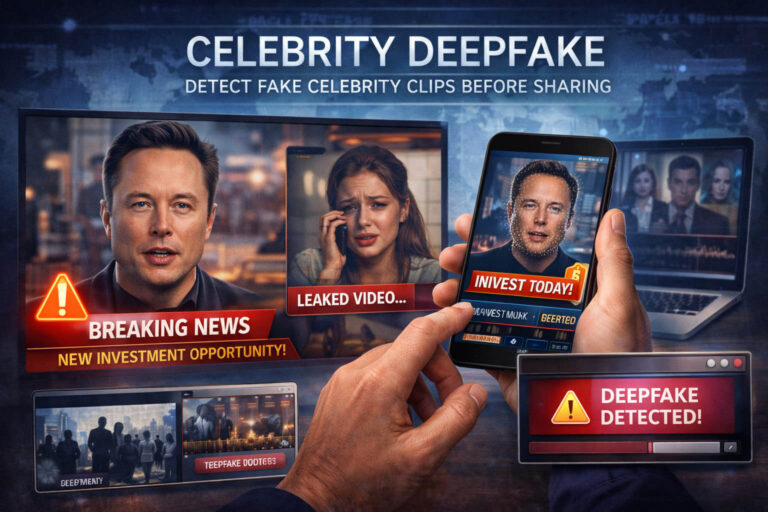
A celebrity deepfake uses AI-generated or AI-manipulated media to make a public figure appear to say, endorse, reveal, or do something that did not happen as presented. The fake may alter a face, clone a voice, synchronize new speech to real footage, or generate most of the scene from scratch.
But the most important clue is often not hidden in the face. It is the purpose of the clip. Fake celebrity videos are increasingly used to sell investment schemes, collect personal information, drive viewers to fraudulent websites, spread political narratives, damage reputations, or exploit a person’s likeness without consent.
Quick answer: if a celebrity video makes a surprising claim, promotes money or a product, or appears only on repost accounts, verify the endorsement outside the video first. Check the celebrity’s established channels, trace the original footage, inspect the account and destination link, then analyze the voice and video for manipulation. A convincing face is not proof that the celebrity authorized the message.
| Celebrity deepfake scenario | What creates the illusion | What to verify first |
|---|---|---|
| Fake investment endorsement | Face, voice, or edited interview footage | Whether the celebrity and regulated firm actually published the endorsement |
| Fake product promotion | AI speech, lip sync, or altered captions | Official brand and celebrity channels |
| Fake confession or scandal | Manipulated interview, voice replacement, or synthetic scene | Original interview and full context |
| Political statement | Synthetic speech or repurposed public footage | Original source, date, full statement, independent reporting |
| Impersonation account | Copied identity plus AI media | Whether the account is genuinely connected to the public figure |
| Sexualized or abusive deepfake | Non-consensual synthetic likeness | Do not amplify it; use platform reporting and removal processes |
What Is a Celebrity Deepfake?
A celebrity deepfake is synthetic or manipulated media that imitates the recognizable identity, voice, appearance, or performance of a famous or well-known person. The subject might be an actor, musician, athlete, influencer, business leader, journalist, politician, or another public figure.
The term covers several different techniques:
- Face replacement: the visible face is changed while much of the original body and scene remain real.
- Facial reenactment: expressions or facial performance are altered.
- AI lip sync: mouth movement is modified to fit new speech.
- Voice cloning or voice conversion: synthetic speech imitates the public figure.
- Hybrid manipulation: real footage is combined with generated face, audio, subtitles, or other elements.
- Fully synthetic video: the person, performance, and scene may be generated rather than captured conventionally.
Not every fake celebrity video is a deepfake. A real interview can be clipped deceptively, subtitles can be altered, or an old celebrity video can be attached to an unrelated offer. If the main question is whether identity manipulation is present, the deepfake detection guide covers the technical detection problem in more depth.
Why Celebrities Are Ideal Targets for Deepfake Impersonation
Celebrity deepfakes work because the attacker is borrowing something that already has value: recognition and trust.
Public figures have large amounts of reference media
Interviews, podcasts, speeches, livestreams, red-carpet footage, social posts, music videos, and public appearances provide many examples of a celebrity’s face, voice, expressions, and speaking style.
Viewers recognize the identity instantly
A scammer does not need to build trust from zero. A familiar face can make an unfamiliar product, investment, website, or account feel credible in seconds.
Parasocial familiarity lowers skepticism
People may feel that they know a celebrity because they have watched them for years. Deepfake impersonation exploits that familiarity even though the viewer has no direct way to authenticate the person in the clip.
Celebrity content travels well
Surprising statements, endorsements, scandals, and confessions generate clicks and reposts. The same virality that benefits legitimate celebrity media also helps manipulated clips spread quickly.
The Most Important Question: What Is the Video Trying to Make You Do?
For celebrity deepfakes, intent is often more revealing than pixel artifacts.
Ask what happens after the viewer believes the clip.
- Are you told to invest?
- Are you sent to an unfamiliar website?
- Are you asked to enter personal information?
- Are you promised a giveaway or reward?
- Are you asked to move the conversation into a private chat?
- Are you encouraged to buy a medical, financial, or unusually profitable product?
- Is the clip trying to trigger outrage about a person, company, or political event?
This changes the verification strategy. If the video is selling an investment, verifying facial artifacts is secondary to confirming whether the public figure and the investment provider actually published the endorsement.
Celebrity Deepfake Scams: The Fake Endorsement Funnel
One of the most commercially dangerous uses of celebrity deepfakes is the fake endorsement.
The pattern often looks like this:
- Recognition: a familiar celebrity appears in a video or ad.
- Authority: the person seems to recommend a product, investment, health treatment, or financial strategy.
- Urgency: the offer is limited, exclusive, or supposedly about to disappear.
- Transition: the viewer is sent away from the social platform to a website, form, app, or private message.
- Conversion: the site asks for money, card data, identity information, contact details, or account registration.
The FTC reported in June 2026 that consumers said they lost $3.5 billion to imposter scams in 2025, and nearly one in three fraud reports involved impersonation. Separately, the FTC reported $2.1 billion in losses from scams that started on social media in 2025. These figures include many forms of impersonation, not only celebrity deepfakes, but they show why identity-based scam content deserves a high verification threshold.
The latest figures are available in the FTC’s 2026 imposter-scam report.
Fake Celebrity Investment Videos Need a Different Verification Standard
A celebrity appearing to recommend an investment is not evidence that the investment is legitimate. Even a genuine endorsement would not prove that an investment is safe or appropriate.
The SEC has specifically warned that AI can be used to create deepfake video and audio for investment fraud, including synthetic media that imitates celebrities, executives, or other trusted people.
If a fake celebrity video promotes an investment:
- do not use the link or app promoted in the video as your verification source
- check the celebrity’s official channels independently
- verify the company and financial professional through appropriate regulatory sources
- do not treat testimonials or apparent account balances as proof
- be especially cautious about guaranteed returns or low-risk, high-profit claims
The SEC’s AI and investment fraud alert explicitly warns that fraudsters can use deepfake voices, images, and videos to deceive investors.
Celebrity Deepfake or Legitimate AI Use?
Not every synthetic celebrity appearance is deceptive.
AI and deepfake-style technology can be used transparently in:
- film and visual effects
- authorized advertising
- localization and dubbing
- comedy and parody
- historical reconstruction
- creative or educational productions
The key differences are authorization, disclosure, context, and audience expectation.
A disclosed fictional performance is not the same problem as a fake celebrity investment ad designed to look like an authentic recommendation. Authenticity analysis should therefore ask not only “Was AI used?” but also “Was the use authorized and clearly represented?”
How to Verify a Celebrity Deepfake Without Starting With Facial Glitches
Use an identity-first workflow. It is faster and less vulnerable to outdated deepfake folklore.
1. Freeze the claim
Write down exactly what the celebrity supposedly did or said.
For example:
- “This celebrity recommends this investment platform.”
- “This actor apologized for this event.”
- “This musician announced this giveaway.”
- “This business leader said this company is collapsing.”
2. Check the celebrity’s established channels
Search the person’s official website and established social accounts. For a genuine major endorsement or announcement, there may be corroborating material, campaign pages, interviews, or brand communications.
Do not trust a link merely because it appears underneath the suspicious video.
3. Identify the underlying footage
Many celebrity deepfakes reuse real interviews, podcasts, Cameo-style recordings, press appearances, or social videos. Finding the original can show what the person actually said.
Use a reverse video search when you need to trace an older upload, full interview, or source clip.
4. Compare the original and suspicious version
Look for changes in:
- speech
- mouth movement
- cropping
- subtitles
- voice
- sequence
- branding or overlays
This side-by-side comparison is often stronger evidence than trying to decide whether one compressed social-media frame “looks AI.”
5. Investigate the destination
If the clip sends viewers to a product, investment, giveaway, app, or website, investigate that destination independently. A manipulated celebrity video may be only the advertising layer of a broader scam.
6. Analyze the media when the identity question remains unresolved
Once the source and claim have been checked, technical analysis can help determine whether the face, voice, or scene shows manipulation evidence.
The Visual Evidence That Still Matters
Visual inspection is useful, but the strongest clues are usually temporal inconsistencies, not a fixed list of facial defects.
Identity drift
Watch whether the celebrity remains recognizably the same person during head turns, expression changes, motion blur, and partial occlusion. Local identity details that change without a physical reason are more useful than general “AI-looking” smoothness.
Occlusion failures
Hands, microphones, glasses, hair, and other objects passing in front of the face can stress manipulated regions. Look for boundaries that appear, disappear, or change incorrectly across adjacent frames.
Lighting and reflection conflicts
Compare the face with the neck, glasses, eyes, walls, and nearby objects. A manipulated region must respond to the same light sources as the rest of the scene.
Geometry that changes through motion
Jaw shape, ears, teeth, glasses, facial proportions, and other features can become inconsistent as the head rotates. The pattern across time matters more than one strange frame.
Do not treat blinking, smooth skin, unusual teeth, or a single distorted frame as proof. Modern models can avoid many older deepfake artifacts, while compression and beauty filters can make real celebrity footage look artificial.
A Celebrity’s Voice Can Be Fake Even When the Video Is Real
A common hybrid attack starts with authentic footage and replaces only the speech. That can preserve convincing body movement, lighting, facial identity, and camera behavior while changing the message.
Listen for:
- voice acoustics that do not fit the room
- background noise changing between phrases
- speech that remains identical in tone while the speaker turns away
- breathing and pauses that feel disconnected from visible speech
- mouth movement that follows the sentence imperfectly
If the main concern is cloned or generated speech, use the dedicated voice deepfake guide.
When Lip Sync Is the Main Manipulation
AI lip synchronization can make real celebrity footage appear to contain entirely new dialogue. This is particularly effective with interviews, podcasts, and close-up social videos because the underlying body language and scene remain authentic.
Do not look only for a constant audio delay. Modern lip-sync manipulation can track speech closely. Instead, inspect difficult transitions, fast syllables, mouth closure, teeth, jaw movement, and whether the surrounding facial motion belongs naturally to the performance.
The AI lip sync explainer covers this manipulation type separately so this page does not duplicate a full lip-sync checklist.
Why Fake Celebrity Videos Can Look Better Than Ordinary Deepfakes
Celebrity content often gives a manipulator excellent source material: high-resolution interviews, controlled studio lighting, clear voices, multiple camera angles, and thousands of examples of the person’s appearance.
At the same time, social platforms reduce the evidence available to the viewer by:
- compressing the video
- displaying it on a small screen
- adding captions and interface overlays
- encouraging rapid scrolling
- making reposts look socially validated
The result is an asymmetry: the creator may start with high-quality source material, while the viewer judges a short recompressed copy.
This is another reason source verification should come before pixel-level certainty.
Celebrity Deepfakes Used for Political or Reputation Manipulation
Not every celebrity deepfake is trying to steal money. A manipulated public figure can also be used to create social proof for a political narrative, manufacture controversy, or damage a reputation.
In these cases, ask:
- Is there a full original statement?
- Did the public figure publish or acknowledge it?
- Does independent reporting confirm the event?
- Is the video circulating primarily through anonymous or newly created accounts?
- Does the wording sound designed to provoke a specific political or emotional response?
A 2026 investigation by Euronews documented manipulated celebrity videos used in a coordinated influence campaign, including real source footage paired with altered messaging. The important lesson is that celebrity deepfakes can function as narrative infrastructure, not only as isolated fake clips.
For public-interest claims, use a broader news verification process rather than treating visual realism as the deciding factor.
Celebrity Deepfakes and Non-Consensual Sexualized Content
Some searches for celebrity deepfakes lead to sites advertising sexualized or so-called “leaked” synthetic content. This is not a useful way to verify whether media is authentic.
Non-consensual sexualized deepfakes are a form of likeness abuse. They can cause serious privacy, safety, and reputational harm even when the depicted event never happened.
If your goal is verification:
- do not rely on sites that market “leaked celebrity deepfakes” as evidence
- avoid downloading suspicious files from unknown deepfake repositories
- do not redistribute explicit synthetic media to ask others whether it is real
- preserve URLs or non-explicit evidence when reporting is necessary
- use the platform’s abuse, privacy, or impersonation reporting process
This is also why queries such as “free fake celebrity” or “celebrity deepfake sites” should not be interpreted as a reason to turn a verification page into a directory of deepfake-generation or abuse sites.
How Platforms Are Responding to Celebrity Likeness Abuse
Platform policy increasingly treats realistic AI impersonation as a separate identity and privacy problem.
YouTube currently allows people to request removal of realistic AI-generated or altered content that looks or sounds like them. Its review process considers whether the content is synthetic, whether it is disclosed, whether the person is uniquely identifiable, whether it is realistic, and whether parody, satire, or public-interest considerations apply.
For public figures, YouTube specifically notes sensitive scenarios such as fake criminal activity, violence, product endorsement, or political endorsement. YouTube also offers an experimental Likeness detection system that can help eligible enrolled creators identify videos in which their face appears altered or AI-generated.
The current process is documented in YouTube’s identity and synthetic-content guidance.
AI Disclosure Is Now More Important in the EU
As of August 2026, Article 50 transparency obligations under the EU AI Act are in effect. European Commission guidance states that certain deepfakes and AI-generated or manipulated content are subject to transparency obligations, including machine-readable marking requirements for relevant AI systems and disclosure duties for deployers in covered situations.
This does not make every disclosed celebrity deepfake deceptive or illegal. It makes transparency about synthetic media a more formal part of the regulatory environment.
The European Commission’s Article 50 transparency guidance explains the obligations that apply from 2 August 2026.
Can Content Credentials Verify a Celebrity Video?
Content Credentials can provide provenance information about how compatible media was created or modified. This is different from visually guessing whether a celebrity’s face looks synthetic.
A provenance record may help reveal:
- how the asset was created
- whether AI generation or modification was declared
- which editing actions were recorded
- which ingredients or source assets were used
- which entity signed the provenance claim
In July 2026, C2PA published new implementation guidance for communicating synthetic, AI-modified, and non-synthetic content through Content Credentials. See the C2PA implementation guidance.
Missing Content Credentials do not prove a celebrity video is fake, and valid provenance does not prove that an external caption is true. For the practical user-facing layer, see our Content Credentials guide.
Celebrity Deepfake vs Celebrity Impersonation
The two terms overlap but describe different parts of the attack.
Deepfake describes synthetic or manipulated media.
Impersonation describes pretending to be, represent, or have authorization from another person.
A scam can use:
- a deepfake on a real-looking fake account
- real celebrity footage on an impersonation account
- a cloned voice in a private message
- a genuine celebrity image next to a fraudulent claim
For high-risk identity cases, use the AI impersonation guide to evaluate the identity claim separately from the media manipulation.
What to Do If You Find a Suspicious Celebrity Deepfake
Your response should depend on the risk.
If it is a harmless, clearly disclosed parody
You may not need to do anything. Synthetic media is not automatically malicious.
If it promotes money, investments, or a suspicious product
Do not click the promoted link. Verify the offer independently and report the ad or account if it appears fraudulent. The scam video guide covers the fraud-verification layer in more detail.
If it makes a damaging factual claim
Preserve the URL and source information, locate the original footage, and look for independent corroboration before amplifying the claim.
If it uses someone’s likeness abusively
Use the platform’s impersonation, privacy, synthetic-media, or abuse reporting mechanisms. Avoid reposting harmful material in ways that increase its distribution.
How Celebrities, Creators and Brands Can Reduce Deepfake Risk
Public figures cannot prevent every fake from being created, but they can make impersonation easier to challenge.
Make official channels easy to identify
Maintain consistent links between the official website and established social accounts so viewers have an independent reference point.
Publish scam warnings before a crisis
If fake giveaways, investments, or endorsements are recurring problems, publish a permanent warning that explains what the person or brand does not promote and where genuine announcements appear.
Monitor likeness abuse
Use platform-native identity, impersonation, and likeness tools where available. Search regularly for suspicious ads, accounts, and videos that combine the name with high-risk commercial language.
Preserve provenance when the workflow supports it
Content Credentials and other provenance mechanisms can strengthen the chain between official media and its production history.
Respond with evidence, not just denial
When possible, point users to the original interview, official statement, source footage, or verified account. A correction is more persuasive when it gives the audience something concrete to compare.
How DetectVideo AI Fits Into Celebrity Deepfake Verification
If the source investigation does not resolve the case, technical analysis can provide another evidence layer. DetectVideo AI can analyze supported video footage across available visual, temporal, audio-video, source, metadata, compression, and manipulation signals.
The useful question is not simply “What percentage fake is this celebrity?” A stronger analysis asks which signals are suspicious, whether they persist across time, and whether they agree with the source and identity evidence.
If the video is a scam, source verification and the destination website may matter more than a model score. If it is a manipulated interview, the original footage may be decisive. If it is a high-quality synthetic identity with no reliable source, technical analysis becomes more important.
A Practical Celebrity Deepfake Decision Table
| Evidence | Interpretation | Next action |
|---|---|---|
| Official celebrity channel confirms the exact video and offer | Identity claim is much stronger | Still evaluate the product or investment on its own merits |
| Original interview contains different words | Suspicious version is manipulated or misleading | Preserve the comparison and report harmful copies |
| Video is unlabeled, source unknown, and links to an unfamiliar investment site | High scam risk | Do not transact; verify independently |
| Creator clearly labels the video as parody or AI-generated | Synthetic nature is disclosed | Judge whether the context remains misleading or abusive |
| Detector flags manipulation but the original source is unavailable | Technical concern, not final attribution | Keep the case unresolved and seek more evidence |
| Real celebrity footage is attached to a fake giveaway | Media may be authentic, endorsement is not | Treat it as impersonation or scam content |
Key Takeaway
Celebrity deepfake verification is an identity problem before it is a pixel problem. The strongest first question is not “Do the eyes look strange?” It is “Did this person actually publish, authorize, or make this statement?”
Check the official identity and source first. Then trace the underlying footage, inspect the commercial or political purpose, evaluate the destination link, and only then move into detailed face, voice, temporal, provenance, and AI analysis.
This approach catches more than deepfakes. It also catches real celebrity videos reused for fake products, deceptive captions, cloned voices, impersonation accounts, and scams that would pass a purely visual “does it look AI?” test.
FAQ About Celebrity Deepfakes
What is a celebrity deepfake?
A celebrity deepfake is AI-generated or AI-manipulated media that realistically imitates a well-known person’s face, voice, identity, expression, or performance. It can make the person appear to say, endorse, or do something that did not happen as presented.
How can I spot a celebrity deepfake video?
Start by verifying whether the celebrity actually published or authorized the claim. Find the original footage, check established accounts, investigate the destination link, then inspect the video and voice for temporal or synthetic inconsistencies. Source evidence is often stronger than one visual artifact.
Are celebrity deepfake videos always scams?
No. They can be used transparently in entertainment, parody, localization, education, and authorized creative work. The risk increases when synthetic media is presented as authentic, used without consent, or connected to fraud, misinformation, or reputation attacks.
How do fake celebrity investment videos work?
The video borrows a recognizable identity to make an investment or trading offer appear trustworthy. The viewer is then moved to an external website, app, group, or payment process. Verify the investment and endorsement independently rather than through links supplied by the video.
Can a celebrity deepfake use real footage?
Yes. Many convincing fakes use authentic interviews or public appearances as the base footage and change only the voice, mouth movement, face, subtitles, or commercial message.
Can a celebrity’s voice be deepfaked without changing the face?
Yes. Real video can be paired with cloned or generated speech. This is why audio authenticity should be evaluated separately from facial authenticity.
Does weird blinking prove a celebrity video is fake?
No. Unusual blinking is weak evidence by itself. Modern deepfakes can reproduce normal eye behavior, while real footage can look unusual because of compression, frame-rate conversion, filters, or natural movement.
Can I trust a celebrity endorsement if the video looks completely real?
No. Verify the endorsement through the person’s official channels and the organization being promoted. A realistic video can be manipulated, and real celebrity footage can be reused in a fraudulent context.
What are celebrity deepfake sites?
The phrase can refer to sites that publish, generate, or aggregate synthetic celebrity media. They should not be treated as verification sources. Some may distribute non-consensual or abusive content, and unknown sites can also create privacy or security risks.
Should I use a “free celebrity deepfake” site to test whether a video is fake?
No. A generation site does not authenticate suspicious media, and uploading another person’s face or sensitive media can create privacy and consent problems. Use source verification, provenance tools, and dedicated detection methods instead.
What should I do about a sexualized celebrity deepfake?
Do not amplify or redistribute the content. Preserve only the information needed for reporting, such as URLs and account details, and use the platform’s privacy, abuse, impersonation, or synthetic-media reporting process.
Can celebrities request removal of AI deepfakes from YouTube?
YouTube allows individuals or their legal representatives to request review of realistic altered or synthetic content that looks or sounds like them. The platform considers factors including identifiability, realism, disclosure, parody, public interest, and sensitive behavior involving well-known people.
Do Content Credentials prove a celebrity video is authentic?
Content Credentials can provide cryptographically verifiable provenance about how compatible media was created or changed. They do not automatically prove that the celebrity authorized an external claim or that a caption, product, or investment is legitimate.
Can AI detectors prove that a celebrity video is fake?
No detector is universal. Technical detection can provide important evidence, especially when the source is missing, but the strongest conclusion combines detector results with original footage, account verification, provenance, audio analysis, and context.
What is the difference between a celebrity deepfake and celebrity impersonation?
A deepfake is manipulated or synthetic media. Impersonation is the broader act of pretending to be or represent the celebrity. A scam can impersonate a celebrity using a deepfake, a stolen real video, a fake account, or even a static photograph.