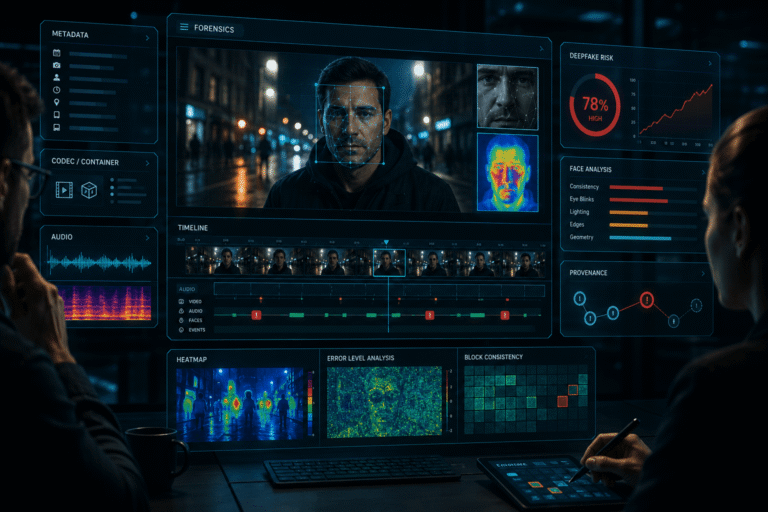
Video forensics is the systematic examination of digital video to determine what the file is, where it may have come from, whether its structure or content shows signs of alteration, and how strongly the available evidence supports a conclusion. It combines video technology, digital forensics, image analysis, timing analysis, metadata interpretation, source comparison, and increasingly, AI-based deepfake detection.
Experts do not authenticate a video by spotting one strange frame or running one detector. They preserve the evidence, examine the file globally and locally, compare multiple independent signals, test alternative explanations, and report only what those signals support. A recompressed file is not automatically manipulated. A deepfake score is not proof of fraud. A camera-original file can still depict a staged event.
What Is Video Forensics?
Video forensics is a branch of digital and multimedia forensics concerned with the scientific examination, comparison, evaluation, and interpretation of video evidence.
The Scientific Working Group on Digital Evidence defines forensic video analysis as the scientific examination, comparison, or evaluation of video in legal matters. Its current best-practice guidance separates the work into technical preparation, examination, and interpretation. See the SWGDE Best Practices for Digital Forensic Video Analysis.
In a broader media-authenticity context, video forensics is also used outside courtrooms by journalists, researchers, platforms, investigators, security teams, and fact-checkers who need to understand whether a clip has been altered or misrepresented.
The Three Questions a Forensic Examiner Separates
A useful starting point is to avoid one overloaded question such as “Is this video real?”
The third question is especially important. SWGDE explicitly notes that a video can be an accurate original recording while the depicted scene itself was scripted or reenacted. File authenticity and event truth are not the same forensic conclusion.
Video Authentication, Manipulation Detection and Deepfake Detection Are Different Tasks
NIST’s Open Media Forensics Challenge separates Video Manipulation Detection from Video Deepfakes Detection. That distinction reflects the fact that deepfakes are only one class of video manipulation.
| Task | Main question | Examples |
|---|---|---|
| Video authentication | Is the file consistent with the asserted source, structure, and production history? | Camera-original assessment, file structure, source identification, content integrity |
| Manipulation detection | Has the video been deliberately modified? | Splicing, insertion, deletion, timing changes, object removal, compositing, altered content |
| Deepfake detection | Does the video contain AI-generated or AI-manipulated content associated with deepfake techniques? | Face swaps, synthetic identity, AI facial reenactment, generated video regions |
| Claim verification | Does the footage support the real-world statement attached to it? | Correct event, date, location, identity, and context |
NIST’s OpenMFC evaluates general video manipulation and deepfake video as separate tasks and uses confidence scores rather than treating forensic detection as a magical binary oracle. See the NIST OpenMFC task framework.
The Forensic Stack: Five Evidence Layers
Professional analysis becomes easier to understand when you treat the video as a stack of evidence rather than a single image.
Each layer answers a different question. A strong forensic conclusion usually depends on agreement across several of them.
Layer 1: File Structure and Container Analysis
A video file is not just a stream of pictures. It is a structured container that can hold video, audio, subtitles, timestamps, metadata, timecode, chapters, and other tracks.
Examiners inspect details such as:
- container format
- codec and profile
- stream count and ordering
- resolution and pixel aspect ratio
- frame rate and time base
- audio format
- bitrate
- embedded metadata
- encoder or writing application
- track structure
Unusual structure can reveal that a file was exported, transcoded, remuxed, or generated by a workflow that differs from the claimed source. But structure alone rarely identifies the exact editorial operation.
The dedicated video metadata guide explains how dates, codecs, software, GPS, and container fields should be interpreted without turning them into unsupported authenticity claims.
Layer 2: Timing, Frames and Encoding Behavior
Video manipulation often changes the relationship between frames and time.
Forensic timing analysis can examine:
- frame presentation times
- duplicate or missing frames
- variable versus constant frame rate
- unexpected timing gaps
- changes in frame cadence
- duration inconsistencies
- GOP and keyframe structure
- changes associated with transcoding or editing
A timing anomaly is not automatically a malicious edit. Screen recordings, messaging apps, video conferencing, surveillance systems, variable-frame-rate phones, and transcoders can all produce unusual timing behavior.
The forensic question is whether the observed timing is consistent with the claimed production history.
Compression Analysis Can Reveal Processing, Not Intent
Video is commonly compressed using inter-frame codecs. Compression leaves structure behind, and a second encoding pass can alter that structure.
Examiners may compare:
- codec parameters
- quantization behavior
- macroblock or coding-unit patterns
- bitrate distribution
- GOP structure
- quality changes between regions or segments
- evidence of recompression
Recompression can support the conclusion that the current file is not the untouched original. It does not by itself prove that meaningful content was falsified. Uploading to a social platform is enough to create a new compression history.
Layer 3: Visual Content Analysis
Content analysis examines the decoded images themselves at global and local levels.
Potential questions include:
- Does an object appear or disappear abruptly?
- Do edges, textures, or noise patterns change locally?
- Does the lighting remain physically consistent?
- Is a region sharper, softer, or compressed differently from its surroundings?
- Does the perspective of an inserted object fit the scene?
- Does the face remain geometrically consistent across motion?
These observations are meaningful only when alternative explanations are considered. Motion blur, denoising, HDR processing, stabilization, rolling shutter, autofocus, low light, chroma subsampling, and platform compression can all produce patterns that look suspicious in isolation.
Local vs Global Analysis
SWGDE distinguishes between analyses applied to the file as a whole and analyses focused on a specific region or segment.
| Analysis type | Example | Question answered |
|---|---|---|
| Global | Container structure, codec, total duration, overall recompression | What is unusual about the file as a whole? |
| Local spatial | Face region, inserted object, suspicious edge, local texture | Is a particular region inconsistent with its surroundings? |
| Local temporal | Short sequence around a cut, head turn, frame gap, or identity change | Does the anomaly persist or develop across time? |
This distinction matters because a deepfake may be localized mainly to a face while the rest of the video is genuine.
Temporal Analysis Is One Reason Video Forensics Differs From Image Forensics
A single suspicious frame can be misleading. Video adds continuity, motion, and repeated observations.
Experts can test whether:
- identity stays stable across head rotations
- objects preserve shape across frames
- lighting changes continuously
- motion blur matches neighboring regions
- occlusions behave consistently
- lip movement and facial motion follow the audio
- an anomaly repeats in a meaningful temporal pattern
Modern deepfake research increasingly uses both spatial and temporal evidence because frame-by-frame analysis can miss inconsistencies that only emerge across a sequence.
Deepfake Forensics Looks for More Than Visual Glitches
Older public guides often focused on blinking, teeth, hands, or obvious face edges. Those can still fail in low-quality synthetic media, but they are not stable forensic rules.
A deeper technical approach may analyze:
The dedicated deepfake detection guide focuses on the narrower task of identifying deepfake media and the limitations of detector outputs.
Why Detector Scores Need Forensic Context
An AI detector usually returns a score, classification, or probability-like measure. That result depends on the detector, training data, media quality, preprocessing, manipulation type, and how similar the tested video is to data the system has seen before.
NIST’s synthetic-content work treats content-based detection as one technical approach among several, alongside provenance, metadata, watermarking, and human-assisted methods. This is a useful model for forensic practice because different evidence types fail in different ways. See NIST AI 100-4 on synthetic content.
A detector result is strongest when it agrees with source evidence, file analysis, temporal behavior, and provenance. It is weakest when treated as a standalone verdict.
Face Swap Analysis Is an Identity Question
A face swap often preserves the body, scene, camera movement, and much of the original performance while replacing facial identity.
That means a forensic analyst can compare:
- the suspicious face against known authentic references
- identity consistency during head turns
- geometry under expression
- occlusion behavior
- face-to-head alignment
- the current video against an earlier base version
If identity replacement is the central question, the face swap video guide provides a more specialized workflow.
Audio Is Part of Video Forensics Too
A multimedia file can contain authentic-looking video and manipulated audio, or the reverse.
Relevant questions include:
- Does the audio stream appear to have a different processing history?
- Do cuts in sound align with visible edits?
- Does mouth movement correspond to speech?
- Does room acoustics match the visible environment?
- Does the speaker identity remain consistent?
- Was cloned speech layered over genuine footage?
Formal audio authentication is its own discipline. SWGDE’s video-authentication guidance explicitly recommends audio examination when a multimedia file contains both audio and video rather than assuming the visual stream answers the whole case.
Layer 4: Source Identification and Comparative Analysis
Sometimes the strongest forensic evidence is not an artifact inside the questionable file. It is a trustworthy reference.
Comparative analysis can ask:
- Does this file structure match known originals from the same camera?
- Does an earlier version show the same scene without the disputed edit?
- Does the encoding profile match other files produced by the claimed device?
- Does a verified source contain a longer version that explains the suspicious segment?
SWGDE describes source identification as an examination aimed at identifying the type of equipment or camera that created the video and notes that comparative analysis with reference material is especially useful.
Layer 5: Provenance and Content Credentials
Traditional forensics infers history from the file and available references. Provenance systems can sometimes record parts of that history directly.
C2PA Content Credentials can bind signed assertions to digital media and document compatible creation or editing actions. That makes them different from ordinary editable metadata.
Provenance does not replace forensic analysis. A valid provenance chain can say useful things about origin and recorded actions, but it does not automatically prove that every external claim about the depicted event is true.
The Content Credentials guide explains how to interpret this evidence without treating it as a universal authenticity badge.
Preservation Comes Before Analysis
If a video may matter as evidence, forensic practice starts by protecting the original.
SWGDE’s current forensic video guidance recommends creating a working copy, using hashing to establish integrity when possible, and conducting examination work on the verified copy rather than the submitted original. Processing steps should be documented so they can be reproduced and independently evaluated.
This matters because careless conversion or re-encoding can destroy metadata, change frame timing, alter compression traces, or create new artifacts before the actual examination begins.
FFmpeg Is Useful, but Tool Use Must Be Documented
FFmpeg and ffprobe are widely useful in multimedia examination. SWGDE’s technical notes describe ffprobe as a tool for obtaining metadata and stream information, and ffmpeg as a framework that can play, inspect, convert, and process multimedia files.
For example:
ffprobe -v quiet -print_format json -show_format -show_streams evidence.mp4This can document container and stream properties without deciding whether the video is authentic.
SWGDE also warns that FFmpeg is an evolving framework, that proprietary formats may not always decode correctly, and that tool versions and settings matter. See the SWGDE Technical Notes on FFmpeg for Forensic Video Examinations.
What a Professional Video Forensics Workflow Looks Like
- Define the forensic question. Source, manipulation, identity, timing, provenance, and claim verification require different tests.
- Preserve the original evidence. Document acquisition and create a verified working copy when appropriate.
- Interrogate the file. Examine container, streams, codecs, timing, metadata, and technical attributes.
- Review the media globally. Understand the entire sequence before focusing on suspicious regions.
- Perform local tests. Analyze the specific segment, face, frame range, audio region, or timing anomaly relevant to the question.
- Compare against references. Use known originals, earlier copies, or source-device samples when available.
- Add deepfake or AI analysis where relevant. Use detector output as one evidence layer, not the conclusion itself.
- Check provenance and external context. Determine whether signed provenance, source history, or public records support the same interpretation.
- Test alternative explanations. Compression, transcoding, stabilization, low light, screen recording, and platform processing can mimic forensic anomalies.
- Report the narrowest defensible conclusion. State what the evidence supports and what remains unresolved.
The Evidence Matrix: One Finding, Several Possible Meanings
| Finding | What it may support | What it does not prove alone |
|---|---|---|
| Editor or encoder tag | The current file passed through a software or encoding workflow | That deceptive visual manipulation occurred |
| Recompression | The current copy was encoded again | That the underlying event is false |
| Timing discontinuity | A possible edit, dropped frames, capture issue, or conversion artifact | The cause without further analysis |
| Deepfake detector alert | The content warrants additional synthetic-media analysis | The exact manipulation, intent, or actor |
| Valid provenance record | Signed information about documented origin or actions | Truth of every claim shown or stated in the media |
| Earlier matching video | The visual material existed by an earlier date | The exact recording time or complete edit history |
Three Cases That Look Similar but Require Different Forensic Conclusions
Case 1: Re-encoded but visually unchanged
A clip has a new encoder tag, different bitrate, and a more recent container date. Frame-by-frame comparison with a trusted original shows no material visual difference.
A careful conclusion is that the current copy was re-encoded or exported. There is no basis from those findings alone to say the depicted content was falsified.
Case 2: Face replacement inside otherwise genuine footage
The body, room, camera motion, and background match an earlier source, but the face differs. Temporal analysis shows identity instability during rotation, and the earlier source contains another person.
This is a much stronger basis for concluding that the later version contains face-region manipulation.
Case 3: Camera-original video with false context
The file structure is consistent with the source device, no material edit is established, and the video appears to be an authentic recording. However, external evidence shows it was recorded years before the event named in the viral caption.
The correct conclusion is not “fake video.” It is authentic footage used with false context.
What Experts Do Not Treat as Proof
- one strange frame
- one metadata timestamp
- one compression artifact
- one AI detector score
- one missing watermark
- one visual mismatch without testing ordinary camera or encoding explanations
SWGDE’s video-authentication guidance recommends using multiple applicable examination methods and cross-verifying results rather than relying on one test. It also recommends avoiding language of absolute certainty except where alterations or deletions are actually known. See the SWGDE Best Practices for Digital Video Authentication.
How Experts Express Confidence
Forensic language should match the strength of the evidence.
| Better wording | Why it is stronger |
|---|---|
| “The file shows evidence of recompression.” | Describes the observed technical finding. |
| “The current copy is inconsistent with a direct camera-original workflow.” | Relates the finding to a specific production claim. |
| “The face region shows manipulation evidence across multiple frames.” | Defines the region and temporal scope. |
| “The available evidence is insufficient to determine whether the clip is AI-generated.” | Preserves uncertainty instead of forcing a binary answer. |
Can Video Forensics Prove a Video Is Real?
Usually, the stronger question is whether the evidence supports a specific asserted history.
An examiner may establish that a file is consistent with a known camera workflow, that no alteration was detected by the applicable tests, that the source chain is documented, and that the content matches independent evidence.
That is stronger than saying “real” without qualification.
No examination can test every possible manipulation under every condition. A conclusion should describe the scope of the analysis and the evidence available.
Can AI Replace a Forensic Video Examiner?
AI can automate useful parts of the workflow, especially pattern recognition, deepfake classification, frame prioritization, anomaly detection, and large-scale screening.
It does not remove the need to:
- preserve evidence correctly
- understand video formats and encoding
- interpret metadata
- compare source history
- distinguish artifacts from manipulation
- evaluate alternative explanations
- document reproducible methods
- state limits and uncertainty
Automated analysis is most useful when it narrows the investigation and contributes measurable evidence to a broader forensic process.
Where DetectVideo AI Fits in the Forensic Stack
DetectVideo AI is most relevant when the unresolved question concerns technical signals in the media itself, including possible AI generation, manipulation, temporal anomalies, or other forensic evidence supported by the platform.
It should not replace source verification, evidence preservation, metadata interpretation, or provenance analysis. Those are separate layers of the same investigation.
For a broader non-forensic workflow that combines source, context, provenance, and media checks, use the video verification guide.
Key Takeaway
Video forensics is not the search for one artifact that proves a clip is fake. It is a structured process for testing a specific claim about a video against multiple independent evidence layers.
Experts examine the file, timing, encoding, content, source relationships, deepfake signals, and provenance. They preserve the original, document their methods, test alternative explanations, and distinguish processing from deception.
The best forensic result is not always “authentic” or “manipulated.” Sometimes the most accurate result is narrower: re-encoded, altered in a specific region, inconsistent with the claimed source, authentic footage with false context, or insufficient evidence.
FAQ About Video Forensics
What is video forensics?
Video forensics is the scientific examination, comparison, evaluation, and interpretation of digital video to answer questions about source, integrity, manipulation, timing, identity, and provenance.
How do forensic experts detect video manipulation?
They combine file-structure analysis, metadata, timing, compression, visual and audio examination, source comparison, and other relevant tests. The exact workflow depends on the manipulation claim and the type of video.
How is deepfake detection different from video forensics?
Deepfake detection is one specialized task inside the broader field of video forensics. Video forensics also covers conventional editing, timing manipulation, source identification, file structure, compression, audio, metadata, and provenance.
Can metadata prove that a video was edited?
Metadata can show that a file passed through certain software or encoding workflows, but ordinary metadata usually cannot identify every edit or prove deceptive manipulation by itself.
Can compression artifacts be mistaken for manipulation?
Yes. Re-encoding, low bitrate, chroma subsampling, scaling, platform transcoding, and motion compensation can create visual patterns that look suspicious. Forensic interpretation must account for normal encoding behavior.
Can a deepfake detector prove a video is fake?
No single detector should be treated as universal proof. Detector performance depends on the model, training data, media quality, and manipulation type. The result should be cross-checked against other forensic evidence.
Why do forensic analysts use hashes?
A cryptographic hash can help demonstrate that a working copy matches the preserved evidence at a specific point in the examination. It is part of maintaining evidence integrity, not a test of whether the visible content is truthful.
What is the difference between video authentication and video verification?
Video authentication focuses on whether the file and content are consistent with the asserted source, structure, and production history. Verification is broader and can also include whether the event, date, location, identity, and surrounding claim are correct.
Can an authentic video still be misleading?
Yes. Genuine footage can be reposted with a false date, location, identity, or description. Forensic file analysis and contextual verification answer different questions.