Video Provenance Is Not One Question
The word origin sounds singular, but a video can have several meaningful origins.| Origin question | What you are really looking for |
|---|---|
| Where was this recorded? | The physical or synthetic creation context of the footage |
| Who first published it? | The earliest public source you can currently establish |
| Where did this version come from? | The parent copy, edit, repost, download, or platform transformation that produced the version you have |
| Where did this claim come from? | The account, caption, article, message, or narrator that attached the current story |
Every Viral Video Has Two Histories
Media history
Capture or generation, first publication, edits, transcodes, crops, overlays, re-uploads, screen recordings, and the current file.
Claim history
Captions, headlines, dates, locations, identities, explanations, and interpretations attached to the video as it spreads.
The Provenance Chain: Five Links Worth Reconstructing
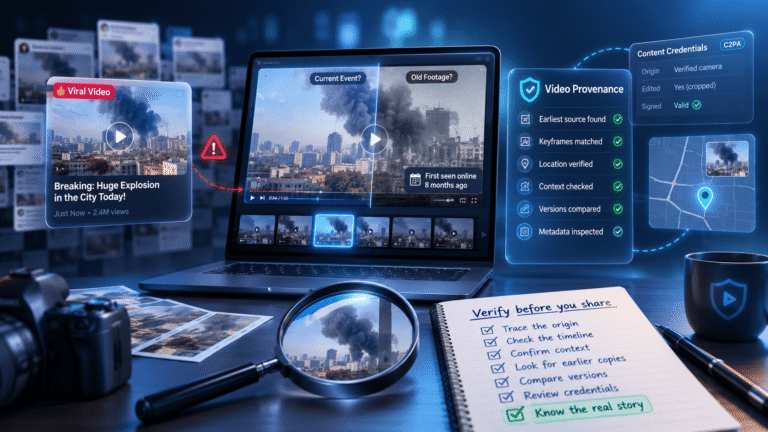
Provenance map
01 CREATIONCamera capture, generation, compositing, or original assembly
02 FIRST SOURCEEarliest credible publication or source record you can establish
03 TRANSFORMSCrops, trims, captions, audio changes, exports, and re-encodes
04 DISTRIBUTIONReposts, embeds, screenshots, messaging apps, and platform copies
05 CURRENT CLAIMThe date, location, identity, or story attached to the copy in front of you
Old Footage or Current Event? Use the Four Clocks
The strongest Search Console intent on this page is essentially: how do I know whether a viral video belongs to the current event or is old footage? The cleanest way to answer it is to stop treating “the date” as one field.Clock 1: Recording date
When the underlying footage was actually captured or generated. This is often the hardest date to prove.
Clock 2: First known publication
The earliest credible public copy you can currently locate. This proves the media existed by that point, not necessarily that it was created then.
Clock 3: Event date
When the claimed real-world event happened according to independent evidence.
Clock 4: Viral claim date
When the current post, caption, article, or message says the footage belongs.
Use scene evidence to connect the clocks
Once you have a publication timeline, test whether the visual world fits the claimed date:- weather and daylight
- seasonal vegetation
- clothing and event signage
- construction state of buildings or roads
- vehicle models, transit markings, or public advertisements
- scheduled events visible in the scene

How to Verify the Origin of a Viral Video
You are usually trying to move upstream from the copy you have toward earlier and better sourced versions.Start with identifiers embedded in the media
Before using a search tool, inspect the clip for information that can point upstream:- usernames and watermarks
- news logos or event branding
- spoken names
- signs and business names
- distinctive captions
- file or creator credits
Turn the video into searchable frames
Extract several keyframes from visually different moments. Choose frames with distinctive information rather than the most dramatic close-up. The InVID Verification Plugin can fragment supported videos into keyframes and send those frames into reverse-image-search workflows. This is useful because a whole video file is much harder for ordinary web search to match than a representative frame.Search several frames, not one
Google Lens can return similar images and web pages containing the same or visually similar image. Its official image-search guidance also explains that results can include sites where an image or similar image appears. One frame may match the viral repost. Another may uncover a longer source, an earlier news article, or an upload with a visible username that was cropped from the version you saw. For a deeper source-finding workflow, use the dedicated reverse video search guide.Build a Version Tree, Not a Single “Original”
One of the most useful provenance habits is to stop drawing a straight line too early. A viral video often branches: Original source → long upload → cropped version → subtitled version → mirrored repost → screen recording → current viral copy Another branch may preserve the audio but change the crop. Another may preserve the full frame but add a misleading subtitle. A news site may embed a higher-quality copy while a messaging app circulates a degraded screen recording. The best source for one question may not be the best source for another.| Your question | Most useful version |
|---|---|
| Who first published this? | Earliest attributable public source |
| Was context removed? | Longest earlier version |
| Was the audio changed? | Highest-quality source with original soundtrack |
| Was a watermark cropped? | Earlier uncropped version |
| Does signed provenance exist? | Original or near-original file that still carries the credential |
Edits Are Part of Provenance, Not Automatic Evidence of Deception
Normal video workflows involve editing. A journalist trims dead time. A creator adds subtitles. A platform recompresses an upload. A documentary changes color and mixes audio. The provenance question is not simply “was this edited?” Ask: “Which transformation occurred, and did it materially change what the viewer is being asked to believe?” A crop that makes a vertical video fit a player may be irrelevant. A crop that removes the person holding a protest sign may alter context. A cut that removes twenty seconds of silence may be normal. A cut that removes the question before an answer may change meaning. This makes version comparison more valuable than vague suspicion about “editing artifacts.”Metadata Helps, but It Should Not Lead the Investigation
Ordinary file metadata can record useful technical information such as timestamps, device details, dimensions, codecs, software, and sometimes location. It can also be:- missing
- changed during export
- stripped by a platform
- inherited from an editing workflow
- edited manually
Content Credentials Add Signed Provenance
Content Credentials address a different problem from ordinary metadata. They use the C2PA architecture to carry cryptographically verifiable provenance information associated with compatible media. The current C2PA technical specification is designed to record information about how an asset originated and changed while using digital signatures and content bindings to make the provenance tamper-evident. Depending on the workflow, a credential can describe:- the signing entity
- the hardware or software that created a claim
- creation and editing actions
- source ingredients
- AI generation or modification signals
- cryptographic bindings to the asset
Hard Bindings, Soft Bindings and Why Provenance Can Survive Change
C2PA makes a useful technical distinction between two ways of connecting provenance to content.Hard binding
A hard binding uses cryptographic hashes to associate a manifest with the exact asset or defined portions of it. Change the bound content and validation can reveal that the asset no longer matches what was signed.Soft binding
A soft binding can use a fingerprint or embedded watermark-like identifier to help recover associated provenance even if the original embedded manifest is no longer directly attached. This matters for video because distribution is messy. Transcoding, social platforms, downloads, screenshots, and re-exports can separate media from its original metadata. Durable provenance systems are designed to make recovery more possible, but no provenance layer should be assumed to survive every transformation.Valid Provenance Does Not Mean “The Video Is True”
This distinction is essential. A cryptographically valid Content Credential can help establish that the provenance record matches the signed asset and has not been unexpectedly altered. It can help you understand the recorded creation and edit history. It does not independently prove:- that the person in the video is telling the truth
- that the caption is accurate
- that the event happened where the uploader claims
- that the creator had permission to record or publish
- that every relevant action was documented
What “No Content Credentials” Actually Means
A missing credential is one of the easiest signals to overinterpret. It does not mean: “This video is fake.” It means only that usable Content Credentials were not available in the copy or workflow you checked. The media may never have had credentials. They may have been removed during processing. The platform may not preserve them. The creator may have opted not to attach certain provenance data. Or the credential may exist elsewhere and require a durable binding to rediscover it. The public Content Credentials verifier is useful when you have a compatible file, but a blank result should be recorded as “no credential found,” not “inauthentic.”When the Provenance Chain Breaks
Real-world media rarely travels in laboratory conditions. A chain can become incomplete when someone:- records the screen instead of sharing the file
- downloads and re-uploads the video
- transcodes it through editing software
- crops or recomposes it
- extracts a short segment from a longer source
- sends it through a service that does not preserve attached provenance
Provenance Without Metadata: The Open-Web Chain
Most viral videos will not hand you a complete signed history. You can still build a useful provenance record from public evidence.| Evidence | What it can establish | What it cannot establish alone |
|---|---|---|
| Earlier public upload | The video existed by that point | The exact recording date or original creator |
| Longer source version | Context removed from the viral copy | Whether the source itself is camera-original |
| Matching username or watermark | A path to a likely upstream source | That the watermark was not copied or overlaid |
| Independent event records | Whether the claimed event occurred at a certain time or place | That this specific video depicts it |
| Signed provenance | Recorded origin and transformation history for compatible media | The factual truth of the external claim |
Four Provenance Patterns You Will See Repeatedly
Pattern 1: Old footage, new event
The video is genuine, but an older source predates the current event. Provenance disproves the caption without proving anything about AI.Pattern 2: Correct event, wrong location
The timing may fit, but landmarks, local signs, or an earlier source identify a different place.Pattern 3: Authentic source, misleading excerpt
The viral clip is cut from a genuine longer video. The edit changes how the statement or event is interpreted.Pattern 4: Synthetic media with transparent provenance
A video may be AI-generated and still have a clear, valid provenance record documenting that creation. In that case, “synthetic” and “deceptive” are separate questions. These patterns are more durable than artifact lists because they remain useful even as generation and editing technology improves.A Provenance Confidence Ladder
Not all provenance conclusions have the same strength.| Level | Example | How to describe it |
|---|---|---|
| Direct | Original file or trusted signed provenance plus attributable source | Origin strongly supported |
| Corroborated | Several independent source, version, date, and context signals agree | Provenance well supported |
| Partial | An early source is found but the recording origin remains unknown | Publication history supported, capture origin unresolved |
| Weak | Only one repost, watermark, or editable metadata field is available | Origin not established |
| Broken | Copies conflict, source disappeared, or provenance validation fails | History cannot currently be trusted or reconstructed |
Where DetectVideo AI Fits in Provenance Work
DetectVideo AI is useful when the provenance investigation raises a media-integrity question that source tracing alone cannot answer. Examples include:- an earlier source exists, but the viral version may contain an AI-altered face
- the audio differs between versions
- the clip appears to contain generated or manipulated regions
- the media has no usable provenance and technical analysis is needed as another evidence layer
Create a Provenance Dossier, Not a Screenshot Folder
This turns provenance into something another person can audit. It also prevents a common research failure: finding an older copy, closing the tab, and later being unable to reconstruct why that copy mattered.Use Precise Provenance Verdicts
A good final statement should describe the part of the chain you actually established.| Verdict | Meaning |
|---|---|
| Origin supported | Strong evidence connects the media to an attributable creation or first-source history |
| Earlier source found | An upstream publication is established, but camera origin may still be unknown |
| Old footage reused as current | The video demonstrably predates the event or date attached to the viral claim |
| Authentic source, altered version | An earlier source exists and the current copy contains meaningful changes |
| Provenance incomplete | Some links in the history are supported while others remain unresolved |
| Provenance unverified | The available evidence is insufficient to reconstruct a reliable history |