

AI propaganda uses AI-generated or AI-assisted messaging to steer how people interpret an issue, an event or a group. The important problem is not merely that a picture, voice or paragraph was generated. It is the relationship between the message, the evidence it appears to offer, and the belief or action it asks the audience to accept.
Use the term carefully. An opinion you dislike is not automatically propaganda, and synthetic production does not prove a deceptive motive. This guide focuses on defensive media literacy: noticing persuasive framing, separating factual premises from emotional pressure, and tracing whether repeated claims lead to independent evidence. Its case study is entirely fictional.
Propaganda and persuasion are not identical verdicts
Persuasion is an ordinary part of public communication. A writer can argue for an idea, an organization can explain its position, and an artist can express a viewpoint openly. The presence of an argument does not establish deception. In this guide, AI propaganda is a working description of AI-assisted influence messaging, especially where apparent evidence, authorship or authority is misrepresented. It is not a label for every persuasive AI-assisted work.
Separate the conclusion from the premises offered to support it. A clip might argue that a community facility deserves support, while claiming that it will close permanently next week. The first is a position; the second is a checkable factual premise. You can consider the position without accepting the unverified premise or endorsing how the clip presents it.
That separation prevents a common trap: treating disagreement as evidence that the media is fabricated, or treating a genuine image as proof that every accompanying argument is sound. A real recording can be selected to tell a partial story. A clearly disclosed synthetic illustration can communicate an honest opinion. The production method does not settle the reasoning.
Keep intent separate from what you can observe. You may establish that a caption omits relevant context without knowing why its publisher omitted it. You may find that several accounts repeat the same clip without proving that they are controlled by one actor. Describe the demonstrated relationship first; do not turn a suspicion into a claim about private motives.
The existing synthetic media guide explains the broader production category. This article asks a narrower question: how does a message try to turn production choices and distribution into persuasive authority? That question remains useful whether the message agrees with your own views or challenges them.
A practical reading habit is to write two short notes: what the message wants you to believe, and what it actually supplies as evidence. If those notes are different, keep the gap visible. You do not need to decide a creator’s ideology or hidden strategy before deciding that a particular premise remains unsupported.
Synthetic visuals, voices and scale change the reading problem
A generated scene can look like a record of an event. A synthetic voice can sound like a statement. AI-assisted text can supply fluent explanations around either one. These forms can also be used openly for illustration, accessibility or creative work. Ask whether the presentation invites you to mistake constructed content for an observation, an authorized statement, or an independently reported fact.
For a video, identify which element makes the factual claim. Is the scene offered as documentation? Does narration attach a date or location that the image cannot establish? Is a speaker’s identity presented as the reason to trust the statement? Looking at these roles is more useful than assuming the entire clip has one undifferentiated “AI” status.
Research can help establish why the concern deserves attention without supplying a verdict for every example. In a Stanford HAI brief by the study’s authors, researchers describe an experiment involving particular English-language articles and GPT-3-generated text. They found persuasive effects under that setup. This is not a measurement of every synthetic video, current model, real campaign or audience.
Do not infer impact from production quality or output volume. A polished clip might go unnoticed; an ordinary image might be widely shared. Even visible reach would not tell you how many viewers accepted the message or why. Claims about an influence operation’s success require evidence appropriate to that outcome, not an attractive montage or a large counter.
When you encounter many similar versions, record the differences that matter for the claim. One version may change a caption, another may replace narration, and another may show the same scene in a different crop. That comparison can reveal how the message changes without requiring you to estimate how cheaply it was made or how effectively it persuaded people.
For the defensive reader, the scale issue is therefore a record-keeping problem: keep the central assertion, identify versions, and avoid treating every new presentation as a new witness. A different voice or thumbnail can accompany the same unsupported premise. Conversely, similar wording alone does not establish that several publishers were coordinated.
Repetition, emotion and apparent authority deserve separate checks
A message can invite trust through presentation rather than evidence. Confident narration, a familiar-looking speaker or an official-looking layout may make an assertion easy to accept. The relevant question is not whether the style feels professional. It is whether the authority being implied can be connected to a source that actually supports the particular statement.
Emotion is not proof of manipulation. A truthful account can be upsetting, and a legitimate appeal can be heartfelt. The reason to pause is when the emotional request replaces the evidence question: the viewer is asked to agree, condemn or share before the claim’s source and scope are clear. You can acknowledge the feeling while postponing the factual conclusion.
| Visible cue | What it may communicate | Question for the reader |
|---|---|---|
| Repeated assertion | The message is familiar or widely circulated. | Do the copies lead to different evidence, or one shared origin? |
| Emotional scene | The issue feels important. | Which factual premise supports the requested reaction? |
| Authoritative presenter | The speaker appears qualified or official. | Who authorized the statement, and where is the attributable record? |
| Confident wording | The conclusion sounds settled. | Does the cited evidence contain the same certainty? |
| A popular response | Other people interacted with the message. | What independent information supports the claim? |
Use the same questions when a clip reinforces your existing beliefs. Familiarity and agreement can make a missing source less noticeable. A neutral check does not require pretending all claims are equally credible. It requires applying the same evidence standard before deciding that one claim deserves confidence.
Watch for a forced identity choice: accepting the message is presented as the only way to be caring, informed or loyal. That framing does not answer whether its factual premise is correct. You can refuse the choice without refusing to care about the underlying issue. Explain the missing evidence rather than insulting people who reacted to the appeal.
Also distinguish apparent authority from relevant expertise. An authentic speaker can comment outside their knowledge. An authorized synthetic presenter can accurately deliver reviewed material. A copied badge or logo can imply a connection that does not exist. These are different cases, and the next check should follow the specific uncertainty.
If the clip imitates a newsroom, the AI news video guide covers that broadcast-format problem in detail. Here, the wider lesson is to identify what is being borrowed: institutional appearance, emotional urgency, repeated familiarity, or a claim of consensus. None is automatically an independent observation.
Context laundering can turn one assertion into apparent confirmation
Context laundering is a useful description for a reading problem: a claim moves through new captions, embeds or quotations until its original qualification or source becomes difficult to see. The reader may encounter several presentations that appear to confirm one another, even though they lead back to the same unverified material.
For example, a fictional facility-closure clip could be reposted as a screenshot, quoted in a commentary post, then cited by another page as something “widely reported.” The number of formats has increased. The evidence for permanent closure has not necessarily increased. Trace what each version actually relies on before counting it as corroboration.
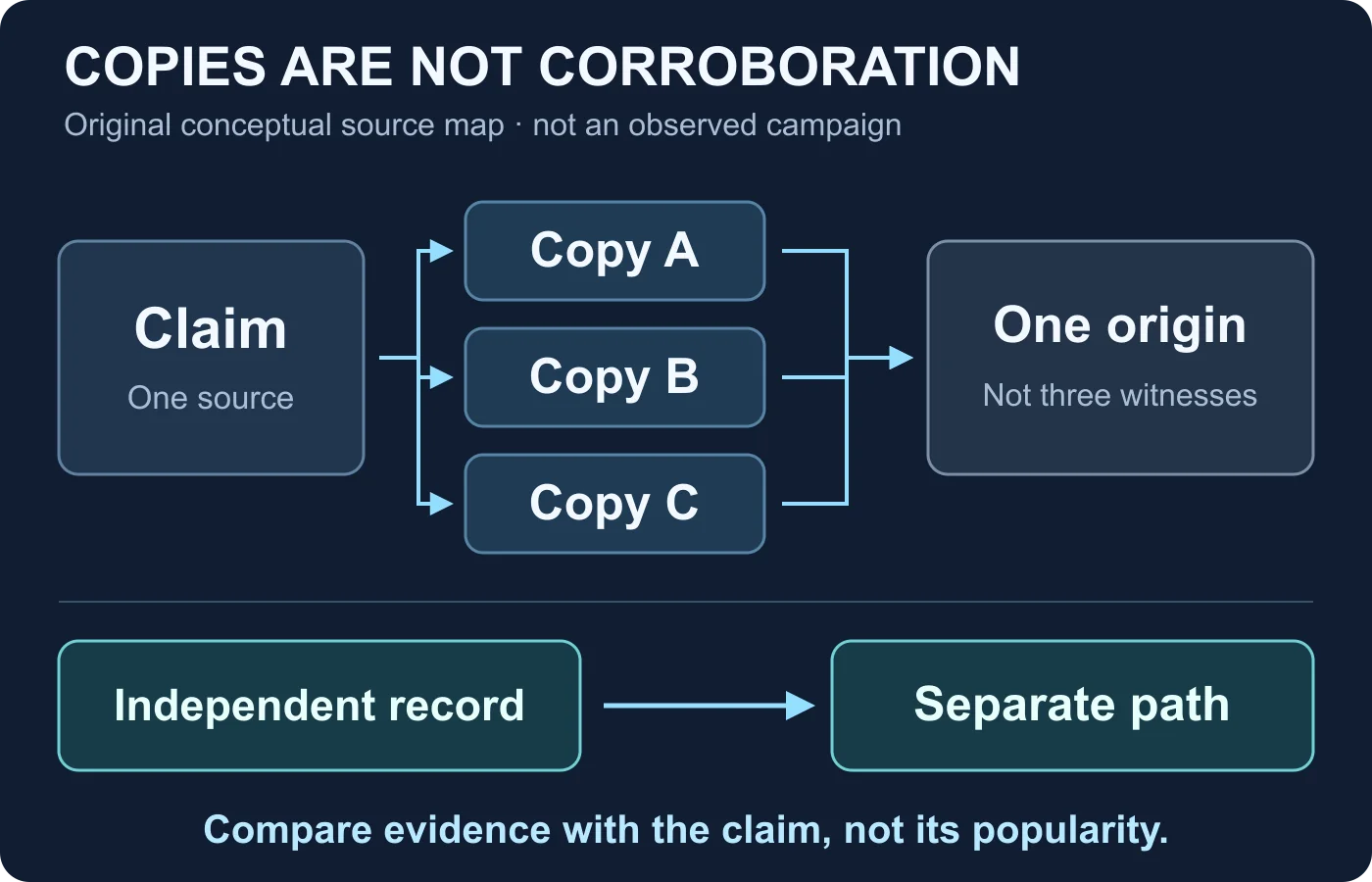
Preserve qualifications during that tracing. A source might say a building closes for maintenance while a retelling says it is being permanently abandoned. The difference is not merely tone. It changes the factual premise used to support the appeal. Compare the actual wording and the source’s scope before considering a technical question about the clip.
A repeated claim can also be accurate. The existence of a common origin is not evidence that the origin is false. It means that the copies should not be counted as separate confirmation. A primary record can be useful on its own while still requiring further interpretation for a broader causal or evaluative claim.
Do not infer an organized operation simply because several accounts post the same message. Sharing, quotation, syndication and ordinary imitation can produce similarity. Attribution of coordinated distribution needs additional evidence. For a personal sharing decision, it may be enough to say that all the copies you checked rely on one source.
The result should be a source relationship, not a dramatic diagram of suspected enemies. Use neutral labels such as current post, earlier version and supporting record. Keep named people, private information and unsupported actor assignments out of a public explanation unless they are necessary and independently established.
Independent verification should test the premise, not your reaction
Choose the assertion that actually carries the argument. If a clip’s appeal depends on a claim that a facility is closing permanently, check that claim rather than debating whether the music is manipulative. If the premise concerns an attributed statement, seek the statement’s authoritative record. Match the evidence to the proposition instead of investigating every possible feature of the post.
Read cited material directly. A headline image may omit a date, a correction or a qualification. A link may document a temporary closure while the narrator claims something permanent. Record the mismatch in ordinary language and retain enough context for another reader to see why it matters.
The UNESCO publication description for its journalism handbook presents a curriculum for understanding disinformation and developing contextual and practical verification skills. That is a useful educational direction, not a claim that a short checklist identifies every influence effort. This guide’s fictional worksheet is an original exercise, not a reproduced handbook lesson.
When you need a wider source, date and claim investigation, use the existing news verification guide. This article does not repeat that entire workflow. Its emphasis is the persuasive relationship: which premise supports which conclusion, and whether apparent corroboration actually adds evidence.
Keep findings and interpretations in separate lines. “The source describes a temporary closure” is a finding about the record. “The permanent-closure appeal is not supported by that record” is a bounded interpretation. “The publisher is part of a covert campaign” would require substantially different evidence and should not be smuggled into the first two statements.
If the evidence remains incomplete, say what is missing and choose not to amplify the claim as settled fact. You do not have to prove deception to withhold endorsement. Nor should uncertainty become an accusation. An honest pause gives you time to investigate without turning an unfamiliar account into a presumed adversary.
What tools can and cannot establish
A media-analysis tool addresses characteristics of the media, not every question about the surrounding argument. It may contribute evidence about generated or manipulated video. It does not independently establish a publisher’s motive, the truth of a policy claim, audience persuasion, or control of an account network.
The original NIST report on synthetic-content transparency distinguishes provenance, labeling and detection approaches and emphasizes their use-case limitations. It also warns that technically legitimate material can be misleading when context changes. That supports a layered reading approach rather than an automatic true/false verdict from one technical signal.
A positive synthetic-media finding should therefore stay attached to its production question. A disclosed illustration can be generated without being deceptive. A clip that appears camera-recorded can still carry a false premise. Do not replace the source-and-argument worksheet with a percentage and assume the persuasive issue has been resolved.
Source-search tools answer different questions again. Finding an earlier copy can help identify a version relationship. It does not automatically identify the original creator or prove the account’s intention. Not finding a copy does not establish originality. Use the result to narrow your next check, not to award the entire message a trust badge.
If a supported video remains uncertain, DetectVideo AI can add a technical evidence layer alongside source and context work. The result does not measure propaganda effectiveness or classify someone’s beliefs. Keep any finding narrow enough that a reader can understand what was examined and what the tool could not determine.
This separation also reduces the risk of dismissing genuine evidence merely because it is inconvenient. Ask the same source questions of persuasive captured media as of persuasive synthetic media. Production transparency can inform a review, but it cannot relieve the reader of assessing the actual premise and conclusion.
A neutral fictional case study: the garden-closure clip
Imagine a fictional public garden, Fern Court, with an invented visitor pavilion. A short clip shows the empty pavilion, uses an authoritative-sounding voice, and claims that public access is ending permanently. It asks viewers to share the clip immediately. Every name, scene and record in this exercise is invented; no actual organization, event, account or measured campaign is represented.
Separate the message into inspectable parts
The visual shows an empty space. The narration supplies the permanent-closure assertion. The urgent sharing request turns that assertion into a proposed action. The apparent official voice supplies an authority cue. These four parts can be recorded separately without deciding that the image or speaker is synthetic.
Write the central premise first: permanent loss of public access. Then note the requested conclusion or action: treat the closure as settled and spread the message. The key gap is already visible. Empty chairs do not establish a permanent access policy, and a confident voice does not establish that an authorized source announced one.
Follow the apparent confirmation paths
Suppose a second page quotes the clip and a third page embeds the quotation. In the exercise, both point back to the original clip. Record them as copies, not additional witnesses. Their agreement might explain how you encountered the message, but it has not supplied independent support for permanent closure.
Now suppose a separate, attributable pavilion notice describes a temporary maintenance closure and names a reopening period. The notice addresses a narrower factual issue directly. Compare its wording with the permanent claim. Do not claim that you have identified who produced the voice or proved what every reposting account knew.
| Part of the message | Available in the exercise | Bounded conclusion |
|---|---|---|
| Empty pavilion | A clip shows the fictional space without visitors. | It does not by itself establish the access policy. |
| Permanent closure | Narration asserts permanence. | That premise needs an attributable record. |
| Many apparent confirmations | Two retellings cite the same clip. | They are not independent evidence paths. |
| Maintenance notice | A separate record describes a temporary closure. | The permanent claim conflicts with the exercise’s record. |
| Synthetic production | No production analysis is supplied. | Do not invent a detector result or a creator identity. |
Choose a proportionate response
A useful correction in the fictional exercise would explain that the provided record describes maintenance rather than permanent closure. It would cite the relevant notice and avoid repeating the urgent sharing request. It would not accuse viewers of stupidity or announce an influence operation that the exercise has not established.
If the premise were still unresolved, the response would change: do not share permanent closure as fact, record the missing source, and seek clarification through an independently found channel. That is a different finding from a documented contradiction. Keep the distinction visible rather than using one suspiciousness label for both.
Use a compact reader checklist
- Write the factual premise and requested action separately.
- Identify the authority the presentation implies.
- Trace each apparent confirmation to its underlying evidence.
- Preserve qualifications that change the argument’s meaning.
- Use technical media findings only for the questions they address.
- Report unsupported, contradicted and unresolved premises distinctly.
The lasting lesson is not that every emotional clip is propaganda or that every generated voice is dishonest. It is that persuasive presentation should not erase the distinction between a premise, an evidence path and a reaction. Read those relationships carefully before the clip becomes part of your own evidence.
Questions about AI propaganda
Is every AI-generated political or opinion video propaganda?
No. Production method, persuasive purpose and deception are separate questions. A disclosed illustration or openly argued opinion should not be assigned a deceptive motive merely because AI was used.
Do repeated posts prove coordinated distribution?
No. They may share a source through ordinary reposting or quotation. Coordination and actor attribution need additional evidence. For verification, first establish whether the copies supply independent information.
Can a real video be used in misleading propaganda?
Yes. Its caption, narration or selection can support a claim the recording does not establish. Check the persuasive premise and context separately from production characteristics.
Can an AI detector identify a publisher’s intent?
No. Technical video analysis can contribute evidence about the media. Intent, campaign organization and audience effects require other information.
What if a persuasive claim cannot be verified?
State what remains missing and avoid spreading it as a settled fact. Unverified is not synonymous with false, and a lack of evidence does not establish a covert actor.
Pause before a persuasive clip becomes your evidence.
Review its source and use a video check as one part of verification.
Sources and limits
- Stanford HAI: How Persuasive Is AI-Generated Propaganda? — authors’ own historical text-experiment brief. No impact statistic, replication procedure or current-model effect is asserted.
- NIST AI100-4: Reducing Risks Posed by Synthetic Content — original report summary, risks and transparency approaches; technical evidence is not universal truth verification.
- UNESCO: Journalism, Fake News and Disinformation — exact handbook’s official publication description and educational purpose. Its full PDF was not readable in this runtime; no unread chapter or study finding is attributed to it.
Sources accessed on 14 October 2026. Fern Court, the pavilion, the notice, the media panels and source map are original fictional teaching material, not a real case or observed campaign.