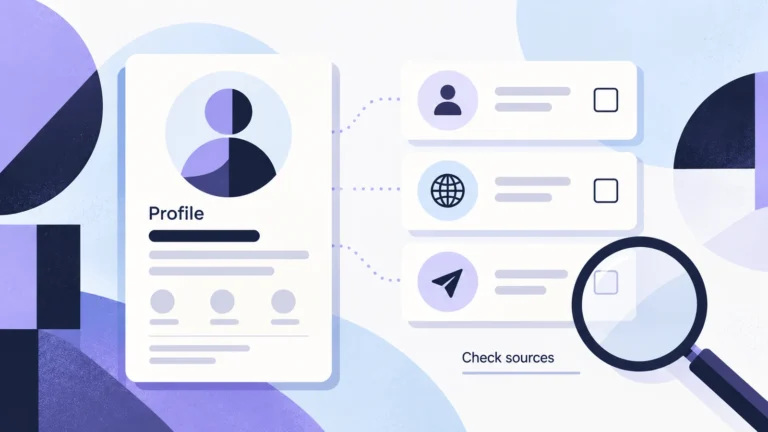
Fake Instagram accounts cannot be identified reliably from one small profile photo, a low follower count, or an unfamiliar username. Start with the identity the account claims and the action it wants you to take. Compare its exact handle with an independent official source, check public history and image context, and pause any request for money, login codes, or private information until the request is confirmed elsewhere.
This guide is for deciding whether to trust an Instagram profile, message, collaboration offer, or shop contact. It is not a method for uncovering a private person’s identity. You do not need to find an operator’s name or prove that their photograph was generated with AI before declining an unsafe request. The practical goal is a defensible decision and, when appropriate, a clear report.
Define what “fake” means in this interaction
A profile can be misleading in several different ways. An impersonator claims to represent someone else. A deceptive shop copies a business identity while directing buyers to an unrelated destination. A compromised account may belong to a real friend but carry a request that the friend did not authorize. A publicity or fan page may instead be legitimate when its purpose is clear. These situations need different evidence.
Do not equate anonymity with dishonesty. A person can use a pseudonym, keep photographs private, run a small personal account, or decline a stranger’s request for identification. Those choices do not establish deception. The question is whether the profile makes a specific claim that is contradicted or remains unsupported where it matters, such as claiming to be your employer’s recruitment account.
Write the claim in one sentence: “This account says it is the studio that sent my invoice.” Then write the requested action: “It wants me to pay using a new link in a direct message.” Now you have two things to verify. A matching logo might support recognition, but it does not confirm the invoice or destination.
The FTC warns that social-media impersonation can involve a hacked familiar account as well as a fabricated profile. Its advice is to confirm suspicious money or information requests through a separate contact route. That distinction matters: an account can have a genuine history while the current message is unsafe. See the FTC’s social-media friend-request warning.
Inspect the Instagram profile without turning it into a score
Record the handle, not just the display name
Display names and profile pictures are recognition cues, not reliable identifiers. In your notes, copy the complete public profile address and exact username as displayed. Compare them with the account linked from the person’s or organization’s independently found website. Watch for additional characters and lookalike spellings, but do not assume every similar name is malicious; unrelated people can have similar names.
If a message claims that a familiar business created a new support profile, the business’s established channel should confirm that change. Find its website from a bookmark, previous transaction, or known official publication rather than following the message’s directions. An official-looking screenshot supplied by the suspect account is still supplied by the suspect account. It does not add independence.
Read history as context, not a verdict
Look at the public posts you can actually access. Does their topic, language, and role fit the claim? Are older captions consistent with a shop that supposedly opened years ago? Do the account’s recent requests differ sharply from its earlier purpose? Record the observable change rather than writing “obviously fake.” An ordinary rebrand, relocation, or account cleanup could also change the history.
Where Instagram exposes account-transparency information, treat it as supporting context. Meta described the introduction of “About this Account” in its April 2020 transparency announcement. That historical announcement is not a guarantee that every profile today displays the same fields. Use only the information currently visible to you; do not invent a join date, location, or username-change record when none is shown.
Follower totals, a sparse grid, generic comments, or polished branding should not become a numerical authenticity formula. An emerging artist may have little history, and a copied business may have a persuasive-looking grid. Use these observations to decide which claim needs corroboration, not to label a person. Missing information is “not available,” not “failed verification.”
Check profile pictures and Reels as separate evidence
An exact-photo search can help you find an earlier public use of a profile picture or product image. Start with an image you are allowed to process and use the least invasive method that answers the question. The reverse image search guide explains source discovery. A match becomes useful only after you open the source page and understand what it says.
For an organization, compare the photo or logo with material on its independently verified website. If an image was copied from a public campaign, the copy establishes reuse, not authorization. If a person’s photo appears under another name, avoid guessing which identity is correct. The image could have been reposted with consent or assigned a misleading caption. Preserve the source relationship and leave personal identification unresolved.
No result is equally limited. The search may not index the relevant site, a profile may be private, or the photo may have been cropped or newly created. It does not verify the account and does not establish an AI-generated face. If a legitimate purpose requires comparing public facial appearances, the reverse face search guide covers limitations and privacy boundaries. Do not use face matching to expose private people.
Reels add a different question. A convincing video can be copied from a genuine creator, edited, or attached to a false caption. Finding the original upload and checking whether the creator links this account may resolve the account question without pixel analysis. Conversely, confirming the profile does not authenticate every clip it shares. Keep “account association supported” separate from “video source or manipulation unresolved.”
When you save evidence, retain enough surrounding context to distinguish the profile from the content. Note the profile address, the post address if available, the caption, and when you observed it. A cropped face alone usually cannot explain an impersonation complaint. Avoid collecting unrelated followers, private messages from other people, or personal details that do not bear on the specific claim.
Evaluate the request before engaging with the account
A request can be unsafe even when you have not settled whether the profile is fake. Ask what would happen if you complied. Would you disclose a login code, sign into a supplied page, change a payment destination, send a document, or move a conversation to another service? Those actions deserve independent confirmation. A friendly introduction does not reduce the need for verification.
For a collaboration offer, separate the company’s existence from the sender’s authority. Find the brand independently and ask its published contact channel whether the account and campaign are theirs. Confirm the work, agreement, and payment process before sending sensitive material. You are verifying a business relationship, not making a judgment about the stranger’s appearance or writing quality.
For an alleged customer-support message, open the service through its app or known website instead of using the supplied link. Do not provide passwords, one-time login codes, or recovery information in a direct message. A link can look familiar while leading elsewhere. Do not test a suspicious login page with real or invented credentials; you gain little and create an unnecessary interaction.
Urgency should change your response process rather than force an immediate accusation. Save the request, stop the sensitive action, and confirm through a known route. If a legitimate deadline exists, the organization should be able to explain it independently. If you cannot confirm the request in time, “I will not proceed until verified” is a complete safety decision; it does not require proving fraud.
If the interaction has become a relationship or investment story, this account checklist is no longer sufficient. The deepfake romance scam guide addresses those higher-risk trust patterns. This article stays focused on Instagram account claims and the evidence needed before trusting a particular message, rather than repeating relationship-fraud advice.
Build an independent account-and-request check
Use two columns in your notes. In the first, write what the Instagram account asserts. In the second, write the independent observation that would support it. “Official shop” might need a link from the established shop website. “New payment instructions” needs confirmation through the contact route used for your original order. Do not let one confirmation silently answer both questions.
| Claim or request | Independent check | Conservative conclusion |
|---|---|---|
| A brand’s account | Follow the Instagram link from the brand’s established website. | The account association may be supported; a new offer still needs review. |
| A friend requesting money | Call the friend using a number you already know. | Confirm the request, not merely the familiar profile. |
| A creator collaboration | Ask the independently found business contact about the campaign and sender. | Unconfirmed authority is a reason to pause. |
| An unfamiliar private profile | Assess only the specific public claim and requested action. | Privacy or limited history alone does not establish a fake. |
| An alleged copied identity | Compare public profile addresses and documented source material. | Record apparent reuse without naming a private operator. |
For a person you already know, use a pre-existing phone number or another established channel. For a public organization, navigate to its official contact page yourself. Do not ask the suspect profile to supply another profile as proof: both may belong to the same unverified chain. A confirmation is independent only when its provenance does not depend on the original message.
The useful result is narrow. You might confirm that the account belongs to a business but discover that its message was not authorized. You might find an apparently copied profile without knowing its operator. Or you might be unable to confirm anything and decide not to respond. These are different outcomes, and none requires building a dossier on a private individual.
Understand what a verified badge does and does not settle
Check any badge in the actual Instagram interface, not in a screenshot or a symbol typed into a display name. Even an authentic platform badge concerns an account’s verification context. It is not a review of every message, external link, product claim, or video. Do not use it to waive a payment or security check.
Meta’s June 2023 explanation of Meta Verified and legacy badges described a subscription-based identity-authentication offering while retaining previously verified accounts. This is a dated explanation of why badges do not all have the same historical pathway, not a current subscription-price or eligibility guide. No purchasing decision in this article depends on that announcement.
For your decision, the important question is practical: does the account match the independently verified channel, and is the request confirmed? A badge on the wrong account is irrelevant to that test. A correct account may still share inaccurate content or become compromised. An unbadged account may be genuine. Evaluate the association, request, and destination separately.
Prepare a useful report, not a public accusation
Instagram’s reporting process should receive the behavior you can document, not a collection of guesses. If the profile claims to be you or your organization, describe that claim and show the relevant public comparison. If it sent a suspicious message, preserve the message context. If an individual post is the problem, record that post rather than treating the entire account as proven deceptive.
Meta’s July 2021 security guidance described reporting accounts from their profiles and reporting individual content. Its account-support update, revised in March 2026, describes newer support tools and evolving availability. Open the report or help controls presented in your current app and follow its prompts. Interface labels and available paths can vary; this guide does not claim a universally verified sequence of buttons.
Choose the category that accurately describes the evidence, such as apparent impersonation or the specific harmful message, when that option is offered. Do not select an unrelated violation to try to force a faster response. Explain what the account claims, what you observed, and how the comparison was obtained. Clear facts are more useful than calling the unknown operator a criminal.
If the platform asks for identity verification, navigate through the app or official help flow independently. Do not send identification to the suspicious account, an unsolicited “support agent,” or a person offering paid removal. For an organization, use the person authorized to handle the account or brand issue. Keep any documents out of public posts and share only what the legitimate process requires.
A report is not a guaranteed takedown. Save its confirmation or status information when available and keep your own dated notes. If a decision does not match your evidence, use the review or support options actually provided rather than mobilizing a harassment campaign. New harmful posts can be documented separately; repeated speculation is not additional evidence.
A fictional shop message: complete the evidence worksheet
Imagine you bought a mug from a small pottery studio. Days later, a similar-looking Instagram profile messages that delivery is blocked and asks you to use a new payment link. Its grid contains attractive product photographs. The studio name looks familiar. You do not know whether the account is an impersonator, a second legitimate shop account, or an account with unauthorized access. This is an invented exercise, not a reported incident or a DetectVideo test.
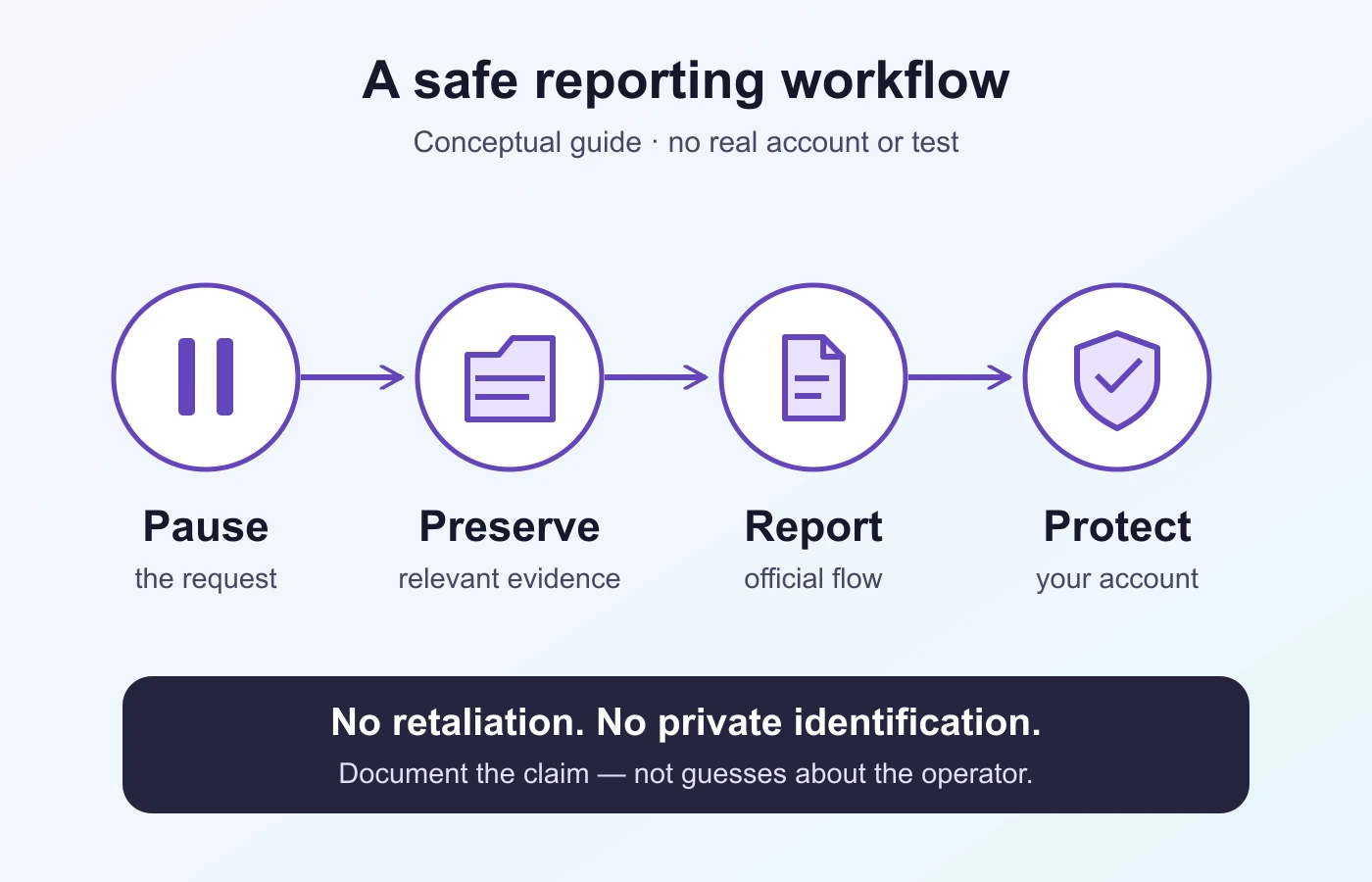
First write the claim and requested action. The claim is an association with the studio; the action is a new payment. Preserve the public profile address, exact handle, message, and observation time. Do not click the payment link just to inspect the checkout. Note the destination text if it is visible without opening it, while keeping any private order details out of a shared report.
Next open the studio website using your original order confirmation or bookmark. Follow its own social link and compare the address with the messaging profile. Then contact the studio through the already established order channel. Ask whether that specific account and payment instruction are authorized. Do not simply ask whether the studio has “an Instagram account”; that broad answer would leave the suspect message unresolved.
Suppose the studio confirms its normal account but says it never requested another payment. The defensible result is “the payment request is not authorized by the shop.” If the profile address also differs, document that mismatch. You still have not established the unknown operator’s identity. If the shop does not respond, label the request unverified and do not pay; silence does not prove which explanation is true.
Use the narrow report packet: one short factual explanation, the suspect profile address, the relevant message, and the official comparison. If you warn another buyer privately, share the independently verified studio contact and say that the request was not confirmed. Do not circulate unrelated customer information or tell people to attack the account. The value of the exercise is separating an actionable risk decision from an unsupported identity accusation.
Preserve evidence, limit exposure, and know when to stop
A compact evidence record can contain the exact profile address, relevant post or message, observation date and time, claimed identity, requested action, and independent comparison. Retain the original context privately where lawful. When sharing with a platform or trusted organization, remove irrelevant personal information from the copy. Keep your private originals separate so a redacted screenshot does not become your only record.
Once you have enough to report the behavior, stop interacting. Do not send bait messages, install tracking links, attempt access to the account, or seek its hidden location. Do not mass-report a person based on an uncertain match. These actions increase exposure and can harm someone who was misidentified. Verification is about choosing safely and documenting what happened, not retaliating.
If you disclosed credentials, paid, or installed something, prioritize containment through the affected provider’s independently accessed support. If threats or immediate danger are involved, seek appropriate local help rather than waiting to complete an account investigation. Preserve only what is safe to preserve. This article is not legal advice and cannot determine the appropriate emergency response for your jurisdiction.
Finish with a short conclusion: association confirmed, request not authorized, apparent image reuse, or unresolved. Include the remaining uncertainty and the next safe action. The AI impersonation guide covers broader identity layers when synthetic audio or video is involved. Here, the key discipline is simpler: a persuasive Instagram profile does not remove the need to verify a consequential request.
Questions about suspicious Instagram profiles
Does a private or empty Instagram profile mean it is fake?
No. Limited public content can reflect ordinary privacy, a new account, or a narrow purpose. Evaluate the claim and requested action. Do not treat missing history as proof of deception.
Can a genuine account send a scam message?
Yes. Account association and message authorization are separate. Confirm unexpected money or security requests through a contact route you already trust, even when the profile is familiar.
Does a reverse image search with no matches verify the photo?
No. Index coverage, privacy, cropping, and a newly made image can explain a missing result. Record “no useful indexed match,” not “verified person” or “AI face confirmed.”
Should I identify the person behind a copied profile?
No private identification is needed to decline or report a misleading claim. Document relevant public evidence. Do not seek private addresses, bypass access controls, or publish unverified accusations.
Can DetectVideo AI verify ownership of an Instagram account?
No. It analyzes supported video for evidence of AI generation or manipulation. Account control, authorization, payment destinations, and biography require independent checks.
Sources and verification limits
- FTC: That friend request could be from a scammer — social-media impersonation and independent confirmation.
- Meta: Making Pages and Accounts More Transparent — historical account-transparency context, April 2020.
- Meta: Expanding Meta Verified to India and Honoring Legacy Verified Badges Globally — dated badge-pathway explanation, June 2023.
- Meta: Keeping Instagram Safe and Secure — historical official account/content reporting guidance, July 2021.
- Meta: Making it Easier to Access Account Support on Facebook and Instagram — support rollout, updated March 2026. Availability is not guaranteed for every account.
Sources checked on 14 October 2026. The worksheet and pottery example are original educational material. Exact current Instagram menu labels, report outcomes, and per-account transparency fields were not independently verified; consult the official in-app help before submitting a report.
A convincing profile can share a misleading clip.
Check the video and verify the account through an independent source.