
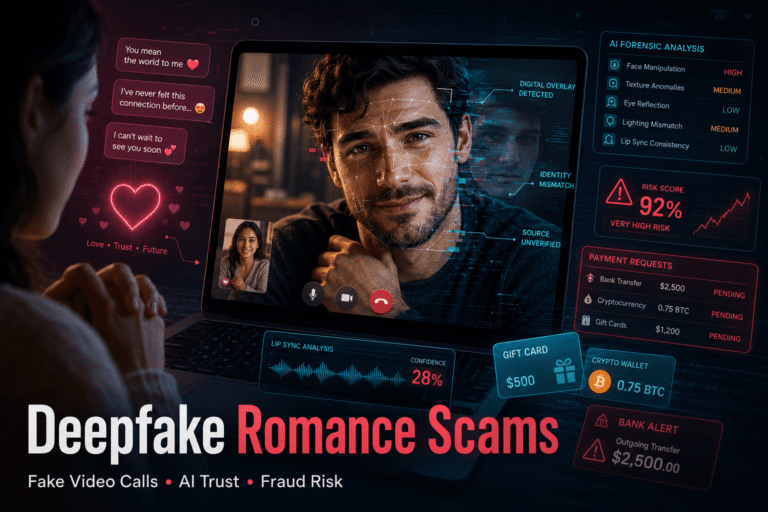
A deepfake romance scam uses AI-generated or AI-modified faces, voices, photos, video calls, or online identities to make a romantic relationship feel real enough to earn trust. The synthetic media is rarely the entire scam. It is usually one part of a longer relationship strategy that can end in requests for emergency money, gift cards, cryptocurrency, fake investments, travel fees, account access, or help moving funds.
The most dangerous misconception is that a video call proves identity. It does not. A scammer can use a real-time face swap, a prerecorded or manipulated clip, a cloned voice, or even a real accomplice who appears on camera. The correct question is not “Did I see them on video?” It is “Can I independently verify that the person, history, location, account, and financial request all belong to the same real individual?”
Never use one video call as proof that an online romantic partner is who they claim to be. Verify the identity outside the relationship: reverse search profile images, compare long-term account history, verify work or public claims independently, notice whether live interaction stays consistent across time, and refuse money or investment requests until the person and destination can be verified through sources they do not control.
What Is a Deepfake Romance Scam?
A deepfake romance scam is a romance or relationship fraud in which artificial intelligence helps create, alter, or sustain a false identity.
That can include:
- AI-generated profile photos
- face-swapped or AI-modified video calls
- cloned or altered voice
- synthetic photos showing travel, work, family or lifestyle
- AI-written messages designed to maintain a convincing relationship
- fake professional or social profiles built around the same persona
The FBI defines romance scams more broadly as fraud in which a criminal uses a fake online identity to gain affection and trust before manipulating or stealing from the victim. See the FBI overview of romance scams.
AI changes the realism and scale of the false identity. It does not change the core mechanism: build trust first, exploit trust later.
The Romance Trust Funnel
Relationship fraud is easier to recognize when you stop focusing on one suspicious message and look at the progression.
Not every romance scam follows every stage, but the structure explains why a realistic video call can be so effective: it arrives during the proof stage, when the target wants reassurance that the relationship is genuine.
Why Fake Video Calls Build So Much Trust
People are used to treating live video as stronger evidence than text or photos.
A video call appears to prove several things at once:
- the person exists
- their face matches the profile
- they can respond in real time
- their voice matches
- they are emotionally present in the relationship
But those are separate claims.
The FBI’s current cryptocurrency investment fraud guidance specifically warns that relationship scammers may agree to some video conference calls, use deepfake technology, or hire real people to interact with targets by phone. That means even a live human interaction can be part of a larger false identity. See the FBI cryptocurrency investment fraud guidance.
Video call ≠ verified identity. A live call can establish that something responsive is happening on screen. It does not independently establish the person’s legal identity, relationship history, location, financial claims, or authorization to receive money.
Five Ways a Romance Scam Can Pass the “Video Test”
| Method | What the target sees | What remains unverified |
|---|---|---|
| Real-time face swap | A responsive face matching the false profile | The real identity behind the camera |
| Voice modification or cloning | A voice consistent with the claimed persona | Who is actually speaking |
| Prerecorded or selectively replayed video | A convincing visual appearance | Whether the interaction is genuinely live |
| Real accomplice | An actual person responding on camera | Whether that person owns the identity and story |
| Mostly real person, false biography | Authentic face and voice | Job, wealth, location, relationship status and financial story |
A Deepfake Is Not Required for a Deepfake-Style Trust Effect
A useful safety principle is to verify the relationship as if the video could be manipulated, even when you cannot prove that it is.
That is because a scammer can produce the same trust effect with:
- a stolen identity
- a real but deceptive accomplice
- edited media
- selective calls
- AI-generated supporting photos
- a fabricated professional history
If the central issue is whether the person’s face or identity is being synthetically replaced, the face swap video guide explains the media-level clues and limitations.
What Real-Time AI Can and Cannot Prove
Real-time synthetic media can make identity deception more convincing, but it does not automatically solve every consistency problem.
Across repeated calls, the false identity has to remain compatible with:
- facial features
- voice
- age
- language and accent
- claimed location
- work schedule
- social history
- family or relationship story
This is why longitudinal verification is often stronger than hunting for one deepfake glitch.
Visual Glitches Are Weak Romance-Scam Evidence
Do not decide that someone is a scammer because a video call has:
- soft edges
- odd skin texture
- brief lip-sync delay
- background blur
- glasses distortion
- low frame rate
Video conferencing, bandwidth, phone cameras, beauty filters, compression and virtual backgrounds can create similar effects.
The stronger question is whether identity continuity breaks across time and whether the broader relationship survives independent checks.
Voice Cloning Can Support the Same False Identity
Voice notes and calls may create even more emotional trust than video.
A cloned or modified voice can be used to:
- maintain the same persona across long conversations
- send affectionate voice messages
- explain why video calls are infrequent
- create urgent emotional requests
- reinforce a fake business or financial story
If synthetic speech is the main concern, the voice clone scam guide covers voice verification and fraud-specific checks.
Warning Signs That Matter More Than One Strange Frame
Look for patterns that affect identity, control and money.
CFTC relationship-investment guidance describes the same long-con structure: a stranger makes contact, slowly builds trust, may use altered or AI-generated images and video, then directs the target toward a fraudulent investment or payment path. See the CFTC relationship investment scam alert.
The Person’s Story Should Survive Outside Their Own Profile
A sophisticated false identity may include a full social presence. Do not measure credibility by profile completeness.
Instead, verify claims through independent sources:
- Does the company they claim to work for independently list them?
- Does the business have a real history outside the person’s profile?
- Do older posts show a coherent life history?
- Do tagged photos and independent accounts support the same identity?
- Does the claimed location match normal daily details?
A fabricated persona can be polished. Independent consistency is harder to fake over time.
How to Verify Someone From an Online Relationship
- Reverse search the profile images.
Search more than one photo. A match to another person’s name, modeling profile, social account or old website can expose stolen identity material.
- Verify claims outside the relationship.
Search the company, occupation, public achievements, business or other facts independently. Do not use only links the person sends you.
- Compare identity across time.
Look for consistency in face, voice, biography, schedule, location, background details and long-term account history.
- Use spontaneous live interaction as supporting evidence.
Natural unscripted conversation, changes in pose or environment, and real-time responses can add evidence, but passing these checks still does not establish legal identity.
- Do not let the scammer define the verification channel.
If they claim to work for a company or public institution, verify through independently found contact information rather than an email address or phone number they supplied.
- Separate identity verification from financial decisions.
Even a real person can promote a fraudulent investment or ask for money under false pretenses.
Reverse Image Search Is Still Valuable in the AI Era
AI-generated profile pictures may not have an older match, but reverse image search remains useful because many scams still reuse real photos, stolen identities and recurring profile assets.
A no-match result means:
“I did not find an indexed earlier use of this image.”
It does not mean:
“This person is verified.”
This distinction is especially important now that synthetic profile images can be created without stealing a photograph.
Should You Ask Someone to Perform a Live Challenge?
A simple live request can add evidence that the call is responsive.
Examples include naturally changing position, showing a nearby object, or responding to an unpredictable conversational request.
But do not build your safety decision around one challenge. A real person using a false identity can pass easily, and improved real-time systems may also handle ordinary motion.
The goal is to increase evidence diversity, not invent a secret deepfake test.
What If They Refuse to Meet in Person?
There are many legitimate reasons people cannot meet quickly, especially across countries or long distances. The problem is not one cancelled meeting.
Concern grows when:
- every meeting becomes impossible
- travel plans always require your money
- new emergencies appear before each meeting
- the relationship escalates financially without physical-world verification
FBI and CFTC guidance repeatedly identify prolonged inability to meet in person as a common romance-fraud pattern.
The Financial Request Changes the Risk Level
Once money enters an online romantic relationship, verification standards should become much stricter.
Common requests include:
- medical or family emergencies
- travel tickets or visa costs
- customs, package or legal fees
- gift cards
- bank transfers
- cryptocurrency
- loans
- investment deposits
- help receiving or forwarding money
The emotional story and the payment destination should be verified separately.
Romance-to-Investment Scams Are a Major Escalation Path
In relationship investment scams, the romantic or friendly relationship becomes the distribution channel for a fake investment.
The person may claim:
- they became wealthy through crypto or forex trading
- a family member has special market knowledge
- they can teach you a low-risk strategy
- the opportunity is part of your future together
CFTC guidance describes fake trading platforms that show rising balances, may allow small withdrawals to build confidence, then block larger withdrawals or demand new fees and taxes.
If the relationship has moved into trading, crypto or investment advice, use the AI investment scams guide for firm, platform, custody and payment verification.
A Small Successful Withdrawal Does Not Prove the Relationship Is Real
This is an important trap.
A fraudulent platform can return a small amount of money to strengthen two beliefs at once:
- the investment platform works
- the romantic partner is helping you succeed
That can make a later request for a much larger deposit feel safer.
The withdrawal proves only that a small payment was returned. It does not prove that the displayed profits, assets or relationship are genuine.
Do Not Become a Money Mule for an Online Partner
A romantic contact may ask you to receive money, crypto or packages and forward them elsewhere.
This can involve funds stolen from other victims.
The CFTC warns that romance-fraud victims can be recruited to move money through bank accounts, digital wallets or trading accounts, exposing them to serious legal and financial consequences. See the CFTC warning on receiving and forwarding money.
Do not move funds for someone whose identity and source of money you cannot independently verify.
Intimate Images Can Create a Second Form of Leverage
Some relationship fraud evolves from financial manipulation into blackmail or sextortion.
If intimate material has been shared, a scammer may threaten to send it to family, friends or employers unless additional money is paid.
Do not assume payment will end the demand. Preserve the threats and account information, stop sending new intimate material, secure compromised accounts and use the reporting options available on the platform and through relevant authorities.
A Genuine Person Can Still Be Running a Romance Scam
Deepfake verification should never become the only safety test.
Possible outcomes include:
| Media finding | Relationship finding |
|---|---|
| Face appears authentic | Identity or biography may still be false |
| Voice appears authentic | The speaker may still be an accomplice |
| No AI evidence found | Financial request can still be fraudulent |
| AI manipulation supported | Strong reason to stop trusting the identity claim and investigate further |
This is why the broader AI impersonation guide separates identity evidence from message, account and transaction evidence.
The “Trust Reset” Rule
When a major inconsistency appears, do not let the existing emotional relationship lower your verification standard.
Examples that justify a trust reset include:
- a different face or voice pattern
- contradictory job or location details
- a new phone number or account with no clear explanation
- a request to hide the relationship
- a sudden investment proposal
- a payment destination unrelated to the person’s claimed identity
A trust reset means pausing financial action and rechecking the relationship from independent sources.
What DetectVideo AI Can Help With
DetectVideo AI can contribute technical evidence when a saved or supported video from the relationship needs analysis for possible AI generation, manipulation, face alteration, temporal inconsistency or other forensic signals.
That analysis answers a narrow media question:
“Does this video contain evidence consistent with AI generation or manipulation?”
It cannot establish whether the person genuinely loves you, whether their biography is true, whether a financial emergency is real, or whether a trading platform is legitimate.
For the broader process of checking source, context, identity and media together, use the video verification guide.
What to Do If You Think You Are Being Targeted
- Stop sending money, crypto, gift cards or financial information.
Do not send another payment to unlock previous funds or prove loyalty.
- Preserve evidence before blocking.
Save usernames, phone numbers, email addresses, profile URLs, payment instructions, wallet addresses, transaction IDs, messages and relevant media.
- Contact the payment provider quickly if money was sent.
Ask your bank, card issuer, payment service or crypto platform what fraud-response options remain.
- Secure your accounts.
Change passwords if credentials or recovery information were shared and enable appropriate multi-factor authentication.
- Report the profile and fraud.
Use the dating or social platform’s reporting system and the appropriate fraud-reporting or law-enforcement channel in your jurisdiction.
- Expect follow-up scams.
Be suspicious of unsolicited people who claim they can recover the money for an upfront fee.
If You Already Sent Money, Do Not Pay a “Recovery” Fee
Victims can be targeted again by people claiming to be investigators, lawyers, crypto recovery specialists or government agents.
A recovery scam may know details of the original fraud, making the second contact sound credible.
Verify any organization independently and do not pay an unsolicited recovery service merely because it knows your loss amount, wallet address or scammer’s name.
A Practical Deepfake Romance Scam Verification Routine
- Preserve the profile and claim. Record who the person says they are.
- Reverse search several photos. Do not rely on one image.
- Check independent identity history. Work, public records where appropriate, old accounts and external references should align.
- Compare identity across repeated calls. Look for consistency rather than one glitch.
- Use live interaction only as supporting evidence.
- Verify major biography claims outside the person’s links.
- Raise the verification threshold when money appears.
- Verify the destination separately. Bank account, wallet, trading platform or recipient should make independent sense.
- Pause immediately when identity and money evidence conflict.
Use Precise Conclusions
| Verdict | Meaning |
|---|---|
| Identity independently supported | Multiple independent sources consistently support the person’s identity and history |
| Synthetic identity evidence supported | Media or account evidence supports AI-generated or manipulated identity presentation |
| Video call responsive, identity unverified | The interaction appeared live, but independent identity evidence remains insufficient |
| Relationship fraud pattern strongly supported | Identity inconsistencies, isolation, financial requests or other evidence align with known romance-scam behavior |
| Investment escalation detected | The relationship is being used to introduce a trading, crypto or investment transfer |
| Insufficient evidence | The available media and identity information do not support a reliable conclusion |
Key Takeaway
A fake video call works because it converts visual realism into relationship trust. The defense is to stop treating visual realism as identity proof.
Verify the person across independent sources, repeated interactions, account history and real-world claims. Treat money, crypto, investment advice and requests to move funds as a new risk stage. A live call can support a relationship claim, but it cannot authenticate the biography, payment destination or financial opportunity attached to it.
The strongest verification is not finding one deepfake artifact. It is requiring the identity, history, relationship and money path to agree outside the scammer’s control.