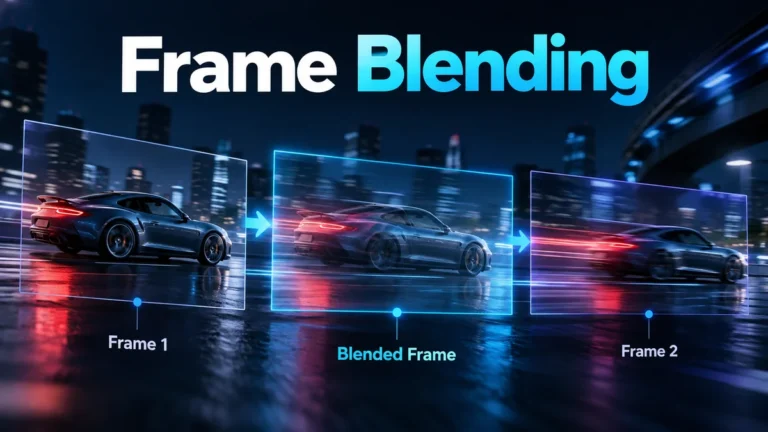
Frame blending combines image values from nearby frames into a new result. When an object occupies different positions in those inputs, a simple blend can leave two faint outlines rather than one newly positioned object. That ghosting is a processing clue, not proof that the scene is fake. Compare the source, identify the actual mixing method, and keep estimated or blended output separate from recorded observations.
This guide owns the narrow arithmetic-mixing question. It does not replace the broader motion-interpolation topic, explain optical-flow correspondence in depth, or teach reconstruction from interlaced fields. Its pixel rows and editing exercise are original chosen examples. No camera clip, editor, FFmpeg command, or motion-estimation algorithm was tested for the article.
What a simple blend does to two pictures
Take two already available images and combine corresponding positions using weights. At each selected position, a simple equal blend uses half the value from the first image and half from the second. It can therefore retain evidence of both appearances within one output picture. The operation does not necessarily move an object into a new middle position.
Weights describe contributions, not object confidence. If one input contributes more, its appearance can become more prominent. That does not prove it is the more accurate source or that its pictured moment is the time you wanted. Keep the choice of weights separate from claims about what was observed between the input frames.
FFmpeg’s tmix filter documentation describes mixing successive frames with specified weights and scaling. It is a concrete temporal-mixing reference, not proof that every editor uses the same defaults or that the filter by itself implements an entire retiming workflow. No command output is presented here.
Real workflows also have defined channel representations and treatment of values. The abstract arithmetic below deliberately isolates mixing. It is not a simulation of physical exposure, a claim about linear-light compositing, or a promise that a particular software preset produces numerically identical samples.
An eight-position example shows why ghosts remain
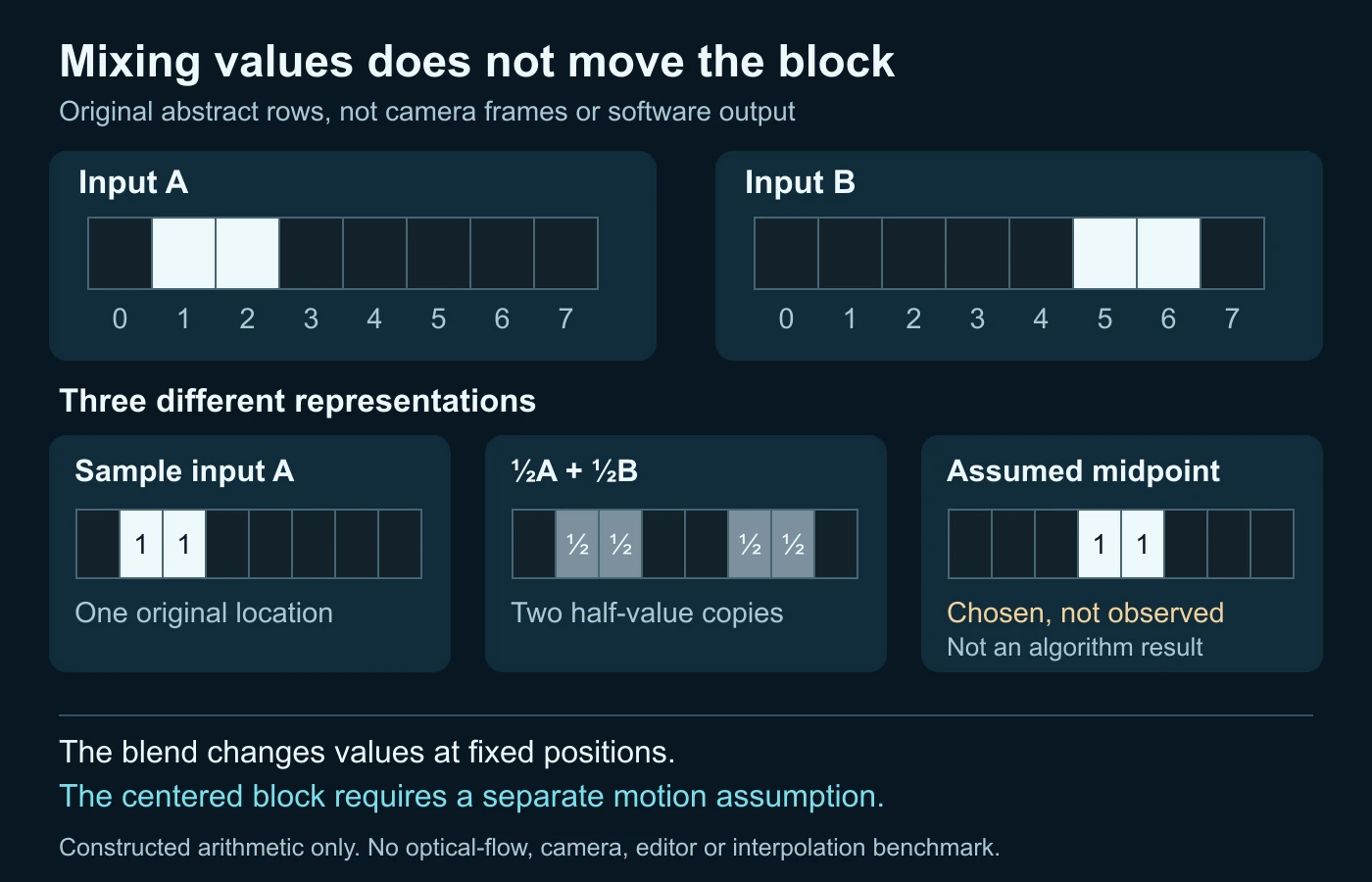
Construct a row with eight positions numbered zero through seven. Let zero represent a dark teaching value and one a bright value. In input A, the two-position bright block occupies positions one and two. In input B, it occupies positions five and six. Every other position is zero. These are drawings, not extracted camera frames.
For an equal blend, calculate half of A plus half of B at each corresponding position. At positions one and two, the calculation is half of one plus half of zero, giving one half. At positions five and six it is half of zero plus half of one, again giving one half. The other positions remain zero.
| Representation | Values at positions 0–7 | Meaning in the example |
|---|---|---|
| Input A | 0, 1, 1, 0, 0, 0, 0, 0 | Block at the earlier chosen position. |
| Input B | 0, 0, 0, 0, 0, 1, 1, 0 | Block at the later chosen position. |
| Equal blend | 0, ½, ½, 0, 0, ½, ½, 0 | Two reduced-value copies, not a centered block. |
| Assumed centered block | 0, 0, 0, 1, 1, 0, 0, 0 | A different constructed picture, requiring a motion assumption. |
The result is visible without a sophisticated model: combining values at unchanged coordinates leaves contributions at both original locations. The blend contains no bright block at positions three and four. Calling it an intermediate picture does not mean it directly observed an object in that middle location.
Now choose unequal contributions: three quarters from A and one quarter from B. The earlier block has value three quarters and the later block one quarter. Their locations are unchanged. This helps explain why one outline can look strong and another faint without proving that the faint outline represents an actual second object.
A second exercise changes the positions rather than the weights. Keep A bright at positions one and two, but put B at positions two and three. Equal mixing now produces one half at position one, one at position two, and one half at position three. The shared position remains bright because both inputs contribute there. The result is wider than either input block, with a strong center and weaker ends.
This overlap case is useful when a reviewer sees what resembles an enlarged outline instead of two separate copies. Write the two input rows and calculate each coordinate before attaching an object-level explanation. In our chosen example, changing a single input position changes the shape of the mixture without adding an object or estimating its path. That is a mathematical relationship, not a diagnosis of an unknown clip. If actual input pictures are unavailable, the exercise helps formulate a question but cannot supply their missing values.
The centered row is only a comparison assumption. If you imagine uniform translation between the endpoints, it is an easy midpoint to draw. The inputs alone do not establish the real path, speed, visibility, or shape during an unseen interval. Do not interpret this row as an actual optical-flow result or measured ground truth.
Why moving boundaries reveal mixing
A stationary region can look similar in both inputs, so an equal blend may preserve its general appearance. A moving edge occupies different coordinates, making the two contributions easier to see separately. This is why a moving hand, object outline, or lettering edge can be a useful place to inspect an already documented blend.
Look beyond one alarming detail. If several moving boundaries show faint copies at corresponding input locations, record that relationship. Do not infer the application or exact weights from the appearance alone. Compression, resizing, source blur, and other operations can complicate the same boundary.
An overlap can also change the apparent shape. If parts of a bright region occupy the same coordinates in both inputs, those positions receive contributions from both. Nearby non-overlapping parts can be fainter. The result can resemble a thicker or partly transparent shape even though the arithmetic never identified an object as a whole.
That is an important distinction from object tracking. A basic pixel mixture combines values at positions; it need not know that two outlines belong to the same moving hand. Keep that mechanism visible in your explanation rather than saying the software “followed” the object unless the documented method actually estimated correspondence.
Sampling, blending, and motion estimation are different choices
Adobe’s Premiere time-interpolation documentation separates Frame Sampling, Frame Blending, and Optical Flow. Sampling repeats or removes frames, blending combines appearances, and optical flow analyzes footage to create intermediate frames. Those descriptions distinguish operations; they are not universal quality grades.
Nearest-input sampling in our row example retains one selected input rather than creating a centered observation. A simple equal blend retains contributions at both input positions. A motion-based method asks an additional correspondence question before proposing another representation. Do not call all three paths identical because an export has more playback pictures.
Terminology needs care. Adobe’s current After Effects frame-blending guidance uses an umbrella containing Frame Mix and Pixel Motion. This article’s arithmetic scope is the simple mixing concept, not a claim that every feature labelled frame blending excludes motion estimation. Record the particular method, not just the umbrella label.
A sharp-looking estimated picture is not inherently a stronger source observation than a visibly ghosted mixture. Both can be processing contributions. Choose a creative result for its task while keeping the evidence boundary clear. No method can retroactively turn an estimated missing moment into a camera observation merely by looking convincing.
Timing tells you which output you are discussing
Retiming changes the relationship between the source sequence and the output timeline. A slowed edit can need pictures at positions not directly supplied as separate recorded observations. A mixing choice can provide output appearances for the presentation, but its chosen time must still be described independently of the input values.
Do not assume that half-and-half always means the exact halfway instant of a real event. The output schedule, selected inputs, and weighting rule determine what the process intends. An unknown derivative may combine several operations. If you cannot recover those relationships, describe the visible mixture without inventing its timestamp mapping.
Likewise, a displayed frame number is not a recording date or a complete motion history. It identifies a position in the representation and tool view you used. The video metadata guide covers the wider limits of fields and timestamps. Keep the source and derivative timelines labelled when comparing them.
Compression references are a different relationship. A B-picture dependency explains how an encoded picture can be reconstructed for playback; it does not by itself mean that the decoded result is the simple ghosted average in our exercise. Nor is a whole-frame mix an explanation of how interlaced fields were combined. Keep those tasks separate.
A fictional moving-label edit, inspected step by step
Imagine an editor slows a permitted clip of a small card moving across a desk. The output shows a faint duplicate of the card’s lettering in a few moments. This is a fictional example, not a filmed or edited test. The editor’s task is to understand whether the duplicate belongs to the source or a documented processing step.
First preserve the source and identify the actual derivative. Align a recognizable part of the card’s movement rather than assuming that matching player timestamps identify the same moment after retiming. Mark the interval and retain surrounding context so a transition is not mistaken for ordinary continuous movement.
Next inspect the relevant original input pictures. If each shows the card once at a different position, compare those positions with the derivative’s faint outlines. A compatible pattern can support a mixing question, but does not independently establish the exact software setting. Look for the editor’s actual processing record.
Suppose the record identifies a simple blend during the speed change. The editor can evaluate a separate candidate with another supported method, while retaining the same source and target interval. The purpose is to compare the documented operation for this delivery, not prove that one technique always wins.
If another candidate improves the lettering but introduces an unwanted change elsewhere, record both. A single attractive still should not decide the whole interval. For a presentation task, the editor may prefer a particular tradeoff. For an evidentiary task, the processed card position still cannot substitute for an unobserved recorded instant.
Now suppose the processing record is unavailable. Keep the conclusion limited: faint duplicated lettering appears in the derivative and is compatible with temporal mixing, but the exact operation remains unknown. Do not turn that uncertainty into proof of generation, or dismiss it simply because ordinary editing can produce similar appearances.
Use a cut as a boundary, not another motion interval
Add a cut to the fictional edit: one shot contains the moving card and the next contains a different desk view. A mixture across that boundary would combine appearances that are not two observations of one continuously moving object. The reviewer should label the cut before describing the blended shapes.
Do not infer a physical path between a card in one shot and a different object in the next. A crossfade or temporal operation can show both scenes temporarily. That is a presentation relationship, not evidence that the scene contained two transparent objects. The actual edit and source context decide which explanation is supported.
If a suspicious frame is located at the transition, compare both neighboring shots and the documented effect. A processing explanation can narrow the anomaly without settling the truth of either scene. Preserve the distinction between a blend across a deliberate cut and a mix within one motion interval.
Build a mixing review record
The original worksheet below helps a reviewer state the scope of an observation. It is not a forensic standard or an algorithm detector. Complete only what you can establish, and retain unknowns when the source or operation account is missing.
| Record | Question | Do not assume |
|---|---|---|
| Inputs | Which source pictures contribute? | Every apparent copy was a separate recorded object. |
| Method | Simple weighted mix, sampling, or estimated motion? | An umbrella menu label specifies the arithmetic. |
| Weights | Are contributions documented or only inferred? | Faintness proves an exact coefficient. |
| Timeline | How does the output relate to the source interval? | Matching player times identify the same moment. |
| Decision | Presentation choice or source-evidence question? | Smoother output is newly captured detail. |
Keep channel and preparation context where it matters. A crop, resize, or color operation can change the comparison before mixing is inspected. Record the known transforms and view the same region at a stated scale. This prevents your own preparation from becoming an unexplained difference attributed to the source.
For a handoff, provide the relevant interval, the available source relationship, and the narrow question. Do not provide private access tokens or unrelated personal information in a public report. Ask the next reviewer to check a specific relationship rather than demand that a single double edge prove the entire video authentic.
Extracting a blended still does not make it original
A frame saved from a processed file remains a picture from that processed sequence. A lossless still export can preserve its current samples without turning it into a camera frame. The frame extractor guide explains how to select and label useful references without confusing extraction with source verification.
When presenting comparison stills, use descriptive roles: input-copy frame, documented blend, or output with unknown processing. Avoid “real” and “fake” labels unless independent evidence supports them. If the mixing relationship is uncertain, the filename should not quietly resolve it for the reader.
Do not try to recover an exact missing input merely by sharpening a ghosted output. A mixture combines contributions, and an unknown weighting/history creates additional ambiguity. Preserve the inputs when they exist. A useful-looking correction is another derivative, not automatic reconstruction of recorded observations.
Choose settings for the actual task
For an allowed creative edit, judge the whole relevant interval at its intended playback rate. Check lettering, moving boundaries, overlap, and cuts rather than accept one pleasant thumbnail. Consult the application’s actual method documentation and record the version used if you perform a comparison.
For a source review, retain the unretimed sequence as primary evidence where available. A processed copy can help discussion, but its inserted or mixed images do not add independent observations. The compression-artifact guide covers other ordinary processing effects that can coexist with the ghosting question.
Do not claim performance superiority from this mathematical illustration. The centered block was chosen by an assumption, not returned by a real tool. Actual footage contains textures, changing light, occlusion, and capture blur that our eight-position row omits. Treat the example as a way to understand the operation, not as a ranking of products or methods.
If the task requires an exact position or event time, seek appropriate source material and qualified examination. A smooth slow-motion picture should not supply precision the inputs lack. State what remains unknown even when a derivative makes the event easier to watch.
Ghost trails are clues, not conclusions
Ordinary captured footage can acquire mixed appearances during editing, and generated footage can pass through the same operations. A ghost trail therefore does not establish which origin occurred. Record the anomaly and known processing before making a broader claim.
The AI video detection methods guide explains why technical review combines evidence families and limitations. A simple mixing explanation supplies context, not a standalone deepfake test. Neither a ghosted picture nor a clean-looking alternative settles a caption, identity, or event claim by itself.
The narrow takeaway is practical: simple blending combines values, not necessarily object positions. Preserve the source, name the method when known, and distinguish a chosen arithmetic result from an observed moment. That makes useful retiming compatible with careful evidence review rather than disguising a processed frame as newly captured truth.
Questions about mixed frames
Why can one moving object appear twice?
A simple blend can retain reduced contributions at both input positions rather than reposition the object into one new location.
Does frame blending always mean the same method in software?
No. An umbrella label can include different options. Identify the actual mix, sampling or motion-estimation method.
Does half-and-half establish the true midpoint of an event?
No. Weights and output timing need context, and the missing scene state was not newly observed.
Are B frames the same as a ghosted blend?
No. Coding dependencies and the simple mixing operation discussed here are different relationships.
Can exporting a blended still make it camera-original?
No. It remains a reference from the processed sequence, even when its current values are saved losslessly.
Does ghosting prove a deepfake?
No. Investigate source and processing context and use appropriate additional evidence for an origin claim.
Primary references and arithmetic limits
- FFmpeg filters manual: tmix — successive-frame weights and scaling.
- Adobe Premiere: Apply time interpolation methods — separate sampling, blending and optical-flow choices.
- Adobe After Effects: Time-stretching and time-remapping — Frame Mix/Pixel Motion terminology and retiming context.
Sources checked on 14 October 2026. Pixel rows, weights, assumed midpoint, editing scenario and diagram are original conceptual examples. No camera, frame-rate conversion, FFmpeg command, editor output or interpolation benchmark was tested.
Ghost trails are clues, not conclusions.
Check the original clip before labeling a motion artifact as fake.