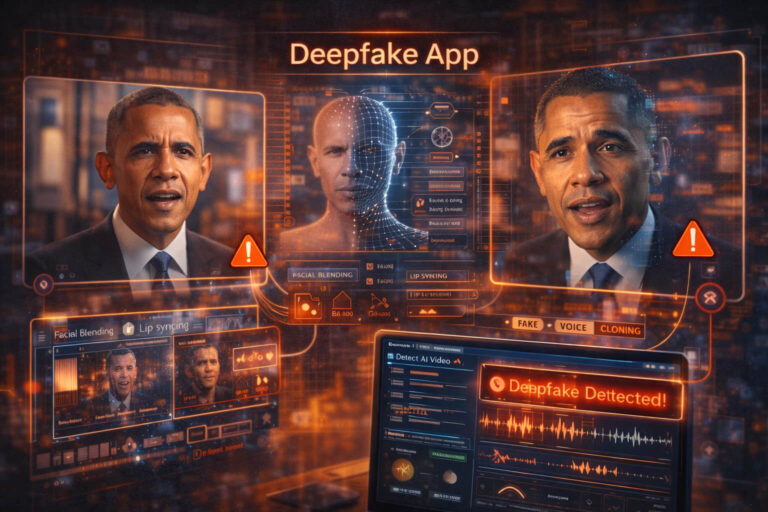
A deepfake app is software that uses AI to create or alter media so that a person can appear to have a different face, voice, expression, or performance. Some apps are built for entertainment and creative effects. Others can produce realistic impersonation content that is difficult to judge from a quick look at a phone screen.
The term is also confusing because people use it for two opposite kinds of tools: apps that create synthetic or manipulated media and apps that check whether a video may be fake. Understanding that difference is the best starting point if you are searching for a deepfake video app, a fake video app, or a fake video detection app.
Quick answer: a deepfake app typically automates tasks such as face tracking, identity transfer, lip synchronization, voice synthesis, or video generation. A deepfake detection app does the reverse: it analyzes media for evidence that may indicate synthetic generation or manipulation. Neither category should be treated as magic. Creation tools can produce convincing results, and detection tools can make mistakes, so high-stakes clips still require source, context, provenance, and technical checks.
| If someone says “deepfake app” | They may mean | Main purpose |
|---|---|---|
| Face-swap app | An app that changes one person’s face into another | Identity transformation |
| Lip-sync or talking-face app | An app that changes mouth movement to fit new speech | Speech reenactment or dubbing |
| Voice-cloning app | A tool that generates or transforms speech to resemble a target voice | Audio impersonation |
| AI avatar or reenactment app | A tool that animates a face, expression, or performance | Synthetic presentation |
| AI video generator | A model that can create an entire scene rather than only alter a real face | Fully synthetic video |
| Deepfake detection app | A tool that analyzes suspicious media | Detection and verification support |
What Is a Deepfake App?
In practical terms, a deepfake app is an application that uses machine learning to synthesize or modify identity-related parts of digital media. The classic example is a face swap, but today’s category is broader. A single workflow can combine a real video with a synthetic face, generated speech, altered mouth movement, background replacement, or other AI-assisted changes.
The word deepfake originally became closely associated with deep-learning face manipulation, but everyday usage now often covers several forms of realistic AI impersonation. That does not mean every AI video is a deepfake.
A useful distinction is:
- Deepfake: usually involves realistic manipulation or simulation of a person, identity, voice, or behavior.
- AI-generated video: can create people, places, objects, or scenes that may never have existed.
- Ordinary video editing: can cut, crop, color-correct, stabilize, subtitle, or rearrange real footage without necessarily creating synthetic identity.
- Deepfake detection: analyzes media for evidence associated with manipulation rather than creating the media.
If your main question is how to determine whether a suspicious clip is a deepfake, use the dedicated deepfake detection guide. This page focuses on the apps themselves, what happens behind the interface, and how to evaluate the output safely.
Why “Deepfake App” Now Covers More Than Face Swaps
Early public discussion of deepfakes focused heavily on replacing one face with another. That is no longer enough to describe the current app landscape.
A modern app can alter several layers independently:
Face identity
The system keeps the target performance or body movement but changes the visible identity. This is still the manipulation most people associate with the word deepfake.
Facial expression and reenactment
An app can modify expressions, gaze, head movement, or facial performance while preserving much of the original video.
Lip movement
A tool can reshape the mouth so that existing footage appears to match new audio. This technique can be useful for dubbing, localization, and accessibility, but it can also make a person appear to say words they never spoke.
Voice
Audio can be generated or transformed separately from the picture. This creates hybrid fakes where the video may be authentic but the speech is not.
Whole-scene generation
Generative video systems can create synthetic shots from prompts, images, or other inputs. These are not always “deepfakes” in the strict identity-manipulation sense, but users may still describe them that way when a realistic person is involved.
This expanding definition is one reason the search phrase “deepfake app” produces mixed results. Some products are creative face tools, some are generative video tools, and some are detection or verification services.
Deepfake App vs Fake Video Detection App
This distinction matters for both search intent and user safety.
| Creation app | Detection app |
|---|---|
| Changes or generates media | Analyzes existing media |
| May accept a face, photo, video, voice, or prompt | Usually accepts a suspicious file or supported link |
| Produces a new image, audio track, or video | Produces evidence, scores, flags, or a forensic report |
| Optimized for realism, speed, or creative control | Optimized for classification, localization, or verification support |
| Can be harmless, deceptive, or abusive depending on use | Can help reduce uncertainty but is not infallible |
If you searched for a fake video detection app rather than a tool for creating synthetic media, the more useful question is not “Which app has the biggest AI label?” It is “What evidence does the checker analyze, and how clearly does it explain uncertainty?” The AI video detector guide covers that evaluation in detail.
How a Deepfake App Works Behind the Tap
The interface may look simple, but the application is coordinating several machine-learning and video-processing stages. You do not need to understand the model architecture to understand the workflow.
1. The app identifies the relevant subject
For identity-based manipulation, the system first needs to locate and track the face or other target region across frames. It estimates landmarks and movement so the synthetic result can follow changes in pose and expression.
2. It builds or applies a representation of the new identity or performance
The model uses the supplied input and its learned representation of faces, voices, motion, or visual structure to generate the requested change. Modern systems may use several different neural architectures, so there is no single universal “deepfake algorithm.”
3. The synthetic region is aligned with the original scene
The generated content has to match head position, perspective, skin tone, lighting, motion, and nearby objects. This integration stage is critical because a convincing identity swap must remain coherent across time, not just look good in one frame.
4. Audio and mouth movement may be processed separately
A video can use real audio, synthetic audio, or replaced speech. If mouth movement is modified to fit new speech, the app has to keep lips, jaw, cheeks, teeth, and facial expression consistent with the soundtrack. For a deeper explanation of that specific technique, see AI lip sync.
5. The output is polished and compressed
Denoising, sharpening, color matching, interpolation, and compression can make synthetic output look more natural. Ironically, those same processes can also erase some of the artifacts viewers once relied on to spot older deepfakes.
Why Modern Deepfake Apps Are Harder to Judge by Eye
The old advice was simple: look for strange blinking, warped teeth, or a flickering face. Those clues can still appear, but they are not reliable enough to serve as a universal test.
Modern models have improved temporal consistency, facial detail, blending, speech synchronization, and post-processing. Social platforms then add another layer of compression, resizing, frame-rate conversion, and transcoding. A real clip can look artificial after processing, while a synthetic clip can become harder to inspect because compression hides fine detail.
NIST’s 2026 deepfake evaluation work emphasizes this operational problem. NIST reports that AI detection systems can show major performance degradation when moving from academic testing into real-world deployment, which is one reason robust evaluation now includes adversarial and forensic transformations rather than only clean benchmark media.
This changes the question from:
“Can I find one visual mistake?”
to:
“Do several independent forms of evidence point toward the same explanation?”
What Information Does a Deepfake App Need From You?
The input depends on the app. A face-swap tool may need one or more portraits. A voice-cloning feature may need an audio sample. A reenactment tool may ask for a source performance. A generative app may start with a prompt, photo, or short video.
Before uploading personal media, ask:
- Is processing performed on the device or uploaded to a server?
- How long are source files retained?
- Can uploaded faces or voices be used to improve models?
- Can you delete the source and generated media?
- What permissions does the app request?
- Does the app add a visible label, watermark, or provenance signal?
- What rights do the terms claim over uploaded and generated content?
The app’s output quality is only one part of the decision. A convincing face effect is not worth ignoring privacy, consent, data-retention, or account-security questions.
Not Every “Deepfake App” Is a Dedicated App
The phrase can refer to a mobile application, desktop program, browser service, API, or a feature inside a larger creative platform. From the user’s perspective, the experience may still feel like an app even when the model actually runs in the cloud.
This is important when evaluating privacy and provenance. A local face effect and a cloud service that uploads source images do not create the same data exposure. Likewise, a browser-based generator may produce output with different metadata, watermarking, or Content Credentials than a phone editor.
Do not infer safety, privacy, or authenticity from the word “app” alone.
Can You Identify Which Deepfake App Made a Video?
Usually not from appearance alone.
Some tools leave recognizable watermarks, metadata, export patterns, or provenance records. Others remove obvious identifiers. Re-uploads and platform transcoding can erase more evidence.
You may be able to develop an attribution lead from:
- a visible watermark or template
- metadata or software identifiers
- Content Credentials or other provenance information
- characteristic export dimensions or encoding patterns
- a source post that names the tool
But a visual artifact such as a soft jawline does not reliably prove which application produced the clip. Attribution requires stronger evidence than detection.
What Makes a Deepfake Detection App Useful?
A useful detector should do more than return a dramatic percentage with no explanation.
It should analyze time, not only isolated frames
Deepfakes are video. Identity, geometry, lighting, motion, and fine details need to remain coherent across frames. Temporal evidence can reveal changes that one screenshot hides.
It should distinguish AI evidence from ordinary compression
Video from social platforms is often recompressed several times. A detector should account for the fact that blockiness, blur, sharpening, and noise can be introduced by normal delivery pipelines.
It should consider audio-video relationships
A convincing face can still be paired with synthetic or replaced audio. Cross-modal analysis is especially relevant when the clip depends on what a person supposedly said.
It should communicate uncertainty
No detector covers every generator, edit, or post-processing transformation. A result that clearly explains confidence and evidence is more useful than a binary label that hides uncertainty.
It should support verification rather than replace it
NIST guidance for identity-proofing systems explicitly calls for automated media analysis to be tested against both manipulated and genuine media and recommends augmenting algorithmic analysis with manual review because false positives and false negatives are expected.
That is the right mental model for consumer verification too.
How to Check a Video That May Have Come From a Deepfake App
Instead of running a long artifact checklist, use a short evidence sequence.
Start with the claim
What is the clip asking you to believe? Did a person really say something? Is the account really theirs? Is this supposedly live footage? The claim determines which evidence matters.
Find the strongest source
Look for an original upload, official account, longer recording, or independent version. A source mismatch can disprove a claim without any facial analysis.
Watch the difficult moments
If identity manipulation is plausible, inspect moments that stress temporal consistency: head turns, partial occlusion, fast expression changes, changing light, and interactions between the face and nearby objects.
Check speech separately
Listen to the voice without staring at the face. Ask whether the rhythm, acoustic environment, and speech timing fit the visible scene. If voice imitation is the central issue, use the voice deepfake guide.
Add technical analysis
For supported video footage, DetectVideo AI can add frame, motion, source, metadata, compression, lip-sync, and other analysis signals. Treat the result as evidence to interpret alongside the source rather than as a substitute for verification.
The Deepfake Clues That Age Badly
One reason deepfake advice becomes outdated is that people turn model weaknesses into permanent rules.
“Deepfakes do not blink normally”
Older systems sometimes produced obvious eye problems. Modern systems can generate normal-looking blinking, so blink frequency by itself is weak evidence.
“AI always gets teeth wrong”
Teeth, mouth interiors, and tongue detail can still fail, especially under motion, but good output may handle them convincingly. Use them as local clues, not proof.
“A smooth face means deepfake”
Beauty filters, denoising, low light, smartphone processing, and compression can all smooth skin.
“No artifact means real”
This is the most dangerous assumption. A manipulation can be visually clean, and a deceptive clip may use completely authentic footage with replaced context.
Detection should evolve with the technology instead of preserving a checklist from one generation of models.
Deepfake Apps, Scams and Impersonation
The largest risk is often not the synthetic media itself but the action someone wants you to take because of it.
A fake executive video may lead to a payment request. A cloned family voice may create an emergency. A celebrity face may be inserted into a fraudulent investment ad. A manipulated video call may be used to create false confidence in an identity.
The FTC reported that consumers said they lost $3.5 billion to impersonator scams in 2025. Deepfakes are only one tool in the broader impersonation problem, but their realism can strengthen the social-engineering story.
If a synthetic identity is being used to establish trust, the safest response is independent identity verification. For that scenario, see the AI impersonation guide.
Deepfake Apps and Consent
The same technology can support legitimate filmmaking, localization, parody, privacy-preserving effects, education, accessibility, or consensual creative work. It can also be used for harassment, fraud, reputational harm, and non-consensual synthetic media.
Before using any person’s face or voice, ask a simple question: do you have a legitimate reason and appropriate consent to create this representation?
App availability is not permission. A feature being technically possible does not mean every use of another person’s identity is acceptable or lawful.
Deepfake Disclosure Rules in the EU
For users and publishers in the European Union, the legal landscape changed materially in August 2026.
Article 50 of the EU AI Act applies from 2 August 2026. The European Commission’s current guidance says deployers of AI systems that generate or manipulate image, audio, or video content constituting a deepfake must disclose that the content has been artificially generated or manipulated, subject to defined exceptions and adjusted requirements for clearly artistic, creative, satirical, fictional, or analogous works.
Providers of systems that generate synthetic content also face machine-readable marking obligations under Article 50. The Commission’s current transparency guidance explains how the rules apply.
This makes labeling and provenance more than a user-experience issue. For many workflows, transparent disclosure is now part of compliance.
Watermarks and Content Credentials: Helpful, but Different
A visible watermark can tell viewers that a tool or workflow marked the output. An invisible watermark can provide a machine-readable signal. Content Credentials can record signed provenance about how media was created or modified.
These mechanisms are not the same as deepfake detection.
The C2PA published updated guidance in July 2026 on using Content Credentials to communicate whether media is synthetic, non-synthetic, or AI-modified through tamper-evident provenance. The Content Credentials explainer shows how provenance can complement content-based analysis.
A missing label does not prove a video is real, and a provenance record does not automatically prove the surrounding story is true.
Deepfake App vs AI Video Generator vs Video Editor
| Tool category | Typical change | Does “deepfake” always apply? |
|---|---|---|
| Deepfake app | Identity, face, voice, expression, or performance manipulation | Usually, when realistic person-level impersonation is involved |
| AI video generator | Creates new shots or scenes from prompts or other inputs | No. Synthetic video is broader than deepfakes |
| AI video editor | Enhancement, object removal, reframing, effects, cleanup | Not necessarily |
| Conventional editor | Cuts, transitions, color, captions, audio mixing | No |
| Deepfake detection app | Analyzes existing media for manipulation evidence | It detects rather than creates |
This classification helps prevent an increasingly common mistake: treating every AI-assisted edit as a deepfake and every realistic synthetic video as a face swap.
Can a Deepfake App Be Used Safely?
Yes, but safe use depends on the workflow, the content, the people represented, and what happens after generation.
A responsible checklist includes:
- use your own media or content you have permission to use
- do not impersonate someone for fraud, coercion, or reputational harm
- label realistic synthetic or manipulated media where appropriate or required
- review privacy and retention policies before uploading biometric media
- do not present generated media as authentic evidence
- preserve provenance information when the workflow supports it
The deeper rule is simple: creativity and deception are different goals. The same model can be used for either.
What to Look for Before Installing or Using a Deepfake App
Do not choose an app only by how realistic its demo looks.
| Question | Why it matters |
|---|---|
| Where is processing performed? | Cloud processing may require uploading biometric media |
| What happens to source files? | Retention and deletion affect privacy |
| Can inputs be used for model improvement? | Your face or voice may have secondary uses depending on the terms |
| Does the app disclose AI output? | Watermarks or provenance can reduce downstream confusion |
| What permissions are requested? | Access should make sense for the feature you are using |
| Can generated content be deleted? | You should understand what control you retain |
| Are consent rules explained? | Identity manipulation creates higher risk when other people are involved |
Why App-Made Does Not Mean Easy to Detect
It is tempting to assume that phone or browser apps produce lower-quality deepfakes than professional tools. That assumption is becoming less useful because many apps are simply interfaces to powerful cloud models.
The device in your hand may only upload the source, send parameters to a server, and receive the result. The actual generation can happen on infrastructure far more powerful than the phone itself.
This is why “made with an app” tells you very little about forensic difficulty. Output quality depends on the underlying model, source quality, post-processing, compression, duration, pose, motion, and how much of the video was manipulated.
What Current Deepfake Research Means for App Users
NIST’s current GenAI Deepfakes program is intentionally testing detectors against challenging manipulations and adversarial transformations. That is a useful signal for ordinary users: reliable detection is not just about recognizing obvious visual mistakes.
NIST’s Open Media Forensics work also treats deepfake detection, broader manipulation detection, and provenance analysis as related but distinct forensic tasks. That separation matters because a video can be edited without being a deepfake, and provenance can reveal information that a visual detector cannot.
You can review NIST’s current GenAI Deepfakes evaluation program for the latest direction in benchmark design and operational testing.
Key Takeaway
A deepfake app is no longer just a novelty face-swap tool. The category now overlaps with voice cloning, lip synchronization, facial reenactment, AI avatars, generative video, and detection software. That is why the first step is to identify what kind of app or output you are dealing with.
If you are evaluating a suspicious video, do not rely on one artifact or one detector score. Start with the claim and source, inspect the difficult temporal moments, separate audio from visual evidence, look for provenance where available, and use automated analysis as an additional layer.
And if you are using a creation app yourself, treat identity media differently from an ordinary filter. Faces and voices are personal, realistic output can travel far beyond its original context, and disclosure requirements are becoming more important as deepfake technology becomes easier to use.
FAQ About Deepfake Apps
What is a deepfake app?
A deepfake app is software that uses AI to create or modify realistic media involving a person’s face, voice, expression, identity, or performance. The term is most commonly associated with face swaps and impersonation, but modern tools can combine several types of synthetic media.
What does “deepfake app” mean?
It is a generic term, not one specific product. It can describe mobile apps, browser tools, desktop software, or cloud services that create deepfake media. People also sometimes use the phrase when looking for apps that detect deepfakes.
Is Deepfake.app the same as a deepfake app?
No. “Deepfake app” is a generic category, while a similarly named website or product is a specific service. Search results can mix the generic term with individual brands or domains, so check what service you are actually viewing before uploading media.
What is a deepfake video app?
A deepfake video app applies AI manipulation to moving footage rather than only a still image. It may perform face replacement, reenactment, lip synchronization, voice manipulation, or a combination of these techniques.
Is a fake video app always a deepfake app?
No. A conventional editor can create misleading video without deep learning, and an AI video generator can create synthetic scenes without impersonating a real person. Deepfake usually refers more specifically to realistic identity or performance manipulation.
What is a fake video detection app?
A fake video detection app analyzes existing media for evidence associated with AI generation, deepfake manipulation, or other forms of tampering. It is different from a deepfake creation app because it examines rather than generates media.
Can a deepfake detection app prove a video is fake?
Not with universal certainty. Detection systems can produce false positives and false negatives, especially after compression, editing, or unfamiliar generation methods. The result is strongest when combined with source, context, provenance, and manual review.
How does a deepfake app work?
At a high level, the app identifies the relevant face, voice, or scene, generates or transforms the requested content with a trained model, aligns the result with the original media, and applies post-processing so the output looks coherent.
Are deepfake apps only used for face swaps?
No. They can also alter expressions, lip movement, voices, and performances. Some modern apps combine these functions, while other tools generate entirely synthetic video.
Can a deepfake app clone a voice?
Some apps include voice synthesis or voice-conversion features, while others focus only on visuals. Video and audio can also be generated by separate tools and combined later.
Can you tell which app created a deepfake?
Sometimes a watermark, metadata field, provenance record, export pattern, or source post provides a clue. Visual artifacts alone usually are not strong enough to attribute a video to one specific app.
What are the best signs of an app-made deepfake?
There is no universal sign. Useful evidence can come from temporal inconsistency, identity drift, difficult occlusions, lighting conflicts, audio-video mismatch, provenance gaps, source history, or detector results. Several agreeing signals are stronger than one artifact.
Does weird blinking prove a deepfake?
No. Blink behavior was more useful against some older systems, but modern models can generate plausible eye behavior. Unusual blinking can also happen naturally or because of editing, frame-rate conversion, or compression.
Are deepfake apps illegal?
The technology itself is not universally illegal. Legal obligations depend on jurisdiction and use. In the EU, Article 50 AI Act transparency rules applying from 2 August 2026 include disclosure obligations for deepfake content, with specified exceptions and special treatment for certain creative works.
Do deepfake apps add watermarks?
Some do and some do not. A tool may use visible labels, invisible watermarks, metadata, or Content Credentials, while other workflows may provide little provenance. Always inspect the actual output rather than assuming a label will be present.
Primary References
- NIST Open Media Forensics Challenge, which distinguishes deepfake detection, manipulation detection, and provenance-related forensic tasks.
- NIST: Reducing Risks Posed by Synthetic Content, covering detection, provenance, labeling, watermarking, and related technical approaches.
- C2PA: Use of Content Credentials for Synthetic and Non-Synthetic Content, current provenance guidance for AI-generated and AI-modified media.