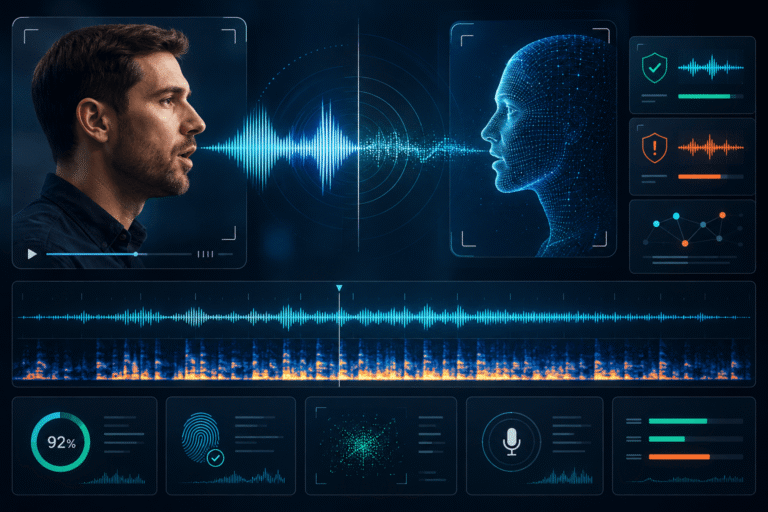
A voice deepfake is not just a voice that sounds artificial. Modern AI can clone a real person’s vocal identity, generate new speech in that voice, convert one speaker into another, or place synthetic audio over genuine video. In a short, compressed social clip, the result can sound completely natural.
That changes the verification problem. Listening for robotic rhythm, missing breaths, or strange pronunciation may still surface weak clues, but those signs are no longer reliable enough to identify a deepfake on their own. The stronger question is: does the audio’s identity, source, timing, environment, provenance, and technical evidence all support the same speaker?
What Is a Voice Deepfake?
A voice deepfake is synthetic or AI-altered speech designed to imitate a real person’s voice or create the impression that a specific person said words they did not actually say.
That includes several different technologies:
NIST distinguishes text-to-speech, speech-to-speech, and imitation-based synthetic audio because the detection problem changes with the generation method. Its current synthetic-content guidance also notes that real-world noise, multiple speakers, preprocessing, and previously unseen generators can reduce detector robustness.
For the visual side of identity manipulation, use the deepfake detection guide.
Voice Deepfake vs AI Voice: They Are Not the Same Thing
An AI voice is not automatically a deepfake.
| Audio type | What it means | Is it a voice deepfake? |
|---|---|---|
| Generic synthetic narrator | An AI-generated voice that does not impersonate a specific real person | Usually no |
| Creator clones their own voice | The person authorizes AI-generated speech in their own vocal identity | Technically synthetic, but not necessarily deceptive |
| Unauthorized clone of a public figure | AI speech imitates a real person without making the synthetic nature clear | Yes, in the ordinary deepfake sense |
| Dubbed or translated speech | Audio is replaced for accessibility or localization | Not necessarily |
| Cloned CEO voice requesting a transfer | AI impersonation is used to make an instruction appear authentic | Yes |
The important issue is not merely whether AI synthesized the waveform. It is whether the audio falsely represents identity, authorship, or intent.
Why Listening Tests Are No Longer Enough
The old advice for spotting fake speech was to listen for overly smooth pronunciation, unnatural pauses, missing breaths, strange emphasis, or a robotic tone.
Those can still be useful observations, but they have three major weaknesses.
High-quality synthesis can sound natural
Modern speech models can reproduce pacing, emotion, accent, hesitation, breath-like sounds, and expressive delivery well enough that short clips may not contain an obvious auditory defect.
Real audio can sound synthetic
Noise reduction, aggressive compression, podcast processing, auto-leveling, dubbing, voice repair, telephone codecs, and social-media transcoding can make genuine speech sound unusually clean or artificial.
Detection changes when the generator changes
Open-set detection is difficult because a detector may encounter synthesis methods it never saw during training. NIST’s recent synthetic-audio guidance highlights this problem, along with the effect of background noise and multiple speakers.
A large in-the-wild benchmark reinforces the same point. Deepfake-Eval-2024 collected 56.5 hours of audio from real online deepfakes and found that open-source audio detectors suffered about a 48% AUC decline compared with their performance on older academic benchmarks. See the Deepfake-Eval-2024 study.
The lesson is simple: auditory weirdness can start an investigation, but it should not finish one.
The Voice Evidence Stack
You do not always need all five layers. If the supposed speaker immediately denies the recording through an official channel and provides the authentic source, the case may already be resolved. If source evidence is missing, technical audio analysis becomes more important.
1. Verify the Source Before You Analyze the Voice
Start by asking where the clip actually came from.
- Is it from the person’s official account?
- Is there a complete interview, speech, meeting, or livestream?
- Does an official organization publish the same recording?
- Is the clip a forwarded voice message with no source history?
- Was the audio extracted from a longer video?
A short repost with no source is weak evidence, even if the voice sounds perfect.
If the clip is part of a larger video claim, the video verification workflow covers source tracing, date, location, and media integrity in more depth.
2. Compare the Voice With Genuine Reference Audio
If the clip claims to feature a known person, compare it with several authentic recordings rather than one favorite interview.
Listen for patterns that tend to remain relatively stable:
- accent and dialect
- pronunciation of names and recurring terms
- speech rate
- habitual fillers
- sentence endings
- vocal register
- how emotion changes pitch and intensity
But do not treat a mismatch as proof. People speak differently when tired, ill, emotional, reading a script, speaking another language, or using different microphones.
The purpose of reference audio is to identify questions worth investigating, not to perform forensic speaker identification by ear.
3. Ask Whether the Audio Belongs to the Scene
A convincing cloned voice can still fail to match the physical recording.
Distance and direction
If a person turns away, walks farther from the microphone, or moves behind another object, the recorded voice should usually change in ways consistent with the microphone and environment.
Room acoustics
Reverberation, echo, crowd noise, traffic, wind, and other background sound should belong to the same acoustic space as the voice.
Cuts and edits
Room tone can reveal inserted dialogue. If the words change but the surrounding ambience behaves unnaturally, investigate the edit.
Visible speech
Lip synchronization can add supporting evidence, especially for close-up video, but it is not a universal test. Dubbing, latency, editing, frame-rate conversion, and ordinary sync errors can also create mismatches.
If mouth movement itself may have been regenerated, see the AI lip sync guide.
How to Find a Specific AI Voice From a YouTube Video
This is a distinct search intent and it needs a precise answer.
You usually cannot identify the exact AI voice or model from sound alone. The realistic goal is to narrow down the provider or find evidence in the publication workflow.
Start with YouTube’s own disclosure
Open the expanded description and look for YouTube’s “How this content was made” information. YouTube requires disclosure when realistic media is meaningfully AI-generated or altered, including cases that make a real person appear to say something they did not say.
YouTube may also apply AI labels based on its own GenAI tools, C2PA metadata, or internal detection. See the YouTube content-origin disclosure guide.
An AI label can tell you that synthetic or altered content is involved. It normally does not identify the exact commercial voice model used.
Check the description, credits, and creator workflow
Creators often name the voice generator, voice ID, narrator, or production tool in the description, credits, pinned comment, project page, or linked workflow.
Use provider-specific detection when you have a plausible provider
If you suspect ElevenLabs, the company currently provides an ElevenLabs Audio Detector. It checks for an ElevenLabs watermark first and can fall back to its older AI Speech Classifier.
The limitation is critical: it is designed for ElevenLabs-origin audio, not every AI voice provider. ElevenLabs also states that its legacy classifier does not reliably classify Eleven v3 audio.
Do not call a “similar voice” an exact match
Some provider tools can return similar voices from a library. That is useful for narrowing candidates, but similar acoustic characteristics do not prove that an exact voice preset generated the clip.
ElevenLabs Watermarking Changed the Attribution Picture in 2026
Provider attribution is becoming more practical because some voice platforms now embed machine-detectable provenance.
ElevenLabs says its newer Audio Detector can detect audio watermarks embedded by ElevenLabs generation systems. The company notes that no ElevenLabs audio created before June 2026 carries this newer watermark and that rollout currently covers its Text to Speech generations for free users plus selected paid features.
This is important for interpretation:
- a detected provider watermark can be strong evidence of origin
- no watermark does not rule out older ElevenLabs audio
- no ElevenLabs watermark says nothing about other voice providers
- provider attribution is separate from proving which human voice was imitated
The same principle applies to other provenance systems: understand exactly what the checker supports before interpreting a negative result.
Can an AI Voice Detector Prove a Deepfake?
No single detector can prove every voice deepfake.
| Detector result | Reasonable interpretation | Do not conclude |
|---|---|---|
| Strong synthetic-audio signal | The audio deserves further investigation and may be AI-generated | The named speaker definitely did not say it |
| Provider watermark detected | The audio contains a supported provider-origin signal | The external claim or identity is automatically true or false |
| No synthetic signal detected | The detector did not find strong evidence under its current coverage | The audio is proven human |
| Two detectors disagree | Coverage, preprocessing, generator type, or audio quality may differ | Choose the result you prefer |
This is why detection systems should expose uncertainty and evidence coverage rather than turning every audio sample into a binary “real” or “fake” label.
The broader technical architecture behind multimodal and synthetic-media detection is explained in the AI video detection methods guide.
Voice Deepfakes in Scams: The Voice Is Only One Part of the Attack
Voice cloning is especially effective in scams because the attacker does not need perfect audio. They need enough familiarity and urgency to make the target act before verifying.
The FTC reported that people lost $3.5 billion to imposter scams in 2025, with imposter scams accounting for nearly one in three fraud reports that year. That figure includes many forms of impersonation, not only voice deepfakes, but it shows why identity verification matters when a message demands action.
Common voice-deepfake scenarios include:
For broader scam-video patterns, see the scam videos guide.
The Safest Response to an Urgent Cloned-Voice Message
The FTC’s consumer advice is deliberately simple: do not trust the voice itself. Contact the person through a phone number or channel you already know.
The FTC specifically warns that scammers can clone a relative’s voice from publicly available audio and use it in family-emergency schemes. Its voice cloning scam guidance recommends calling the supposed sender through a number you already know.
AI-Generated Voices in Robocalls: A U.S. Legal Note
In the United States, the FCC ruled in February 2024 that AI-generated voices in robocalls count as “artificial” voices under the Telephone Consumer Protection Act. That gives regulators and state attorneys general additional tools against illegal voice-cloning robocall schemes.
The ruling does not mean every synthetic voice is illegal. The legal issue depends on the call, consent, content, and other applicable rules. The FCC’s AI-generated robocall announcement explains the decision.
What to Check When a Public Figure’s Voice Sounds Fake
Public figures have abundant public speech samples, which makes them attractive targets for voice cloning. It also gives you useful reference material.
Use this order:
- Find the full source. Look for the complete speech, interview, stream, or official post.
- Search the exact quote. If a dramatic statement exists only in one repost, treat that as a warning.
- Compare known genuine recordings. Use several, not one.
- Check whether the visible video and audio belong together.
- Look for platform disclosure or provenance.
- Use technical analysis only as another layer.
If the manipulation is broader than the voice and involves identity fraud across face, speech, and accounts, the AI impersonation guide covers that larger threat model.
How DetectVideo AI Fits Into a Voice Deepfake Case
DetectVideo AI can add technical evidence when the suspected voice appears inside a video and the case also involves visual, temporal, audio-video, compression, metadata, source, or manipulation signals.
Use it to ask questions such as:
- Does the audio-video relationship support the visible speech?
- Are several manipulation indicators present in the same clip?
- Is the suspicious evidence localized around one segment or persistent?
- Could normal editing, dubbing, or compression explain the result?
- Does the technical finding agree with the source history?
Do not treat a video-level result as proof of a specific voice provider unless provider-specific provenance supports that conclusion.
For Creators and Brands: Protect Identity, Not Just Audio Files
Public audio can be copied, sampled, and imitated. The practical defense is to make authentic communication easier to verify.
Useful measures include:
- publish high-risk announcements on an official website or account first
- state clearly which channels are used for payments or sensitive requests
- never rely on voice alone as authentication for financial actions
- use multi-person approval for unusual transfers
- keep original recordings and production records for important public statements
- use provenance or watermarking when supported by the production workflow
This does more than teach followers to “listen for AI.” It gives them a reliable route back to an authenticated source.
What to Do If Your Voice Was Cloned
If synthetic audio is impersonating you or your organization:
- Preserve evidence. Save the original post, URL, account name, audio or video file, timestamps, and screenshots.
- Publish a correction through an official channel. State what is fake and where authentic information can be found.
- Report the content to the platform. Use impersonation, synthetic-media, fraud, or likeness reporting tools where available.
- Notify affected contacts. Especially if payments, credentials, or urgent instructions were involved.
- Contact financial institutions quickly if money moved.
On YouTube, altered or AI-generated content can also trigger likeness-related processes when a person’s face or voice is implicated, depending on the platform’s available tools and eligibility rules.
A Better Voice Deepfake Verdict
A responsible conclusion should describe what the evidence establishes.
| Verdict | Meaning |
|---|---|
| Verified genuine source | The speaker and recording are supported by strong original-source evidence |
| AI-generated voice, disclosed | Synthetic speech is present and transparently identified |
| Voice clone / impersonation supported | Source, provenance, provider, or technical evidence supports unauthorized identity imitation |
| Edited or dubbed, not necessarily deceptive | The audio differs from the original recording, but the purpose may be legitimate |
| Suspicious, unresolved | Evidence is incomplete or conflicting |
“Sounds fake” is not a forensic verdict. “No AI detected” is not proof of human origin. Precision matters.
Key Takeaway
Voice deepfake detection is now an identity and provenance problem as much as an audio-quality problem.
Start with the source. Compare the clip with genuine recordings. Test whether the audio belongs to the visible scene. Use YouTube disclosures, provider-specific detectors, watermarks, or other provenance when available. Then add technical synthetic-audio analysis without pretending one model can detect every generator.
If the clip asks you to take urgent action, the safest verification method is often the simplest one: contact the supposed speaker through a trusted channel that did not come from the suspicious message.
FAQ About Voice Deepfakes
What is a voice deepfake?
A voice deepfake is AI-generated or AI-altered speech that imitates a real person’s vocal identity or makes it appear that the person said words they did not actually say.
What is the difference between a deepfake voice and a normal AI voice?
A normal AI voice may be a generic synthetic narrator with no real-person impersonation. A voice deepfake usually involves identity imitation, false attribution, or synthetic speech presented as a specific real person.
How can I detect a voice deepfake?
Verify the source, compare the speech with genuine reference recordings, check audio-video consistency, inspect provenance or provider-specific signals, and use technical detection as an additional evidence layer. Listening for odd pronunciation alone is not enough.
Can a voice deepfake sound completely real?
Yes. High-quality synthetic speech can sound convincing, especially in short or compressed clips. That is why source and provenance evidence are often more reliable than intuition.
How do I find a specific AI voice from a YouTube video?
Check YouTube’s “How this content was made” disclosure, the video description and credits, creator comments, and any linked production workflow. If you suspect a specific provider, use that provider’s detection tool when available. Exact voice-preset attribution is usually not possible from sound alone.
Can ElevenLabs detect whether audio came from ElevenLabs?
Yes. ElevenLabs currently offers an Audio Detector that checks supported ElevenLabs watermark signals and can fall back to its older AI Speech Classifier. It does not function as a universal detector for every AI voice provider.
Does a YouTube AI label identify which voice model was used?
No. YouTube’s disclosure can indicate that content was meaningfully AI-generated or altered, but it does not normally identify the exact commercial voice model or preset.
Can lip-sync problems prove that the voice is fake?
No. Dubbing, editing, latency, frame-rate conversion, and ordinary sync errors can create mismatches. Repeated audio-video inconsistency can support suspicion but should be checked with source and technical evidence.
Can an AI voice detector prove who the speaker is?
No. Synthetic-audio detection and speaker identity are separate problems. A detector may identify synthetic characteristics without proving which real person was imitated.
What should I do if a family member calls asking for emergency money?
Do not rely on the voice. End the call and contact the person using a number or channel you already know. If you cannot reach them, verify the story through another trusted contact before sending money.
Can scammers clone a voice from public videos?
Yes. Public speech, podcasts, social videos, interviews, and voice messages can provide material that voice-cloning systems may use to imitate a person.
What should I do if my voice was cloned?
Preserve the evidence, publish a correction through an official channel, report the impersonation to the platform, warn affected contacts, and contact relevant financial or legal authorities quickly if fraud or financial loss is involved.
Can DetectVideo AI identify a specific voice provider?
DetectVideo AI can contribute technical evidence about manipulation in supported video, but provider attribution should come from provider-specific watermarks, provenance, project records, or other direct source evidence.