
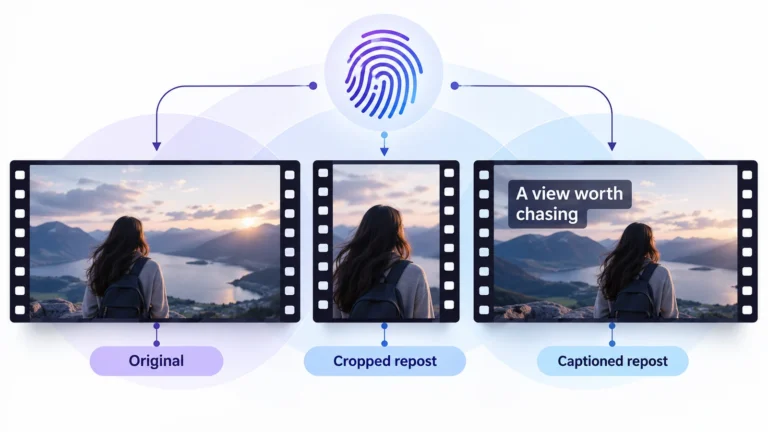
Video fingerprinting creates a compact representation of a clip so a system can compare it with reference videos. Depending on the method, a match may survive some changes to the file or presentation. The result is evidence of shared content, not automatic proof of the original uploader, recording date, copyright ownership or truth of a repost’s caption.
This guide explains the matching mechanism and how to read its output responsibly. You will separate exact file identity from content similarity, work through a conceptual sequence example and build a small match record. If you want the practical search workflow instead, the existing reverse video search guide covers finding candidate sources on the public web.
What a video fingerprint represents
A video is too rich to describe with one universal identity label. It can contain moving pictures, audio, captions and a history of file transformations. A fingerprint selects information that a particular matching method finds useful. It may summarize visual patterns, represent selected frames or preserve relationships between features across a sequence.
That selection creates a trade-off. A compact descriptor makes comparison manageable, but it does not carry every detail of the source. A method designed to tolerate a modest delivery change may ignore some information that another investigation needs. Ask which kind of similarity the system aims to recognize before interpreting its result.
The pHash design documentation includes a variable-length video hash based on selected frames and image descriptors. It is one concrete approach, not a definition of every modern system. Other methods use learned representations or different information, so avoid describing all video fingerprints as the same tiny number.
A useful metaphor is a searchable reference card rather than a certificate. The card may help find a related clip quickly, while you still need the clip and its source history to answer the larger question. Keep the fingerprint’s purpose visible in a report: matching content, detecting an exact copy and authenticating an event are separate tasks.
Exact file hashes and perceptual matches answer different questions
A cryptographic file hash is useful when you want to check whether the bytes of a saved copy match a recorded reference. Changing the encoded file can produce a different hash even if a viewer sees much of the same clip. That sensitivity is useful for integrity records; it is not a failure of the hash.
A perceptual representation is designed for a different relationship. It can attempt to recognize shared visual material despite certain differences between copies. How much difference it tolerates depends on the method and its settings. A near match therefore does not imply identical bytes, nor does it show that every region of the video is unchanged.
In NIST’s AI 100-4 report, section 3.1.2.1, exact and perceptual hashing are distinguished in the context of linking content with metadata. For your own record, name the comparison type explicitly. “The saved file matches this hash” and “this segment resembles a reference segment” are useful findings with different boundaries.
Do not discard the exact hash because a perceptual match exists. Preserve both if they serve your task. The first can identify the material you actually examined; the second can direct you toward related material. The existing video authentication guide explains preservation and integrity without turning them into a claim that the depicted event was truthful.
Matching can use frames, audio and sequence relationships
A visual matcher may compare features from selected frames. An audio matcher may find a recurring recording or sound segment. A sequence-oriented matcher can ask whether compatible features occur in a compatible order. These are related mechanisms, but a product may support only one of them or combine them in a particular way.
Matching soundtrack alone can produce a different finding from matching footage. Two unrelated videos may use the same music. A visual match with a replaced soundtrack may still identify reused footage. Separate the modalities so the reader knows what the system actually compared.
Sampling also matters. A whole-clip summary, a collection of frame descriptors and a time-localized comparison are not interchangeable outputs. A short reused segment may sit inside a much longer montage. A broad similarity score can suggest a relationship without identifying the exact interval where the shared material appears.
The original 2023 Video Similarity Dataset and Challenge paper distinguishes copy detection from temporal localization: finding a related video pair is different from locating shared segments within both videos. That distinction gives you two concrete questions to ask a system rather than accepting an unexplained “match” label.
The reference collection limits what can be found
A comparison needs something to compare against. If the relevant source never entered the reference collection, the system cannot retrieve it merely because your clip is recognizable to a person. Coverage may differ across providers, platforms, languages, access restrictions and available versions.
A fingerprint does not provide an unrestricted search of every video ever recorded. A private reference database, a platform’s registered materials and indexed public webpages are different collections. Ask which collection the result came from and whether you are seeing every match or only candidates above the service’s display rule.
Google’s official explanation of YouTube Content ID describes matching uploaded videos against reference materials supplied by eligible copyright owners. It illustrates a bounded reference system. It does not mean an ordinary viewer has access to that entire system or that every related public upload has been registered there.
A no-match report should name the searched collection when known. “No candidate was returned by this service” is more precise than “the clip is original.” The latter would require evidence about creation and distribution that an empty result cannot supply. If coverage is unknown, state that limitation rather than assuming it is comprehensive.
Crops, overlays and re-encoding change the comparison problem
Reposts can change framing, add text, alter the soundtrack or export footage through another encoder. A matching system may tolerate some of these changes within its evaluated conditions. Do not convert that possibility into a promise that any edit remains detectable.
A crop can leave useful scene detail while removing the most distinctive part of a reference frame. A large caption can cover important material. A small insert inside a complex montage may occupy only part of the available time. The useful question is what shared content remains accessible to the method, not whether the transformation belongs on a universal list of “safe” changes.
Compare the actual candidates before speculating about method failure. If the visible segment is short and generic, another scene may offer a stronger basis for matching. If a candidate corresponds to the same scene from another camera, it may depict the same event without being a copy of the same recording.
This guide does not provide recipes for defeating a matcher or bypassing rights enforcement. Its purpose is to interpret a received result and preserve meaningful evidence. When a tool does not identify a relationship you can demonstrate manually, record the versions and the mismatch. Do not silently change the query repeatedly until one score produces the answer you hoped for.
Read scores and thresholds as parts of a decision
A similarity score tells you how a method represents a comparison. Its scale may not be a probability that the uploader stole a video or that two files have the same creator. Read the documentation and the output labels before translating a score into ordinary language.
A threshold determines which candidates a system treats as matches or displays for review. A stricter rule can miss related material; a more permissive one can return unrelated candidates. What counts as acceptable depends on the task and the cost of different mistakes. There is no responsible universal cutoff to apply to every tool.
The VSC research cited above evaluates detection and localization under defined benchmark conditions with many unrelated reference candidates. Its results belong to that setting. They do not supply a ready-made accuracy claim for your platform, the entire internet or DetectVideo AI.
Ask for the evidence behind a match: the reference identifier, the relevant interval, the modality and any limitations. If those details are unavailable, describe the output as a candidate relationship rather than a fully verified content history. A strong report makes the result inspectable instead of hiding it behind a confident score.
An original sequence-matching example
The following sequence is an invented explanation, not a benchmark or an actual fingerprint output. Imagine a fictional clip with five distinctive moments: a blue door opens, a yellow object moves across a table, a lamp turns, a curtain moves and the door closes. Label these reference moments A, B, C, D and E for the exercise.
A repost contains an unrelated introduction, followed by the table, lamp and curtain moments, then an unrelated ending. Represent that simplified sequence as X, B, C, D, Y. The letters stand for visible events, not real hash values. You are looking for a shared ordered segment, not comparing the meaning of the letter labels.
The middle B–C–D sequence is a candidate relationship. Its position in the repost differs from its position in the longer reference. A useful output would identify the corresponding spans in both files so a reviewer can open and compare them. A whole-clip label alone would not show how much of the repost was shared.
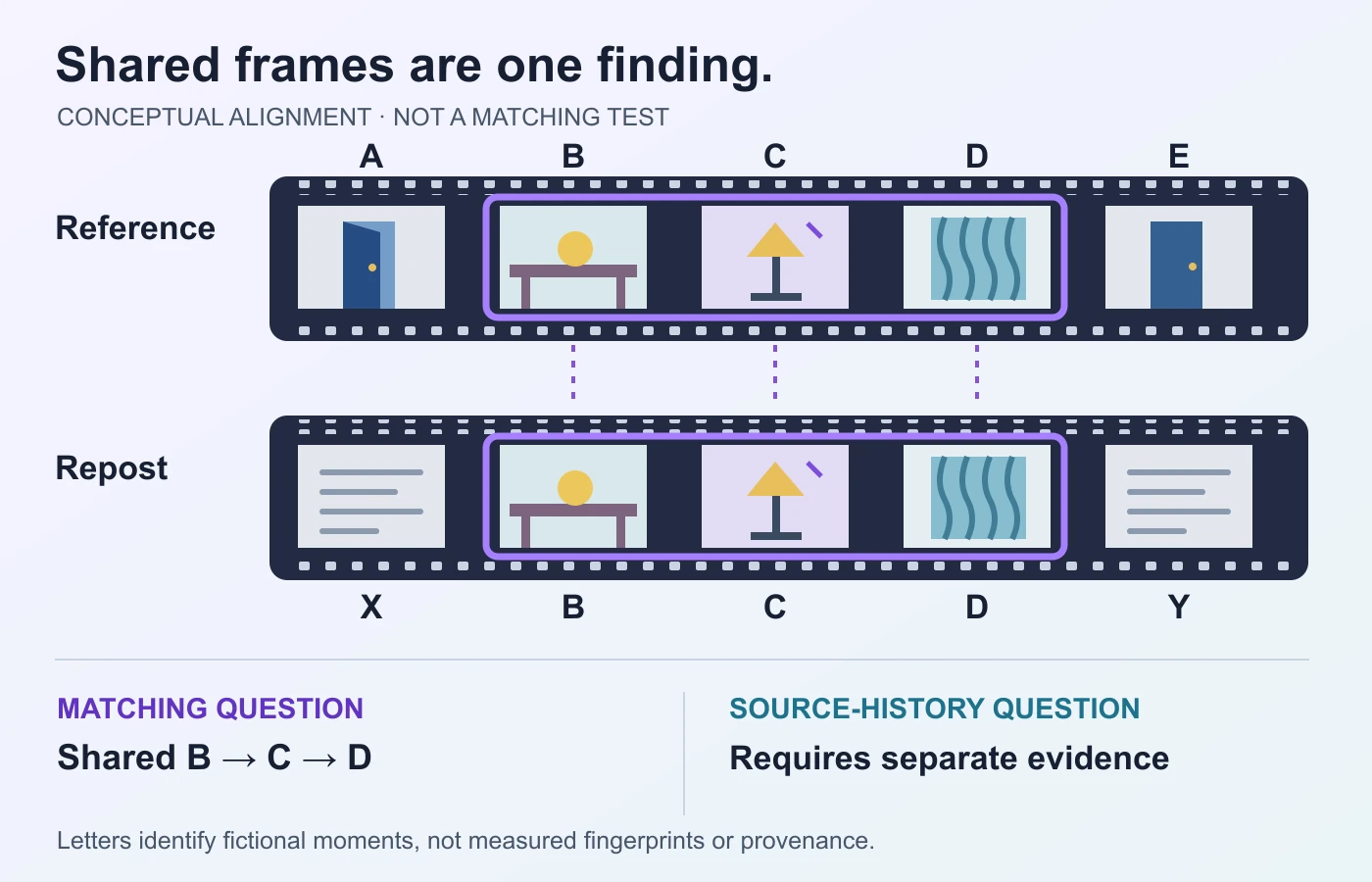
Now imagine that another video shows a similar lamp turning but has no matching table or curtain sequence. That resemblance could be a false candidate or a different recording of a similar action. The surrounding order gives you something additional to inspect. It does not mean three matching symbols would be sufficient in every real system.
Finally, suppose the reference page was posted before the repost. The matching segment plus that publication evidence can support a relationship between the versions. It still does not establish the original creator, the capture date or the truth of the repost’s new caption. Those questions require the next stage of verification.
Build a match record instead of a screenshot verdict
Save a compact record for each useful candidate. Identify the query copy, the reference copy and the service or method. Note whether you compared pictures, audio or both. Preserve the relevant time ranges and any uncertainty about how the system calculated them.
The table below is an original review worksheet. It separates the technical relationship from the claims people often attach to it. Fill it with actual evidence from your case; the fictional sequence is only a demonstration of the fields.
| Question | Evidence to record | Remaining limit |
|---|---|---|
| What content matches? | Relevant visual/audio material and corresponding intervals. | A score without inspection may remain a candidate. |
| Are the files identical? | A suitable exact file comparison or preserved hashes. | A perceptual match is not byte identity. |
| Which public copy appeared earlier? | Documented publication history. | Publication does not automatically establish capture time. |
| Who created the material? | Credible attribution and source records. | Hosting or reposting alone is not authorship. |
| Does the caption hold up? | Independent evidence about the depicted claim. | Reused footage can carry a new false story. |
Keep the original matching result alongside your human comparison. If you disagree with it, record why: wrong scene, incomplete segment, ambiguous timing or unavailable reference. A reviewable disagreement is more valuable than deleting inconvenient candidates or presenting a single accepted screenshot.
Move from content similarity to source verification
Once you have a plausible match, inspect the reference’s publisher and context. Does the page attribute the clip to another source? Is there a longer version? Is the footage labeled as an illustration or a creative production? Follow the source chain rather than treating the first returned reference as its endpoint.
Record the difference between a known earlier public copy and an established source. A credible publication may still be carrying licensed or contributed footage. A watermark can identify a distributor without identifying the camera operator. Keep the chain transparent rather than collapsing all roles into “the original.”
The existing video provenance guide explains those origin and processing questions in depth. Use it when the investigation moves from recognizing shared content to reconstructing history. A fingerprint can assist that process, but does not replace it.
For manual comparison, select meaningful frames or moments. The existing video frame extractor guide covers obtaining useful stills without confusing a frame with the whole clip. Preserve the context around a matched segment so a convenient crop does not hide an important change in meaning.
A match does not authenticate the whole video
A repost may contain a genuine matched segment and an unrelated fabricated introduction. It may replace speech, change order or attach a false caption. Finding shared material does not establish that every part of the new file is unchanged, that its audio belongs to the same event or that the narrative is accurate.
A matching reference can also be synthetic media. Content similarity identifies a relationship; it does not transform either copy into camera-original evidence. Ask separately whether the underlying clip is generated, altered or accurately represented.
Signed provenance, when available, answers another set of questions. The C2PA specification describes assertions associated with an asset, not a truth judgment about an external event. The existing Content Credentials guide helps interpret such records without confusing them with a similarity score.
Keep your final statements layered. “This segment matches this reference” is one finding. “The reference predates the repost” needs publication evidence. “The repost’s caption is wrong” needs claim evidence. A concise report can contain all three, but each should have its own basis.
Use a bounded comparison in your own authorized collection
If you are assessing a matching tool for a legitimate collection, start with materials you may use. Identify the practical task: duplicate management, clip discovery or source comparison. Make a small set of known relationships and unrelated examples, recording how that set was assembled.
A demonstration should distinguish a candidate it retrieves from a relationship you actually verify. Keep both successful and unsuccessful comparisons in the notes. If the tool finds a crop but misses a short insert, report those observed conditions rather than turning the example into a universal tolerance claim.
Check whether the system exposes matched intervals and whether a reviewer can inspect the source. A result that cannot be reviewed may be useful for internal triage, but its limits matter if someone plans to use it in an allegation or public correction. Do not infer evaluation quality from an impressive interface.
This is a proposed evaluation workflow, not an experiment reported by this article. No claim of measured accuracy or a completed product test is made. For a disputed real-world case, preserve the material and consult the relevant media or platform expert instead of treating a small demonstration as a certified method.
Finish with a precise finding and a useful next step
A good closing record names the shared material, reference and limitations. It might say that a particular sequence appears in an earlier publication, while authorship or capture date remains unresolved. That is more actionable than calling the whole file “original” or “stolen” from a score alone.
- Identify the exact query and reference copies.
- Record the matched modality and relevant spans.
- Separate similarity from exact byte identity.
- Check the reference publisher and source chain.
- Verify the caption or external claim independently.
- State coverage and method limitations when known.
If no result appears, decide whether another source-search route could add evidence. If a result appears but its reference is unavailable, retain it as a lead rather than a resolved case. Video fingerprinting is useful because it can connect versions that would be hard to compare manually; its value increases when the connection remains inspectable and its meaning stays precise.
Questions about video fingerprinting
Can fingerprinting find an edited repost?
Some methods can recognize shared content through particular transformations or locate a reused segment. Tolerance depends on the method, input and reference coverage. It is not a promise to find every edited copy.
Is a fingerprint the same as a file hash?
Not necessarily. An exact file hash checks bytes, while a perceptual representation supports a defined similarity task. Name the type before interpreting a match.
Does a match prove who uploaded the original?
No. It identifies a content relationship to the available reference. Authorship, publication chronology and source history need additional evidence.
Does no match mean a clip is new?
No. The relevant reference may be absent or the method may not recognize that version. Record the searched collection and limits where known.
Can matching prove that a clip is not AI-generated?
No. Both copies may contain the same synthetic material. Matching and authenticity analysis answer different questions.