
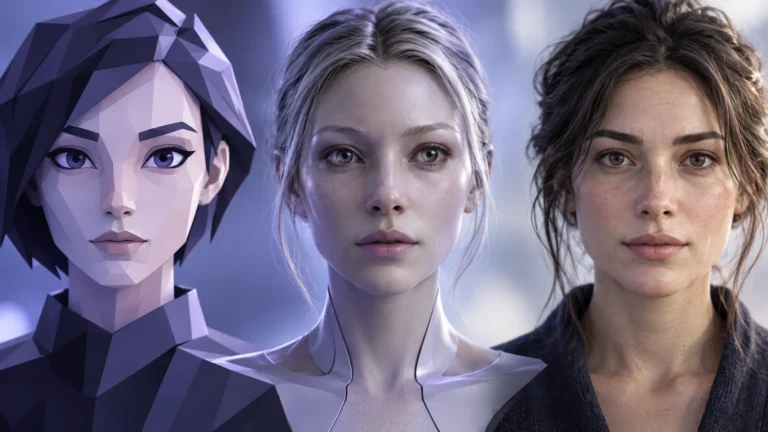
The uncanny valley is a hypothesis about why a nearly human artificial character can feel less comfortable to watch than an obviously stylized one. Small mismatches in appearance or behavior may stand out when realism creates human expectations. That reaction can help describe your viewing experience, but it cannot establish whether a person or video is AI-generated.
This guide helps you separate three questions that are often mixed together: what the hypothesis means, what specifically felt unusual in a face or performance, and what evidence would be needed to verify a clip. The practical contribution is a viewing worksheet that turns a vague reaction into a bounded observation. It is an editorial exercise, not a psychological test, detector benchmark, or diagnosis.
The meaning of uncanny valley
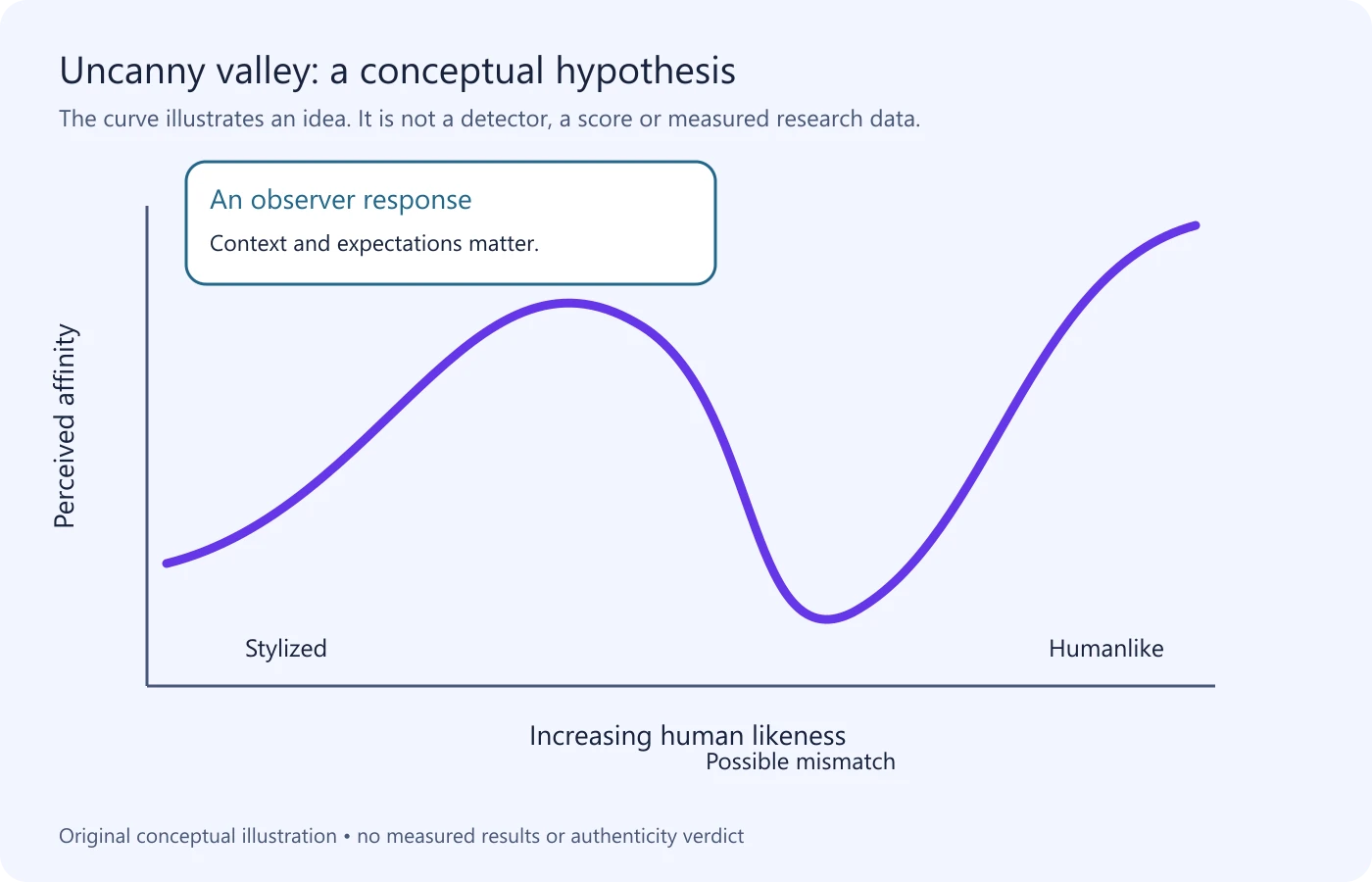
Roboticist Masahiro Mori introduced the idea in a 1970 essay. In the authorized English translation, he proposed that increasing human resemblance might initially increase a viewer’s affinity, then produce a drop as an artificial figure approaches lifelike appearance without fully matching it. He also considered movement important. These are the historical claims behind the familiar valley-shaped drawing; the essay did not supply a universal measurement scale for every face or viewer. Read Mori’s original essay in translation.
In ordinary language, uncanny means strangely familiar. A character may look close enough to a person that you expect an ordinary human performance, yet something about the eyes, mouth, skin, or timing does not fit. The word valley describes the proposed dip in a relationship between human likeness and the observer’s response. It does not describe a physical location, a specific software effect, or a percentage of AI involvement.
Imagine three fictional presenters. The first is a flat illustration with a deliberately simple mouth. The second is a polished digital person with realistic skin but an expression that does not seem to change during speech. The third is a coherent lifelike performance. You might find the middle version less comfortable than either alternative. That is an example of the idea, not evidence that every viewer would rank these presenters in the same order.
The concept is useful because it encourages a question more specific than “Why does this look bad?” Perhaps the intended visual style and the performance are not communicating the same level of realism. However, a single uncomfortable character does not demonstrate the entire curve. To establish a research relationship, investigators need defined stimuli, defined outcomes, and an appropriate comparison. Casual viewing does not provide those controls.
Human likeness is not one adjustable slider
A face can be realistic in one respect and simplified in another. Skin texture, geometry, lighting, expression, gaze, speech, body movement, and interaction with the scene are different properties. Increasing detail in a still image does not automatically improve the relationship among them. A character can have elaborate pores while its gestures remain stylized; another can use simple textures while conveying an internally consistent performance.
Cheetham, Suter, and Jäncke studied controlled transitions between avatar and human faces using behavioral tasks and functional MRI. Their findings concerned category perception and discrimination, including a boundary between avatar and human judgments. The researchers stressed that physical changes along a morph sequence need not correspond to an equally simple subjective human-likeness scale. This study should not be described as a ready-made deepfake test or proof that every near-realistic image produces discomfort. See the original study and its methods.
For your own reading of media, separate appearance from reaction. “The face looks photographic” describes a presentation property. “I feel uneasy” describes your response. “The clip was synthesized” describes production history. These statements can coexist, but one does not logically establish the next. Treating them as separate fields is more informative than giving a face a single authenticity rating.
The same separation helps creative review. If a designer wants a friendly animated guide, the relevant question is whether viewers understand and respond to that character as intended. If a journalist needs to verify a recorded statement, the relevant question is who recorded it and whether the performance was altered. Visual comfort can matter to the first task without answering the second.
Motion can change what a face communicates
Mori’s essay proposed that movement could alter the response to a humanlike figure. Applying that idea to contemporary video suggests a useful viewing distinction: inspect the relationship between the still appearance and the moving performance. A frame may look convincing on its own while the sequence feels less coherent. This is a way to organize observations, not a claim that a particular movement defect always indicates AI.
Consider a fictional animated presenter who smiles before the cheerful line begins and returns to a neutral face abruptly afterward. That pattern might be an artistic choice, imperfect animation, an edit, or another production effect. Your observation should identify the timing instead of assigning a cause immediately. “The smile ends abruptly after the sentence” is a statement another viewer can inspect. “The face has no soul” is neither precise nor testable.
Watch one sequence at normal speed before pausing. A frozen mouth or unusual blink can be a poor representative of the performance. Then choose a short interval with a clear beginning and end: a head turn, a greeting, a change of expression, or a hand crossing the face. Ask whether the feature that drew your attention persists across that interval, appears only at a cut, or disappears when normal playback resumes.
Do not use a fixed blinking rule. The frequency or timing of a person’s blinks is not an authenticity certificate, and an animated character can be designed to blink plausibly. If a movement genuinely needs investigation, connect it to a defined production question. The existing face-swap guide addresses identity continuity rather than whether a performance feels comfortable.
Where the hypothesis fits and where it does not
The uncanny valley belongs primarily to discussion of humanlike artificial figures and observers’ responses. It can offer vocabulary for reviewing robots, animated people, virtual presenters, and digital characters. It is less useful as a loose label for anything strange on the internet. A surreal landscape, an unexpected camera angle, or an unfamiliar accent may be unsettling for different reasons.
Before using the term, ask what is almost human about the subject and what creates the apparent mismatch. If neither can be described, “uncanny valley” may be functioning as a general expression of dislike. That is acceptable as personal criticism, but it should not be presented as a technical explanation. A stronger critique names the visual or temporal relationship that failed to work for the viewer.
Context also matters to the question being asked. In an openly fictional animation, realism may not be the goal. A stylized design can make exaggeration easy to understand, while a realistic design may encourage different expectations. In a disclosed demonstration of a robot, visible mechanical movement can be part of the point. The evaluation should match the purpose rather than punish every artificial figure for being artificial.
Research about a particular set of avatars or robots must also remain attached to its conditions. Do not convert a laboratory finding into a claim that all cultures, ages, viewing situations, or current generative models behave identically. The appropriate phrasing is that a study informs a defined aspect of perception. It does not certify a universal threshold at which realistic characters become disturbing.
Examples from animation and virtual people
The following examples are invented reading exercises. They illustrate different questions a reviewer could ask; they are not reports of measured audience reactions. Keeping them fictional avoids attributing a psychological effect to a real person or claiming a particular production system was tested.
| Presentation | Observation to record | What remains unknown |
|---|---|---|
| A cartoon guide with simple facial shapes | The expression is deliberately exaggerated and easy to read. | Whether greater realism would help its actual audience. |
| A lifelike digital presenter with very restrained expressions | The face remains nearly unchanged during an emotionally varied script. | Whether that is an artistic choice, a workflow limitation, or an intentional style. |
| A realistic face over a stylized moving body | The face and body communicate different kinds of movement. | Whether viewers find the combination appealing, unsettling, humorous, or neutral. |
In the first case, simplified detail is not a defect. It establishes a style. Adding photographic eyes while leaving the rest untouched could create a different impression, but a reviewer should evaluate the whole design rather than assuming that more texture is always better. The task is to identify the intended visual language and where the character supports it.
In the second case, the concern is a relationship between a realistic face and its expressive range. A still portrait cannot settle that question. Review a greeting, an ordinary explanatory sentence, and a change of emotional tone. Record exactly where the mismatch appears. If it occurs only in one edit, the next step may be to inspect that edit rather than reject the entire character.
In the third case, the combination might be intentional comedy. Without the creator’s stated purpose, you cannot assume that inconsistency represents failure. This is why labels and context matter. The synthetic-media overview separates a production category from deception: an artificial person can be transparently used in a legitimate creative work.
Why real people can also look unfamiliar on screen
A recorded person is not viewed directly. You see a representation shaped by the camera, lighting, processing, display, and distribution path. A strong beauty filter can smooth texture; unusual lighting can emphasize features differently; a low-quality copy can remove the detail you expect. A narrow crop or brief pause can also deprive you of the surrounding performance that would explain an expression.
These are reasons to examine the recording conditions, not reasons to judge the person. Avoid using physical appearance, disability, medical differences, age, or manner of expression as evidence that someone is artificial. A person need not match your expectations to be a real person. A media verification process should scrutinize the provenance and construction of the file rather than stigmatize its subject.
If something feels unfamiliar, first describe the recorded property: soft texture, an abrupt transition, an unusual color treatment, or limited facial movement in the chosen segment. Then list possible explanations that do not require fabrication. If you cannot distinguish those explanations with the available copy, leave the cause unresolved. The absence of a satisfying explanation is not positive evidence for one particular alternative.
Comparison material should be relevant. A professionally lit studio interview and a dim webcam feed differ in many ways before any manipulation is considered. Compare similar angles and conditions when possible, and preserve the reason for choosing each reference. An unrelated flattering photograph is not a reliable baseline for how a person must look in every video.
Why perception is not verification
A feeling is real as a feeling, but it is not a record of how an image was made. A convincing artificial performance can avoid obvious discomfort. A genuine recording can create it. Neither the pleasantness nor the eeriness of a face establishes camera origin, identity, consent, or the truth of a statement.
NIST’s synthetic-content report treats provenance, automated detection, and human-assisted review as distinct approaches that may be combined. It discusses limitations in human judgments and variation across methods and contexts. The practical implication is to avoid treating a viewer’s response as a universal authenticity filter. The report also distinguishes tracing content history from inspecting its content for synthetic signals. Read NIST AI 100-4, particularly section 3.2.
For verification, write the claim first. Is the video said to show a particular person making a particular statement? Is it advertised as an unedited interview? Is the creator openly presenting a virtual character? Those are different tasks. The first might require an original recording and identity comparison; the second requires sequence and source review; the third may already be answered by transparent disclosure.
Do not collect a long list of impressions and call the result proof. A dozen descriptions of the same soft facial texture are still one kind of observation. Seek evidence with a different origin: an earlier version, a creator disclosure, a trustworthy production record, or a documented technical result. The existing deepfake examples guide explains manipulation categories without claiming that every synthetic clip looks the same.
A viewing worksheet for a suspicious clip
Use this worksheet when you notice an uncomfortable performance and want to decide whether further checking is justified. It deliberately keeps emotional response, visible observation, and authenticity evidence in separate fields. Copy the fields into your own notes; do not interpret the worksheet as a scoring system.
- Describe the claim. Write one sentence about what the uploader wants you to believe. Include the identity, statement, event, or production claim that actually matters.
- Record the first reaction. Note whether the clip felt unfamiliar, neutral, convincing, or otherwise memorable. Keep this as a response, without adding “therefore fake.”
- Locate the observation. Identify a timestamp and a specific visual or temporal property. Avoid claims about a person’s character or biology.
- List alternatives. Consider capture, lighting, compression, editing, animation, and synthesis where relevant. Do not treat all alternatives as equally likely without evidence.
- Choose a distinguishing check. Find a longer version, compare a less processed copy, read a disclosure, or inspect the relevant sequence at ordinary speed.
- Write the bounded result. State what changed after that check and what remains unknown. “Unusual expression at a cut, cause unresolved” is a valid result.
Here is a worked example using an invented clip. A public post claims that a familiar executive delivered an urgent investment message. Your first reaction is discomfort because the presenter barely changes expression. That impression is not enough to establish synthesis. The important claim concerns an endorsement and a transaction, so the first distinguishing check is an independently located official source, not a close-up of the eyes.
Suppose the claimed official recording cannot be found. That leaves the endorsement unverified; it does not yet prove that the face was generated. You can preserve the public URL and the exact claim, seek confirmation through a trusted channel, and compare any available original footage. If a stronger source later shows that the same performance said different words, the source comparison becomes evidence. The original feeling merely told you where to begin.
A second invented case shows the opposite outcome. A studio openly publishes a virtual presenter as part of a design demonstration. Its expression feels slightly mismatched to you, but its artificial origin is already disclosed. There is no need to turn the viewing exercise into an exposure story. You can discuss the design’s coherence while keeping questions of production transparency separate from aesthetic preference.
For unresolved video construction, a technical review can add another layer. Use the strongest authorized copy, read which evidence groups were available, and retain alternative explanations. The video verification workflow covers broader source and contextual checks. Neither a worksheet nor a detector can independently settle every claim attached to footage.
When sharing your notes with another reviewer, include the source URL, selected timestamp, and exact version you watched. Ask them to describe the same interval before revealing your preferred explanation. Agreement about an observable transition is more useful than agreement that the face simply feels strange. If the reviewers disagree, retain both descriptions and inspect the source again.
Feeling uncertain about a clip?
Check the video for additional signals instead of relying only on how a face feels. Use the origin assessment alongside source and contextual evidence.
Questions about uncanny valley and AI faces
Does uncanny valley mean a face is generated?
No. It describes a possible perceptual response to a humanlike artificial figure. A viewer’s reaction cannot establish the production history of an unknown recording.
Can a stylized character avoid the problem?
A coherent stylized design can set different expectations, but no style guarantees the same response from every viewer. Evaluate the character against its intended purpose and audience.
Why can a still face look better than its video?
The sequence adds movement, timing, and expression relationships that a still image does not show. Identify those relationships rather than declaring that motion alone proves synthesis.
Is the familiar valley curve measured data?
The original curve illustrates a hypothesis. A conceptual diagram should be labeled accordingly; it is not a universal chart of current AI systems or all human responses.
Should I call a real person uncanny?
Discuss the recording conditions or a specific media observation instead. Appearance and mannerisms are not proof of artificial identity, and a verification process should avoid stigmatizing the subject.
Sources used
- Masahiro Mori, The Uncanny Valley, authorized English translation published by IEEE Spectrum. Historical hypothesis, not a detector validation.
- Marcus Cheetham, Pascal Suter, and Lutz Jäncke, The Human Likeness Dimension of the “Uncanny Valley Hypothesis”, Frontiers in Human Neuroscience, 2011. Controlled category-perception and neuroimaging study.
- NIST, Reducing Risks Posed by Synthetic Content, AI 100-4, 2024. Complementary transparency and detection methods and their limits.