
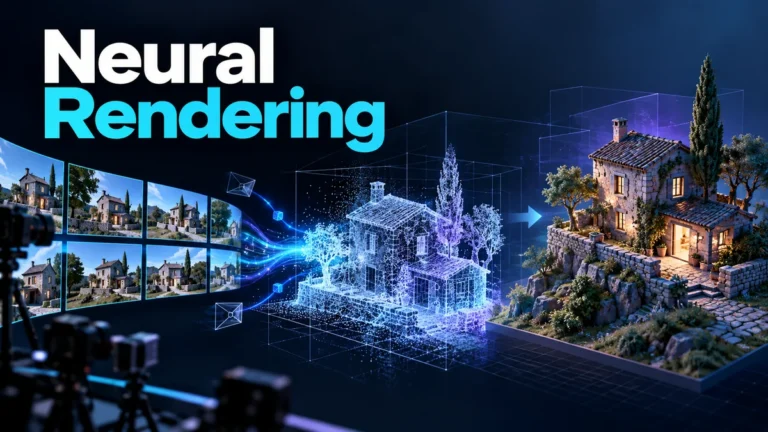
Neural rendering uses learned components within an image-generation or graphics workflow to produce a view of a scene. In scene-reconstruction applications, captured images help fit a representation that can then be rendered from a different viewpoint. That new view may look photographic without being a recording made by a physical camera at that position. Treat capture, representation and rendered output as different evidence objects.
This guide explains that distinction through radiance-field examples and an original, hypothetical scene-review worksheet. It is not a ranking of rendering tools or a tutorial for creating misleading evidence. The aim is to understand what an output derives from, what its viewpoint represents and which observations remain unavailable even when the image looks convincing.
Separate capture, representation and rendering
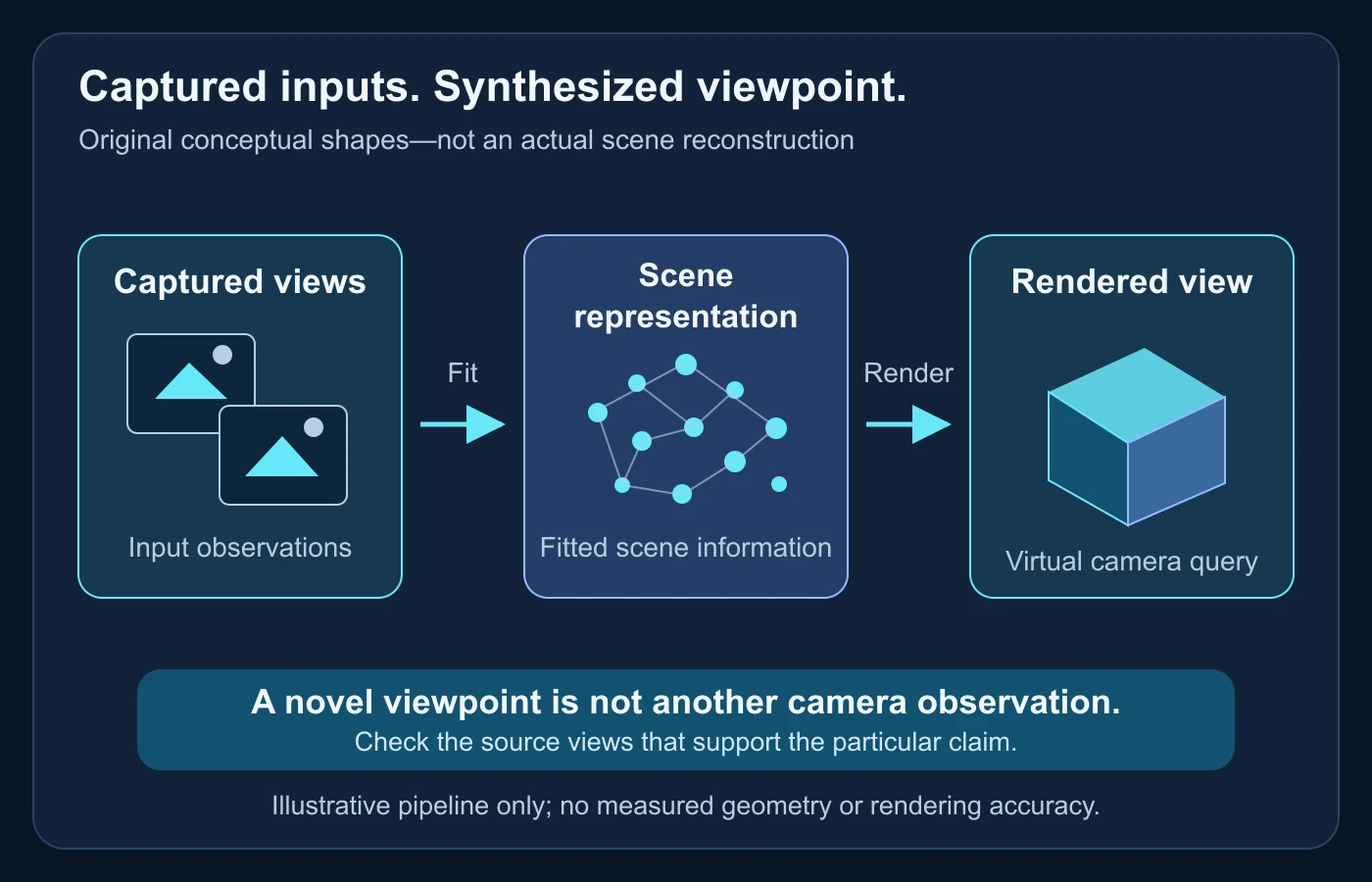
A captured image is an observation from a recording workflow. A scene representation is a model used to describe relevant aspects of a scene. Rendering produces an image from that representation and selected viewing parameters. The three stages can be connected without becoming interchangeable.
The primary State of the Art on Neural Rendering report discusses approaches that combine graphics knowledge with learned components and controllable image synthesis. Neural rendering is therefore a family of methods, not one algorithm that every product implements. Which part is learned and what can be controlled depend on the actual method.
Ordinary graphics can render a manually constructed scene. A learned reconstruction can instead fit information from available images into a representation. Other neural-rendering workflows can modify appearance or use different inputs. Do not assume that every use of the term means one particular network, data source or production history.
For evidence review, give each object its own identity. Preserve the captured inputs separately from the fitted scene and the exported fly-through. If the rendered video is later cropped, captioned or re-encoded, identify that derivative too. A filename such as “original tour” is not enough to tell which stage you received.
Ask which question the output can support. A visualization may help someone understand a spatial arrangement without proving what a camera saw at a particular time. A reconstruction can be useful while its uncertain regions remain unsuitable for a factual claim about a hidden detail.
A novel viewpoint is a query, not a new observation
A viewpoint describes where and how the scene is viewed. In a rendered result, the selected viewpoint can belong to a virtual camera rather than a device that physically recorded there. “Novel view” means a new view produced from the representation; it does not mean that a new real-world observation was acquired.
This distinction matters when a rendered camera appears to move smoothly through a room. The motion may be a chosen virtual path. Its apparent continuity does not establish that an operator walked through the room along that route, at that speed or on the date described by a caption.
Keep viewpoint and time separate as well. Changing a viewing position for a static-scene representation is not the same operation as reconstructing a moving event across time. A convincing orbit around an object cannot automatically establish what happened before or after the captured inputs.
Ask whether the claimed viewpoint was actually recorded, synthesized between observed positions or requested beyond the available capture coverage. That description is more informative than calling the entire output “real” or “fake.” It identifies the relationship between the result and the material that supports it.
The explanatory diagram below uses an invented scene pipeline. The pictures and points are original illustrative shapes, not actual training images, a scanned property or a renderer’s measured output. It shows where a synthesized view belongs in the workflow.
Radiance fields and splats illustrate different representations
The original NeRF example
The original NeRF paper represents a static scene through a continuous function of spatial location and viewing direction. Its model supplies density and view-dependent color; volume-rendering operations combine queried information along camera rays into an image. The reported method fits the representation using input images with known camera poses.
That description explains a mechanism, not a claim that every NeRF system has identical requirements or behavior. Later methods can alter representations, inputs and training procedures. Do not attribute the original paper’s architecture or performance to an unnamed contemporary service merely because it uses the word NeRF.
Most importantly for review, the model and rendered view are not additional camera measurements. Keep the input photographs and their recording context available. If an output is offered as evidence, the relationship to those inputs matters more than recognizing a technical acronym.
The original 3D Gaussian Splatting example
The primary 3D Gaussian Splatting paper uses an explicit set of optimized three-dimensional Gaussians to represent a scene and a visibility-aware splatting renderer to produce views. Its described static-scene input includes images and calibrated cameras, with sparse points from the calibration process used for initialization.
This is not simply the original NeRF network under another name. A learned or optimized radiance-field representation can be paired with a different rendering mechanism. Distinguish representation, fitting and rendering rather than assuming that every realistic reconstruction is a diffusion-generated video.
The original papers contain evaluations under specified conditions. This guide does not reproduce their benchmark rankings, frame rates or quality measurements as promises for your scene. A research result and a tool’s performance on an untested input are different claims.
Missing views remain an evidence limitation
A visible output can conceal the distinction between observed and weakly supported parts of a scene. Before inspecting realism, establish which input viewpoints exist and which areas they actually show. A large collection of near-identical views is not automatically broad coverage of every surface.
The original Gaussian Splatting paper documents artifacts in poorly observed regions and views with little overlap with training views. It also describes appearance-related artifacts in its implementation. These limitations concern that method and evaluation; they are not a universal visual signature that identifies every reconstructed scene.
For a practical review, mark the relevant region and ask whether it appears in the input material. If it is hidden behind an object in every available photograph, a clean-looking rendered detail does not become a direct observation. Do not reward visual plausibility by silently removing the coverage limitation.
Conversely, a rendering artifact does not tell you the creator’s intent. It may reflect imperfect reconstruction, input limitations or the method’s behavior. Describe the visible discrepancy and seek supporting inputs rather than declaring that a particular algorithm or deceptive actor has been identified.
Uncertainty can differ across the scene. A well-observed wall and an obscured corner should not inherit the same confidence just because they appear in one polished video. Keep the important claim attached to its actual supporting views, not to the output’s overall production quality.
Camera poses and appearance need context
A camera pose describes a viewing position and orientation relative to the scene model. It is not a claim about the observer’s identity or authority. When the method uses calibrated views, retain the relationship between each input and its viewing information rather than keeping only a final model file.
Appearance can also depend on viewing direction. A shiny surface seen from one side may look different from another side. The original NeRF method explicitly includes view-dependent color. That does not mean its representation independently separates every material, light source and reflection into a complete physical explanation.
When a result is used to make a factual claim, distinguish the observable surface from its interpretation. A bright patch might be a visible appearance feature without proving a lamp’s position. A reflected object might need supporting views before it can identify something elsewhere in the room.
Do not infer metric accuracy from a smooth fly-through. If an application requires reliable dimensions or positions, ask what calibration, validation and uncertainty information supports them. This educational guide supplies no surveying tolerance and makes no claim that an attractive reconstruction is a qualified measurement.
The method’s name is not enough to answer those questions. Ask for the actual input and processing description appropriate to the use case. Where it is unavailable, record the limitation rather than filling it with a generic account of how a different paper’s method works.
An original captured-versus-rendered worksheet
Use this worksheet to review a reconstructed view offered in a presentation, property tour or explanatory video. It is not a certification standard. Its role is to separate the source material from the output and identify the next evidence that would support a particular claim.
| Stage | What to record | What not to assume |
|---|---|---|
| Captured input | Attributable image/video source, relevant date and viewpoints | Every hidden surface was observed. |
| Representation | Method, input relationship and known processing | A model is an untouched camera file. |
| View query | Virtual viewpoint or path and whether it was recorded | A smooth camera move happened physically. |
| Rendered output | Version, visible region and disclosed reconstruction | Realistic appearance verifies geometry or chronology. |
| Claim | Specific fact the output is used to support | The entire scene inherits one truth label. |
| Next evidence | Relevant original view or independent confirmation | A cleaner render replaces missing evidence. |
Choose the relevant input comparison
If the claim concerns a shelf, ask for inputs showing that shelf rather than a general overview of the building. Identify whether the same surface and time period are represented. A different room, an earlier renovation or a similarly shaped object is not necessarily the right reference.
Retain the context around the chosen detail. A tight crop can make two surfaces look similar while removing the information needed to locate them. Keep a wider view alongside any close comparison so another reviewer can understand where the observation belongs.
Describe provenance without overclaiming
The existing video provenance guide explains wider source and version history. For this task, a concise record should identify which captured inputs informed which representation and which rendered export was shared. Do not confuse an upload date with the date the scene was recorded.
If a creator can provide only the output, that is a real evidence limit. It does not automatically establish fraud, but it may prevent you from checking whether a relevant part of the reconstruction follows the source. Say which relationship you could not inspect.
Prepare a small view-coverage note
For a hypothetical comparison, label two supplied photographs C1 and C2 and the requested rendered view Q. These are chosen record labels, not an experimental dataset. Beside each label, identify the important surface that is actually visible. Keep “visible in C1,” “visible in C2” and “visible only in Q” as separate descriptions until supporting capture material establishes another relationship.
If Q reveals a detail absent from both photographs, the record should ask whether other inputs were used. It should not assume that the publisher supplied the complete source set, nor assume that the detail was captured merely because the rendered viewpoint appears close to C2. Record the response and retain the original labels so a later reviewer can follow the comparison.
This is not a confidence heat map or a geometric accuracy measurement. It is a coverage note for one claim. You can use the same simple approach when reviewing a short virtual-camera path: identify which relevant region appears, what source supports it and where the observation remains unavailable.
A hypothetical display-case reconstruction
Imagine a fictional gallery display case photographed from the front and both sides. The rear of an object remains obscured in the available inputs. A reconstruction produces a smooth virtual camera path that appears to reveal the back. This is an invented review scenario, not a demonstration run with a rendering system.
First identify what was observed
Your initial record lists the front and side inputs and the obscured rear region. You do not assume that the smooth final video contains another photograph taken behind the case. The next question is whether additional inputs support the apparently revealed area.
Suppose the publisher’s caption says the animation explains the object’s layout. That is different from claiming that the back surface was documented in a camera recording. Clear labeling can let a reconstruction serve an educational purpose while leaving the unobserved region appropriately uncertain.
Then test the specific claim
Now suppose the output is presented as proof of a marking on the back. Ask for an attributable captured view of the marking or another appropriate independent source. The animation’s realism cannot substitute for that observation. If no supporting material is available, record the marking claim as unresolved.
If a later input photograph becomes available, compare the relevant surface, orientation and recording context. A disagreement should be documented rather than explained away because the reconstruction looked convincing. Agreement can support the particular detail while still leaving the rest of the rendered path synthetic.
Report a limited conclusion
A useful note might say: “The front and side views support the visible arrangement; the rear detail in the rendered export was not confirmed from the supplied inputs.” That statement helps another reviewer request the missing evidence. It does not label the entire creator, scene or method deceptive.
Keep the illustration and review note apart from actual case evidence. A conceptual cube or invented gallery example should never be passed off as a reconstruction of somebody’s premises. Labeling the example is part of making its educational reasoning reproducible.
Creative reconstruction is not inherently deceptive
Reconstructed scenes can help explain spaces, present creative work or make viewpoints easier to explore. Their value does not require pretending every rendered position was occupied by a physical camera. A clear description of the source and processing can make the result more understandable.
Use disclosure that addresses the meaningful distinction: captured input images were used to construct a scene representation, and the displayed path or new viewpoint was rendered. Avoid vague labels that leave viewers unsure which parts were observed and which were synthesized.
Keep a separate untouched source collection when you are entitled to preserve it. Do not overwrite it with a polished export or convert a reconstruction into the only remaining record. If private spaces or sensitive material are involved, limit access and do not publish extra viewpoints merely because the tool can generate them.
The accuracy required depends on the claim and use. An artistic navigation experience and a factual account of a hidden object are not the same task. If the result will inform a consequential decision, appropriate independent verification is more important than a visually seamless presentation.
A creator’s disclosure also does not validate every surrounding statement. A clearly labeled reconstruction can still carry an incorrect date or description. Evaluate those claims through source and context rather than treating technical transparency as a universal truth certificate.
Media analysis and reconstruction history are separate layers
The existing AI-generated video guide covers the broader production categories. Neural scene reconstruction is a more specific mechanism discussion. Do not use this article to classify every generated landscape or to assume that every synthetic video contains a recoverable three-dimensional scene.
The AI video detection methods guide explains technical evidence families and their limits. A detector result does not, by itself, identify the exact rendering algorithm, recover missing training views or confirm an object’s physical dimensions. The reconstruction’s source record remains a separate question.
If an output looks unusual, describe where and how the appearance changes across the sequence. Compare the strongest available source before assigning a cause. Camera behavior, encoding, editing and rendering can interact; one isolated artifact should not become a claimed signature of a named research method.
If the output looks flawless, keep the same source questions. Absence of an obvious artifact does not convert a virtual viewpoint into a captured one. The clearest conclusion identifies what was recorded, what was reconstructed and what remains unknown about the scene or claim.
Before relying on a reconstructed view
- Identify captured inputs separately from model and rendered export.
- State whether the viewpoint or path was physically recorded.
- Check coverage of the particular region used to support a claim.
- Retain method and processing context without inventing an implementation.
- Separate appearance quality from independently validated geometry.
- Preserve original source material and disclose synthesized views.
- Seek additional observation for important hidden or uncertain details.
- Report a bounded finding rather than an all-purpose real/fake label.
Neural rendering can create a useful way to explore scene information. Its responsible interpretation starts with a simple distinction: a synthesized view is an output derived through a representation, not another camera observation. Keep that boundary visible even when the result looks photographic.
A realistic view can be reconstructed.
Check the video and ask where the original recording came from.
Questions about reconstructed views
Is neural rendering one specific algorithm?
No. It describes a family of approaches using learned components in rendering or image synthesis. Check the actual method and inputs before describing a particular system.
Does a novel view count as original footage?
A synthesized view is not automatically a camera recording from that position. Keep the input observations and rendered output separately identified.
Are NeRFs and Gaussian splats identical?
No. The original methods use different representations and rendering procedures. Their relationship to radiance-field reconstruction does not make their implementations interchangeable.
Does an artifact prove somebody was deceptive?
No. Describe the discrepancy and review the supporting inputs. Reconstruction limitations, processing and other causes need to be considered separately from intent.
Can a detector recover missing viewpoints?
Do not assume that technical video analysis supplies missing capture evidence, exact geometry or the renderer’s input history. Those need appropriate source material and independent support.
Primary research used
- Tewari and colleagues: State of the Art on Neural Rendering — authored 2020 survey, definition and graphics/learning relationship.
- Mildenhall and colleagues: NeRF — original 2020 scene representation and volume-rendering method.
- Kerbl and colleagues: 3D Gaussian Splatting — original 2023 method and stated limitations.