
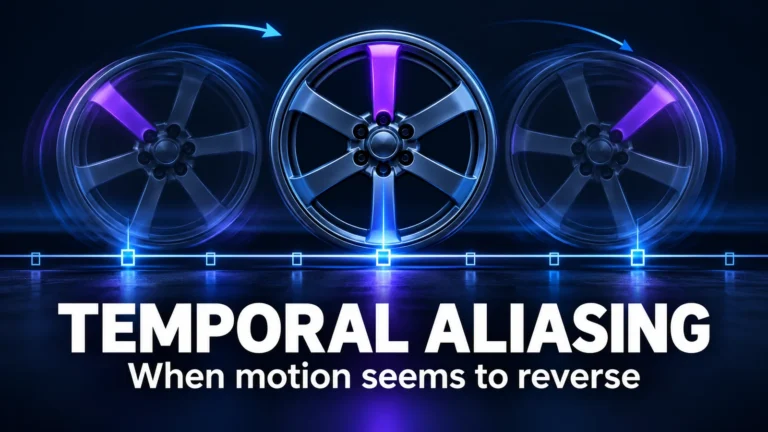
Temporal aliasing happens when a changing scene is sampled in time so that different real motions can produce the same recorded sequence. A wheel may appear to stop or turn backward even while it keeps rotating forward. The camera supplies separated observations; the viewer sees a plausible motion connecting them, but that apparent connection may not be the motion that occurred.
The familiar wagon-wheel effect is one example. It is not limited to old films, and it is not evidence by itself that a modern clip is generated. To understand it, separate how often frames are captured from how long each frame is exposed, then ask what happened between the recorded moments.
What the camera does not show between frames
A video is not an uninterrupted record of every intermediate position. Each frame contains information gathered during an exposure, and frames arrive at particular times. Motion between those observations can be ambiguous, especially when an object repeats its appearance as it moves. A wheel returning to a similar orientation is a particularly effective example.
Imagine a clock with one clearly marked hand. If you inspect it infrequently, a small backward step and a large forward turn can leave the hand at the same next position. Knowing that it is a normal clock helps you choose the expected explanation. The sampled positions alone do not supply that prior knowledge.
UC Davis’s lesson on the wagon-wheel effect uses a clock to demonstrate this ambiguity. Its central warning is about inferring a continuous process from insufficient discrete observations. The practical implication is not that video has no value, but that apparent direction and true rotation should not be assumed identical.
The broader mathematical framework is described in Foundations of Computer Vision’s sampling chapter. Sampling can make different underlying signals indistinguishable in the samples. Reconstruction therefore needs conditions and assumptions; merely playing the samples smoothly does not restore missing knowledge.
A complete calculation with one marked rotor
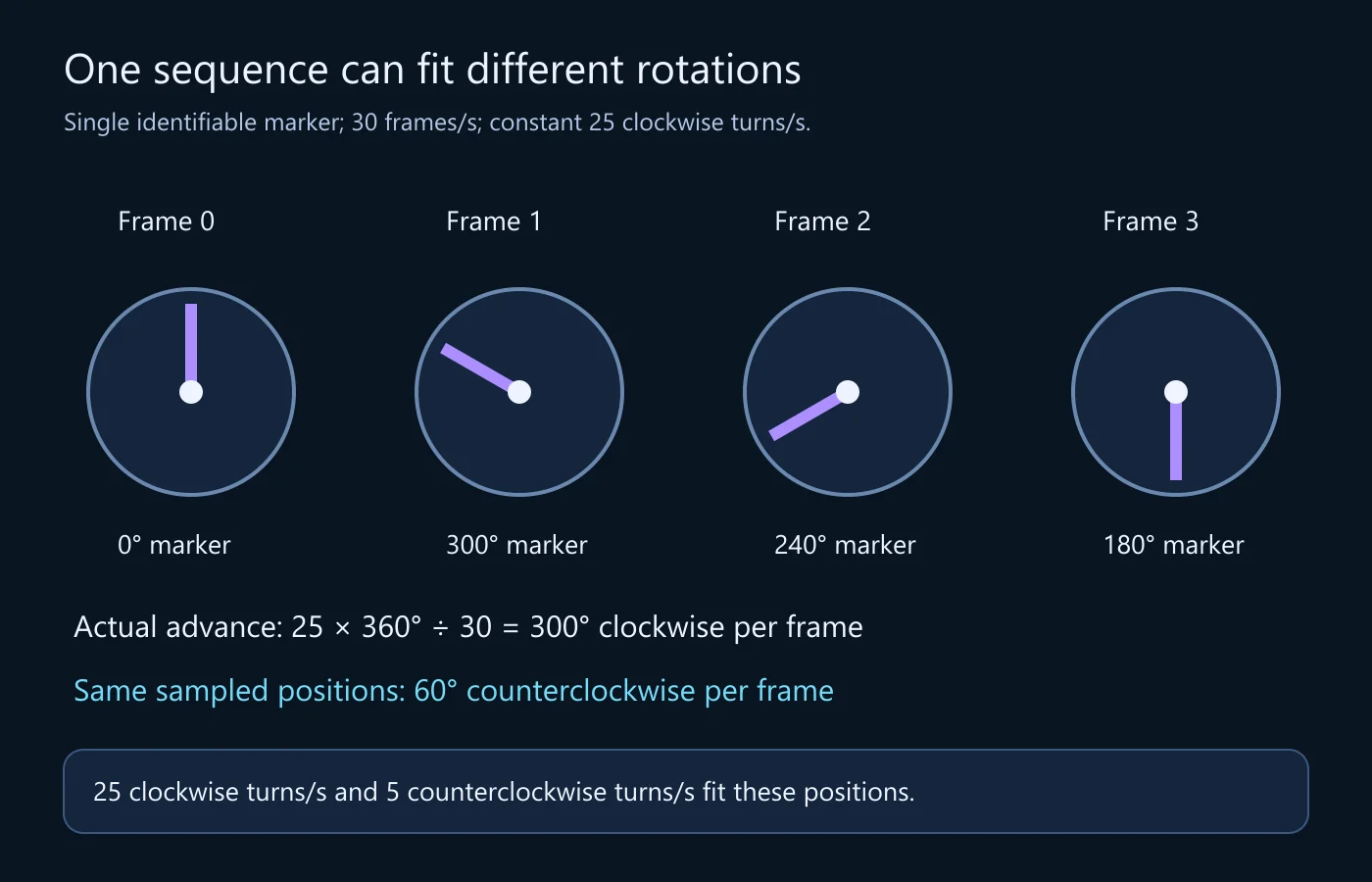
Use a simple invented setup so every assumption is visible. A rotor turns clockwise at a constant 25 revolutions per second. One unique marker makes its orientation identifiable. A camera records 30 evenly spaced frames per second. Assume short exposures, no dropped frames and a view in which the marker remains visible.
The rotor advances 25/30 of a revolution between frame starts. Multiply by 360 degrees and the advance is 300 degrees clockwise per frame. The first four marker orientations, starting at zero, are 0, 300, 240 and 180 degrees when reduced to the usual 0–360-degree range.
Those same positions can be connected by steps of 60 degrees counterclockwise. Six such steps make a reverse revolution, and 30 steps occur per second. A viewer following the shorter step can therefore see an apparent rotation of five revolutions per second backward, even though the assumed rotor turns 25 revolutions per second forward.
This is arithmetic under stated conditions, not a measurement of a fan or engine. It shows why the visible sequence does not uniquely determine speed. A rotor turning five revolutions per second backward, or 55 clockwise, could occupy the same marked positions at those sampling instants. Their behavior during each exposure could still differ.
Check the calculation in both directions
At 25 clockwise turns per second, the marker completes most of a turn between samples: five-sixths of 360 degrees. At five counterclockwise turns per second, it completes one-sixth of a turn in the other direction. Both land at the same next orientation. The missing complete turn is why interpreting only the shortest connection gives the wrong physical direction in the first setup.
In frequency notation, adding or subtracting whole multiples of the sampling frequency can preserve the sample phases of a simple periodic signal. In this example, 25 − 30 = −5, and 55 − 60 = −5. This compact expression explains the equivalence; it is not permission to calculate a machine’s true rotation from a repost’s apparent speed.
To recover the true rate, you would need additional information that distinguishes those alternatives: an independently established speed range, suitable higher-rate capture, a reliable reference measurement or another constraint. Without it, reporting a single speed gives the ambiguity a false precision.
What changes if the same marked rotor is sampled faster?
Keep the assumed speed at 25 clockwise turns per second and change only the sampling rate. At 60 frames per second, the between-frame advance is 25 times 360 divided by 60, or 150 degrees clockwise. At 120 frames per second, it is 75 degrees clockwise. In this simplified single-marker example, the shorter connection now follows the assumed direction instead of reversing it.
| Recorded frames per second | Clockwise advance between samples | Shorter apparent step |
|---|---|---|
| 30 | 300 degrees | 60 degrees counterclockwise |
| 60 | 150 degrees | 150 degrees clockwise |
| 120 | 75 degrees | 75 degrees clockwise |
The table shows the benefit of genuinely closer observations under the example’s assumptions. It does not establish that 60 frames per second is sufficient for all rotating objects. A faster rotor, repeated indistinguishable markings or other high-frequency detail changes the problem. Nor does exporting the 30-frame source into a 120-frame container reproduce the last row: the missing observations would still be missing.
If the rotor accelerates, the phase advance changes from one interval to the next. The apparent pattern may seem to slow down or reverse as it crosses different sampling relationships. That transition does not mean the underlying speed changed in the same direction as the apparent speed. Without an independent constraint, a smoothly changing alias remains an ambiguous account of the physical motion.
Camera movement adds another variable. Perspective can change the projected shape and visibility of the marker, while an obstruction can interrupt correspondence. The arithmetic model holds those complications aside so the sampling mechanism is understandable. Before applying it to real footage, identify which assumptions survive and which do not. A correct model used outside its conditions can still produce an unjustified conclusion.
Repeated spokes make the ambiguity stronger
The marked rotor is deliberately easier than a wheel with identical spokes. If a wheel has six indistinguishable equally spaced spokes, rotating it by 60 degrees can reproduce the same visible spoke arrangement. You may not be tracking one physical spoke at all. The apparent feature in the next frame could be its neighbor.
This is why counting how far “the spoke” moved requires an identity assumption. A unique mark can help, but only if it is actually resolved throughout the sequence. A compression mark or a flickering reflection is not automatically a stable physical identifier. The feature’s reliability matters as much as the geometry.
A symmetric fan can appear stationary when successive frames sample the same repeating arrangement. A slight change in speed can make that arrangement drift one way, slow, then drift the other way. The fan does not need to physically reverse. Its relation to the sampling times changes.
Do not transfer the single-marker numbers directly to an unmarked multi-spoke wheel. Repetition changes the relevant visible cycle. For a complicated object, different textures can have different repetition rates, so one part can seem to move differently from another. Real footage can contain several competing cues rather than one tidy alias.
Frame rate and exposure time answer different questions
Frame rate describes the frequency of recorded observations. Exposure time describes how long light contributes to each observation. Increasing the frame rate can provide more temporal samples. Shortening exposure can make each sample less blurred. These changes are not equivalent.
A very short exposure at a low frame rate can produce crisp but ambiguous positions. In fact, removing blur may make the backward-stepping pattern more conspicuous. A longer exposure can blend movement within a frame, making a wheel less sharply defined without supplying additional discrete observations between frames.
That does not make long exposure a universal cure. Blur can obscure details you need, and rapidly changing illumination can complicate the result. The useful choice depends on the recording goal. A creative shot, a safety inspection and a quantitative motion measurement require different standards.
The existing shutter-angle guide explains exposure duration and motion blur. Keep that subject separate from the ambiguity taught here. A shutter setting can change the appearance of aliasing without guaranteeing that the true motion can be recovered.
Do not confuse temporal aliasing with rolling shutter
Rolling shutter exposes or reads different image rows at different times. That can distort an object’s geometry within a frame. Temporal aliasing concerns the relation between changing content and temporal samples. They can occur together, but a backward-looking wheel is not the same observation as a bent blade or leaning vertical line.
If a clip contains both a strange rotation and warped spokes, describe them separately. Ask which feature concerns between-frame correspondence and which concerns within-frame shape. The rolling-shutter explanation covers that row-timing mechanism without requiring this article to repeat it.
Likewise, pulsing or rolling illumination can change what is visible at each moment. A repeating light source may provide a stroboscopic sampling influence in addition to the camera’s frame timing. Do not assume the nominal video frame rate is the only temporal structure involved.
The file you received may not preserve the capture timing
A delivered file can repeat, drop or synthesize frames. It can also be slowed or sped up. The frame rate reported by a player describes some aspect of that file’s presentation; it does not necessarily establish the camera’s original capture cadence. A screen recording adds another capture and playback relationship.
Start by identifying the version you actually have. Was it downloaded from the original publisher, exported by an editor or recorded from a screen? Retain any documented speed changes. If the processing history is unknown, say so rather than silently treating every delivered frame as a fresh camera observation.
When comparing two copies, align a recognizable event, not just their displayed seconds. A trim or altered playback speed can shift the same action to different times. Compare the actual available frame progression around that event. Smooth playback is not evidence that all intermediate physical positions were captured.
If an application offers generated in-between frames, switching that option may change the viewing experience. It does not create new measurements of the rotating object. Use supported controls and preserve the original version; do not treat an aesthetically smoother derivative as a higher-speed camera record.
A useful review of an apparently backward wheel
Suppose a public clip shows a vehicle moving forward while a wheel appears to rotate backward. The accompanying claim says the direction mismatch proves that the whole scene is synthetic. The immediate task is to determine what the direction observation actually supports.
First confirm that the apparent reverse motion persists over a meaningful interval. A single still has no rotation direction. A very short loop can also encourage a particular correspondence that a longer sequence does not support. Keep the vehicle’s movement and the wheel’s surrounding context in view.
Next identify whether any spoke or mark is distinguishable. If not, report apparent movement of a repeating pattern rather than movement of a specific physical spoke. Note whether the pattern changes as the vehicle accelerates or as the camera angle changes. These observations may be consistent with sampling effects, but they do not identify an exact capture configuration.
Then inspect the best available version and its documented processing. A lower-rate derivative can create a different temporal relationship from the source. If an earlier version resolves the motion differently, retain both; that difference is useful evidence about the delivered sequence, not automatically a complete account of how either version was made.
A bounded conclusion could say: “The repeating wheel pattern appears to move backward in this copy. Temporal sampling offers an ordinary explanation, and no uniquely identifiable spoke establishes a contradictory physical motion. This observation alone does not determine the scene’s origin.” You have addressed the specific argument without claiming comprehensive authentication.
How to record a better comparison safely
If you control a new recording, use a safe, noncritical demonstration object rather than experimenting around moving machinery. Never remove guards, approach a running fan or alter a machine’s operation to improve a video example. If the goal is an engineering measurement, use an appropriate approved method and qualified personnel.
For a harmless tabletop demonstration, document the sampling settings, illumination and whether a unique mark is visible. Change one capture condition at a time. A higher-frame-rate version can be useful, but only if the device actually records additional observations rather than generating them later.
Compare the camera’s source outputs before posting them to a platform that may transform them. Retain a separate ordinary playback copy for sharing. This keeps an educational demonstration reproducible without assuming that a platform’s processed version preserves every relevant frame or timestamp.
Do not infer a precise speed merely because the appearance becomes more plausible at a higher setting. A credible quantitative result needs adequate sampling for the relevant motion, known timing and a reliable correspondence. Better-looking motion is not itself a calibration.
What “more than twice the frequency” really asks you to know
Sampling theory is often shortened to a rule about taking more than two samples per cycle. That statement depends on the signal being appropriately limited in frequency and on the reconstruction problem being defined. A textured rotating object is not automatically a single clean sinusoid. Repeated edges and fine markings can introduce faster visible variations than the object’s basic rotation rate.
The boundary case is also important. Sampling a single marker exactly twice per revolution can produce two alternating opposite positions without uniquely establishing clockwise or counterclockwise travel. A rate at the theoretical boundary is not a robust practical guarantee, particularly when timing, blur and noise are imperfect.
For ordinary viewers, the lesson is not to solve a Fourier-analysis problem for every clip. It is to avoid treating a simplistic threshold as proof. Ask what feature repeats, what timing is actually known and what assumptions are needed before a movement can be interpreted.
Questions to resolve before using the motion as evidence
Can aliasing happen in genuine recorded footage?
Yes. It follows from sampling and repetition, not from a requirement that content be generated. Synthetic footage can also depict or acquire such effects. The presence or absence of a backward-looking wheel does not settle the larger origin question.
Can slowing playback reveal the true direction?
It lets you inspect the available frames more comfortably, but it does not add the missing intermediate observations. If several real motions fit the samples, slower playback preserves that ambiguity. Generated slow-motion frames may supply an interpretation rather than new evidence.
What should a reviewer report?
Report the apparent pattern, the version examined, the timing information actually known and whether a unique feature could be tracked. Distinguish an observation from a calculated example and a calculation from a physical measurement. That makes the remaining uncertainty clear without dismissing useful footage.
Temporal aliasing is a reminder that recorded motion has a sampling history. Understanding that history does not make every unusual movement ordinary, but it prevents one very ordinary recording limitation from becoming an extraordinary unsupported claim.
Technical references
- UC Davis: Temporal Aliasing—The Wagon Wheel Effect — clock sampling and direction ambiguity.
- Foundations of Computer Vision: Image Sampling and Aliasing — sampling, reconstruction and spatiotemporal aliasing.
The 25-turns-per-second rotor is a transparent arithmetic example created for this article, not a tested apparatus or a speed estimate from a real clip.