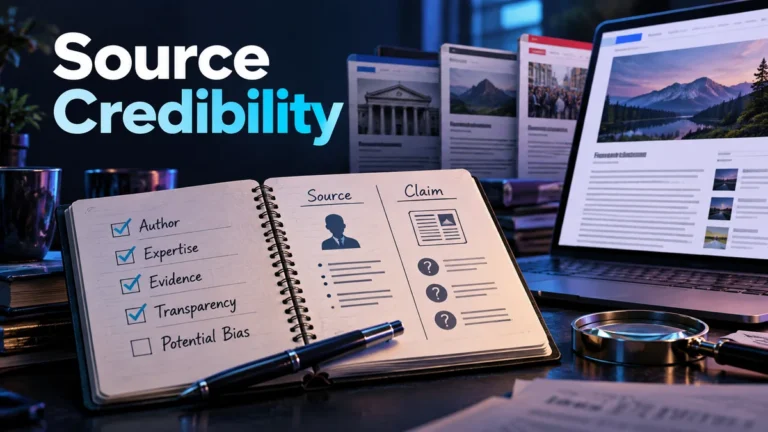
Source credibility is the confidence you can reasonably place in a publisher or author for a particular purpose. Evaluate who is speaking, their relevant expertise or access, the evidence they make inspectable, their interests and their correction behavior. A trustworthy-looking logo is not a substitute for those checks, and a credible source can still publish an inaccurate claim.
This guide builds a source-level worksheet: what a person or organization is positioned to know, and what you still need before relying on their work. It does not replace the broader news verification guide, which owns the full claim, date and context investigation. The dossiers below are fictional teaching examples, not ratings of real publishers.
Separate credibility of the source from truth of the claim
A source assessment and a claim assessment answer different questions. The first asks whether this publisher is a useful source for this task. The second asks whether the available evidence supports a particular statement. You can find a strong answer to one and a weak answer to the other. Keeping both visible prevents reputation from doing more work than it should.
Consider an authentic maker’s announcement about its own product. It may be a strong source for the maker’s published specifications. It is not automatically independent evidence that the product is better than every alternative. The same page can be appropriate for one sentence and insufficient for another. Credibility should follow the proposition, not attach permanently to a whole domain.
The ACRL information-literacy framework treats authority as contextual. For a reader, the useful implication is to identify the knowledge relevant to the question rather than assuming one credential settles every topic. Formal expertise, direct experience and a relevant record can each matter in different ways.
Source confidence is also provisional. New evidence, a correction or a changed authorship arrangement can alter how you use a publication. Avoid permanent labels such as always trustworthy or always false. A more useful record says which kind of information you relied on, why that source was suitable, and which limits remained at the time.
Do not turn missing information into an accusation. An unsigned community notice may still be accurate, while a professionally signed report may contain mistakes. Missing authorship tells you that attribution is unclear. It does not establish dishonesty. Your next step should address the missing attribution or seek a better-supported source, not invent a motive.
Identify the author, publisher and source role separately
Start with the exact item in front of you. Record its author if named, its publisher and the role it claims to play. Is it reporting, first-person observation, expert explanation, an advertisement, an official announcement or commentary? Those categories can coexist, so write a short description rather than forcing every publication into a single box.
A large organization may host many contributors with different relationships to the subject. A guest opinion, an employee announcement and an independently reported article are not interchangeable merely because they appear under one logo. Read the byline and any role label. If the item does not disclose the relationship, record that uncertainty instead of borrowing the institution’s authority for the individual claim.
Use the author’s own profile as a lead, not the whole verification. Look for independently attributable evidence of the relevant role: a publication record, a professional association’s public entry, or another appropriate source. The object is not to collect personal details. It is to establish the connection needed for the claim you intend to cite.
For example, someone who maintains an instrument can describe its controls from direct experience. Their access does not automatically establish expertise in interpreting every result the instrument produces. A researcher might explain the interpretation but not have witnessed this particular measurement. Write these strengths separately so one person’s access does not erase another person’s specialized knowledge.
When the identity cannot safely be established, narrow your use. You may treat the item as a lead that deserves corroboration, not as an attributable statement. Do not pressure a vulnerable witness to reveal private information for an ordinary reading task. A responsible assessment can acknowledge limited attribution without making the person less worthy of consideration.
Test expertise against the exact question
Write the question before reviewing credentials. “Who scheduled this recording?” needs operational access. “What can this sensor measure?” needs relevant technical knowledge. “Did this clip record the claimed event?” needs evidence connecting the media and event. A biography that answers the first question might contribute little to the second or third.
The Purdue OWL source-evaluation guidance recommends examining relevant author background, supporting references, purpose and evidence. Use those prompts selectively for the current task; they do not supply a universal score or guarantee that an apparently qualified author is correct.
Make expertise fit explicit in your notes. Replace “expert” with a narrower phrase such as “has published work on this measurement method” or “was responsible for the venue’s stated opening schedule.” That wording tells a later reader what you actually established. It also makes a mismatch visible when the source moves from its knowledge area into a broader conclusion.
A useful check is to ask what evidence could change your assessment. If your answer is only a more impressive title, you may be evaluating appearance rather than fit. Seek a relevant method, an inspectable record or a demonstrated connection to the matter at hand. You do not need to decide the person’s overall intelligence or social standing.
Be especially careful with cross-topic borrowing. Technical skill in editing video does not alone establish the truth of a medical statement in that video. An authentic witness to a meeting may know what they heard but not whether a scientific conclusion is justified. Respect the useful part of each source without extending it into a different kind of authority.
Inspect evidence access rather than confident presentation
Ask what the source lets you inspect. A document reference, a described method, a direct observation and an unsupported assertion provide different starting points. The relevant question is not how many links a page has, but whether its cited material addresses the statement you want to rely on. A bibliography can be substantial while missing the essential evidence.
Distinguish a publisher’s access from your access. A reporter may say they reviewed a record that is not public. That can be an attributable report, but you cannot claim to have independently examined the record. Note which part is the publisher’s description and which part you could inspect yourself. This preserves an important limitation without automatically rejecting confidential reporting.
For a video, the source may have the original file, only a derivative, or just an embed copied from elsewhere. Those positions affect what they can establish about the media. The existing video provenance guide covers the media’s history. This source dossier records whether the publisher explains their relationship to that history, not a second complete chain-of-custody exercise.
A direct record can also be limited. An organization’s own statement is primary evidence of what it announced, but not independent confirmation of every assertion within the announcement. Identify the role the record plays: a statement of policy, an observation, a calculation or a claim about someone else. “Primary” should not become another shortcut for “proven true.”
When evidence is inaccessible, choose a proportionate response. For low-stakes background reading, an attributable and appropriately qualified explanation may be sufficient. For a consequential public assertion, the missing record may require withholding a strong conclusion. Describe the limitation and the intended use rather than pretending every task needs the same investigation.
Record interests, transparency and correction behavior
Disclosure helps interpretation; it does not decide truth
Look for a relationship that is relevant to the item: employment, sponsorship, ownership, advocacy or participation in the event. Record what is disclosed and where. A disclosed interest is not proof that the work is false. It tells you something about perspective and independence that should influence which claims need outside support.
Likewise, silence about funding does not establish a hidden arrangement. Separate no disclosure found from evidence of an undisclosed relationship. If the difference matters to your decision, seek an appropriate public record or clarification through an independently found channel. Avoid turning a routine source check into speculation about private finances or personal associations.
For a comparative product claim, an interested source may be useful for explaining its own offer but weak as the sole support for superiority. For a first-person account, participation is the reason the person has access. The same relationship can be a useful qualification and a reason to seek corroboration. Keep both lines in the worksheet.
Evaluate a correction’s substance, not its mere existence
A correction can show that an error was acknowledged and repaired. Examine what changed, whether the earlier assertion remains visible in context, and whether the revised version actually addresses the problem. One correction is not a numerical measure of a publisher’s reliability. A publication that has never displayed a correction is not automatically error-free.
Use an example you can inspect rather than repeating reputation claims. A dated note identifying the amended figure supplies more information than an undated “updated” label. If your own citation relied on the earlier figure, record the revision and reconsider the sentence that used it. Correction behavior matters most when connected to a real use of the source.
Do not make the worksheet a punishment for transparency. A candid correction may be more useful than an unexplained replacement. Conversely, visible willingness to correct does not make the new statement correct by itself. Review the revised supporting material and keep the correction record separate from the remaining evidential question.
Find context outside the publisher’s own presentation
Mike Caulfield’s original SIFT formulation includes investigating the source, finding better coverage and tracing original context. The source-related move helps you understand who is speaking and their relevant agenda or expertise. SIFT is Caulfield’s framework; the dossier exercise here is an original application, not a renamed proprietary method.
Use external context to answer a limited question. If an author claims a particular technical role, seek an attributable record of that role. If a publisher says it is independent of a named organization, look for relevant ownership or disclosure information. Do not read every unrelated search result; stop when you have enough context for the current decision or a clearly stated unresolved field.
Popularity is a different property. A high follower count can tell you that many people may encounter an account; it does not establish subject expertise or independent evidence. A verified account identity, where available, is also not a blanket endorsement of its statements. Treat identity, audience and evidential quality as separate columns.
A logo or polished layout is useful for navigation, not proof of affiliation. Confirm that the item is actually published by the organization it appears to represent. A screenshot can omit the domain, author role or correction note. For source evaluation, prefer an inspectable original page where available and describe what a screenshot cannot show.
External commentary can be informative without being independent evidence for every claim. Several biographies may copy one original profile. Several reports may quote the same announcement. Your source dossier should identify the underlying record for the relevant qualification rather than treating every repeated description as an additional confirmation.
Use a compact, task-specific source dossier
This original worksheet avoids a single credibility score. A total would invite you to trade unrelated strengths against missing evidence: a famous logo could appear to compensate for absent expertise. Instead, write a short finding for each row and a final decision for one stated use. An unresolved row remains unresolved rather than receiving an invented average.
| Field | Record | Limit to preserve |
|---|---|---|
| Authorship and role | Who produced this item and in what capacity? | Publisher identity does not establish every contributor’s role. |
| Relevant expertise or access | What connects this source to this particular question? | Credentials and firsthand access answer different questions. |
| Evidence available | Which supporting record can you actually inspect? | A source’s reported access is not your independent examination. |
| Interests and transparency | What relevant relationship is disclosed or established? | Interest is not proof of falsehood; missing disclosure is not proof of concealment. |
| Correction behavior | What inspectable revision is relevant to your use? | One correction does not measure an entire publisher. |
| Use decision | What can you cite, and what still needs another source? | Source suitability is not a verdict on the whole claim. |
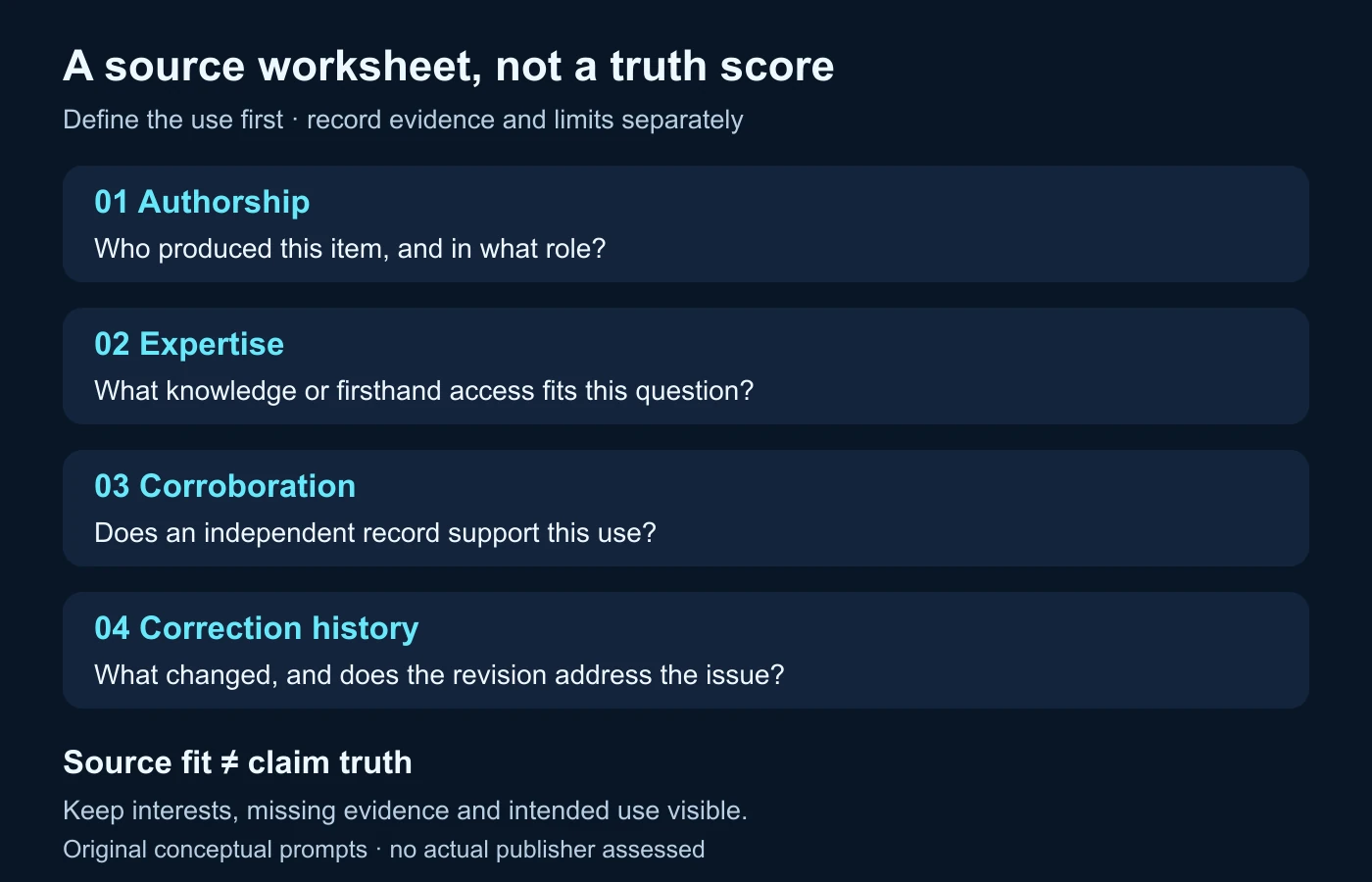
Use a brief evidence note rather than a yes/no tick when nuance matters. “Named operator, access to the schedule, no authority for the medical claim” is more useful than marking the author credible. Keep a date and the item reviewed so the decision can be revisited after a correction or a change in the supporting material.
Compare two fictional sources without choosing a universal winner
Suppose you are preparing a description of a fictional demonstration at Alder Studio. One question concerns when a session was scheduled. Another concerns whether the demonstration supports a broad scientific conclusion. These are deliberately different questions. No actual event, organization or experiment is represented by the example.
Source A: the studio coordinator’s notice
The fictional notice names the coordinator, states the session time and explains that the studio organized the demonstration. For the scheduled time, the coordinator’s operational role is relevant. The notice is interested, but that interest does not erase its usefulness as the studio’s own announcement. You can attribute the announced schedule while checking later changes where they matter.
Now imagine the same notice calls the demonstration definitive scientific proof. The scheduling role does not establish the expertise or method needed for that conclusion. Record the mismatch. The appropriate action is not to call the coordinator dishonest; it is to avoid using an operational notice as the sole authority for the scientific statement.
Source B: the technical reviewer’s explanation
The second fictional source names a reviewer with relevant work on the method and links an explanation of what the demonstration can and cannot show. That background is relevant to interpretation. However, the reviewer did not attend the session and relies on the studio’s notice for its time. Their expertise does not turn that repeated schedule into independent eyewitness evidence.
Your dossier can therefore use Source A for the attributed announcement and Source B for a bounded technical explanation, while identifying the evidence still needed for the broad conclusion. There is no overall winner. The sources’ strengths are complementary, and their shared schedule reference should not be counted twice.
Revisit the dossier after a change
Suppose the studio adds a dated correction to the announced time. Update the schedule statement and record the revision. The technical reviewer may still be useful on method limits, but their copied time needs reconsideration. This is why a source decision should identify the specific use rather than grant permanent trust to every sentence on a page.
For a source describing where a real recording occurred, the evidence needs to address location. Relevant author expertise does not replace landmarks, maps or other supporting material. Use the existing video geolocation guide for that investigation instead of asking the source dossier to certify a location merely from reputation.
Write a bounded decision and stop proportionately
A useful final note has three parts: appropriate use, remaining limitation and next action. For the fictional studio notice, that might be “suitable for attributing the studio’s announced schedule; not independent support for the scientific conclusion; seek the relevant method and evidence before using that conclusion.” This gives another reader a practical decision without a sweeping trust label.
Match the depth to the stakes. Background reading, an attributed quote and a consequential factual assertion require different support. If you cannot establish the essential source role or evidence, choose a more suitable source or qualify the statement. You do not need to prove bad intent to decide that the current item is insufficient.
- State the question and intended use before reviewing the source.
- Separate author, publisher and relationship to the item.
- Check relevant expertise or access, not prestige alone.
- Identify what evidence you inspected and what remains reported.
- Record interests and corrections without converting them into motives.
- Write a use-specific conclusion that can change with new evidence.
Source credibility remains valuable precisely because it is not a shortcut to truth. It helps allocate attention and choose appropriate evidence. Treat a strong source as a good starting point, a weakly attributed source as a reason for caution, and every specific claim as something whose support must match the conclusion you intend to draw.
Check both the source and the clip.
Use DetectVideo AI as one supporting step, not a replacement for evidence.
Questions about source credibility
Can a credible source publish an inaccurate claim?
Yes. Relevant expertise and a good record make a source useful, not infallible. Check the evidence for the statement and review relevant corrections.
Are primary sources always more trustworthy?
No. A primary record has a direct relationship to what it records, but its purpose and limits still matter. An announcement establishes what was announced, not every broader assertion it contains.
Does a conflict of interest mean the source is wrong?
No. It affects interpretation and independence. Record the relationship and seek suitable outside evidence for claims where that relationship matters.
Can follower counts or verification badges prove credibility?
No. Audience size and account identity are different from relevant expertise and evidence. Do not use them as a substitute for a source-level check.
Can video analysis decide whether a publisher tells the truth?
No. It can contribute evidence about a clip’s production characteristics. Publisher credibility and claim truth require source and contextual evaluation.
References and scope
- ACRL: Framework for Information Literacy for Higher Education — the Authority Is Constructed and Contextual frame; not a numerical source-rating system.
- Purdue OWL: General Guidelines for Evaluating Sources — relevant background, purpose and evidence prompts; not a guarantee of accuracy.
- Mike Caulfield: SIFT, The Four Moves — original 2019 formulation, read on the author’s public site; SIFT remains attributed to its creator.
Sources read on 14 October 2026. Alder Studio, its coordinator, reviewer and notices are fictional educational examples. The worksheet is an original practical exercise, not an observed investigation, legal assessment or publisher ranking.