

AI denoising uses a learned model to estimate a cleaner image or video from a noisy input. The model must distinguish unwanted variation from meaningful detail, and that distinction can be uncertain. A smoother result can be easier to view without preserving every texture, small mark or temporal feature needed to interpret the source.
This guide gives you a noise-versus-detail review procedure, an original calculated toy example and a decision worksheet for accepting a processed copy. It is about one processing operation, not a complete restoration pipeline or a ranking of software. Keep the unprocessed source available and decide what the derivative needs to accomplish before judging its appearance.
Noise is unwanted variation relative to a task
Image noise can appear as changing brightness or color that makes a picture harder to inspect. But not every irregular pixel is noise. Fine fabric, hair, a printed stroke and natural surface variation can also create small-scale patterns. A method trying to remove unwanted variation must use assumptions about what belongs to the image. It cannot simply classify every small change as disposable.
Start with the question the picture needs to answer. A smooth background may be useful in a presentation, while the same processing is unsuitable for determining whether a tiny identifying mark was visible. Define the important regions before moving an intensity slider. Otherwise, the most attractive whole-image result can conceal the loss that matters to your actual task.
Also separate capture noise from later degradation. Compression, blur and scaling can interact with noise, but they are not identical problems. A downloaded clip may have been processed several times before reaching you. The compression-artifact guide covers that distinct encoding context. Calling every block, soft edge or flicker “sensor noise” makes a denoising comparison less useful.
A learned estimate is not an additional observation
A learned denoiser uses relationships acquired during training to estimate how a cleaner result should look. Some models estimate unwanted variation and subtract it; others estimate a cleaned representation more directly. The original DnCNN paper provides a specific residual-learning example: its network predicts a residual associated with noise. That is one research design, not the architecture of every current tool. Zhang and colleagues: Beyond a Gaussian Denoiser
A learned prior is information from training, not a new measurement of this particular object. It can help separate structure from variation, but it does not independently confirm the identity of a small symbol or the exact texture of a face. The output combines input information with the method’s assumptions. Record that processing relationship rather than describing the derivative as another camera observation.
Do not call all learned noise reduction generative filling. Some systems estimate noise without intentionally replacing an object or inventing a scene. Nevertheless, removing or modifying a pattern changes the delivered image. The relevant review question is which useful information remains supported, not whether the marketing category sounds conservative or advanced.
Traditional smoothing explains one common tradeoff
A simple smoother combines nearby values. That can reduce isolated fluctuations, but it can also reduce a narrow feature that resembles those fluctuations at the chosen scale. More advanced classical or learned methods use richer structure and context. The basic conflict remains useful to understand: noise suppression and detail preservation are related objectives, not necessarily the same result.
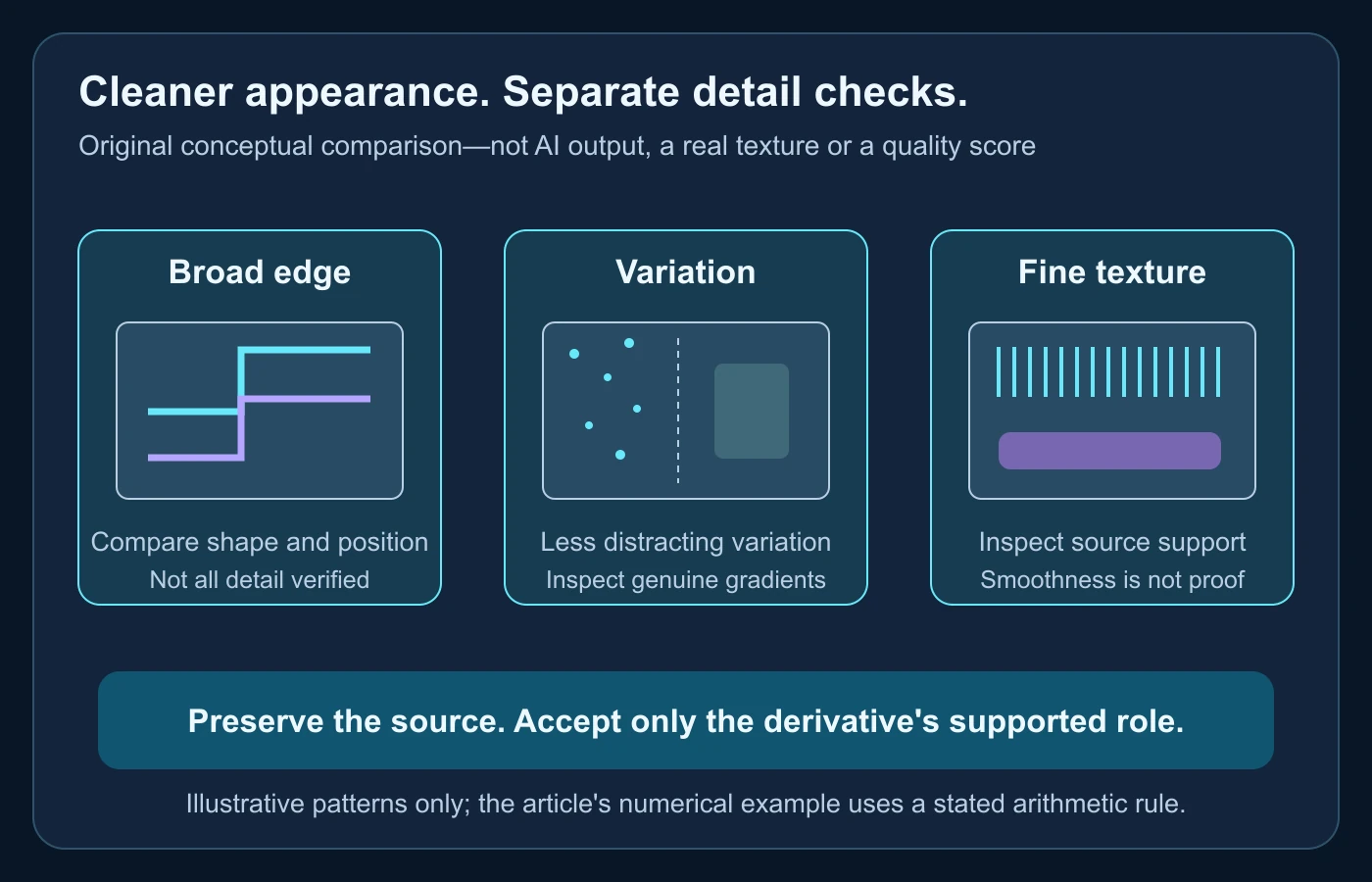
A sharp boundary and a fine pattern should be reviewed separately. A denoised picture can retain a broad silhouette while losing a thin line inside it. That is why “the edge still looks good” is not enough when a tiny marking carries the claim. Conversely, a derivative that remains slightly noisy may serve a detail-review purpose better than a perfectly smooth version.
There is no universal best intensity for every source or purpose. Do not borrow a setting from an unrelated demonstration and describe it as evidence-safe. Compare the relevant input and output under understandable viewing conditions. If the source cannot establish the detail, state that limit rather than increasing processing until one interpretation becomes persuasive.
An original calculated example separates texture from noise
For this article, we calculated a small one-dimensional illustration using explicitly constructed values. It is not a camera experiment, an AI-model run or a benchmark. The known clean row has eleven positions: 0, 0, 1, 0, 0, 0, 1, 1, 1, 0, 0. A narrow bright feature and a broader bright region both belong to that defined source.
We constructed a perturbed row: 0.1, 0, 1, 0.1, 0, 0, 1, 0.9, 1, 0.1, 0. Then we applied a three-position arithmetic mean to each interior position, leaving the endpoints unchanged. At the narrow bright feature, the average is approximately 0.367. At the broad region’s middle, it is approximately 0.967. These values follow from the stated calculation, not from a measured restoration score.
The rule smooths some variation while weakening a genuine narrow feature. It therefore demonstrates why a cleaner-looking row is not automatically a better representation of every detail. The known source lets us identify the lost feature in this toy setup. In an unknown photograph, that reference may be unavailable. Do not assign the toy’s averaging behavior to a commercial neural model.
Use the example to design a review, not to infer a universal failure rate. Ask which fine structures matter, whether the source supports them and how the chosen derivative treats them. Keep a separate record if a method also resizes, sharpens or changes contrast. Those additional operations can affect the comparison and should not be credited entirely to noise reduction.
Review smooth surfaces, fine texture and edges differently
A smooth wall can show distracting variation without containing a meaningful repeating pattern. Inspect whether treatment improves its use while retaining real boundaries and illumination changes. Do not remove every gradient just because it resembles unevenness. A wall with a genuine stain or shadow has information that may matter to the scene.
For woven material or hair, inspect pattern direction and continuity. Does the derivative preserve a texture compatible with the source, soften it into an indistinct area or produce a different-looking pattern? Describe the observed change. Do not assert that newly convincing texture must have existed on the original surface merely because the output appears natural.
For text and small markings, compare the strokes the source actually supports. If several readings remain possible, a denoised candidate should not become a confident transcription. Seek a better original moment or an independent appropriate reference. Avoid processing private faces or identifying details into increasingly persuasive evidence when the source cannot support the resulting claim.
Video adds a temporal review, not just more screenshots
In video, noise reduction may use information from adjacent moments as well as the current frame. The original FastDVDnet paper describes a specific architecture using consecutive frames and discusses temporal coherence. Its research configuration is an example, not a capability claim about any unnamed editor or Detector. No reported speed or quality figures are transferred here. Tassano and colleagues: FastDVDnet
Watch the relevant interval at ordinary playback speed, then inspect selected source moments. A smooth paused frame can conceal texture that changes abruptly as an object moves. Record whether the issue is visible in the original, appears in the derivative or remains uncertain. A temporal anomaly motivates review; it does not identify the exact model or prove deceptive editing.
Pay particular attention where a detail becomes hidden and visible again. A hand crossing patterned fabric or an object moving against a textured background creates a more demanding comparison than a static wall. Keep the same moment and region aligned between versions. Do not compare different frames and attribute their natural differences to the denoiser.
Audio is outside this article’s image-denoising scope. A video tool might offer separate audio treatment, but clean sound does not establish how the picture was processed. Record the actual operations rather than bundling every improvement under one “AI denoise” label. The recipient should know which visual derivative they are reviewing.
Check a documented tool without turning its claims into a guarantee
Adobe’s Camera Raw documentation provides a still-image example with an adjustable Denoise intensity and a preview comparison. It lists supported image sources and excludes video files in that documented workflow. Treat those facts as product-specific instructions, not permission to assume identical support in another application. Check the current documentation for the source you intend to process. Adobe: Improve image quality using Camera Raw
A vendor statement about preserving detail is not an independent finding about your file. Inspect the important region yourself and retain the source. If a processing panel also enables sharpening or enlargement, record that combination. Disable or hold other controls constant where appropriate for your comparison; do not mistake a bundled preview for an isolated test of noise reduction.
Save enough settings information for another reviewer to understand the selected version. A product update can change the available processing path, so include a relevant version or release identifier when your workflow exposes it. Do not publish private file paths, account information or embedded location data merely to make a review appear technical.
Use a region-based acceptance worksheet
Instead of giving a whole image one quality label, select a few regions that represent the actual task. Include a smooth area, an important edge and meaningful fine detail when those exist. The worksheet below is an original review aid, not a detector score. It separates an observation from the acceptance decision that follows from your intended use.
| Region or behavior | Compare with the source | Decision to record |
|---|---|---|
| Smooth area | Variation, genuine gradients and boundaries | Useful cleanup or meaningful information removed? |
| Important edge | Shape, position and surrounding context | Retained sufficiently for this task? |
| Fine texture or mark | Source-supported strokes and pattern continuity | Preserved, softened, changed or unresolved? |
| Moving detail | Same interval, appearance during motion and occlusion | Stable treatment or derivative inconsistency? |
| Accepted export | Final file, actual scale and known processing | Presentation copy, review aid or unsuitable evidence? |
Write a reason for accepting the derivative. “Less distracting background for an authorized presentation” is different from “supports reading the small sign.” You can accept the first purpose while refusing the second. The output does not need one universal verdict. It needs a clear role and a preserved relationship to the source.
A hypothetical clip review gives the worksheet a purpose
Imagine an authorized low-light recording of a fabric sample on a table. The team wants a comfortable viewing copy for a design discussion. It also wants to know whether a narrow printed mark is readable. This scenario is fictional and no actual denoising output is claimed. Its two goals deliberately require different acceptance standards.
Choose the comparison before processing
The reviewer preserves the source, identifies the relevant interval and selects the fabric, table edge and mark as regions. The derivative’s intended role is “presentation copy with noise reduction.” The reviewer does not label it the original or promise to recover the mark. If the processing changes dimensions as well, that additional transformation goes in the note.
For the design discussion, the reviewer compares how the fabric looks across movement. A softened texture may affect a conversation about weave and should therefore be reported even if the background is more pleasant. The table edge serves a different role: it helps check whether treatment changes object shape. The mark remains a separate question rather than being judged by overall visual improvement.
Accept a limited benefit without inventing certainty
Suppose a hypothetical candidate looks easier to view, but its fine texture is simplified and the mark remains ambiguous in the source. The reviewer can accept it for discussing broad placement while keeping it unsuitable for identifying the mark or evaluating fine weave. That is a useful outcome, not a failed demand for perfect restoration. The acceptance note describes the benefit and the missing information.
If a later original frame shows the mark clearly, that observation may resolve the reading. Keep the reasoning explicit: the later source, not repeated denoising of the ambiguous frame, supplied the support. The reviewer should not credit a processing tool with evidence obtained through another route. This prevents a plausible enhancement from acquiring a stronger role than it deserves.
Choose variants by the task, not by a dramatic preview
For the fictional fabric discussion, the team can describe two candidate purposes before comparing anything. A modest treatment might retain visible variation while keeping the weave easy to discuss. A stronger-looking treatment might make the table background more pleasant but simplify the pattern. These are hypothetical alternatives, not results claimed for a named tool. The meaningful choice depends on whether the meeting concerns broad placement or fine material appearance.
Hold unrelated adjustments constant when comparing the two treatments. If one version also raises exposure and sharpens the edges, the team cannot attribute its different look solely to noise reduction. Record that combined operation or prepare a comparison suited to the narrower question. An honest note can still accept a combined presentation version; it simply should not misdescribe the cause of the benefit.
Let another reviewer reach the same source region without guessing which frame or crop was used. Identify the interval and explain whether the candidate views were shown at matched scale. If the weave becomes visible only in an independent better-lit recording, use that recording as support rather than calling it a denoising result. The review should preserve where each finding came from.
Give unresolved regions a specific next step
A useful unresolved entry names the feature and what could resolve it. “Narrow mark remains unreadable; request a clearer authorized source” is actionable. “Try more AI” is not a stopping rule and can encourage selection of whichever output best fits the expected story. If no additional material is available, the uncertainty belongs in the final note rather than disappearing from the report.
Do not carry the acceptance of one region into every other region. The team can approve the table background while withholding a conclusion about the fabric pattern. It can approve a general viewing copy while requiring the source for technical analysis. These are ordinary task decisions, not contradictions. The worksheet is valuable precisely because it allows a limited benefit without converting every processed feature into established evidence.
Preserve the source and document the derivative
Keep the unprocessed version separate, particularly when the file could support an important claim. The video-authentication guide explains preservation and integrity more fully. This denoising review does not provide chain of custody or establish camera-original status. It needs a clear source identifier, a processing record and an honest description of the derivative.
A concise handoff note can identify the purpose, source interval, relevant settings, additional operations and regions that remain uncertain. Give the recipient access only through an appropriate authorized route. If privacy prevents sharing the source, record that comparison limit. Do not ask the recipient to treat the smoother copy as self-verifying.
Inspect the final delivered export rather than only the application preview. Further compression may introduce different texture or edge behavior. If a concern appears after delivery, locate the stage where it appears instead of attributing everything to the original noise reduction. Keep accepted versions identifiable so a familiar filename does not silently cover a later, differently processed file.
Keep noise reduction separate from authenticity conclusions
A processed camera recording can contain altered texture without depicting a fabricated event. A synthetic clip can also be denoised. The presence of processing does not settle the origin or truth of the source. The video-forensics guide places these observations within a broader evidence review; do not ask the denoising comparison alone to authenticate the event.
- Define the purpose and identify meaningful regions.
- Preserve the input before creating a derivative.
- Record noise reduction separately from scaling, sharpening and export.
- Compare source-supported detail, not just smoothness.
- Watch video motion as well as paused views.
- Accept only the role the comparison supports and retain unresolved findings.
The useful result is a cleaner working copy with its limitations still visible. A retained edge can help presentation; removed variation can reduce distraction; uncertain texture remains uncertain. State those outcomes separately. That makes enhancement useful without allowing the most polished version to replace the evidence needed for a consequential claim.
Cleaner is not always more original.
Check the untouched video alongside any enhanced version.
Questions about learned noise reduction
Can denoising remove a genuine small feature?
It can modify useful detail while suppressing unwanted variation. Inspect the feature against the unprocessed source instead of assuming smoothness means preservation.
Is denoising the same as upscaling?
No. Noise reduction concerns unwanted variation; upscaling changes the output grid. A workflow can combine them, so record both operations.
Does the toy average demonstrate an AI model’s accuracy?
No. It is a calculated illustration using constructed values and a stated arithmetic rule, not a neural-network or camera benchmark.
Why watch a denoised video instead of one frame?
Treatment can behave differently through motion and occlusion. Compare the same source interval to understand temporal as well as local changes.
Should the cleaner copy replace the original?
No. Keep the source and label the derivative with its purpose and known processing, especially when important detail or evidence is involved.
Primary sources used
- Zhang and colleagues: Beyond a Gaussian Denoiser — original DnCNN residual-learning mechanism.
- Tassano and colleagues: FastDVDnet — original neighboring-frame video-denoising architecture.
- Adobe: Improve image quality using Camera Raw — specific still-image Denoise workflow and source support, not independent accuracy.