
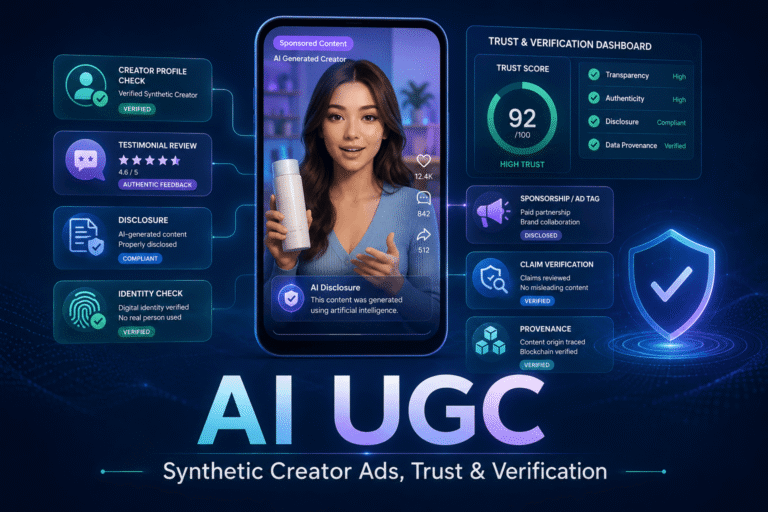
AI UGC is synthetic or AI-assisted content designed to look and feel like user-generated creator content. It often uses an AI avatar, generated voice, scripted testimonial, synthetic product demo, translated creator, or virtual presenter to reproduce the direct-to-camera style common in TikTok, Instagram Reels, YouTube Shorts, product pages, and paid social ads.
The name can be misleading. In many cases, AI UGC is not literally user-generated content because no real customer independently created it and no real creator necessarily had the experience described. It is better understood as UGC-style synthetic advertising or creator-style synthetic media. That distinction matters for trust, disclosure, testimonials, product claims, and verification.
AI UGC can be a legitimate marketing format when the synthetic nature, sponsorship, and product claims are presented honestly. The risk begins when a fictional creator is presented as a real customer, a synthetic spokesperson claims an experience that never happened, a real person’s likeness is used without authorization, or AI media is used to hide the commercial nature of the message. Verify the creator, the claimed experience, the sponsor, the product claim, and the media disclosure separately.
What Does AI UGC Mean?
AI UGC is industry shorthand for AI-generated or AI-assisted media that imitates the visual language of ordinary user-generated content.
Typical characteristics include:
- vertical short-form video
- direct-to-camera delivery
- casual language
- product demonstration or recommendation
- creator-style captions
- phone-camera aesthetics
- a first-person or conversational script
The production method can range from light AI assistance to fully synthetic video.
AI-assisted UGC
A real creator records the content, while AI helps with scripting, captions, cleanup, translation, dubbing, editing, background replacement, or versioning.
AI avatar UGC
A synthetic presenter delivers the script. The presenter may be a licensed digital avatar, a fictional AI person, a digital twin of a consenting creator, or a generated human-like character.
Fully synthetic UGC-style video
The presenter, voice, background, product scene, and sometimes the product interaction itself may be generated or composited.
The broader technical category is covered in the synthetic media guide. This page focuses specifically on creator-style advertising, endorsements, and trust.
AI UGC vs Real UGC
| Question | Real UGC | AI UGC |
|---|---|---|
| Who created the media? | A real user, customer, creator, or employee | An AI system, AI-assisted workflow, synthetic presenter, or hybrid production team |
| Did the speaker have the claimed experience? | Potentially yes, but it still needs to be truthful | Not necessarily. A fictional avatar cannot personally experience a product |
| Can it be sponsored? | Yes | Yes |
| Can it be misleading? | Yes | Yes, especially if synthetic production is used to imply a real customer experience |
| Does AI use automatically make it deceptive? | No | No. Transparency and claim accuracy matter more than the mere use of AI |
AI UGC Is Usually UGC-Style, Not Literally User-Generated
This semantic distinction is important for both marketers and viewers.
Imagine a synthetic presenter saying:
“Here are three features of this wireless microphone.”
That can function as a scripted spokesperson message.
Now imagine the same avatar saying:
“I used this microphone for six months, and it completely fixed my audio problems.”
The second statement implies a personal experience. If no real person had that experience, the issue is no longer just synthetic production. It becomes a testimonial and truth-in-advertising problem.
Trust, Testimonials, and the AI UGC Trust Stack
Do not reduce AI UGC verification to “real person or fake person.” Trust depends on several layers.
A video can pass one layer and fail another.
For example, a brand may openly disclose that the presenter is AI-generated while still making an unsupported claim about customer results. Transparency about production does not make an inaccurate advertising claim true.
Why Brands Use AI UGC
AI UGC can reduce some of the production friction involved in short-form advertising.
Common uses include:
- creating many script variations
- localizing the same message into multiple languages
- producing different hooks for paid social testing
- creating synthetic presenters without organizing repeated shoots
- updating product details without reshooting an entire campaign
- generating creator-style explainers for large product catalogs
- testing concepts before commissioning human creators
These are production advantages. They do not remove the normal responsibilities attached to advertising, endorsements, claims, likeness rights, or platform disclosure.
AI UGC vs AI Influencers, Virtual Influencers, and Deepfakes
| Format | Primary idea |
|---|---|
| AI UGC | Creator-style or testimonial-style synthetic advertising content |
| AI influencer | A persistent synthetic persona with an ongoing social identity and audience presence |
| Virtual influencer | A fictional digital personality, which may be AI-driven, 3D-rendered, animated, or human-operated |
| Deepfake | Generated or manipulated media that makes an existing person, object, place, entity, or event appear authentic in a false way |
| Digital twin | A synthetic representation based on a real consenting person, often used for scaled production or localization |
Not every AI UGC presenter is a deepfake. A fictional avatar that does not imitate a real person is a different case from an unauthorized face or voice clone.
If an ad appears to borrow a real person’s identity or authority, the AI impersonation guide covers that risk separately.
The Most Important Question: Is It a Spokesperson or a Testimonial?
This distinction changes the trust analysis.
FTC Rules Make Fictional Experience Claims Especially Important
In the United States, the FTC’s Endorsement Guides state that endorsements must be truthful and not misleading, endorsers should not describe a product experience they did not actually have, and material connections that can affect how people evaluate the endorsement should be disclosed clearly.
FTC guidance also emphasizes that the responsibility for a clear and conspicuous disclosure does not disappear because a social platform provides its own disclosure tool. See the FTC Endorsement Guides guidance.
AI-generated fake testimonials can create a separate rule problem
The FTC’s Consumer Reviews and Testimonials Rule specifically addresses fake or false consumer and celebrity testimonials, including testimonials that misrepresent that they are by someone who does not exist or by someone who did not have the claimed experience. The FTC explicitly identifies AI-generated fake reviews as an example of the conduct addressed by the rule.
See the FTC final rule on fake reviews and testimonials.
Practical rule: a synthetic actor can present factual product information, but brands should be extremely careful about scripting fictional first-person experience, fake customer history, fake expertise, or fabricated results as if they came from a real endorser.
Disclosure Has Two Separate Meanings
AI UGC can require more than one kind of transparency.
Commercial disclosure
Is the viewer told that the content is advertising, sponsored, affiliate-based, or otherwise connected to the seller?
Synthetic-media disclosure
Is the viewer told that the presenter, voice, scene, or meaningful part of the media was generated or substantially altered with AI where the platform or law requires it?
These disclosures solve different problems.
“Ad” tells you who benefits.
“AI-generated” tells you something about production.
Neither one automatically proves the product claim.
How Major Platforms Handle AI-Generated Creator Content
Platform rules continue to evolve, but the direction is clear: realistic synthetic media increasingly receives creator labels, automatic labels, or provenance-based disclosures.
| Platform | Current transparency approach relevant to AI UGC |
|---|---|
| TikTok | Requires labeling of realistic AI-generated content and supports creator labels and automatic labels, including signals from Content Credentials |
| YouTube | Requires disclosure when realistic content is meaningfully generated or altered with AI and can apply labels through creator disclosure, internal systems, YouTube AI tools, or C2PA signals |
| Facebook and Instagram | Use AI information labels for detected AI-generated media and require disclosure for certain photorealistic video or realistic-sounding audio that was digitally created or altered |
TikTok’s current guidance requires creators to label realistic AI-generated audio, image, and video and explains that automatic labels can be applied when compatible Content Credentials are present. See TikTok’s AI-generated content guidance.
YouTube similarly requires disclosure for realistic content that makes a real person appear to do something they did not do, alters a real event or place, or generates a realistic scene that did not occur. See YouTube’s official GenAI disclosure guidance. The dedicated YouTube altered or synthetic content guide explains that platform-specific system in detail.
Meta currently uses an AI info label for content it detects as generated by AI and requires disclosure for certain organic photorealistic video or realistic-sounding audio that was digitally created or altered. See Meta’s current explanation of its AI labeling approach.
AI Labels Are Useful, but They Are Not Quality or Truth Scores
A label can tell you that meaningful AI was involved. It may not tell you:
- which exact scene was generated
- whether the person is fictional or a licensed digital twin
- whether the product claim is accurate
- whether the testimonial reflects a real experience
- whether the brand relationship is properly disclosed
- whether the linked store or offer is legitimate
Likewise, no AI label does not prove the media is camera-recorded or unaltered.
Content Credentials Can Add Production Evidence
When AI UGC is created and distributed through a compatible C2PA workflow, Content Credentials can provide signed provenance about how the asset was created or changed.
This can help distinguish:
- camera capture
- generative creation
- editing actions
- source ingredients
- signing identity or tool information
For users who want to inspect that evidence layer directly, the Content Credentials guide explains validation, recorded actions, and limitations.
The EU Adds a Broader Transparency Layer
In the European Union, Article 50 transparency obligations of the AI Act apply from 2 August 2026. The framework includes machine-readable marking obligations for providers of generative AI systems and disclosure obligations for deployers in cases such as deepfakes.
The European Commission’s current guidance emphasizes that deepfake disclosure should be clear and perceivable to people and cannot rely only on hidden machine-readable marking. Not every AI UGC ad will qualify as a deepfake, so the exact legal obligation depends on the media, the resemblance involved, and the deployment context. See the European Commission overview of Article 50 transparency rules.
This article provides general media-verification and advertising-transparency information, not legal advice. Advertising, consumer-protection, biometric, privacy, and AI rules vary by jurisdiction.
How AI UGC Can Become Misleading Without a Deepfake
An ad does not need an impersonated celebrity to mislead viewers.
Common trust problems include:
- a fictional “customer” describing an experience no person had
- a synthetic expert presented as a real professional
- AI-generated before-and-after imagery presented as real results
- a generated product demonstration showing performance the real product cannot reproduce
- fake comments or testimonials surrounding the ad
- a fictional lifestyle story designed to create social proof
The underlying problem is not simply “AI content.” It is a mismatch between what the viewer reasonably believes and what actually occurred.
AI UGC Can Also Be Used in Scam Funnels
Scammers can use cheap creator-style synthetic videos to produce many variations of the same fraudulent pitch.
The presenter may promote:
- a fake store
- a counterfeit product
- a fraudulent investment
- a fake giveaway
- a phishing page
- a subscription trap
In these cases, media verification is only the first step. The scam videos guide focuses on what the ad is trying to make you click, buy, install, or send.
How to Spot AI UGC Without Falling for Artifact Folklore
There is no universal visual defect that proves a creator is synthetic.
Possible clues include:
- identity details changing across cuts
- unnatural product contact or hand-object interaction
- text or packaging changing between frames
- voice and mouth timing that does not remain stable
- repeated synthetic-looking backgrounds or creator templates across many unrelated ads
- a presenter with no verifiable identity outside the ad ecosystem
But compression, filters, beauty processing, dubbing, background replacement, and ordinary editing can create similar effects.
The better question is not:
“Can I catch the AI by looking at fingers?”
It is:
“Can I verify who is speaking, what experience is being claimed, who sponsored the message, and whether the product evidence exists outside this video?”
A Practical AI UGC Verification Workflow
-
Classify the message.
Is this a product explainer, advertisement, testimonial, expert recommendation, customer story, or creator endorsement?
-
Identify the creator claim.
Does the ad imply that the speaker is a real customer, professional, employee, influencer, or fictional spokesperson?
-
Check the identity outside the ad.
Search the creator, account history, brand relationship, older content, and public presence. A new synthetic persona may have no meaningful history.
-
Separate personal experience from product facts.
“This product contains X” and “I used this for 30 days” are different claim types and need different evidence.
-
Look for commercial disclosure.
Is the sponsorship, affiliate relationship, brand ownership, or other material connection clear?
-
Look for AI disclosure or provenance.
Check platform labels, creator disclosure, Content Credentials, or other production information where available.
-
Verify the product claim independently.
Use the real product page, documentation, credible testing, regulatory information, or other sources appropriate to the claim.
-
Inspect the destination before acting.
Confirm the domain, seller, checkout, app, wallet, or contact path independently of the video.
-
Add technical media analysis only when needed.
If the remaining question is whether the video itself is AI-generated or manipulated, analyze that media question separately.
A Verification Matrix for Viewers
| What you observe | What it supports | What it does not prove |
|---|---|---|
| Platform AI label | Meaningful AI generation or alteration was disclosed or detected under the platform’s system | That the product claim is false or true |
| Real creator identity | The speaker appears to be a real identifiable person | That the endorsement is honest, sponsored correctly, or authorized |
| No older profile history | The persona deserves additional verification | That the creator is definitely AI-generated |
| Valid Content Credentials | Documented provenance can be evaluated | That the marketing claim is accurate |
| Visible AI artifact | The media may deserve technical analysis | Fraud, intent, or exact generation method |
| Brand confirms the campaign | The advertisement is associated with the brand | That every testimonial or performance claim is substantiated |
When DetectVideo AI Fits
DetectVideo AI can contribute technical analysis when a saved or supported AI UGC video needs review for possible AI generation, face manipulation, temporal inconsistencies, compression, audio-video mismatch, metadata, or related forensic signals.
That analysis answers a media question. It does not replace advertising verification.
A strong investigation still asks:
- Is the creator real or synthetic?
- Was the claimed experience real?
- Is the commercial relationship disclosed?
- Is the product claim substantiated?
- Is the destination legitimate?
For a complete source and claim workflow, use the video verification guide.
A Safer AI UGC Publishing Standard for Brands
Brands can use synthetic creators without pretending that fictional experience is real.
- Define the presenter honestly. Know whether the media uses a real creator, licensed digital twin, fictional avatar, or generated voice.
- Separate spokesperson scripts from customer testimonials. Do not invent first-person experience for a persona that never had it.
- Substantiate product claims before production. AI can generate language faster than legal or factual review can validate it.
- Disclose sponsorship and material connections clearly.
- Apply required AI labels and disclosures. Follow the relevant platform and jurisdiction rules.
- Get appropriate likeness and voice permissions. Disclosure does not substitute for authorization.
- Preserve source assets and production records. Keep scripts, permissions, human approvals, versions, and provenance where available.
- Review the destination too. Make sure pricing, checkout, subscriptions, guarantees, and landing-page claims match the ad.
Can AI UGC Be Authentic?
Yes, if “authentic” refers to transparent communication rather than camera origin.
A synthetic spokesperson can openly say:
“I’m an AI-generated presenter created for this brand. Here are the documented features of the product.”
That content is synthetic, but it can still communicate honestly.
By contrast, a photorealistic fictional person saying:
“I bought this with my own money and have used it every day for a year.”
creates a false experiential claim if no such customer experience exists.
The production technology does not decide trust by itself. The relationship between representation and reality does.
Can AI UGC Replace Human Creator Content?
It can replace some production functions, but not every trust function.
AI is well suited to:
- localization
- script iteration
- product explainers
- variant testing
- fictional spokesperson formats
Human creators remain different when the value of the content comes from:
- real product experience
- personal credibility
- community history
- expertise
- long-term audience trust
Replacing a real testimonial with a synthetic performance is not merely an efficiency decision if the ad still implies genuine personal experience.
Use Precise AI UGC Verdicts
| Verdict | Meaning |
|---|---|
| Synthetic spokesperson disclosed | The presenter is AI-generated or meaningfully altered and that production method is transparently communicated |
| AI-assisted real creator | A real creator appears to be the source while AI supports production, editing, translation, or enhancement |
| Fictional testimonial risk | The content appears to attribute a personal product experience to a synthetic or nonexistent endorser |
| Undisclosed commercial relationship | The creator-style message appears sponsored or brand-controlled but the material connection is unclear |
| Impersonation suspected | The synthetic media may be using an existing person’s identity, face, voice, or authority without clear authorization |
| Media synthetic, claim unverified | AI involvement is supported, but the product or advertising claim requires independent verification |
Key Takeaway
AI UGC is best understood as synthetic creator-style content, not automatically as genuine user-generated experience.
It can be useful, scalable, and legitimate when a brand is transparent about the presenter, sponsorship, and production method and when the claims are accurate. The risk comes from using synthetic realism to manufacture customer experience, expert authority, social proof, or identity that never existed.
For viewers, verify five layers: identity, experience, sponsorship, production, and claim. For brands, design AI UGC so those same five layers remain honest even after the content leaves the production tool and enters a social feed.