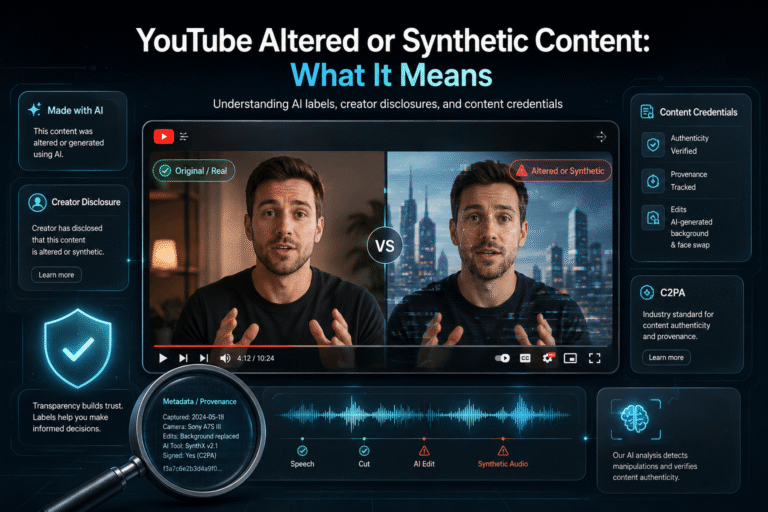
On YouTube, “altered or synthetic content” refers to realistic media that has been meaningfully generated or changed with AI or similar tools in a way that can affect what viewers understand about a real person, place, event, or scene. The disclosure system is designed to tell viewers how content was made, not to declare that the video is false, fraudulent, prohibited, or fully AI-generated.
Current YouTube labels may use wording such as “Made with AI” or show AI-generation or alteration information below the player, on Shorts, or in the expanded description. The exact label depends on the content and how YouTube received the disclosure.
What Does “Altered or Synthetic Content” Mean on YouTube?
YouTube requires disclosure when creators use AI to meaningfully alter or generate photorealistic content.
The platform’s current help guidance identifies three core cases:
- making a real person appear to say or do something they did not say or do
- altering footage of a real event or place
- generating a realistic scene that did not actually occur
This can apply to media that is fully generated or only partly altered.
YouTube’s current disclosure requirements are documented in its official GenAI disclosure guidance.
“Altered” and “Synthetic” Are Related but Not Identical
The terms describe two broad production patterns.
| Term | Practical meaning | Example |
|---|---|---|
| Altered content | Existing media is meaningfully changed | A real person’s face, speech, action, background, or event footage is modified |
| Synthetic content | New media or a new element is generated rather than directly captured | A realistic event, person, voice, image, video segment, or music track is generated with AI |
YouTube does not require viewers to solve this distinction before interpreting the label. Both categories are handled within the same broader AI transparency system when the generation or alteration is meaningful under the platform’s rules.
For the broader media category, the synthetic media guide explains how AI-generated, AI-modified, hybrid, and conventional media differ.
The Label Is a Production Disclosure, Not a Truth Verdict
This is the single most important interpretation rule.
What Content Must Creators Disclose?
The current standard is not simply “AI was used somewhere in production.”
YouTube focuses on realistic AI content and meaningful changes that could affect what viewers understand about what actually happened.
Examples YouTube says require disclosure include:
- AI-generated music
- realistic AI footage added to a video of a real place
- realistic generated footage of real professional athletes in an event that did not happen
- making a real person appear to give advice they did not give
- showing a realistic weather disaster approaching a real city when it did not occur
- making it appear that a public figure committed or admitted to an act they did not perform
- making a real person appear arrested or imprisoned when that did not happen
The list is intentionally broader than deepfakes. A meaningful AI alteration can involve a person, place, event, audio, or fully generated realistic scene.
What Usually Does Not Require Disclosure?
YouTube does not require the same disclosure for clearly unrealistic synthetic content or minor edits that are primarily aesthetic and do not materially change what viewers understand happened.
Current examples include:
- beauty filters
- color or lighting adjustment
- background blur and vintage-style effects
- AI assistance for outlines, scripts, thumbnails, titles, or infographics
- automatic captions
- video sharpening, upscaling, repair, or ordinary audio repair
- idea generation
- cloning your own voice for voiceovers or dubbing
- clearly unrealistic or animated AI content
The boundary is therefore meaning and realism, not whether an AI tool touched the workflow.
A Simple Disclosure Decision Test
- Was AI or a synthetic-media tool used? If no, this disclosure system is not the issue.
- Did it create or materially change content that viewers may interpret as real? Minor aesthetic or production assistance usually falls outside the main requirement.
- Does the change affect a real person, real event, real place, realistic scene, meaningful audio, or other substantive media?
- Could a reasonable viewer misunderstand what actually happened without disclosure?
- If yes, disclose the AI use through the YouTube Studio workflow.
This is a practical interpretation of the current policy, not a replacement for YouTube’s own case-specific rules.
How Creators Disclose AI Use in YouTube Studio
YouTube currently provides an AI use setting during the upload workflow.
The current process is:
- open the video upload workflow in YouTube Studio
- go to the Attributes section
- under AI use, select Yes if the content meets the disclosure criteria
- continue with the remaining video details
After the creator selects Yes, YouTube adds an AI-generation or alteration disclosure for viewers.
Where Does the AI Label Appear?
YouTube made its AI labels more prominent in its current interface.
For photorealistic and meaningfully AI-altered or generated content:
- long-form video: the label can appear directly below the video player, above the description
- Shorts: the label can appear as an overlay on the video
- other disclosed content: additional information can appear in the expanded description
YouTube announced the more visible label placement and automatic AI detection rollout in May 2026. The platform says this is now its single label format for photorealistic and meaningfully AI-altered or generated content. See the YouTube update on AI labels.
Interface placement can change over time, so the meaning of the disclosure is more important than memorizing one screen position.
What Does “Made with AI” Mean?
In YouTube’s How this content was made system, “Made with AI” indicates that a video contains content that has been meaningfully altered or synthetically generated.
YouTube says this disclosure can appear through several routes:
- the creator manually discloses AI use
- the creator uses YouTube’s own generative AI tools
- the media contains valid Content Credentials indicating that the entire video was made with AI
- YouTube applies a label through internal or manual detection systems
YouTube explains the viewer-facing system in its How this content was made documentation.
“Made with AI” Does Not Always Mean “100% AI Video”
The phrase can be easy to overread.
A video may contain meaningful AI alteration while other parts remain camera-recorded or human-created. YouTube’s disclosure framework covers content that is fully or partially altered or generated.
Therefore, if you need to know exactly what was synthetic, inspect the context, creator explanation, provenance information, or the media itself.
A label can answer:
“Was meaningful AI involved under the platform’s disclosure system?”
It may not answer:
“Which exact frames, words, sounds, or objects were generated?”
How YouTube Can Apply a Label Automatically
Creator disclosure is still part of the system, but it is no longer the only route.
YouTube says it may automatically apply an AI label when:
- content was created with YouTube’s generative AI tools
- the content contains relevant C2PA metadata
- YouTube’s internal systems detect AI-generated or altered content
If YouTube’s internal detection applies a label, creators can change the disclosure in many cases if they believe it is wrong.
However, YouTube says disclosures cannot be adjusted in several cases, including content created with its own AI tools, content carrying qualifying C2PA information, or content labeled after manual review.
What Happens If a Creator Does Not Disclose?
YouTube says creators who consistently fail to disclose qualifying AI-generated or altered content may face:
- manual application of a label
- content removal in applicable cases
- suspension from the YouTube Partner Program
Separate Community Guidelines still apply regardless of whether a creator adds the AI disclosure correctly.
A disclosure does not turn prohibited content into permitted content.
Does the AI Label Hurt YouTube Reach or Monetization?
According to YouTube’s current policy, the disclosure label alone does not limit a video’s audience, change recommendation eligibility, or remove monetization eligibility.
YouTube states that discovery continues to depend on audience and content signals, while AI disclosure functions as transparency information.
This distinction matters for creators: avoiding a required disclosure out of fear that the label itself will automatically suppress the video is not supported by YouTube’s current guidance.
C2PA Can Carry AI Disclosure Into YouTube
YouTube also uses Content Credentials to carry forward certain production information.
The platform says it can carry forward secure Content Credentials from C2PA 2.1 or higher when those credentials indicate the entire video was made with AI. This may result in a player label or disclosure language in the expanded description.
The accompanying Info from attribution can identify the signing authority associated with the Content Credential.
For the practical provenance layer, see the Content Credentials guide. The more technical metadata model is covered separately in the C2PA metadata guide.
C2PA Disclosure Is Stronger Than an Ordinary Text Claim, but It Is Still Not a Fact-Check
A cryptographically verifiable production record is different from a creator simply typing “AI was used.”
But even valid provenance does not prove:
- that a spoken statement is true
- that a depicted event happened in the way the caption claims
- that a person consented to the use of their likeness
- that the video is harmless or policy-compliant
Production provenance and factual verification are different evidence layers.
What Does “Captured with a Camera” Mean?
YouTube also has a separate Captured with a camera disclosure for compatible workflows that attach secure provenance information to camera-origin media.
This is conceptually the opposite direction from a “Made with AI” signal: instead of disclosing synthetic generation, it provides secure information associated with camera capture and media integrity in a supported workflow.
But the absence of a Captured with a camera disclosure does not mean a video is AI-generated or altered. Most videos will not necessarily have compatible capture provenance.
No AI Label Does Not Mean the Video Is Authentic
Important: absence of a YouTube AI label is not proof of camera origin.
A label may be absent because:
- the creator did not disclose
- automatic detection did not identify the content
- the synthetic change falls outside the platform’s disclosure scope
- provenance was never present or did not survive the workflow
- the content is old, conventional manipulation rather than AI, or misleading through context instead of synthesis
This is why viewers should not reverse the logic of the label.
Label present can provide evidence of AI involvement.
Label absent does not establish no AI involvement.
The Label Is Not the Same as a Deepfake Warning
A deepfake is only one subset of altered or synthetic content.
The disclosure can also apply to:
- generated weather events
- synthetic music
- AI-generated footage of a real place
- realistic fictional events
- modified real-event footage
If the central question is whether a video specifically contains deepfake identity or facial manipulation, use the deepfake video guide.
An AI Disclosure Does Not Grant Permission to Use Someone’s Likeness
Transparency and consent are separate.
YouTube’s current likeness-claim system explicitly says that labeling a video as synthetic or disclosing AI generation does not give the creator permission to use another person’s face or voice.
YouTube can apply likeness claims to altered or AI-generated media that matches a specific person’s face or voice, and qualifying claims can block a video. See the YouTube likeness claims documentation.
If the problem involves identity misuse, the AI impersonation guide covers verification of the person and authorization separately from the production label.
How Viewers Should Read the Label
Use the disclosure to generate better questions, not a binary verdict.
| Question | Why it matters |
|---|---|
| What appears to be altered or generated? | The label may cover one meaningful component rather than the entire video |
| Does the synthetic element affect the claim? | An AI background and a fabricated confession have very different evidentiary impact |
| Is provenance available? | Content Credentials can add information about documented production history |
| Can the real-world claim be verified independently? | A correct AI disclosure does not fact-check the video |
| Is another person’s likeness involved? | Disclosure does not establish consent or authorization |
Four Examples of Correct Label Interpretation
Example 1: AI-generated tornado over a real city
The label indicates meaningful synthetic content. The viewer should not treat the tornado footage as documentation of a real weather event without independent confirmation.
Example 2: Real interview with AI-generated translation or modification
The video may be mostly camera-captured while a meaningful audio or visual element is synthetic. The label does not mean the underlying interview never occurred.
Example 3: Fully generated fictional short film
The content may be synthetic and properly disclosed without being deceptive. Production method and harmful intent are different questions.
Example 4: Real video with no AI label but false caption
The footage can be completely authentic while the date, location, event description, or identity claim is wrong. No altered-content label would solve that context problem.
For Verification, Separate Production From Claim
When the label matters because you are trying to decide whether a clip is trustworthy, write two separate conclusions.
This prevents a common reasoning error:
“AI-generated” does not automatically mean “false claim.”
And:
“Camera-recorded” does not automatically mean “true claim.”
The video verification guide covers the broader process for source, context, timing, place, provenance, and media integrity.
For Creators: A Safer Disclosure Standard
If a realistic AI change could materially affect what the viewer believes happened, disclose it.
Do not rely on the argument that:
- only one part was synthetic
- the video is mostly real
- the change is obvious to you
- the audience will probably understand
YouTube’s current rule is about whether realistic content was meaningfully generated or altered, not whether 51% of the file is synthetic.
For Viewers: A Safer Interpretation Standard
When you see an altered, synthetic, or Made with AI disclosure:
- Read it as production information.
- Identify the factual claim that matters.
- Ask whether the synthetic part changes that claim.
- Check source and provenance where available.
- Verify the claim independently if the stakes are high.
This approach is more reliable than assuming either “AI equals fake” or “properly labeled equals trustworthy.”
Key Takeaway
YouTube’s altered or synthetic content disclosure tells you something about how media was made, not everything about whether it should be believed.
Realistic AI that makes a real person appear to say or do something they did not, changes footage of real events or places, or generates realistic events that did not happen generally falls within YouTube’s disclosure requirement. Minor aesthetic edits and many forms of production assistance do not.
Current labels can come from creator disclosure, YouTube’s own AI tools, C2PA Content Credentials, internal detection, or manual review. The label alone does not reduce reach or monetization eligibility under YouTube’s current guidance, and it does not grant permission to use another person’s likeness.
Use the label as a starting point: identify what was synthetic, decide whether it affects the claim, then verify the claim itself.
FAQ About YouTube Altered or Synthetic Content
What does altered or synthetic content mean on YouTube?
It means realistic content has been meaningfully generated or altered with AI or similar tools under YouTube’s disclosure system. This can include changing a real person’s actions or speech, altering a real event or place, or generating a realistic event that did not occur.
Does altered or synthetic content mean the video is fake?
No. The label describes production method, not truthfulness. A synthetic video can be clearly disclosed and legitimate, while an authentic camera video can still contain a false claim or misleading context.
What does “Made with AI” mean on YouTube?
It indicates that the video contains content that was meaningfully altered or synthetically generated. The disclosure may come from the creator, YouTube’s AI tools, C2PA Content Credentials, or YouTube’s detection and review systems.
Does every use of AI need to be disclosed on YouTube?
No. YouTube generally does not require the same disclosure for clearly unrealistic content, minor aesthetic edits, captions, ordinary repair, script assistance, thumbnails, idea generation, or other production assistance that does not materially change what viewers understand happened.
Does a YouTube AI label hurt monetization?
YouTube says the disclosure label alone does not affect recommendation eligibility or the video’s ability to earn money. Other monetization and Community Guidelines still apply separately.
Can YouTube automatically label AI content?
Yes. YouTube can automatically apply AI disclosures to content made with its own AI tools, qualifying C2PA metadata, and content identified by internal AI-detection systems. Manual review can also result in labels.
Can a creator remove an automatically applied AI label?
In some cases creators can update the AI disclosure if they believe automatic detection was wrong. YouTube says labels tied to its own AI tools, qualifying C2PA metadata, or manual review cannot be adjusted in the same way.
Does no AI label mean a YouTube video is real?
No. A missing label does not prove camera origin, authenticity, or absence of manipulation. It only means you do not have that particular disclosure signal.
What is the difference between Made with AI and Captured with a camera?
Made with AI communicates meaningful AI generation or alteration. Captured with a camera is a separate provenance disclosure for compatible workflows that securely document camera-origin media and integrity information.
Does an AI disclosure give permission to use someone’s face or voice?
No. YouTube states that altered-content disclosure does not prevent likeness claims or grant permission to use another person’s face or voice.