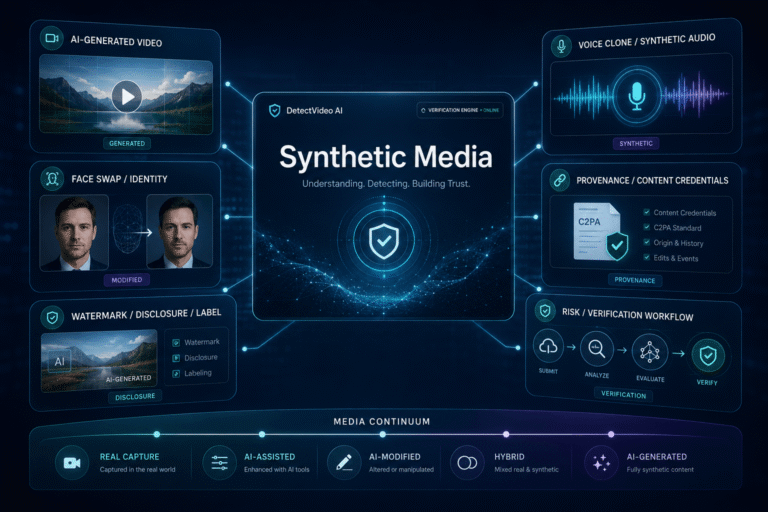
Synthetic media is digital content whose image, sound, video, text, or other meaningful elements are generated or materially altered by automated systems, especially generative AI. It includes fully generated scenes, cloned voices, AI avatars, face swaps, synthetic narration, AI-edited footage, and multimodal content that mixes captured and generated material.
But “synthetic” does not mean “false,” and “real-looking” does not mean “captured from reality.” A synthetic training video can be useful and transparent. A genuine camera recording can be misleading because of a false caption. A deepfake can be clearly disclosed as satire. The production method, the authenticity of the media, and the truth of the claim are three different questions.
Synthetic media describes how content was produced or materially changed, not whether the content is truthful, harmful, legal, or deceptive.
What Does Synthetic Media Mean?
In practical terms, synthetic media is an umbrella category for content that is wholly or partly created, reconstructed, or meaningfully transformed by computational generation systems.
The exact boundary varies by technical, academic, legal, and platform context. Some definitions focus specifically on AI-generated or AI-manipulated media. Others use a wider definition that includes automated or algorithmic media synthesis more generally.
For video verification, the most useful working definition is:
Synthetic media is media in which AI or another generative process creates or materially changes information that a viewer may otherwise interpret as captured, spoken, performed, or authored directly by a human or real-world event.
NIST uses the closely related term synthetic content in its work on digital content transparency and examines several complementary approaches for dealing with it: provenance, watermarking, labeling, content-based detection, testing, and human review. See NIST AI 100-4 on synthetic content.
Is “Synthetic Content” a Synonym for “Synthetic Media”?
They are often used interchangeably, but they are not perfect synonyms in every context.
| Term | Best practical meaning |
|---|---|
| Synthetic media | Broad media term for generated or materially altered image, audio, video, text, or multimodal content |
| Synthetic content | Very close umbrella term, often used in standards, policy, safety, and detection discussions |
| AI-generated media | Usually emphasizes content created by AI rather than captured first and then materially modified |
| AI-modified media | Captured or existing content that receives a meaningful generative alteration |
| Generative media | Media produced through generative systems; usage is less standardized |
| Deepfake | A narrower subclass involving realistic synthetic or manipulated representation, often involving identity, speech, actions, people, places, objects, or events |
| Manipulated media | Broader term that can also include conventional non-AI edits, so it is not an exact synonym |
If someone searches for a synthetic media synonym, the closest everyday alternatives are “synthetic content” and “AI-generated or AI-modified media.” “Deepfake” is too narrow to be used as a synonym for the entire category.
The Synthetic Media Map: Four Questions Classify Almost Any Example
Instead of memorizing dozens of categories, classify synthetic media along four axes.
This model is more durable than asking whether the content has an “AI look.” Two visually identical videos can have very different trust implications depending on source, purpose, and disclosure.
The Synthetic Media Spectrum
AI involvement is not always binary. Media can move through a spectrum from captured content to fully generated content.
This spectrum explains why the question “Is this AI?” can be too vague. A better question is “Which meaningful part of this content was generated or altered?”
Minor AI Assistance Is Not the Same as Meaningful Synthetic Alteration
Modern production workflows use AI everywhere: transcription, denoising, color assistance, upscaling, caption generation, background blur, script support, and audio cleanup.
Those uses do not necessarily change what the media claims happened.
By contrast, a change becomes materially important when AI creates or changes information that affects a viewer’s understanding of identity, speech, action, place, event, object, or evidence.
YouTube makes a similar distinction in its disclosure policy. Minor or aesthetic edits generally do not require its altered-content disclosure, while realistic AI changes that make a real person appear to say or do something they did not, alter footage of a real event or place, or generate a realistic event that did not occur do require disclosure. See YouTube’s altered and synthetic content disclosure guidance.
What Does “Altered or Synthetic Content” Mean on YouTube?
The phrase “altered or synthetic content” on YouTube refers to realistic content that has been meaningfully generated or changed using AI or similar tools in a way that could affect what viewers understand about the depicted person, place, event, or action.
Examples that can require disclosure include:
- making a real person appear to say something they did not say
- making a real person appear to perform an action they did not perform
- meaningfully changing footage of a real event or place
- generating a realistic event that did not occur
YouTube’s “How this content was made” area can display information such as Made with AI when the creator discloses meaningful AI use, the content comes from certain platform tools, or compatible provenance signals such as Content Credentials are available. See YouTube’s content-origin disclosure documentation.
The absence of that label is not proof that a video is fully captured or human-made. Disclosure systems have scope, workflow, and adoption limits.
Synthetic Media vs Deepfake
Deepfake is a subset of synthetic media, not another name for the whole category.
A text-to-video model can generate a fictional landscape without impersonating anyone. That is synthetic media, but not necessarily a deepfake in the useful everyday sense.
A deepfake usually matters because realistic generated or altered content changes the perceived identity, speech, behavior, or reality of a person, object, place, or event.
For the deeper category-level explanation, see the deepfake video guide.
Synthetic Media vs AI-Generated Video
AI-generated video is one branch of synthetic media.
A synthetic-media page needs to cover more than videos generated from a prompt. It also includes:
- captured footage with a synthetic face
- authentic video with cloned speech
- AI-generated presenters
- AI-modified scenes and backgrounds
- synthetic audio
- mixed media where only selected regions or moments are generated
The dedicated AI-generated video guide focuses on the narrower question of video generation and how to evaluate it.
Common Types of Synthetic Media
| Type | What is synthetic? | Typical legitimate use | Potential misuse |
|---|---|---|---|
| Generated image | Most or all visual content | Design, illustration, concept work | Fabricated evidence or identity |
| Generated video | Scene, motion, people, or objects | Creative production, visualization | False event footage or fabricated testimony |
| Face swap | Facial identity | Film, entertainment, consent-based creative use | Impersonation or false attribution |
| AI lip sync | Mouth motion and related facial regions | Localization and dubbing | Making a person appear to speak new words |
| Voice clone | Vocal identity and generated speech | Accessibility, dubbing, authorized narration | Fraud, impersonation, fake endorsements |
| Synthetic avatar | Presenter or character | Training and communication | Fake expert, customer, or authority |
| AI-modified real footage | Selected object, background, face, audio, or action | Post-production and creative editing | Changing material evidence or context |
For speech-specific synthetic identity, see the voice deepfake guide. For identity transfer in video, use the face swap video guide.
Synthetic Does Not Mean Fake, and Fake Does Not Mean Synthetic
This distinction prevents a large amount of bad verification.
| Media | Synthetic? | Misleading? |
|---|---|---|
| Clearly labeled AI training avatar | Yes | Not necessarily |
| AI-generated illustration in a fictional film | Yes | No, if context is clear |
| Real protest video reposted with the wrong country | No | Yes |
| Authentic interview cut to reverse the meaning | Not necessarily | Potentially |
| Cloned celebrity voice promoting a fake investment | Yes | Yes |
| AI-modified product demo with transparent disclosure | Yes | Depends on the claim and presentation |
The truth of a claim cannot be inferred from the production method alone.
The Three Verdicts: Production, Integrity and Claim
A useful synthetic-media investigation should avoid one overloaded “real/fake” label. Record three separate conclusions.
This model lets you say something precise such as:
“The video is AI-generated and clearly disclosed, but the statistics in the narration remain unverified.”
Or:
“The footage appears camera-captured, but the viral caption uses it for the wrong event.”
Legitimate Uses of Synthetic Media
Synthetic media is not primarily a fraud category. It is a production category with both beneficial and harmful applications.
Legitimate uses include:
- film and visual effects
- translation and lip-synchronized dubbing
- accessibility and authorized voice restoration
- training and educational avatars
- privacy-preserving or fictional characters
- advertising and product visualization
- prototyping scenes that are expensive or impossible to film
- creative experimentation
The important governance questions are usually consent, disclosure, accuracy, rights, and whether the audience is likely to confuse a synthetic representation with real-world evidence.
Where Synthetic Media Creates Real Risk
NIST’s synthetic-content work treats the problem as broader than detection alone. Risks can involve impersonation, fraud, non-consensual imagery, misinformation, evidence manipulation, and erosion of confidence in authentic media.
Identity and impersonation
Face, voice, writing style, and video can be generated or altered to represent a person who did not create or authorize the communication.
The broader identity problem is covered in the AI impersonation guide.
Fraud and deceptive advertising
A synthetic presenter, cloned celebrity, fabricated testimonial, or generated investment “proof” can create trust before the user is moved to a fraudulent destination.
The scam video guide focuses on that transaction and fraud layer.
False evidence and misinformation
Synthetic content can fabricate a scene, person, object, recording, or statement. But ordinary authentic footage with false context remains equally important, which is why synthetic-media detection is not a substitute for fact verification.
Consent and likeness
Generated or altered media can reproduce a person’s face or voice without permission. Disclosure that AI was used does not automatically resolve consent, privacy, likeness, or personality-rights questions.
Verification Should Match the Question You Are Trying to Answer
There is no single “synthetic media check” that answers every trust question.
| Your question | Best evidence to prioritize |
|---|---|
| Was AI used? | Content Credentials, provider watermark, platform disclosure, model-specific evidence, content-based detection |
| Did this event happen? | Original source, independent reporting, event records, date and location evidence |
| Did this person say this? | Original recording, official source, identity comparison, voice or lip-sync analysis where needed |
| Was this file edited? | Source comparison, provenance, version history, metadata and forensic analysis |
| Is this offer legitimate? | Business identity, official channels, destination and payment verification |
| Is this video safe to share as evidence? | Combine source, context, provenance, media integrity and claim verification |
The broader end-to-end process is covered in the video verification guide.
The Evidence Ladder for Synthetic Media
Different evidence types answer different questions and have different failure modes. A useful hierarchy starts with evidence closest to the media’s origin.
This is not an absolute ranking for every case. A clear original source can resolve a case faster than a complex detector. The principle is to prefer direct evidence over inference when direct evidence exists.
C2PA and Content Credentials: Provenance, Not a Truth Score
C2PA provides an open technical standard for recording and verifying provenance information associated with digital media.
Content Credentials can use tamper-evident, cryptographically signed manifests to describe creation and editing history in compatible workflows. Current C2PA guidance explains how these credentials can communicate AI-generated, AI-modified, and non-synthetic content. See the C2PA implementation guidance.
That makes provenance highly valuable, but it is important to interpret it correctly.
Content Credentials can help answer:
- which compatible tool or signer made a provenance claim
- whether documented edits are associated with the asset
- whether AI generation or modification was recorded
- which source ingredients were included when the workflow records them
They do not automatically prove:
- that a statement inside the video is true
- that the caption is accurate
- that a depicted event really occurred
- that the creator had permission to use every likeness
For the practical checker workflow, see the Content Credentials guide.
C2PA Metadata, Watermarks and Labels Are Different Signals
| Signal | What it does | Main limitation |
|---|---|---|
| C2PA / Content Credentials | Cryptographically records compatible provenance claims and history | Not universally present and not a fact-check of the external claim |
| Invisible watermark | Embeds a machine-detectable signal into media | Usually scheme-specific and can have robustness limits |
| Visible watermark | Shows a human-readable mark or logo | Can be cropped, copied, covered, or added later |
| Platform label | Communicates what the platform or uploader says about AI use | Coverage depends on platform rules and available signals |
| AI detector | Infers synthetic or manipulated patterns from the content | Probability and performance depend on model, media quality, and manipulation type |
The technical distinction between provenance fields and the C2PA standard is covered more deeply in the C2PA metadata guide. Watermarking is covered separately in the AI video watermark guide.
Why Detection Alone Cannot Solve Synthetic Media
NIST’s review of synthetic-content transparency describes detection as a continuing adversarial problem. Content-based detectors can depend on the generators they were trained to recognize, while new generators and post-processing can reduce performance. Partially synthetic media is especially difficult because most of the asset may be genuine while only one region, object, voice, or sequence is generated.
NIST also notes that human detection is not a dependable universal fallback and that automated, human-assisted, provenance, watermarking, and labeling approaches have different strengths and limitations.
This leads to a more useful rule:
Detection estimates production characteristics. Verification establishes what the evidence supports.
“Captured With a Camera” Is Useful, but It Has a Specific Meaning
YouTube can display a Captured with a camera disclosure when compatible C2PA-based capture technology provides secure provenance indicating the video’s origin and that its audio and visual content have not been altered within the supported chain.
That is strong provenance evidence when present, but YouTube also makes an important limitation explicit: if the disclosure is missing, it does not mean the video was altered.
The platform also describes an “air-gap” problem: a camera can record another screen showing synthetic content. In that case the new camera file is genuinely camera-captured even though what the screen depicts may itself be synthetic. See YouTube’s Captured with a camera documentation.
This is a perfect example of why provenance must be interpreted together with the claim.
Transparency Rules Are Becoming Part of Synthetic Media Infrastructure
Technical provenance is increasingly being paired with human-visible disclosure requirements.
In the European Union, Article 50 of the AI Act applies from 2 August 2026 and introduces transparency obligations for certain AI-generated and manipulated content. The European Commission’s current guidance distinguishes provider obligations around machine-readable marking from deployer obligations to disclose deepfakes and certain other AI-generated content to people. See the European Commission Article 50 guidance.
This is a general description of the current transparency framework, not legal advice. Scope, exceptions, roles, and sector-specific obligations depend on the use case.
How DetectVideo AI Fits Into Synthetic Media Verification
DetectVideo AI can add technical evidence when a supported video may contain AI generation or manipulation and the media itself remains unresolved.
Depending on the clip and available evidence, analysis can contribute signals relating to visual behavior, temporal consistency, audio-video relationships, compression, metadata, source, and manipulation.
Use technical analysis to answer a specific question:
- Is there evidence consistent with generated or manipulated video?
- Does suspicious evidence persist across time?
- Is the manipulation localized or widespread?
- Could ordinary editing, filtering, or compression explain the signal?
- Does the technical result agree with source and provenance evidence?
Do not use a detector to answer a question outside its scope. A media detector cannot independently prove that a news event occurred, a business is legitimate, or a person consented to the use of their likeness.
A Synthetic Media Record That AI Systems and Humans Can Read
If you publish, investigate, or archive synthetic media, use explicit language instead of a vague “AI” label.
| Field | Example |
|---|---|
| Production | AI-generated video / AI-modified camera footage / hybrid |
| Modified element | Face, voice, background, object, lip motion, full scene, unknown |
| Source | Original creator, official account, earlier version, unknown |
| Provenance | Valid Content Credentials / watermark / platform disclosure / none found |
| Claim status | Supported / contradicted / context mismatch / unverified |
| Confidence limits | What evidence is missing or uncertain |
This structure is useful for search, AI extraction, editorial review, and later auditing because each claim has a defined meaning.
Common Synthetic Media Verification Mistakes
Calling every AI-assisted edit synthetic evidence
Minor cleanup and production assistance do not necessarily change the represented event. Focus on meaningful alteration.
Calling every synthetic video a deepfake
Deepfake is narrower. Fully generated fictional content can be synthetic without impersonating anyone.
Calling a missing label proof of authenticity
Labels and provenance are not universal. Absence is usually an absence of evidence, not proof of human origin.
Calling a positive detector result proof of deception
Synthetic media can be legitimate and disclosed. Detection does not establish intent or truth.
Using visual artifacts as permanent rules
Generators change. Compression, filters, and ordinary video processing can also create suspicious-looking artifacts.
Ignoring the real-world claim
A technically authentic video can still be the wrong video for the caption, date, location, or event.
Key Takeaway
Synthetic media is a production category, not a truth category.
The most reliable way to understand it is to separate four things: where the media came from, what AI materially changed, what the content claims about reality, and what provenance or disclosure supports the production history.
Deepfakes, generated videos, cloned voices, face swaps, synthetic presenters, and hybrid clips all fit somewhere inside that map. None should be judged by visual intuition alone.
Use direct source evidence when available. Use Content Credentials, watermarks, and platform disclosures for provenance. Use content-based detection when the media remains uncertain. Then verify the external claim separately.
FAQ About Synthetic Media
What is synthetic media in simple terms?
Synthetic media is digital content that is wholly or partly generated or materially changed by automated systems, especially generative AI. It can include video, images, audio, text, avatars, deepfakes, and hybrid media.
What does synthetic content mean?
Synthetic content is a closely related umbrella term for AI-generated or AI-modified digital content. In many technical and policy contexts it is used almost interchangeably with synthetic media.
What is another word for synthetic media?
Common related terms include synthetic content, AI-generated media, AI-modified media, and generative media. They overlap but are not always exact synonyms. Deepfake is a narrower subtype.
What does altered or synthetic content mean on YouTube?
It refers to realistic content that has been meaningfully generated or changed with AI or similar tools in a way that can affect how viewers understand a real person, action, place, event, or realistic event that did not occur.
Is synthetic media the same as a deepfake?
No. Deepfakes are one subset of synthetic media. Synthetic media also includes generated scenes, AI avatars, synthetic narration, modified backgrounds, cloned voices, and other AI-generated or AI-modified content.
Is all AI-generated content synthetic media?
In the broad media sense, AI-generated images, audio, video, and text are forms of synthetic content. The term becomes most relevant to authenticity when generated material could be confused with captured or human-authored reality.
Does synthetic mean fake?
No. Synthetic describes how content was produced or materially altered. It does not tell you whether the creator disclosed AI use, whether the content is deceptive, or whether the underlying claim is true.
What is C2PA in synthetic media?
C2PA is an open standard for content provenance. Compatible Content Credentials can cryptographically record information about how media was created or modified, including AI-generation or AI-modification signals when the workflow records them.
Can Content Credentials prove content is true?
No. They can provide strong evidence about documented origin and editing history. They do not independently fact-check the statement, event, caption, or external claim.
Can AI detectors reliably identify all synthetic media?
No. Detector performance varies with generator, modality, compression, editing, unseen models, and whether only part of the content is synthetic. Detection should be one evidence layer rather than the sole verdict.
Does no AI label mean the content is real?
No. A label may be missing because the platform, creator, file, or workflow does not provide or preserve that signal. Absence of a label is not proof of human origin.
What is the best way to verify synthetic media?
Match the method to the question. Check source and provenance first, inspect labels or watermarks when available, compare earlier versions, use technical detection when the media remains uncertain, and verify the real-world claim separately.