
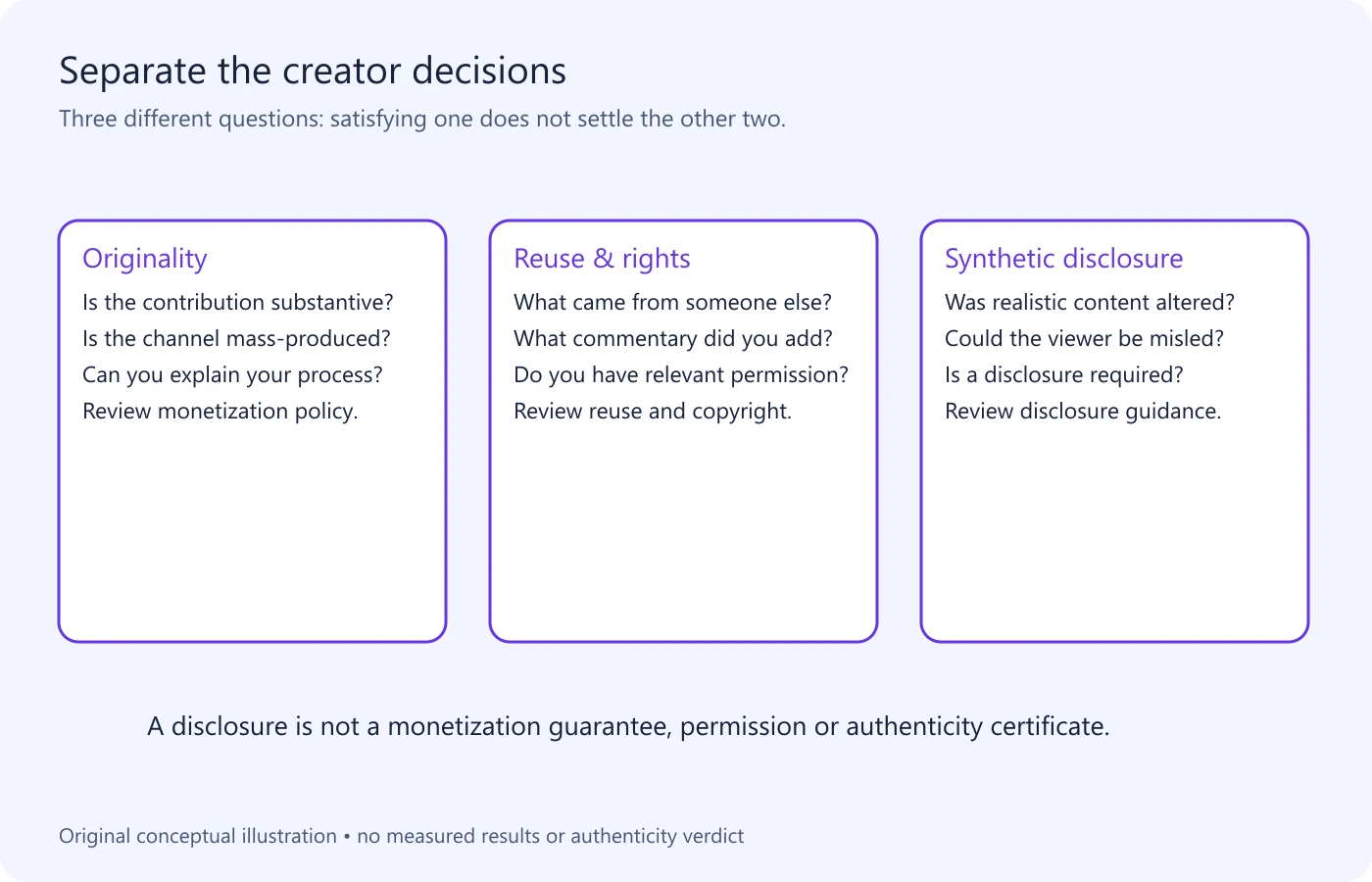
YouTube inauthentic content is a monetization concern about generic, repetitive or mass-produced material that lacks meaningful original value. It is not a synonym for every AI-assisted video. A useful creator review separates the substance of a channel from copyright, AI disclosure and advertising suitability, then documents the decisions behind its videos.
This guide gives you a practical way to audit a recurring series before you expand it. You will create an episode-by-episode contribution record, compare two illustrative production workflows, and identify where your evidence is incomplete. The worksheet is our editorial tool, not a YouTube approval test. No checklist, detector score or production log can guarantee monetization.
Start with the current policy, not a blanket AI ban
YouTube’s channel monetization policy records the change from “repetitious content” to “inauthentic content” in July 2025. The current guidance addresses generic or repetitive work, reused material, unsatisfying or manipulative formulas, and AI personas presenting sensitive-topic expertise. Similar branding is different from interchangeable substance; permission to reuse an asset is different from adding original value.
Read the live guidance before making a channel decision. Its examples and headings can evolve. Do not treat a creator’s old screenshot, a social-media claim about a “faceless-channel ban,” or this article as the final authority for your particular notice. Copy the exact policy category shown in YouTube Studio into your review notes, then investigate that category.
The broader direction is also visible in YouTube’s official explanation of its 2026 priorities: the platform discusses creative AI tools and reducing low-quality repetitive material together. That is a reason to evaluate what the viewer receives, rather than simply asking whether an automated tool appears anywhere in production.
Keep four production decisions separate
A creator can fix the wrong problem when every warning is reduced to “AI content.” Use the following planning table to keep different evidence folders separate. It describes questions to investigate, not an official eligibility formula.
| Decision | Question for your review | Useful record |
|---|---|---|
| Original contribution | What can the viewer learn or experience here that the other episodes do not provide? | Episode thesis, demonstrations and editorial changes |
| Source use | What came from elsewhere, and what did you do with it? | Source list, rights notes and contribution map |
| AI transparency | What was generated or meaningfully altered? | Generation notes and disclosure decision |
| Earning eligibility | Which current program requirements and notices apply? | Studio status and relevant official guidance |
For example, an original demonstration may contain a synthetic illustration. An entirely camera-recorded compilation may contribute little beyond assembling other people’s footage. Those observations belong in different columns. Recording them separately prevents you from trying to solve weak editorial substance by changing a voice, or trying to solve a permission problem by adding a disclosure label.
YouTube’s GenAI disclosure guidance covers specified realistic generation and meaningful alterations. It also states that disclosure itself does not remove earning eligibility. Our existing guide to YouTube altered or synthetic content explains that transparency task in depth. Keep this article’s channel-originality worksheet separate from the upload-label workflow.
Eligibility is another separate task. YouTube’s earning overview explains that program participation and individual earning features have requirements. A persuasive creative record is therefore only one part of your preparation. Check your own account’s current status rather than assuming that a good episode automatically unlocks every feature.
A five-part audit of creative substance
Choose a manageable sample from the series you want to review. Include several adjacent episodes rather than only your favorite video. Keep the selection small enough that you can inspect the scripts, source assets and final edits closely. Write down why you selected each episode. This avoids a convenient sample that hides the repetition you were trying to evaluate.
1. Name the specific viewer task
Finish the sentence “After this episode, the viewer can…” with a concrete outcome. “Learn about cameras” is too broad to guide an audit. “Choose between two microphone positions for recording a quiet kitchen demonstration” gives you something to inspect. For entertainment, describe the distinctive story, joke, perspective or character development instead of inventing a practical learning goal.
Compare those statements across your sample. If the only change is a product name or location, ask what changes inside the video. A series can use a consistent format while answering different questions. Your record should show those differences directly, without depending on the thumbnail to make every episode feel new.
2. Identify your contribution at the relevant moments
For each episode, select a few moments that carry its value. Note the time in the final edit and describe the decision you made there. Perhaps you explain why one setup failed, compare two sources that disagree, demonstrate a different technique, or build an original scene. Be precise enough that a colleague can find the moment and understand the contribution without your commentary.
“Edited in our software” is a process statement, not a description of the resulting value. Try “Compared the two recordings at the same playback level and explained why the refrigerator hum changes the choice.” This connects the work to something visible or audible in the episode. It also gives you a useful quality-control reference when a later revision accidentally removes the explanation.
3. Test what survives a subject swap
Take a script from the sample and imagine replacing its main subject with the subject of another episode. Which sentences, demonstrations and conclusions still work unchanged? A greeting, visual identity or explanation of a recurring method may reasonably survive. If the central argument and examples survive as well, your episodes may be sharing more than a format.
Mark each passage as reusable structure, subject-specific evidence or subject-specific interpretation. You do not need a percentage threshold. The exercise is meant to reveal missing decisions, not to calculate a platform score. Revise the episode around its actual question: add the detail that would become wrong, incomplete or irrelevant if you swapped the subject.
4. Match the promise to what is demonstrated
Read the title and thumbnail before watching the final edit. Write down the question you expect it to answer. Then identify the exact sequence that answers it. If the title promises an explanation of a failure but the video only shows a dramatic outcome, the editorial gap is clear even before you discuss a monetization category.
For synthetic illustrations, check what the viewer may mistake for documentation. A generated diagram can clarify a proposed mechanism, but it should not masquerade as a recorded experiment. Label illustrative scenes in the context where they appear. Keep an explanation of what you actually observed separate from what you used an image tool to imagine.
5. Review the sequence as an audience experience
Watch your sample in order. Note where you feel that you already know the next turn, conclusion or emotional payoff. Repeated pacing is not automatically a defect, but it can hide repeated substance. Ask whether the series progressively builds knowledge, explores different situations or advances a story, rather than simply giving the same promise a new surface.
A colleague can help by writing one sentence about what each episode adds. Give them the videos before your production notes so that the notes do not supply value missing from the finished work. If they cannot distinguish the contribution of neighboring episodes, use that observation to improve the series. Do not turn it into a fabricated audience study or an official policy determination.
Worked example: two kitchen-video production plans
The following example is illustrative. It describes invented planning choices, not channels we tested, actual YouTube decisions or guaranteed earning outcomes. Both plans use the same title-card style and a recurring kitchen setting. That shared presentation is not the key difference. Their editorial records show what the creator chose to investigate.
Plan A: an interchangeable product script
The first plan starts with a script template: introduce an appliance, show a polished scene, list three benefits, promise an easier life and end with a purchasing suggestion. A new product name and generated backdrop are inserted for each episode. The producer has no recording of the appliance in use and no explanation of how its listed benefits were checked.
Our worksheet cannot establish how YouTube would classify this channel. It does reveal practical weaknesses. The audience task is vague, the benefits may be unverified, and the script can be transferred to another product without changing its reasoning. More elegant graphics would not repair those gaps. Neither would a different narrator reading the same unsupported statements.
Plan B: an episode about one documented problem
The second plan investigates why a countertop recording sounds different when the microphone is moved. The creator records the two positions, keeps the unedited audio, explains the room arrangement and identifies a limitation: other rooms may behave differently. A simple generated diagram shows the positions, while the audio demonstration remains connected to the real recording.
The next episode addresses a different problem, such as how a reflective counter changes the camera view. It needs a different demonstration and conclusion. The recurring introduction can stay; the substance cannot be produced by replacing “microphone” with “camera” in the first script. The producer’s records now point to specific editorial work rather than a generic assertion of originality.
| Worksheet entry | Plan A | Plan B |
|---|---|---|
| Viewer task | Unclear benefit promise | Compare two recording positions |
| Episode-specific evidence | Product statements without verification | Identified recordings and room diagram |
| Contribution | Subject name changes inside one script | Explanation of a distinct practical choice |
| Remaining uncertainty | Claims and production origin need review | Results cannot be generalized to every room |
You can adapt the same method to fiction, animation or commentary. A fictional episode might contribute a new character conflict rather than a measurement. A commentary episode might compare competing explanations rather than record a physical demonstration. The useful question is what makes this installment worth watching in its own right, not whether every channel must use one approved production style.
Keep the exercise honest. Do not create a demonstration after the fact and imply that it supported an earlier claim. If the original episode lacks evidence, record that gap and revise the content appropriately. A tidy production folder should make uncertainty visible, not cover it with confident language.
Build a production record that someone else can follow
A useful record connects the final video to your actual process. It does not need to be elaborate. Begin with one document per episode and link to the working files you already keep. The following six entries are an optional organizational method; YouTube does not prescribe this particular form.
- Purpose. Write the specific question, story or experience the episode provides. Include the intended audience and the point where the video delivers on its promise. If your purpose changes during editing, preserve a brief explanation rather than silently replacing the initial plan.
- Source map. Identify footage, audio, research and illustrations from outside your production. Record where each item came from and what permission or other rights question you considered. Keep this map separate from your notes about originality: the two records answer different questions.
- Contribution map. Link several moments in the final edit to your explanation, demonstration, narrative choice or substantive modification. Describe the result in ordinary language. Another editor should be able to connect the note to the final piece without needing access to your private intentions.
- AI-use record. Note what was generated, which assets it affected, and how you represented those assets to viewers. A production assistant and a fictional expert presenter are different situations. Preserve your actual disclosure reasoning; do not invent a neat workflow that you did not follow.
- Verification and limitations. Connect important factual claims to the source or recording that supports them. If a statement is uncertain, say why. Explain when an illustration is conceptual, a comparison is incomplete, or a result is specific to one setup. This makes later corrections easier.
- Revision trail. Keep meaningful versions of the script and final edit, with a short note about major changes. Avoid unnecessary personal information, credentials or private audience data. Protect raw recordings and permission documents appropriately instead of attaching the whole folder to a public video description.
Use descriptive filenames that connect the work to the episode, such as a project name and revision label. Your exact naming system matters less than being able to retrieve the right source. Test the record by opening it a week later and finding one important moment. If the links are broken or the notes refer only to “final-final,” simplify the system before expanding production.
For collaborative work, identify who created and reviewed the relevant component. Record a real role rather than an invented credential. If one person provides narration and another writes the analysis, that is useful context. It does not turn the project into a guaranteed policy pass, but it helps you explain the process accurately when a question arises.
Place AI assistance inside a deliberate workflow
Decide what a tool is helping you accomplish before generating assets. An outline can organize your research; it cannot replace checking whether a claim is supported. A generated visual can explain a concept; it cannot document an event you never recorded. Treat the output as a production ingredient that still needs editorial judgment.
When a tool proposes several versions, record why you chose one. Perhaps the diagram makes a complicated relationship easier to understand, or the fictional scene matches a deliberate narrative. “It looked impressive” may explain an aesthetic preference, but it does not explain how an unsupported claim became valid. Review both the pixels and the message you attach to them.
If you are creating a presenter, ask whether viewers may mistake the character for a real expert or a customer describing personal experience. Check the current sensitive-topic guidance before proceeding. For the distinct advertising and testimonial problem, read our guide to AI UGC. It addresses creator-style commercial claims rather than this article’s series-originality worksheet.
A technical video analysis can support a media question when you do not know the origin of a supplied clip. It cannot determine whether your whole channel adds original value, whether you have the required permissions, or whether YouTube will approve monetization. Keep technical findings narrow and preserve the source file. Do not submit private production material unnecessarily just to obtain a reassuring score.
The wider quality-and-scale discussion belongs in our AI slop guide. Here, the useful next step is more specific: connect each episode’s purpose to the work that actually appears in it. Publishing fewer well-defined episodes may give you a clearer editorial process than multiplying versions whose main difference is their subject label.
If you receive a monetization notice
Read the notice in your own account and save a private copy. Establish whether it concerns program participation, an application, an individual video or another issue. Do not assume that someone else’s remedy fits your situation. A channel audit is useful preparation, but it does not replace the actual process and deadline shown to you.
YouTube’s official appeal guidance describes supported appeal routes and different deadlines for scheduled and completed suspensions. It says appeals assess the channel’s current state and advises against deleting videos before submission. Where video appeal is available, its instructions call for a brief unlisted upload showing production and connecting examples to the relevant policies. Follow the current account instructions and official page precisely.
Organize your explanation around the identified issue. If the question is about repetitive substance, show how adjacent episodes differ and point to their actual contributions. If the issue concerns reused sources, connect your source map to the final edit. Avoid a long list of tools as your main argument; tool ownership does not describe what the viewer received.
Do not alter records to make the process look more impressive. Show the parts you can substantiate, identify missing evidence, and seek account-specific guidance when needed. If you decide to revise a series, distinguish planned changes from changes already completed. A proposed recording, additional explanation or new episode is not evidence that the existing content contained it.
A practical review before the next upload
Use this short checklist after completing the worksheet. It is a final editorial check, not a substitute for current platform rules:
- The episode has a specific purpose that differs from its neighbors.
- The final edit contains the contribution described in your notes.
- Important factual claims connect to real supporting material.
- Borrowed assets and your treatment of them are identifiable.
- Synthetic demonstrations are not presented as recordings of real tests.
- The title and thumbnail promise something the video actually delivers.
- Your disclosure decision is based on current guidance.
- Another editor can follow the production record without guessing.
When an entry fails, identify a concrete action: verify the claim, add the missing explanation, change an unsupported promise or document the uncertain source. Avoid chasing cosmetic signals that merely make the video look more labor-intensive. The goal is a series with distinct, understandable contributions and an honest record of how they were produced.
Verify a clip before building on it.
Review suspicious video material while keeping your own production records. Technical media evidence supports one part of your review; it does not certify originality or monetization eligibility.
Questions creators ask about inauthentic content
Does using AI automatically make a video inauthentic?
No blanket conclusion follows from tool use alone. Review the current policy and what the episode contributes. In your own worksheet, distinguish production ingredients from the final explanation, story or demonstration the audience actually receives.
Is a recurring introduction the same as repetitive content?
A shared introduction does not tell you whether the substance is interchangeable. Compare the central questions and contributions of adjacent episodes. Our subject-swap exercise helps identify repetition without turning consistent branding into the entire assessment.
Will an AI disclosure label solve an originality problem?
No. A disclosure communicates relevant production information. It does not add an explanation, demonstration or original narrative missing from the video. Keep the disclosure decision and creative-contribution review in separate records.
What should I preserve while making a series?
Keep retrievable source assets, scripts, meaningful revisions and notes connecting your contribution to the final edit. Our six-entry record is an optional organizational method, not an official document requirement or a guarantee that an appeal will succeed.
Can a detector tell me whether my channel will monetize?
No. Technical analysis of a specific video cannot substitute for channel review, rights checks, current eligibility rules or YouTube’s decision. Use media analysis for the media question and the appropriate official workflow for the program question.
Sources and policy checks
- YouTube channel monetization policies — YouTube Help.
- Disclosing use of GenAI content — YouTube Help.
- How to earn money on YouTube — YouTube Help.
- Appeal a YouTube Partner Program suspension or application rejection — YouTube Help.
- From the CEO: What’s coming to YouTube in 2026 — YouTube Blog.