
Prebunking prepares people to recognize misleading persuasion before they encounter it. Instead of correcting one claim after it spreads, a defensive lesson can warn about a recurring technique, explain why its reasoning is weak, and use a harmless example for practice. Recognizing the technique is a cue to verify, not proof that a particular claim is false.
This guide provides an original preparation worksheet for everyday readers and small editorial teams. Its examples are fictional, nonpolitical and deliberately low stakes. They are not a tested intervention, a recipe for manipulating an audience or a guarantee of resistance to deception. The existing news verification guide remains the place for checking an actual news claim.
Prebunking and debunking answer different timing questions
Debunking addresses a claim that already needs correction. A prebunk aims to prepare the reader for a misleading argument or presentation they may encounter later. The distinction is not that one uses facts and the other avoids them. It is whether the explanation is offered as advance preparation or as a response to a particular assertion.
For example, you can learn in advance that a message may offer only two choices when other reasonable options exist. When a real post later does that, you have a question ready: what choices were omitted? The preparation does not tell you which real-world option is best, or whether every sentence in the post is wrong.
The original 2022 Roozenbeek and colleagues study tested short technique-focused videos using controlled studies and a YouTube field study. It provides evidence for that research setup, not a promise that this article protects every reader. Its field measurement concerned technique recognition within a limited period; it was not a complete record of people’s later sharing behavior.
Do not treat the term inoculation as literal medical immunity. It is an analogy used in a psychological theory. A person who remembers an explanation may still miss a tactic, disagree about its application or lack the evidence needed to check the claim. Preparation should make a useful next question easier to ask, not make the reader feel invulnerable.
Nor does preparation make later correction unnecessary. If a misleading claim is already circulating, clear evidence and context are still needed. A team can maintain a general defensive lesson while also responding to a specific error. Keep the roles distinct so a reusable explanation does not become an excuse to avoid checking the actual case.
Choose a defensive goal before choosing examples
Write the goal as something a reader can do: notice when a forced choice replaces evidence, separate an emotional demand from a factual premise, or ask whether an apparent authority is relevant. Avoid goals such as making everyone agree with a preferred conclusion. That would confuse media-literacy preparation with persuasion toward an outcome.
A useful preparation card has a narrow scope. It should tell the reader what pattern to notice, why the pattern does not settle the question, and what ordinary verification action remains available. A broad warning that everything online is deceptive gives no discriminating task. It can also encourage a reader to dismiss good information without examining it.
For a small editorial team, connect the goal to a recurring review difficulty. Perhaps urgent captions cause staff to repeat a source claim before reading it. The defensive preparation can explain that urgency is not supporting evidence and rehearse a pause-and-source-check response. It need not teach the whole newsroom workflow or assign a motive to every urgent message.
Keep the objective independent of party, identity or personal dislike. Apply the same explanation to a message that supports your view and one that challenges it. A technique should be identifiable from the relationship between argument and evidence, not from whether you like the speaker. Genuine disagreement must remain possible after the lesson.
Finally, define what the lesson does not cover. Recognizing a rhetorical problem cannot establish a video’s recording date, locate a scene or verify a transaction. Those require other checks. Stating the boundary before practice reduces the risk that a memorable lesson becomes a universal authenticity shortcut.
Use warning, harmless example and explanation as a preparation structure
The original Cambridge, BBC Media Action and Jigsaw practical guide describes warning, preemptive explanation or refutation, and a weakened harmless example as components of prebunking. It also discusses limits of short messages and changing audiences. The worksheet here applies that idea independently rather than copying the guide’s examples.
Give a calm, specific warning
Say what the reader might encounter, not that an unseen enemy controls everything. “A post may treat asking for evidence as disloyalty” is a bounded warning. It leaves the reader free to evaluate the next post. A vague alarm that everyone is trying to deceive them adds pressure without teaching a useful distinction.
Make the warning understandable without specialist terminology. You can introduce false dichotomy later, but the initial question can be ordinary language: are these really the only choices? That wording lets a reader use the skill before remembering a label. The point is not to win a vocabulary quiz.
Use an example that cannot become a harmful rumor
Choose a wholly invented, trivial setting and label it before the example. A fictional paper-kite club is more suitable for this exercise than a fabricated statement about a real public figure. Avoid real logos, names, emergencies or financial offers. You do not need a believable harmful claim to demonstrate a weak argument.
Keep the example short enough that its reasoning is visible, but supply the corrective explanation immediately. A dramatic isolated screenshot can travel without its lesson. Prefer a complete card or paragraph that identifies the fictional setting, the pattern and the reason it does not establish the conclusion.
Explain the gap and the safe next question
Do not stop at “this is manipulative.” Identify the gap: a demand for loyalty does not answer how a contest winner was selected. Then give the reader an appropriate next question, such as asking for the selection rule. That connection turns a label into a defensive habit while avoiding a verdict about an unknown real claim.
The explanation should also identify a legitimate counterpart. A deadline can be real; a passionate appeal can be honest; an expert can be relevant. The problem arises when presentation is used instead of the evidence needed for the conclusion. Showing the counterpart helps readers avoid treating every strong feeling or authoritative voice as deception.
Practice with neutral patterns, not a catalog of enemies
In the following original examples, Meadow Kite Club is entirely fictional. No actual competition, complaint or announcement is represented. The exercise concerns reasoning and presentation only. It does not establish whether a real club’s policy is fair, whether a speaker intended harm or whether any footage was generated.
| Fictional message pattern | Gap to notice | Safe reader question |
|---|---|---|
| A choice between supporting the club and asking about its rules | Those actions are not necessarily opposites. | Can someone support the activity and still request the rule? |
| A demand to react immediately to a dramatic prize announcement | Strong feeling does not establish the announcement’s source. | Where is the club’s actual notice? |
| A decorated presenter treated as proof of the judging result | Appearance does not show authority for this contest. | What connects this presenter to the judging record? |
| An insult used instead of answering a question about selection | A personal attack does not supply the missing explanation. | What evidence addresses the selection question? |
These examples are not a comprehensive list of persuasion techniques. They give a reader several opportunities to practice the same separation: what response is requested, and what supports the factual statement? Naming every possible rhetorical label is less important than recognizing the missing link in the particular exercise.
There can be more than one reasonable description of a pattern. A fictional message may combine emotional pressure and a forced choice. Ask readers to explain the evidence gap rather than argue over one mandatory label. The worksheet is useful if it leads to a proportionate check, not if it creates a contest to identify the most suspicious interpretation.
A worked preparation card: asking a question is not opposing a project
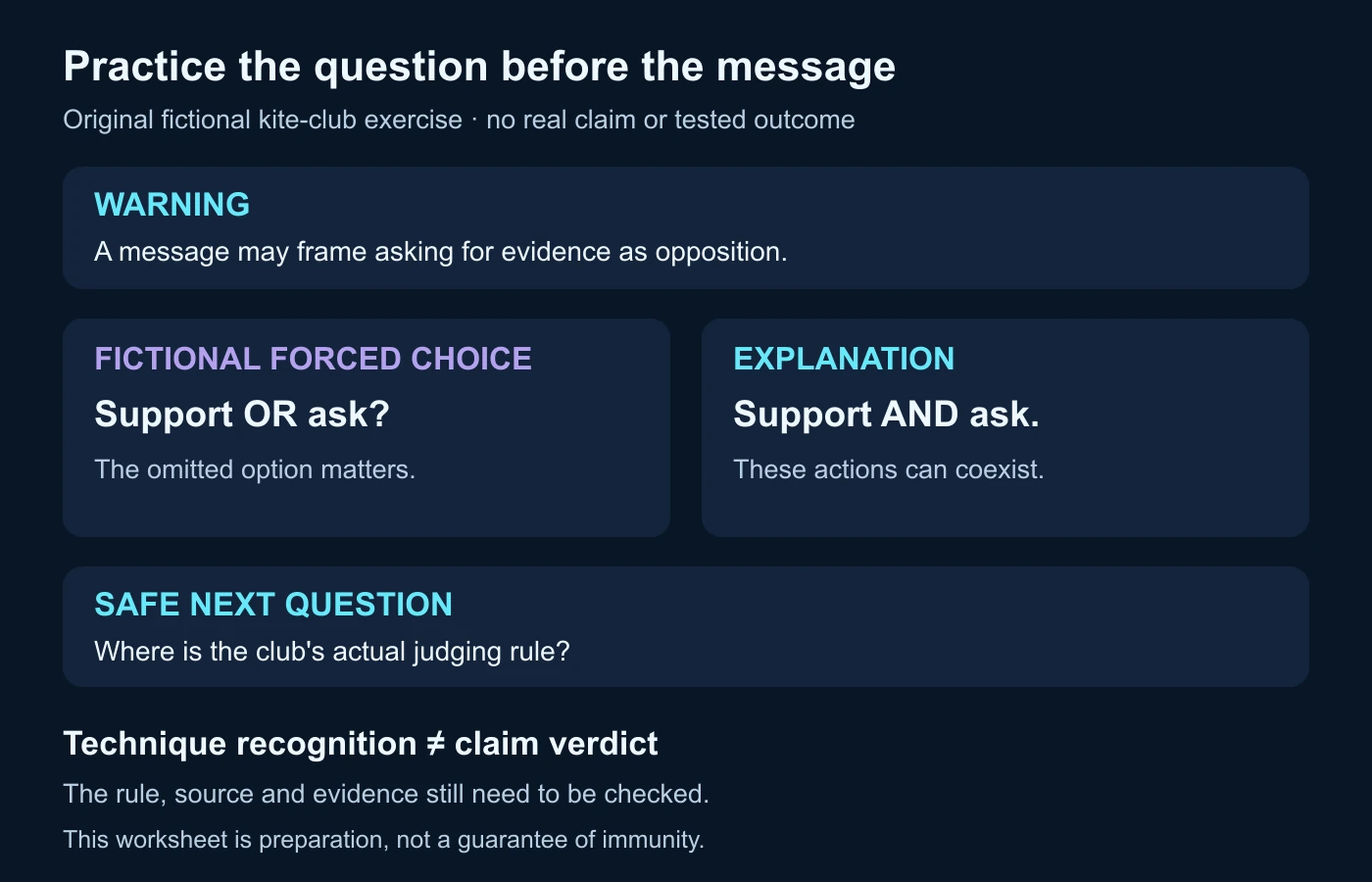
Imagine you want to prepare a club newsletter reader for a forced-choice argument. The original card begins with a narrow warning: some messages may frame a request for evidence as opposition. It then gives the fictional example that supporting a paper-kite activity and asking for its judging rules are mutually exclusive. The explanation shows why that exclusion has not been established.
Write the response in your own words
A reader’s response might be: “I can support the activity while asking how the judging works.” That sentence identifies the missing option. It does not accuse the fictional organizer of fraud, declare the contest unfair or assume the answer to the judging question. The preparation stays defensive because it preserves the reader’s ability to ask and evaluate.
Next, the reader names the evidence needed: the published judging rule or an attributable explanation. The question follows from the reasoning gap, not from a general belief that organizations should be distrusted. If the rule is supplied, the reader can inspect it. If it remains unavailable, the missing information can remain unresolved.
Compare a legitimate counterpart
A neutral counterpart says that the club welcomes support and publishes its judging rule for anyone who wants to inspect it. Another could say that a submission deadline is approaching while still allowing questions. Neither proves the contest is perfect; both leave the evidence question open rather than making inquiry a test of loyalty.
Ask what changed between the fictional versions. The useful answer concerns available options and inspectable evidence, not merely a softer tone. A politely worded false choice can still exclude a reasonable action. An emotional but well-supported notice can still contain relevant information. Practice should notice those distinctions rather than reward a preferred style.
Keep practice separate from measurement
A completed worksheet records that you articulated a response to this example. It does not show how well you will respond to unfamiliar material next month. Do not convert a small exercise into a resistance score or claim that a group is protected because everyone filled in the boxes. Formal outcome claims require an appropriately designed evaluation.
For an informal team discussion, a more modest success condition is that participants can state the missing option and identify a safe evidence question. Record misunderstandings so the explanation can be improved. That is feedback on the lesson’s clarity, not a measured reduction in real-world misinformation or a substitute for the research cited above.
Prepare without amplifying a harmful claim
Keep the fictional label attached whenever the example is reused. If a cropped card or slide loses the explanation, it can resemble an unsupported assertion rather than a lesson. Before sharing educational material, check that the invented setting and corrective reasoning remain readable in the format a viewer will actually see.
Do not use the exercise to rehearse realistic impersonation, a fraudulent payment funnel or targeting of a vulnerable group. The defensive learning goal can be demonstrated with low-stakes reasoning. A preparation lesson does not need details that make a harmful message easier to deploy, or a real person’s likeness to make false authority recognizable.
Let people decline an example that is upsetting or irrelevant to their context. A neutral explanation can be offered without forcing someone to recount a personal experience. Avoid collecting private stories or treating a reader’s prior mistake as proof that they need public correction. A useful exercise supports reflection rather than humiliation.
Accessibility matters to the defensive purpose. Use plain language, a readable text explanation and a diagram that does not depend on color alone. If the activity uses audio or video, give the same essential reasoning in text. Do not make the lesson’s meaning depend on a fleeting animation or an intimidating performance.
For a small team, preserve the example, explanation and review notes together. When someone updates the card, check that the new version still teaches the same bounded skill. More dramatic wording is not automatically better instruction. The safe next question should remain easier to notice than the fictional claim.
Review the preparation card before using it with a team
Give a colleague the complete fictional card and ask them to explain its lesson without a prompt. This is a clarity check, not a controlled assessment of deception resistance. If they remember only that the invented club is suspicious, revise the card: the intended takeaway is that asking for a rule and supporting an activity can coexist.
Use four short review fields. The first records the pattern the colleague noticed. The second records the missing evidential link. The third records what the card does not establish. The fourth records a safe next action. Those fields help you see whether the lesson retained its boundary rather than merely making the example memorable.
For the kite exercise, an acceptable boundary is that the card does not establish unfair judging or a deceptive organizer. The safe next action is to inspect the rule, not confront someone or spread a warning about the fictional club. If the response becomes a broad accusation, make the distinction between a reasoning gap and a factual verdict more visible.
Review the legitimate counterpart too. Ask whether a reader can explain why a real deadline or a passionate invitation might be appropriate while the evidence question remains open. A lesson that only teaches suspicion misses this distinction. Keep enough explanation that readers can apply the same standard to a message they already like.
Finally, check what happens when the card is separated from your verbal explanation. The fictional label, the missing option and the safe question should all remain understandable. If a social preview crops them away, use a different presentation instead of distributing an isolated misleading sentence. The review is about making defensive instruction complete, not optimizing its reach or emotional impact.
Understand limits before applying the lesson elsewhere
The original study’s methods and discussion matter because recognition under a defined setup is not universal resistance. Its U.S.-focused materials and samples do not establish identical outcomes in every language or culture. The field test’s limited time window also does not demonstrate permanent learning. No percentage improvement is claimed for the original examples in this guide.
In your own use, a technique label may not transfer neatly to every setting. A concise message can omit context because of a format limit rather than a deceptive motive. An urgent announcement may concern a genuine deadline. When you notice the pattern, inspect what is missing and what evidence is available before assigning an intent.
A further danger is overgeneralized suspicion. If the lesson makes every confident statement feel untrustworthy, it has not given the reader a discriminating check. Return to the legitimate counterpart: confidence can accompany evidence, and emotion can accompany a truthful account. The relevant issue is whether the presentation replaces the support needed for the claim.
Preparation also cannot predict every new tactic or resolve specialist questions. A reader might identify a false choice while still lacking the knowledge to evaluate a technical assertion. In that case, seek a relevant source rather than treating technique recognition as subject expertise. Remembering a lesson and knowing the answer are different achievements.
If you refresh the exercise later, revisit the reasoning rather than inventing a fixed booster schedule for everyone. The need for a reminder depends on the purpose and audience; this article has not tested a retention interval. A calm review of the same evidence gap is preferable to repeatedly exposing readers to dramatic fictional rumors.
When you encounter a real message, move from preparation to verification
Mike Caulfield’s original SIFT framework provides a complementary source-and-context approach, including investigating the source and tracing original context. That is a different role from our fictional practice card. Recognizing a persuasive pattern should lead you toward evidence, not let you skip the source check.
If a real video borrows newsroom appearance, use the existing AI news video guide to examine the actual publication and media relationship. A convincing presenter does not establish the reporting, but neither does artificial-looking presentation prove that the underlying account is false. The preparation supplies a question; verification supplies case-specific support.
If the message requests money, credentials or an unsafe action, the scam video guide owns the transaction and destination checks. You do not need a technical media verdict before refusing an unverified high-risk request. Avoid turning a low-stakes rhetorical exercise into operational advice for handling a financial or account emergency.
Use a short closing checklist for ordinary reading: identify the requested reaction, state the evidence gap, preserve the factual question, and choose an independent way to check it. If the evidence remains missing, qualify the claim or withhold amplification. You do not need to prove a publisher’s hidden motive before deciding not to repeat an unsupported statement as fact.
The lasting value of prebunking is preparation for a better response, not a badge of immunity. Practice a bounded pattern with harmless material, keep the legitimate counterpart visible, and use the skill to ask a more precise question when real content arrives. Then let the actual source, context and evidence determine what you can responsibly conclude.
Recognize the tactic, then verify the footage.
Add a video check to independent source verification.
Questions about prebunking
How is prebunking different from debunking?
Prebunking prepares a reader for misleading reasoning before a particular encounter. Debunking addresses an assertion that already needs correction. Both should preserve the role of evidence.
Does recognizing a manipulation technique prove a claim is false?
No. It identifies a reasoning or presentation problem worth checking. The factual statement still needs appropriate source and contextual evidence.
Does psychological inoculation mean permanent immunity?
No. The analogy does not establish permanent protection. Outcomes depend on the actual lesson, audience, task and measurement; this worksheet has not been experimentally evaluated.
Must a practice exercise repeat harmful misinformation?
No. A clearly fictional, low-stakes example can expose a reasoning gap without repeating a real rumor or impersonating a real person.
Can an AI video detector replace prebunking or claim verification?
No. Technical video findings concern the media. Defensive reading, source context and evidence for the factual claim are separate parts of a responsible review.
References and scope
- Roozenbeek and colleagues: Psychological inoculation improves resilience against misinformation on social media — original 2022 research; methods, population, outcome and discussion limits were read. No results assigned to our exercise.
- Cambridge, BBC Media Action and Jigsaw: A Practical Guide to Prebunking Misinformation — original guide’s structure, safe-example and limitation sections; not a copied lesson or campaign.
- Mike Caulfield: SIFT, The Four Moves — original source/context framework, complementary to advance preparation rather than another prebunking experiment.
Sources read on 14 October 2026. Meadow Kite Club, messages, worksheet and diagram are original fictional educational material. No real campaign, intervention outcome or participant result is represented.