
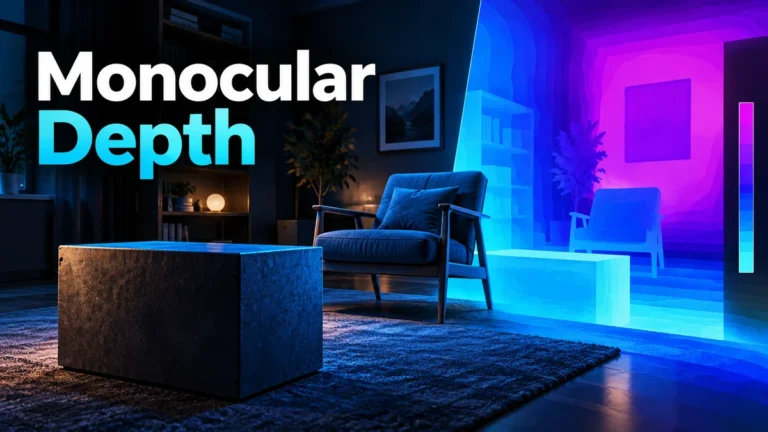
Monocular depth estimation predicts scene depth from a single image. Depending on the model and output, that can mean a relative ordering of nearer and farther areas or estimated distances in physical units. Neither a colorful map nor a detailed contour automatically establishes measured geometry. Read the output’s definition before deciding what it tells you.
The most useful starting question is not which map looks most impressive. It is whether the map answers your particular question about the source image. This guide uses an original, hypothetical room scene to separate depth order, scale, display choices and evidence limits. The examples are teaching material; no depth model or physical measurement experiment was run.
What monocular depth estimation predicts
A normal image records an appearance from a viewpoint, not an explicit distance value at every visible pixel. A monocular depth model infers a depth representation from that appearance. The official Hugging Face task guide distinguishes relative depth from absolute or metric depth. The distinction should accompany any output you are asked to interpret.
Keep four things separate: the source image, the model’s prediction, a visualization of the prediction, and the claim somebody makes with it. A screenshot of colored bands usually shows only the third item. Without the first two, a reviewer may be unable to check which input was used or what the displayed values originally meant.
Consider a fictional room with a box in the foreground, a chair beyond it and a rear wall. A conceptual depth map might make that order easy to see. It does not follow that the map establishes the room’s dimensions, the chair’s exact position, or the date the image was recorded. Those are different questions with different evidence requirements.
Write your intended question before inspecting the overlay. “Does this map place the visible box in front of the chair?” is a depth-order question. “How far is the chair from the camera?” asks for scale. “Was this room actually recorded?” concerns origin and authenticity. A helpful output for the first question may be insufficient for either of the others.
This also keeps depth prediction separate from object labeling. A smooth depth region does not necessarily identify a chair, and a correctly named object does not supply its distance. Both kinds of representation can be useful without being interchangeable. If the actual task concerns whether a video was generated or manipulated, our AI video detection methods guide covers broader evidence families rather than treating geometry inference as an authenticity verdict.
Relative depth and metric depth are different promises
Relative depth describes relationships within a scene. It may support a comparison such as one region being nearer than another, without supplying a real-world distance. Metric depth aims to express depth in units such as meters. “Metric” describes the output’s intended meaning; it does not promise that every prediction is an accurate measurement.
The original MiDaS project documentation explicitly distinguishes its relative maps from a metric extension used by ZoeDepth. This is a useful historical example of why the particular model matters. The repository is archived, and this article is not recommending an installation or reproducing its performance tables.
| Representation | Useful reading | Missing information to request |
|---|---|---|
| Relative depth | The map’s ordering of the box, chair and wall | Do not invent meters from a color difference. |
| Metric prediction | Estimated depth values with documented units | Model, input conditions and suitable validation for the intended use |
| Color preview | Displayed spatial pattern under a supplied legend | Underlying values and the display transformation |
| Physical measurement | A result obtained through a defined measurement procedure | Method, reference conditions and uncertainty appropriate to the claim |
Do not convert a relative map into a metric claim by attaching a guessed number to one object. A familiar-looking chair is not automatically a verified size reference. Its design, orientation, crop and distance all matter. If an application needs dimensions, ask what establishes the scale and how the specific output was checked.
Similarly, a depth value printed with several decimal places is not evidence of equally precise knowledge. The number can be a model output while its uncertainty remains undisclosed. A useful report identifies the representation and validation limits instead of copying the apparent precision into a factual statement.
Sometimes the relevant conclusion is simply that the supplied material cannot answer the requested measurement question. That is not a failure of understanding. It is the correct boundary between interpreting an inference and claiming a measurement that has not been independently supported.
Read the legend before reading a depth map
Start with the display convention. Does a brighter region indicate near or far? Is the palette showing depth, inverse depth, or a normalized preview of an underlying prediction? Request a legend that answers those questions. There is no reason to assume that another project’s familiar colors mean the same thing here.
A visualization can change without a change to the source scene. The Hugging Face documentation demonstrates turning predicted values into a display range for a preview. That makes the pattern easier to view, but the preview’s color scale is not automatically a scale of physical distances. Keep the underlying output separate from the image created to show it.
For the fictional room, identify the box, chair and wall in the unaltered source first. Then locate the corresponding regions in the map. If a map has been resized or cropped, establish how it aligns with the source before evaluating a boundary. A colored edge in the wrong position may be a display alignment problem rather than the depth error someone claims.
Review the broad arrangement before zooming into small contours. Does the displayed order follow the legend? Does a continuous wall appear as a coherent region? Where does the foreground box meet the floor? These questions help you describe what the visualization says without treating every color transition as a real physical step.
Do not compare colors across unrelated images unless their display scales are compatible. A dark chair in one preview and a light chair in another may reflect different normalization, not a change in measured distance. Ask for the convention and underlying values before making a cross-image claim.
A good note names the source, the map, the display rule and the region being discussed. “Under this preview’s near-to-far legend, the box is shown ahead of the chair” is specific. “The AI knows the room” skips the very information another reviewer needs to assess the conclusion.
Why a convincing image can leave scale unresolved
Imagine looking through a fixed camera viewpoint at a plain rectangular object. A smaller nearby rectangle and a larger distant rectangle can occupy the same apparent image size. If you see only that plain projected shape, its size on the image does not uniquely tell you its physical size and distance. The diagram below illustrates this ambiguity, not two measured arrangements.
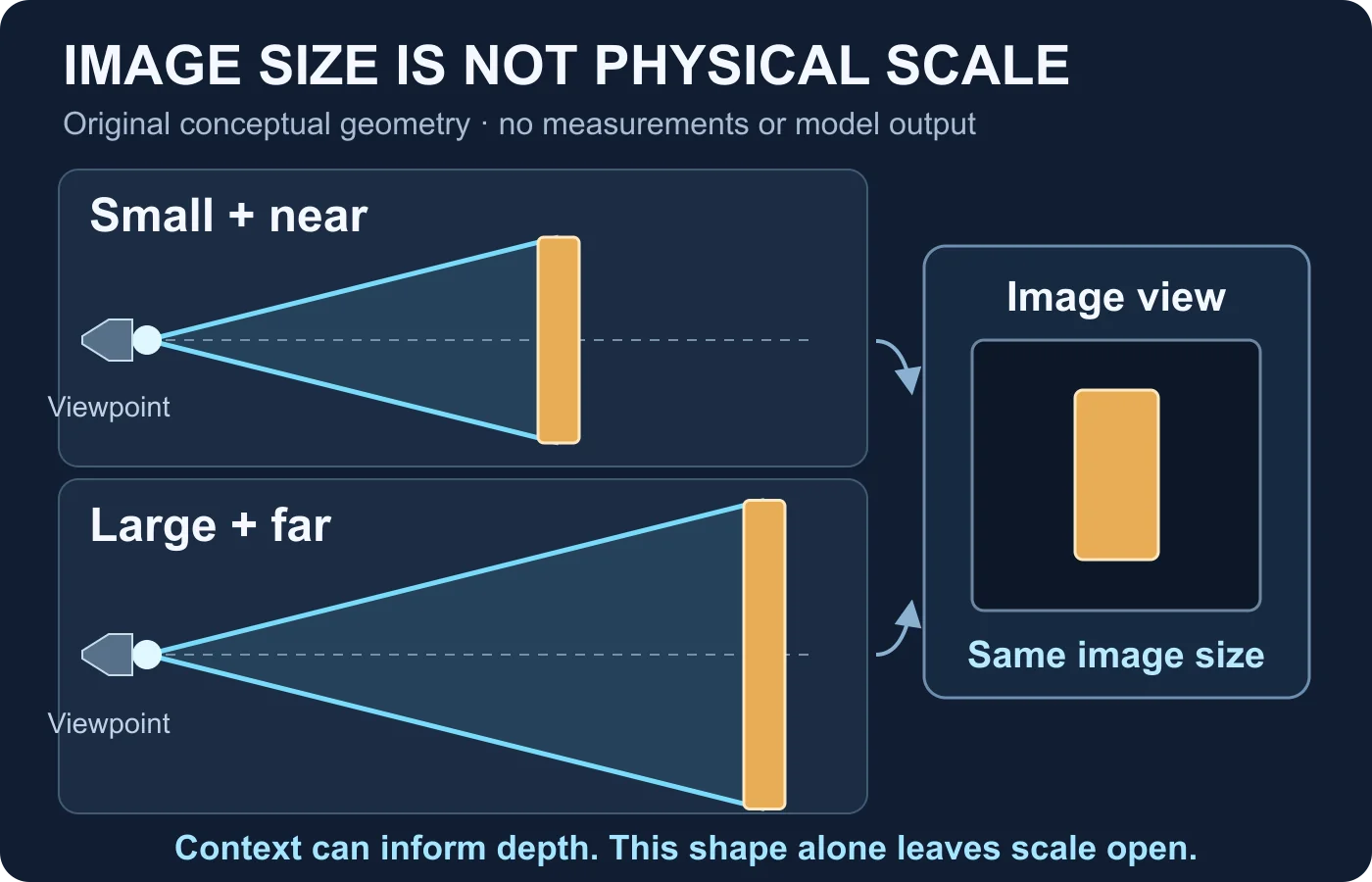
Real scenes provide more clues than a plain rectangle. In their original research on learning depth from single images, Saxena, Chung and Ng discuss contextual cues such as occlusion, texture patterns and known object sizes. The useful lesson here is that interpretation depends on surrounding evidence and prior knowledge, not just a local patch of color.
That is why a model can produce a plausible estimate without the image uniquely determining every dimension. A chair may resemble chairs found in learned examples. A floor pattern may suggest a perspective arrangement. Those cues can help an inference while remaining different from a verified account of this particular room’s dimensions.
Known size can be useful only when it is actually known. In a review, distinguish “this resembles a familiar object” from “an independent source establishes this object’s size.” A miniature, a drawing on a wall, or an unusual design can complicate an appearance-based assumption. Do not introduce a reference scale simply because it would make the worksheet easier to complete.
The same caution applies to camera information. Camera intrinsics describe aspects of the imaging geometry; they are not interchangeable with a guessed field of view from a screenshot. Ask which camera information the method expects and what the source provides. Do not invent settings or assert that an unnamed model has calibrated the scene internally.
Keep this distinction in your closing language. A map may suggest a useful spatial ordering. A metric-capable model may provide estimated distances. Neither statement means that the source image alone has become an unquestionable survey of the physical scene. The evidence required depends on how consequential the measurement claim is.
A room-scene worksheet for bounded interpretation
Use the fictional box, chair and wall as a reading exercise. The aim is to make your observations understandable to another person, not to score a model that you have not tested. Keep one row for the supplied evidence and another for each question that evidence cannot yet answer.
| Item | What to write | What not to substitute |
|---|---|---|
| Source image | Which room frame or file was supplied | A visually similar image from another scene |
| Output meaning | Relative order or metric estimate; documented units if any | A distance inferred from a palette alone |
| Box and chair | Which region the map places nearer under its legend | A claim about exact separation without scale evidence |
| Floor boundary | Where the source and map show the contact region | A sharper contour invented for a presentation |
| Uncertain surface | Reflection, blur, occlusion or missing source detail | An automatic synthetic-media verdict |
| Next evidence | Legend, source, processing description or appropriate reference | An unsupported accuracy percentage |
Begin with an untouched reference. If the image comes from a video, retain the original clip and identify the relevant frame before making derivatives. Our video frame extractor guide explains how to preserve a useful still and its context. A depth preview should not become the only surviving version of the image.
Next write an observation without assuming a mechanism. You might say that the box region is displayed nearer than the chair under the supplied legend. You cannot yet say how much nearer. If the legend is missing, the observation should remain about the display pattern until its intended meaning is established.
Now identify a difficult region. Suppose the chair’s thin leg is soft in the source image and appears to blend into the floor in the preview. Record the source’s visibility limit and the preview’s appearance separately. That lets another reviewer ask whether the difference concerns available detail, processing, prediction or display alignment, without prematurely naming one cause.
Then write the next action appropriate to your question. If the question is depth order, a clearer source and legend may help. If it is a physical distance, you need an appropriate scale and validation procedure. If it is video authenticity, a better colored depth map is not a substitute for source history and media evidence.
A completed exercise should leave a short, bounded conclusion: the supplied preview suggests a particular order; scale is not established from this material; one boundary remains unclear; and the next evidence requested is identified. This is a useful outcome even if no numerical distance appears in the report. You have separated an interpretable representation from an unsupported measurement claim.
Reflective surfaces and missing boundaries need care
Do not assume that every visible region describes a simple opaque surface. A mirror shows an appearance of another part of the scene. Glass can reveal content behind it while also reflecting something in front. When reviewing a depth visualization, ask what surface or visible appearance the relevant prediction is intended to represent.
The original Depth Anything V2 paper discusses difficult transparent and reflective surfaces, fine boundaries, and differences between relative and specially trained metric models. Those are research-specific discussions, not a claim that every current model fails in the same places or achieves the paper’s results on your image.
For the room exercise, imagine a mirror on the rear wall. If the preview displays the reflected chair as though it were another visible region, do not silently treat that as a second physical chair. First establish what the source shows and whether the method documents a relevant interpretation. Describe the ambiguity instead of making a count or distance claim from the reflection alone.
Thin structures deserve the same restraint. A chair leg can occupy little image space, and the distinction from the background may be weak in the supplied copy. Inspect the source before declaring that a missing contour reveals manipulation. A more detailed preview is also not automatically more correct; it needs the appropriate reference for the question.
Finally, distinguish absence of visibility from absence of an object. A box may hide part of the chair. A prediction that looks continuous behind it does not provide a new photograph of the hidden area. This guide is about reading inferred depth, not reconstructing missing scene evidence or editing it into the source.
Use precise uncertainty descriptions: reflection interpretation unclear, boundary difficult to compare, source detail unavailable, scale unsupported, or output convention undocumented. Those phrases help a reviewer request evidence. “Impossible geometry” is a much stronger conclusion and should not be based only on a visually unfamiliar depth preview.
Keep frame-level depth separate from video evidence
A frame extracted from a clip remains one image. If a provider supplies maps for several frames, ask whether they are independent predictions or part of a method with documented temporal behavior. Repeated colors and familiar contours do not establish stable three-dimensional tracking by themselves.
Imagine the fictional box moving across the room sequence. Before comparing the previews, watch the original clip and check which camera or object movements occurred. Then compare corresponding regions under compatible display conventions. If each preview uses its own display range, a color change can be misleading when read as a physical distance change.
Do not turn an unstable preview into an automatic conclusion about the video’s origin. First consider what is known about the source copy, prediction method and visualization. A scene can be difficult to interpret without being synthetic; a generated scene can look spatially convincing without becoming a captured event.
Provenance is a separate layer. Our Content Credentials guide explains recorded creation history and its limitations. A depth estimate comes from an inference about appearance; a provenance record concerns a documented workflow. Neither should be made to answer every question on behalf of the other.
For a claim about an event, keep the source, caption and sequence together. If the image is being used to assert an exact distance or position, request support appropriate to that assertion. If the question concerns possible video generation or manipulation, retain the time-based media for technical analysis and contextual verification.
This article does not claim that DetectVideo AI produces monocular depth maps, performs surveying, or supplies calibrated room measurements. Its connection to video analysis is the reading discipline: distinguish available evidence from a derived representation, and state which question each item can legitimately help answer.
Report what the map supports and what remains unknown
Before closing a review, check whether your strongest sentence is supported by the material you actually received. A useful conclusion can be specific without being absolute. Identify the representation, the region, the display convention and the unresolved condition that limits its interpretation.
- Specify the task. Is the output a relative-order map, a metric prediction or only a display preview?
- Preserve the source. Keep the unannotated image or video frame and any information needed to locate it in the clip.
- Request the legend. Establish near/far direction, units if applicable and the relationship between values and colors.
- Check alignment. Compare the same crop and orientation before treating a displaced edge as a depth discrepancy.
- Record ambiguity. Note reflections, occlusions, weak boundaries and unsupported scale without filling them with guesses.
- Separate the final claim. Depth order, physical measurement, event context and authenticity require different support.
For the fictional room, a careful closing note might say: “Under the supplied relative-depth legend, the box is shown nearer than the chair. The image and preview do not establish physical distances. The reflected region and thin chair boundary need further context before interpretation.” That is an original example of reporting, not a model’s measured result.
Monocular depth estimation can make spatial relationships easier to examine. Its value is not diminished by acknowledging what a single image leaves uncertain. The responsible reader keeps the map useful without converting inferred appearance into measured truth, recovered hidden detail, or an all-purpose verdict about the media.
Questions about single-image depth
Can monocular depth estimation provide exact distances?
Some models aim to predict metric depth, while others provide relative depth. Metric output remains an estimate that needs validation for its intended use. A relative color map should not be converted into meters without appropriate scale information.
Does bright always mean near in a depth map?
No. Palettes, inverse-depth conventions and display normalization differ. Read the supplied legend and output definition before interpreting a color as distance.
Why can one image leave physical scale uncertain?
Apparent size depends on both object size and distance. Context and learned cues can inform an estimate, but a familiar-looking object is not automatically a verified size reference.
Can a depth map reveal what is hidden behind an object?
It is not a new observation of an occluded region. A predicted or illustrated continuation should not be presented as recovered camera evidence of the hidden scene.
Does an unusual depth map prove that a video is AI-generated?
No. Inspect the source, method and display convention, then combine appropriate technical and contextual evidence. A geometry inference alone does not establish the video’s origin.
Depth is inferred. The source still matters.
If the image comes from a video, preserve the clip and combine technical analysis with its source and context before drawing a conclusion.
Sources and reading limits
- Hugging Face: Monocular depth estimation — official task categories and visualization workflow; specific model semantics govern output units.
- Original MiDaS project — relative-depth example and documented distinction from a metric extension. Archived project, not a current tool recommendation.
- Saxena, Chung and Ng: Learning Depth from Single Monocular Images — original research introduction and contextual monocular cues. Its benchmark results are not reproduced.
- Yang and colleagues: Depth Anything V2 — original research on relative/metric models and difficult scene conditions. No inference or performance comparison was performed for this guide.
Sources accessed on 14 October 2026. The room scenario, worksheets and scale diagram are original conceptual material, not a measured camera experiment, detector output or reconstruction of a real location.