
Mode collapse is a failure in which a generative model produces a limited range of outputs instead of representing the intended diversity. In the classic GAN setting, several different inputs can lead to the same or similar output types. A polished sample can therefore look convincing while the generated collection misses important parts of the target distribution.
This guide explains GAN output coverage through an original shapes-and-review exercise. It is not a training recipe, a model benchmark or a diagnosis of an unknown video. Keep this technical problem separate from the publishing-quality concept in the existing AI slop guide: repetitive posts can have editorial or distribution causes without establishing a GAN training failure.
Output quality and distribution coverage are different questions
Sample quality asks whether an individual output satisfies a relevant requirement. Coverage asks whether a collection represents the variety that the task requires. A system can produce one excellent-looking kind of picture repeatedly while failing to produce other required kinds. Judging only the most attractive sample leaves that second question unanswered.
For example, a fictional generator might be intended to represent circles, triangles and squares. A gallery of beautifully drawn circles does not show that it can represent all three groups. The issue is not that the circles look bad. It is that the gallery gives no examples of the other required groups. This is a simplified teaching situation, not a description of a trained model.
Google’s original GAN common-problems course describes mode collapse as a generator repeatedly producing the same or a small set of plausible outputs. It presents the problem as part of GAN training, alongside other failure modes. That account does not establish that every repetitive gallery online came from a collapsed GAN.
Keep the intended variety explicit. If a creative task requests only circles, a set of circles does not by itself reveal a coverage failure. The same visible collection can be appropriate for one task and incomplete for another. Define the target before using the term collapse, rather than treating visual repetition as self-explanatory.
Also separate missing variety from missing polish. A collection can cover many kinds of shapes while drawing them poorly. Another can represent a narrow set with great detail. Those are different review findings and may require different changes. A single vague quality score can obscure the distinction.
Generator and discriminator: why “adversarial” needs context
At a high level, a GAN has a generator that produces samples and a discriminator trained to distinguish generated samples from reference data. Their training interacts. The generator’s objective is not identical to a human checklist of every kind of output that should appear in a delivered gallery.
The original Unrolled Generative Adversarial Networks paper discusses how plausible samples and mode coverage can diverge, and investigates an objective that accounts for discriminator updates. It is a historical research example of addressing training dynamics, not a universal cure or a method tested for this article.
The word adversarial here refers to that training relationship. It should not be confused with a person deliberately modifying an input to make a classifier misread it. Generator diversity and defensive classifier robustness are different tasks. This guide does not provide attack techniques, detector-evasion instructions or claims about bypassing DetectVideo.
Do not interpret the discriminator as an independent fact-checker. Its training role concerns the reference distribution and generated samples. It does not verify a caption, establish a real event or certify a source’s honesty. A sample that succeeds under a model’s training objective can still be unsuitable evidence for a real-world claim.
For a reader reviewing unfamiliar media, the architecture may not be known at all. A polished image or repeated style does not reveal the exact generator and discriminator setup. Use the term as an explanation of a documented model problem, not as a label inferred confidently from one public thumbnail.
Missing modes are not the same as exact duplicate files
A mode concerns the structure of a distribution. In an introductory exercise, labeled groups can stand in for the kinds of variation the task expects. In an actual model, those categories may not correspond neatly to probability-density peaks. State the simplification instead of presenting a classroom shape count as a complete statistical measure.
Several outputs can differ in small details while remaining concentrated in a narrow part of the intended distribution. Changing a circle’s outline or color may create distinct files without representing the missing square group. Byte-level uniqueness and meaningful coverage are therefore different properties.
The reverse distinction matters too. Reusing the same file in several posts is an observed duplication behavior, but it does not establish that the generator lacked other outputs. A publisher might select one image repeatedly, use a fixed template or distribute an authorized asset. Those are possible production or publication choices, not evidence of a particular learning failure.
Choose a relevant level of variation before counting. If the task is to cover different object categories, inspect those categories. If it is to represent viewpoint or lighting variation within one category, a category count alone is inadequate. The review criteria should follow the target, not whatever difference is easiest to notice in a gallery.
Do not treat every new background as evidence of healthy diversity. An unchanged central object may still fail a requirement for different object forms. Conversely, a consistent background may be intentionally fixed while the requested forms vary appropriately. Keep constraints and desired variation in separate lines.
An original constructed example: three groups and two collections
Define a teaching reference set containing nine hand-drawn symbols: three circles, three triangles and three squares. The exercise requires representation of all three groups. Now construct two imaginary output collections with eight symbols each. No training data, random generator or real model supplied any of these symbols or counts.
Collection A contains six circles, two triangles and no squares. Collection B contains two circles, two triangles and four squares. This deliberately chosen comparison makes one coverage difference visible. It is not a claim that Collection B reproduces the reference distribution perfectly or is superior for every purpose.
| Set | Circles | Triangles | Squares | Visible groups represented |
|---|---|---|---|---|
| Reference | 3 | 3 | 3 | 3 |
| Collection A | 6 | 2 | 0 | 2 |
| Collection B | 2 | 2 | 4 | 3 |
The total in A is six plus two plus zero, and in B it is two plus two plus four. Both contain eight symbols. Equal collection size has not made their group coverage equal. A reviewer could record that A does not show the square group while B does. That is a finding about these constructed collections, not the latent ability of a generator.
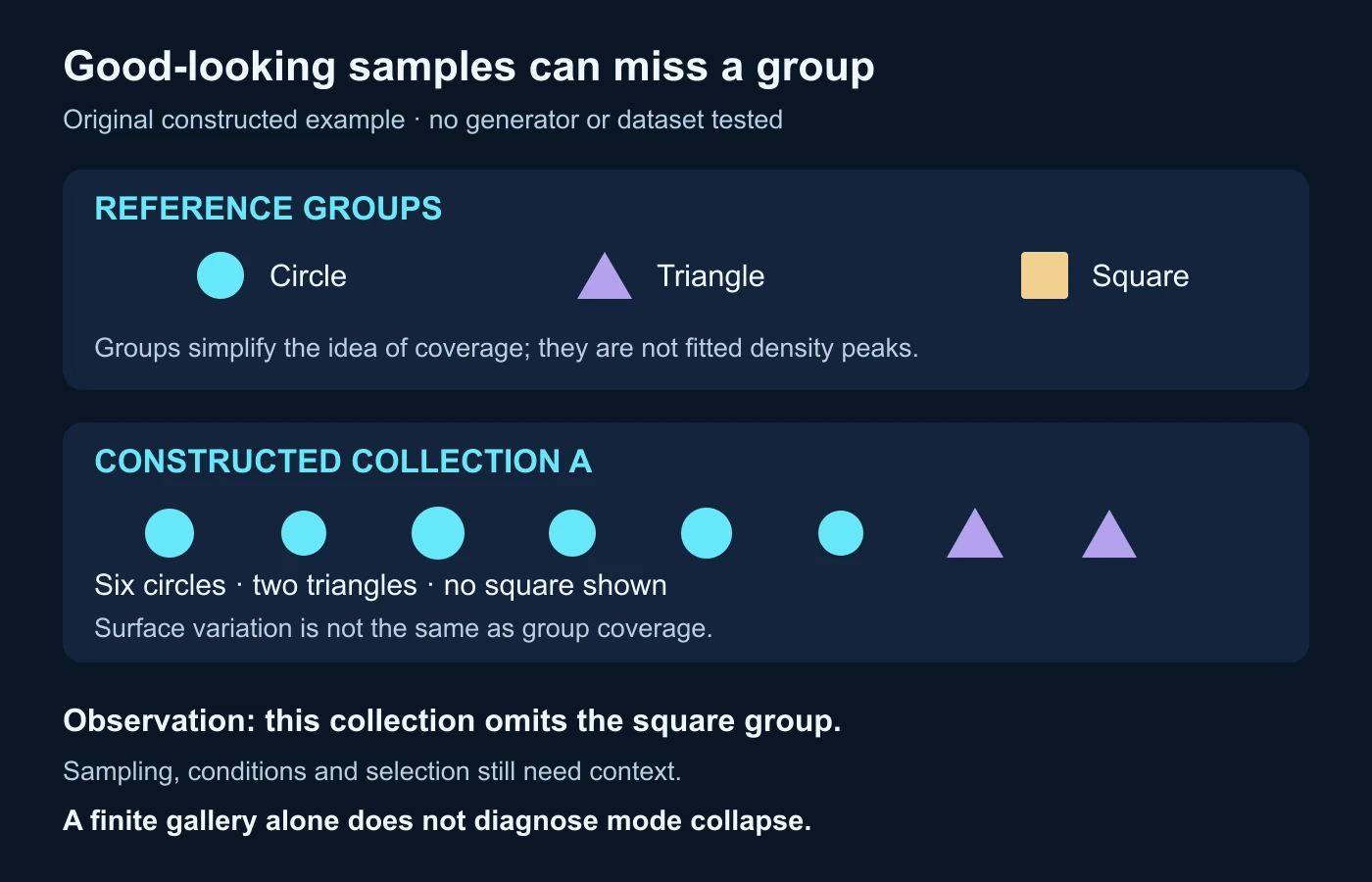
Now imagine that every symbol in A has a different decorative outline. The file count and surface variation can increase while the square group remains absent. This shows why a review needs a task-relevant distinction rather than simply asking whether all thumbnails look different.
Conversely, B’s inclusion of all groups does not settle frequency balance, within-group variation or drawing quality. The exercise demonstrates one gap, not a universal diversity metric. A responsible report keeps those questions separate instead of calling the group count an accuracy score.
Ask three separate diversity questions about the teaching sets
The first question is group coverage: which required groups appear at least once? Under the declared classroom labels, A represents two groups and B represents three. That finding is simple, but it is not a complete account of how a learned distribution behaves. The labels were defined by us, not discovered by a model or fitted to real data.
The second question is balance. The reference contains equal counts of the three groups, whereas B has twice as many squares as either circles or triangles. Inclusion of every group has not reproduced the reference proportions. Whether that imbalance matters depends on the task: a reference board seeking one example of each form differs from a statistical evaluation seeking a distributional match.
The third question is variation within a group. Three circles can have different sizes, boundary shapes or other defined attributes, while still counting as circles. If those differences are important to the requested work, the group count conceals them. If they are irrelevant, emphasizing them may distract from the actual missing category. Write which attributes matter before inspecting the most noticeable surface change.
For an original review example, suppose a design brief asks for all three forms, each in a clearly readable silhouette. Coverage and silhouette legibility are the relevant requirements. A decorative background does not compensate for an absent form. Now change the brief to several different circle outlines for one icon family: all-circle outputs may be appropriate, and imposing the earlier three-group target would be unfair.
This comparison also explains why a gallery’s convenient count cannot be transferred automatically into a model-quality claim. The target, category rules and sampling procedure define what the count could mean. A number becomes useful when those conditions are known; without them it may only make an uncertain judgment look exact.
Keep these three questions in separate notebook fields. An output can be plausible, all groups can be present, and meaningful within-group variation can still be limited. Conversely, a visually varied set can remain incomplete. Describe the combination rather than collapsing it into one approved-or-failed label for the entire generator.
Sampling and selection can make an output set look narrow
A visible gallery is not necessarily an unselected sample from the model. Its creator may have chosen a theme, rejected particular results or published only their favorites. Before attributing the gallery’s narrowness to learning, ask what produced the collection you are actually seeing.
A small finite sample can also omit an available kind of output. The omission may be informative, but the sample alone does not establish that the model never represents that kind. Avoid converting “not shown here” into “impossible for this model” without an appropriate examination of the model and conditions.
Conditions can deliberately narrow the task. A request for one object, an imposed layout or a fixed source reference may limit the range for an understandable reason. A review should identify the constraints before comparing the result with a broader expectation. Do not diagnose a coverage failure from a condition that excluded the group you expected.
Repeated inputs are another confound. A set generated under effectively the same conditions may say less about the available range than a record spanning the intended conditions. If the conditions are unknown, keep the uncertainty visible. Do not invent a history of varied random inputs merely because the gallery contains many filenames.
Keep selection notes separate from generation notes. One tells you what was produced; the other tells you what a person kept or displayed. If rejected outputs are unavailable, a published gallery may be useful for evaluating the delivered work but insufficient for evaluating the generator’s entire distribution.
The practical next request is therefore a relevant production record, not a more confident guess from appearance. Ask whether the collection was selected, what its intended range was and what conditions were held fixed. The answer can narrow the review without exposing private training material or pretending that a viewer has access to the model’s internals.
Use a coverage notebook that does not become a false diagnosis
The following original notebook is designed for discussing a supplied collection, not validating a model statistically. Give the collection a clear identifier and preserve the available items. State the review goal and the expected distinctions. If the task has no defined reference or diversity requirement, record that before judging what is missing.
Describe the observed range
Write what is visibly present and absent under your chosen criteria. For the constructed Collection A, the note is that circle and triangle groups are represented while no square is shown. Do not silently expand that into a claim about every possible output, a failed training run or a named provider’s capabilities.
Keep ambiguous cases separate. A rounded quadrilateral may not fit your simple circle-or-square labels cleanly. Mark the uncertainty rather than forcing it into a category to make the total look complete. In a real task, the category definitions may require domain expertise or more careful evaluation than a visual classroom exercise.
Identify the records needed for a stronger interpretation
A stronger model-level review would need the intended target, relevant sampling conditions, the relationship between displayed and generated items, and an evaluation appropriate to the task. An editor reviewing delivered work may not possess those records. That limitation should change the conclusion rather than encourage an invented metric.
For example, if the supplied brief required all three shape groups, A fails that visible delivery requirement in the teaching exercise. You can request square examples or a clarification of the scope. You still do not need to claim that the underlying GAN has technically collapsed. A task-level acceptance decision can be useful without a model-level diagnosis.
Record a proportionate next action
- Define the expected distinctions and fixed constraints.
- Describe the supplied collection rather than an imagined complete distribution.
- Keep repeated files separate from repeated semantic groups.
- Ask whether selection or unknown conditions explain the narrow set.
- Separate visible delivery gaps from documented model-training failures.
- Use an appropriate evaluation before assigning a technical diagnosis.
The notebook helps a team avoid talking past one another. One reviewer may mean that the displayed designs are repetitive; another may mean that a distribution is inadequately learned. Writing the scope lets them discuss the actual evidence rather than agreeing on the word collapse while making different claims.
Mode collapse is not the same question as model collapse
The names are similar but the reader should not use them interchangeably. Classic GAN mode collapse concerns limited output diversity in the learned generator. Recursive-training model collapse concerns what happens across generations of models trained using generated data. A narrow gallery alone does not establish either complete history.
Shumailov and colleagues’ original public preprint, The Curse of Recursion: Training on Generated Data Makes Models Forget, defines its generational process and explicitly relates its naming to GAN mode collapse. That connection does not make the mechanisms identical. The paper’s particular assumptions are not a declaration that every use of synthetic data necessarily fails.
In your notes, ask which process the speaker means. Are they describing one generator’s coverage, a sequence of training generations, or simply repetition in published work? Those are distinct explanations. A familiar term should not smuggle in unavailable training records.
Do not confuse either term with an authenticity label. A camera-recorded series can be repetitive. An intentionally constrained synthetic series can be diverse within its task. A technical learning problem describes a model and setup; it does not automatically tell you whether a specific clip depicts a real event.
When discussing a research result, preserve its actual setup and date. An older method can illustrate a problem without representing every modern generator. Do not transfer a paper’s favorable outcome to a current tool, and do not call a mitigation a universal cure merely because its title or abstract emphasizes improvement.
What a diversity review can responsibly establish
A review of an available gallery can establish observations about that gallery. It can identify a missing requested category, redundant delivered items or limited visible variation under a stated criterion. It cannot, by appearance alone, reconstruct the complete training distribution or tell you which private algorithm produced the work.
For synthetic-video categories and their interpretation, use the existing AI-generated video guide. That page owns the broader production and verification question. This article explains why plausible individual samples and adequate distribution coverage are different properties; it does not infer every modern video’s architecture from its style.
Similarly, a detector result and a diversity observation answer different questions. The existing AI video detection methods guide explains the relevant evidence families and their limitations. DetectVideo AI is not presented here as a service that diagnoses GAN mode collapse from a gallery or identifies training failures from repeated designs.
Keep your closing statement bounded: “The supplied collection does not show the required square group; the sampling and selection records are unavailable.” That finding is clear and actionable. It avoids a fabricated percentage, a guess about a provider or an accusation about the creator’s intent.
The useful lesson is to ask two questions instead of one: are individual outputs suitable, and does the available set cover the intended range? Preserve the conditions and evidence for each. Mode collapse explains why those properties can diverge, but a responsible reader still distinguishes a learning concept from a diagnosis they have not established.
Repeated outputs are a clue, not a verdict.
For a related video, combine technical analysis with its source and production context.
Questions about mode collapse
Can realistic outputs still show poor diversity?
Yes. Individual plausibility and coverage of the intended range are different properties. A polished gallery can omit required kinds of output.
Do duplicate files prove mode collapse?
No. Reuse, selection, templates or fixed conditions can produce repeated files. Model-level interpretation needs relevant training and sampling evidence.
Is a missing group in a small gallery enough to diagnose a GAN?
No. It is an observation about that gallery. Sampling, conditions and selection can limit what it shows; stronger diagnosis requires an appropriate evaluation.
Are mode collapse and model collapse the same?
No. The classic GAN issue concerns output coverage. Recursive-training model collapse concerns a generational data-learning process; similar terminology does not establish the same mechanism.
Can DetectVideo AI identify a generator’s mode collapse?
This guide does not claim that capability. A supported video’s technical analysis and source context answer different questions from model-distribution coverage.
References and scope
- Google: GAN Common Problems — original educational problem description and remedy caveats; no universal fix asserted.
- Metz and colleagues: Unrolled Generative Adversarial Networks — original ICLR 2017 method and mode-coverage discussion; no paper figure, benchmark or training run reproduced.
- Shumailov and colleagues: The Curse of Recursion — original public preprint version 3, April 2024; used narrowly to distinguish its model-collapse process, not to diagnose every synthetic-data workflow.
Sources read on 14 October 2026. Reference symbols, Collections A and B, counts, diagram and notebook are original hand-constructed teaching material. No actual GAN, dataset, output-distribution estimate or tested training improvement is represented.