

Image embeddings are numerical representations of pictures produced by a model. They let a system compare images in a feature space, often to retrieve related content. A close match can be a useful search lead, but it does not prove that two files are identical, that they share a creator or that they depict the same event.
This guide explains representation and matching rather than a particular search-tool interface. The reverse image search for video guide owns the practical frame-search workflow. The small vector exercise below is original, hand-assigned arithmetic; no image model, search engine or DetectVideo analysis was run to produce its numbers.
What it means to represent a picture as a vector
A vector is an ordered list of numbers. An image model can turn a large array of pixels into such a representation. The resulting numbers are useful because a comparison rule can operate on them. They are not necessarily a readable list of objects, a caption or an explanation of why a particular pair looks related.
Think of the representation as a task-dependent description, not a miniature copy of the file. A method trained for a certain objective may retain distinctions useful to that objective while treating other differences as less important. Two images can therefore be close in its representation even when a human investigator needs to distinguish them.
Google’s original MediaPipe Image Embedder guide describes output feature vectors and a cosine-similarity comparison utility. It also lists input processing and region-of-interest options. That is an example of an embedding implementation, not evidence that every image-search service uses the same model or settings.
Do not assume each coordinate has a simple label such as red, bridge or trustworthy. Some explanatory diagrams draw labeled axes to make the idea visible, but learned coordinates may not have that direct interpretation. If a chart uses a simplified map, its caption should say whether the positions came from an actual computation or were drawn conceptually.
The representation also belongs to a particular model and processing convention. A list of the same length from another model is not automatically comparable. Recording the model version, preprocessing and comparison method is more useful than saying only that you have an embedding. Otherwise, the numbers may look compatible while describing different spaces.
How training influences what appears similar
Models learn representations through their training objectives and data. There is no single training recipe behind all image embeddings. Some representations are designed around visual categories or relationships, while some multimodal systems connect image and text representations. The purpose should be identified before a similarity result is interpreted.
The original CLIP paper describes jointly training image and text encoders to associate matching pairs. It is a concrete historical example of a shared multimodal representation. It does not describe every embedding system, and its reported benchmark outcomes should not be assigned to a current search service or an unrelated model.
For a reader, the practical implication is that similarity follows a learned representation rather than a universal definition of sameness. A method may bring pictures of the same object category closer while not preserving the distinctions needed to identify a particular source photograph. Another method may emphasize different visual relationships. Inspect the task instead of transferring expectations between systems.
Training context can also differ from the material you are searching. A collection dominated by familiar product photography is not the same task as identifying a dark frame from a moving camera. Without relevant evaluation, a result should remain a candidate. A fluent explanation or a plausible-looking cluster does not establish that the representation handles your material reliably.
Even an apparently sensible result can have more than one explanation. Two fictional illustrations of cups may share an object concept, a color scheme, a background or a composition. A high similarity value alone does not tell you which feature drove the relationship. Check the actual images and the information needed for your purpose.
Similarity and distance are comparison rules, not probabilities of truth
A system needs a rule to compare vectors. With a distance measure, smaller values often mean closer representations. With a similarity measure, larger values often mean closer representations. Read the definition before interpreting the number; the direction and scale are not interchangeable across metrics or services.
The original Faiss metric documentation distinguishes squared Euclidean distance, inner product and cosine similarity. Cosine compares normalized direction; raw inner product is not automatically cosine. For unit vectors, squared Euclidean distance relates to their dot product. These definitions support the arithmetic exercise, not an authenticity threshold.
A similarity of 0.8 is not an eighty-percent probability of the same photographer, event or file. It is a value under a particular rule. A confidence-like display may invite that interpretation, so check what the interface actually reports. If the system does not explain the score, avoid converting it into a factual probability.
Also distinguish rank from absolute support. The first result can be the closest item among a limited collection while still being unsuitable for your question. A ranking answers a relative comparison. It does not promise that a valid source exists in the collection, or that the top item passes a separate match-validation rule.
For a review note, record the comparison method and what action it controls. A score used to choose which candidate a person inspects is different from one used to make an automatic public attribution. The latter requires much stronger validation. Do not copy a threshold from an unrelated demonstration merely because the numbers share a familiar range.
A hand-assigned vector exercise makes the distinction visible
Define a toy query Q as the two-number vector (1, 0). Assign three toy candidates: A = (0.8, 0.6), B = (0.6, 0.8), and C = (-1, 0). These are already unit length: the sum of squared coordinates is one for each. They were chosen to make the arithmetic transparent, not produced from photographs.
The dot product with Q selects the first coordinate: Q dot A is 0.8, Q dot B is 0.6, and Q dot C is -1. Because the vectors are unit length, those values are also their cosine similarities. The exercise ranks A above B above C under that rule. It says nothing about the origin of an image.
| Toy item | Assigned unit vector | Cosine with Q | Squared distance from Q |
|---|---|---|---|
| Q | (1, 0) | Reference | 0 |
| A | (0.8, 0.6) | 0.8 | 0.4 |
| B | (0.6, 0.8) | 0.6 | 0.8 |
| C | (-1, 0) | -1 | 4 |
Check the first distance directly: (1 – 0.8) squared plus (0 – 0.6) squared is 0.04 + 0.36 = 0.4. The second is 0.16 + 0.64 = 0.8. The third is 4 + 0 = 4. Lower distance produces the same order in this particular normalized exercise. The calculation is reproducible without claiming any model performance.
Now give the toy items different fictional source records. A belongs to one illustrator, B to another, and C has an unknown record. Nothing about the numerical ranking changes. The source information is separate from the comparison. The illustration helps explain why a semantic or visual lead must not silently become an authorship conclusion.
Two dimensions make the exercise drawable, but real representations may have many more coordinates. A simple two-dimensional projection of real vectors can also lose relationships from the original space. Do not read every apparent gap in a plotted map as the exact search distance unless the mapping and its limits have been explained.
What nearest-neighbor retrieval can and cannot tell you
A retrieval system compares a query representation with representations in an indexed collection. Its nearest neighbors are candidates closest under the chosen rule. This is valuable for narrowing a large set, but the collection boundary matters. A missing item cannot become a retrieved source merely because the model recognizes its general topic.
Suppose a fictional archive contains many drawings of ceramic cups but not the exact illustration in your query. A representation may still retrieve related cup drawings. That would be useful for a broad discovery task and insufficient for a source-identification task. The same result can be successful for one purpose and a false lead for another.
Preserve the question in the review. “Find related designs” permits a semantic neighbor. “Locate an earlier use of this exact composition” requires a more specific relationship. “Prove who created the underlying video” needs source evidence beyond a still-image representation. Do not let a general result label merge these different tasks.
Index freshness is another limit. A private, deleted, unindexed or newly created item may be absent. No useful result is therefore not proof that the image is original or synthetic. It is a finding about that attempt and collection. Record what you searched, what was returned, and what the result could actually address.
If the task concerns the complete video, a still-image embedding is only part of the available evidence. It does not preserve speech, sequence or all moments. The reverse video search guide handles the wider source-tracing task. This mechanism explanation does not replace it with a one-frame verdict.
Keep a mismatch notebook instead of trusting a persuasive score
Before relying on a result, describe how it relates to the query. Is the same object depicted? Is the composition similar? Does the page actually contain the queried image? Does an apparently matching scene differ in a sign or surrounding context? The answers reveal what remains to be checked without requiring a story about the model’s hidden reasoning.
For an original conceptual example, imagine a query illustration of a violet cup on a shelf. One candidate shows another violet object on a shelf; another shows a cup with a different background. They supply different similarities. Do not invent numerical scores for them. The review asks which candidate serves the intended search, not which broad relationship sounds more intelligent.
Record a region change as a new query rather than an improved truth result. A crop can emphasize the object while removing context. It may produce useful candidates, but the original scene relationship still needs inspection. Preserve the uncropped input so a later reviewer can see what information was excluded.
Pay attention to text and small identifying details. A representation useful for broad visual relationships may not answer the specific wording on a sign or label. If the source question depends on that wording, inspect it directly or use an appropriate text channel. Do not assume an embedding comparison has verified every detail visible to you.
Bias and task mismatch belong in this notebook as limitations, not a guessed explanation for each result. The original CLIP paper discusses limitations and the influence of task design. A current system needs its own evidence. Avoid using one model’s historical paper to declare a universal failure rate or to promise that a different system has solved the issue.
For sensitive material, consider the consequence of a wrong match before acting on it. A generic similarity between scenes is not enough for a public accusation or identity claim. Use the result to locate inspectable evidence, then establish the relevant connection with a method appropriate to that question.
Separate semantic similarity, file identity and shared provenance
Semantic similarity describes a relationship in a representation. File identity concerns the bytes of the compared files. Shared provenance concerns the history connecting media, creators and derivatives. These questions can overlap in a real investigation, but no single similarity value automatically answers all three.
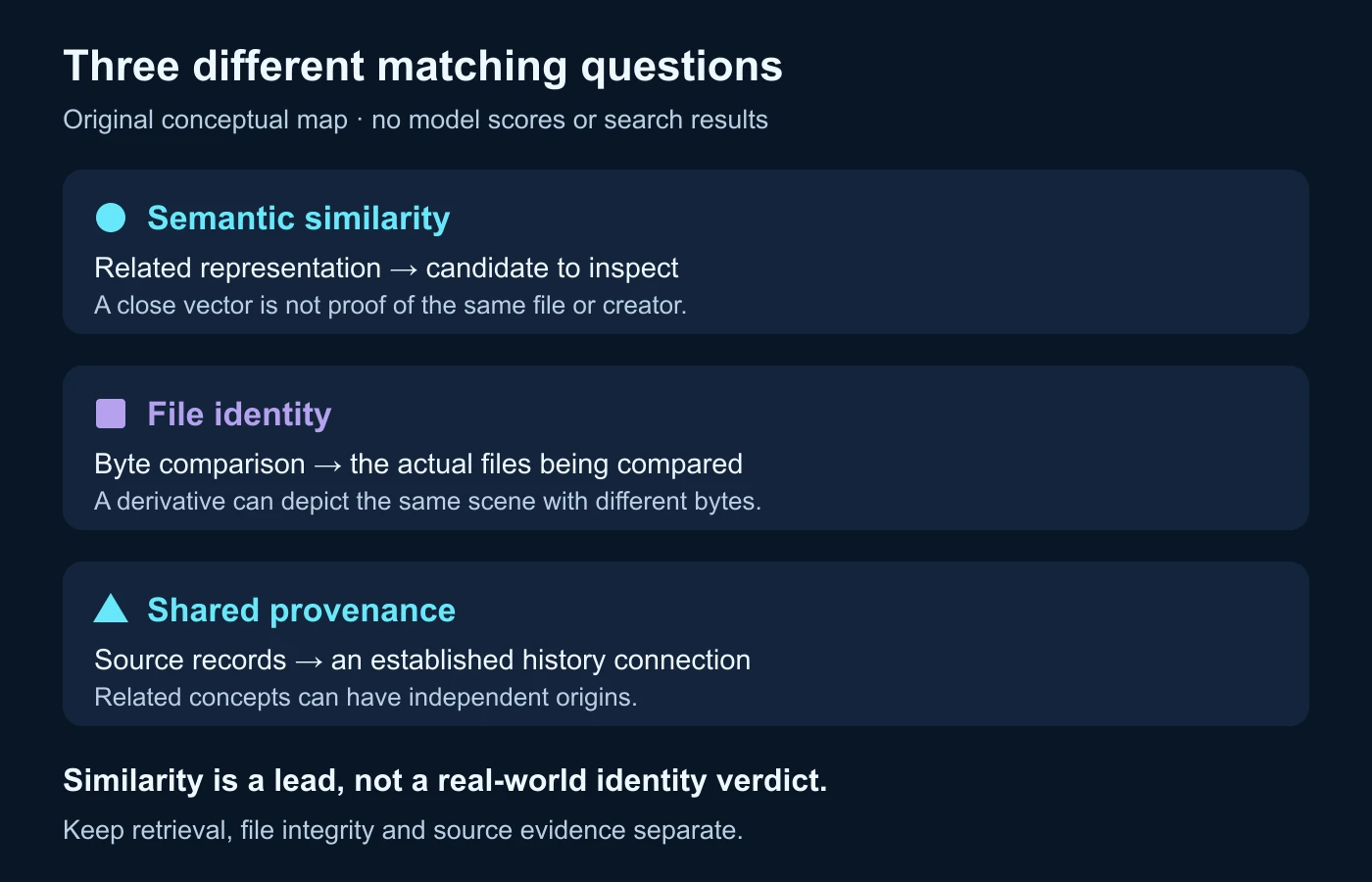
A cryptographic file digest is used for a different comparison from a semantic representation. A derivative can depict the same scene while containing different bytes. Conversely, a source assertion attached to a byte-identical copy can still be wrong. Keep an integrity record connected to the precise files compared, not to every possible interpretation of their content.
A perceptual hash also has a different purpose from a semantic embedding. It can support approximate visual-fingerprint comparison under its method, whereas a learned representation may retrieve conceptually related but independently created pictures. These are useful distinctions, not a declaration that every implementation behaves identically or that one method proves provenance.
For source history, inspect actual pages, dates, attribution and the media relationship. A related thumbnail might lead to the original; it might instead be an independent illustration of the same subject. Explain the connection you can establish rather than calling a candidate the creator’s original because it ranks highly.
Do not use an image embedding as an AI-generation or truth score. A synthetic illustration and a camera photograph may share a concept. A genuine photograph can accompany a false caption. A retrieved neighbor answers a representation-based search question; production and factual context need separate evidence.
An original retrieval-review worksheet for a fictional archive
Imagine reviewing candidates in an invented design archive called Cobalt Shelf. The goal is to find related cup illustrations for an internal reference board, not identify a real person or establish a public event. No archive was searched for this article. The exercise demonstrates how to preserve the difference between a useful discovery and a source claim.
Define the permitted conclusion
Write “related design candidate” as the initial output label. If a result shares only a broad cup concept, it may still belong on a discovery list. If your task later changes to locating the exact illustration, change the acceptance question too. Do not leave an old semantic-search label carrying a more specific source-identification conclusion.
For each candidate, keep the actual image and its source page together. A thumbnail without its page can conceal a different creator, publication context or usage permission. Record any relevant relationship as evidence, not as an interpretation of the vector coordinates. The representation leads you to the record; it is not the record itself.
Record reasons for keeping and rejecting candidates
A useful note might say that one drawing matches the object concept but has a different composition, while another provides an inspectable earlier use of the same illustration. The first is related design material. The second deserves a closer source check. Neither should automatically inherit a claim that its creator recorded a particular video.
Keep uncertain cases separate. A small preview may be too compressed to distinguish details, or the page may be unavailable. “Candidate relationship unresolved” is more accurate than either a match or a nonmatch. That note tells the next reviewer what is missing rather than making the ranking appear conclusive.
Use a short acceptance checklist
- State whether the task is semantic discovery, copy finding or provenance research.
- Record the query, model or service where known, and comparison rule.
- Inspect the candidate image rather than relying only on its score.
- Keep the source page and relevant context with the candidate.
- Distinguish a related concept from an established media connection.
- Preserve unresolved details and avoid unsupported identity or generation claims.
If you use a public interface instead of your own vectors, the Google Lens video-search guide covers that specific workflow. Do not assume this article’s toy coordinates describe Lens, or that the service exposes the metric used here. The mechanism and the current interface remain different subjects.
Use representations for discovery without erasing context
Embeddings can make a collection easier to explore, but the outcome still needs a description appropriate to its use. Related pictures can inspire further searches. They cannot, by similarity alone, establish a shared event, license, author or recording history. Keep the relevant evidence question visible after the convenient ranking has narrowed your attention.
Handle private inputs and representations through an appropriate authorized workflow. A vector is not automatically anonymous or free of sensitive relationships merely because it is numerical. Do not upload private media or build identity links just to demonstrate a mechanism. The examples here use invented geometric material precisely to avoid those claims.
The practical lesson is simple: identify the representation, read the comparison rule and inspect the candidates in context. A similarity result is useful when it tells you where to look next. It becomes misleading when a relative numerical relationship is presented as proof of a real-world connection that the system has not established.
Similar images can tell different stories.
Find the source and check a related video before making a connection.
Questions about image embeddings
What does an image embedding represent?
It represents an image in a model’s numerical feature space. Its useful relationships depend on the model, processing and task; it is not necessarily an interpretable caption or file identifier.
Does a high similarity score prove a shared source?
No. It can identify a useful candidate. Shared provenance needs evidence connecting the actual media and source history.
Is cosine similarity a probability that images match?
No. It is a mathematical comparison of vector direction. Do not turn its value into an authenticity or authorship probability without separate validated support.
Are image embeddings the same as perceptual hashes?
No. They can serve different matching purposes. Semantic representations may connect independently created images of the same concept; visual fingerprints address approximate content comparison under their method.
Does no retrieved neighbor prove an image is original or AI-generated?
No. The attempted collection or query may lack a useful candidate. A failed retrieval does not establish origin or production method.
References and scope
- Radford and colleagues: Learning Transferable Visual Models From Natural Language Supervision — original CLIP method, broader-impact and limitation sections; historical research example, not a current-service benchmark.
- Google AI Edge: Image embedding task guide — original output, preprocessing and comparison documentation; no MediaPipe model executed here.
- Faiss: MetricType and distances — original metric definitions; no index was built and no retrieval performance measured.
Sources read on 14 October 2026. Toy vectors, the Cobalt Shelf archive, matching diagram and review exercise are original conceptual teaching material. Numerical values are hand-assigned arithmetic, not model scores, tested retrieval results or DetectVideo capabilities.