

Demosaicing reconstructs a full-color image from the differently filtered light samples recorded by many digital camera sensors. In a common Bayer arrangement, each sensor location supplies one filtered measurement, not an independently measured red, green and blue triplet. Software estimates the missing channels using surrounding samples and a reconstruction method.
That ordinary step explains why a camera image is not a direct, channel-for-channel transcription of the scene. Fine edges and colors can depend on reconstruction choices before the image is resized or compressed. Understanding those choices is useful when two versions differ—or when false color is mistaken for evidence that the entire scene was generated.
What a color-filter array actually records
A photosite responds to incoming light. Placing a colored filter over it changes the wavelengths contributing to its response. In the simplified red-green-blue description, one site provides a red-filtered sample, another a green-filtered sample and another a blue-filtered sample. The filter responses are not perfectly isolated mathematical color channels, but the shorthand is useful for understanding the layout.
A Bayer pattern repeats a two-by-two arrangement containing one red, two green and one blue position. Different arrangements of the same pattern can begin at different color positions. The complete array therefore contains samples of all three types, but not all three at each location. Reconstructing the missing values is the central demosaicing problem.
The word “pixel” can conceal this distinction. People use it for a sensor sample, a location in an output image and a displayed picture element. Those are related but different objects. Saying that an output has a certain number of RGB pixels does not mean every output channel was independently measured at every corresponding sensor location.
Not every camera uses a Bayer sensor. Other color-filter arrangements and sensor architectures exist, and monochrome capture does not require the same color-channel reconstruction. The darktable demosaic documentation explicitly distinguishes Bayer, other filter patterns and monochrome cases. Keep the model-specific facts separate from the teaching example below.
A small reconstruction you can calculate yourself
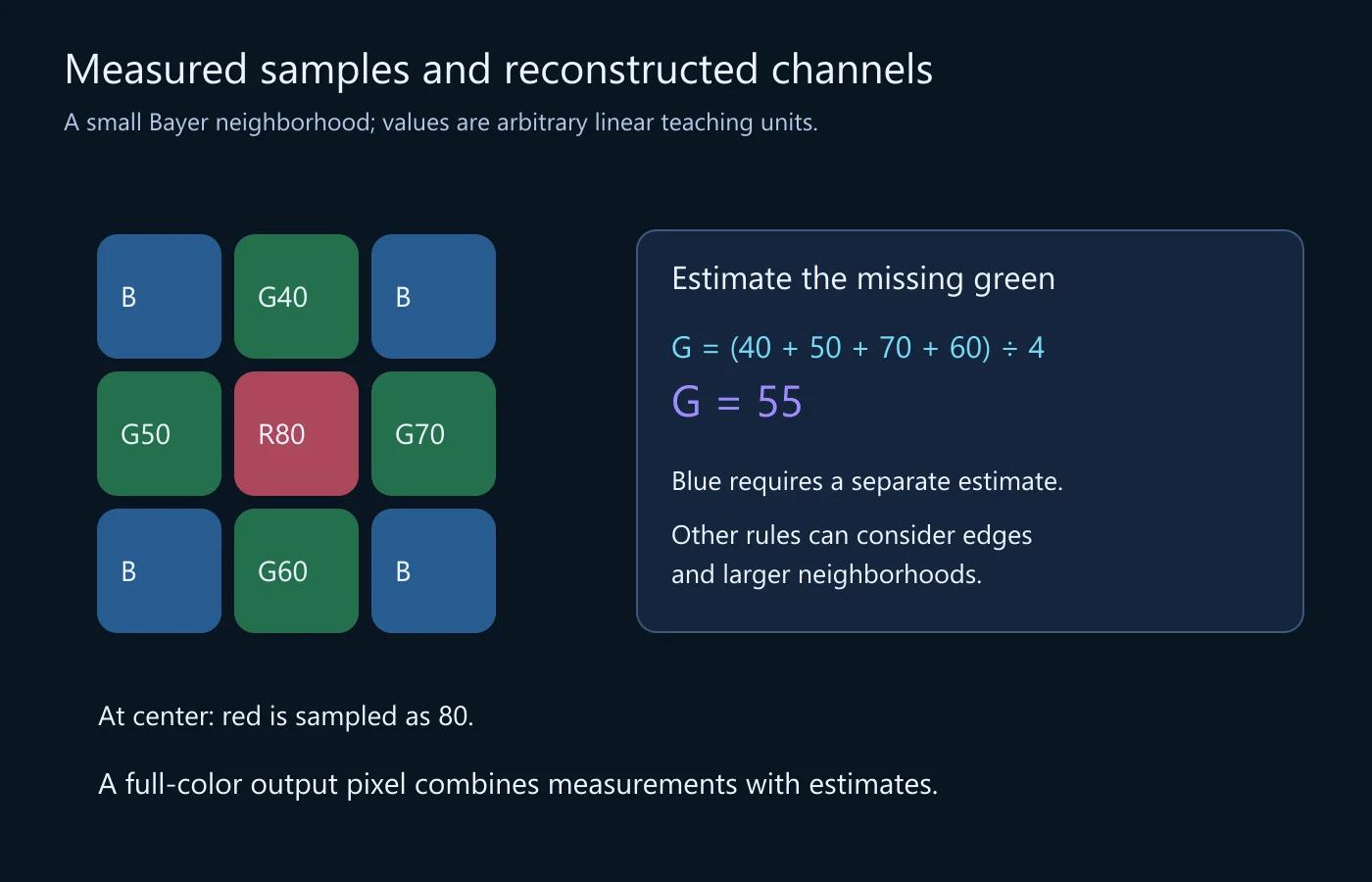
Take a red-filtered site in the middle of a small Bayer neighborhood. Give its measured red sample the value 80. Its four immediate horizontal and vertical neighbors are green-filtered sites with values 40 above, 50 to the left, 70 to the right and 60 below. These are arbitrary linear sample units selected for an arithmetic exercise.
A simple averaging rule estimates the missing green channel at the red location as (40 + 50 + 70 + 60) / 4 = 55. The important distinction is between the red sample, which was measured at that location, and the green value, which this rule estimates from neighbors. Both become part of the reconstructed output.
For a complete teaching triplet, suppose the four diagonal blue-filtered samples have values 20, 30, 40 and 50. A corresponding simple average estimates blue as 35. The reconstructed triplet is then red 80, green 55, blue 35. This is not a display-ready color: subsequent calibration, white balance and color conversion have not been specified.
The example demonstrates one elementary interpolation choice, not an assertion that all cameras average in this way. More advanced methods can examine edge direction, channel relationships or larger neighborhoods. They make different assumptions about how the scene varies between the recorded samples.
Why an edge makes this less straightforward
The same neighborhood can produce different estimates without changing a single input sample. Copying the upper green value would give 40. Averaging only the vertical pair gives (40 + 60) / 2 = 50. Averaging the horizontal pair gives (50 + 70) / 2 = 60. The four-neighbor estimate was 55. These differences arise from the rule, not from four separate observations of green at the center.
Which estimate is closest to the scene’s missing central green response? The listed numbers alone do not tell us. A smooth gradient might favor one assumption; a boundary with a particular direction could favor another. Additional neighboring structure can inform the choice, but it does not retroactively create a direct measurement at that location.
This is also a useful way to read an algorithm comparison. Ask whether the author has a reference against which an error can be established, or only two outputs judged visually. A known reference and a defined task can support a meaningful evaluation. Without them, “different” is observable while “correct” may remain unestablished. Keep that distinction even when one reconstruction looks more convincing.
Suppose the left side of the neighborhood belongs to a dark railing and the right side to a bright wall. Averaging across that boundary can mix information from different scene surfaces. An edge-aware method might prefer samples aligned along a boundary rather than samples crossing it. That is a reconstruction decision, not a new measurement of the missing channel.
Now rotate the boundary so that it crosses the mosaic diagonally. The best-looking interpolation may change because the available samples and edge direction interact differently. This helps explain why a method can preserve one kind of fine edge well yet produce an awkward pattern in another region. One attractive crop is not a universal algorithm comparison.
A smooth area creates a different problem. Neighboring values may reasonably be similar, but noise can still make them differ. A method that aggressively follows every small variation may retain unwanted structure; a method that smooths strongly may lose real detail. Evaluating that tradeoff requires the source and the actual task, not a rule that sharper always means more accurate.
Where demosaicing sits in the camera-to-image path
The camera collects filtered sensor responses and stores or processes them according to its design. A rendering pipeline combines reconstruction with other operations needed to produce a viewable image. The exact order, grouping and implementation vary. Treat a diagram of the stages as a conceptual map rather than a universal firmware specification.
RAW generally preserves information useful for development, but “RAW” does not guarantee an identical untouched data layout across all cameras. Consult the format and device documentation for consequential conclusions. Some workflows include sensor corrections or other processing before the material reaches a desktop converter.
A camera-produced JPEG or video has already undergone substantial rendering. Opening it in another application does not normally return you to the original color-filter samples. You can modify the rendered pixels, but that is a different task from choosing a demosaicing method for a supported RAW source.
DxO’s technical introduction describes the reconstruction stage and its relation to fine-detail artifacts. It also contains product-performance claims. Those claims are not treated here as independently established rankings of converters. The useful shared point is that reconstruction can affect the delivered color detail.
Recognize an artifact without naming its cause too quickly
False color near fine detail
A neutral-looking repeated structure may acquire colors in a rendition. Color reconstruction and spatial sampling can contribute to that appearance, but a colored patch alone does not identify a particular demosaicing algorithm. Lens effects, lighting, processing and subsequent resizing can also complicate the result.
Compare the region at a useful scale and in context. Is the color associated with very fine texture? Does it change between two documented developments of the same source? Those are informative relationships. Calling it “AI color” replaces a description with an unsupported origin claim.
Zipper-like edges or small maze patterns
At difficult boundaries, reconstruction can produce alternating or patterned detail that looks unlike the intended smooth edge. The visible pattern can depend on the source, reconstruction choices and later sharpening. Do not infer a unique processing history from a screenshot of a tiny crop.
The practical question is whether the pattern is stable and relevant to the reader’s task. A few affected pixels in a decorative background may have little consequence. The same uncertainty around fine lettering can matter if someone is trying to read an identifier. Describe that difference in purpose rather than assigning every artifact equal importance.
Lost color detail is not the same as a changed object
A reconstruction may fail to preserve a narrow colored feature accurately. That is different from evidence that someone inserted or removed the object carrying it. A delivered pixel is influenced by measurement and processing, so an unreliable tiny color boundary should not be used to make a confident claim about physical paint or material.
When a consequential distinction rests on small color details, seek a better source or a capture designed for the task. Increasing the dimensions of the rendered copy does not establish the missing original channels. It can make the uncertainty easier to inspect without resolving it.
Do not merge demosaicing with neighboring processes
Moire concerns larger patterns arising from fine repetition and sampling relationships. Demosaicing concerns reconstructing missing color channels. They interact, but explaining the same patterned patch twice does not create two independent findings. Keep the full interference demonstration in its own topic and use this page for the reconstruction question.
Chromatic aberration concerns how a lens forms different colors. A converter can attempt to correct visible fringes, yet the optical cause and color reconstruction remain different stages. A correction control with a familiar name does not establish which mechanism produced an ambiguous fringe.
Denoising reduces unwanted variation; upscaling creates a larger representation. Either can be combined with reconstruction in software, but their goals are not interchangeable. A larger, smoother result does not show that more independent sensor samples were recorded. Avoid using a product’s broad “enhance” label as a technical explanation.
Compression affects how a rendered signal is represented and delivered. A small shared JPEG can have both reconstruction artifacts inherited from development and additional delivery artifacts. To isolate the earlier stage, use a suitable source and controlled developments rather than compare unrelated exports.
A fair comparison of two RAW developments
Suppose you have permission to examine a RAW photograph of a patterned building facade. One converter produces a fine colored fringe near a railing; another produces a softer but less colorful boundary. The task is to understand the difference, not to announce a universally superior converter.
Use the same source file and record the application versions. Keep output dimensions, white balance, exposure adjustments, sharpening and noise treatment as comparable as the software permits. If the programs couple operations differently, disclose that limitation. A fair attempt at control does not mean every internal stage is identical.
Select several regions before choosing your favorite result: the problematic railing, a smooth wall and a meaningful edge elsewhere. This reduces the risk that one crop determines the whole comparison. View the complete image at its intended size as well as the detail crops; a pixel-level difference may be immaterial to the final use.
Do not apply unmatched automatic enhancements merely because they are the defaults. If a default workflow is the actual subject of the comparison, label it that way. “Default output from application A” is a different claim from “only the demosaicing algorithm changed.” Both can be useful, but they should not be confused.
Retain the source, the development settings and the exports. A result such as “this development has less visible false color at the selected railing, with softer fine detail” is inspectable. “This converter restores the true colors” would require evidence the comparison does not supply.
Why the mosaic’s position and the image border matter
Reconstruction needs to know which color filter corresponds to each source position. Shift a Bayer mosaic by one row or column and the starting color arrangement changes. A system that interprets the wrong pattern can produce incorrect colors even though the underlying sample values have not changed.
This is an implementation concern, not an invitation to edit a camera file’s metadata at random. When developing software, use documented pixel formats and layout information. When reviewing someone else’s file, preserve it and investigate a suspected interpretation problem on a working copy through supported tools.
The border creates another practical limitation: a neighboring sample used by an interior rule may not exist at the edge. Basler’s debayering note explains this missing-neighbor issue. The choice of border handling can affect the outer image without implying that someone altered the depicted scene.
For an evidential comparison involving the very edge, do not assume it behaves like the center. Record whether an export cropped or padded the image and whether the tool’s handling is documented. A narrow border difference can be a processing clue while remaining insufficient to identify the entire pipeline.
How to discuss “real color” responsibly
The phrase sounds reassuring but hides several questions. Do you mean a stable interpretation of the sensor responses, an accurate reproduction under a defined viewing condition, or a pleasing appearance? These are not identical goals. A rendering can be visually attractive without being a calibrated measurement of a surface’s reflectance.
The red-filtered sample in the arithmetic exercise is itself influenced by illumination and the sensor’s spectral response. The estimated green channel adds another layer of assumptions. Later white balance and color transforms make the output usable, but they do not turn every RGB triplet into an unconditional description of an object’s physical color.
If color accuracy is essential—for example, a documented product-color workflow—use appropriate capture, lighting, references and calibration procedures. A casual comparison between two web images is not a substitute. This guide explains a processing mechanism, not a complete colorimetry method.
For ordinary readers, a modest description is often enough: “The fine colored detail differs between these developments.” That preserves the observation and invites a relevant source comparison without claiming that the original material has been scientifically identified.
What survives in a rendered copy
A published image may retain visible clues consistent with color reconstruction, but it usually does not disclose all the choices that produced it. Resizing, compression and retouching can mask or alter those clues. Their absence does not prove that no demosaicing occurred, and their presence does not identify a unique sensor.
That is particularly important when the only source is a screenshot. The screenshot describes a displayed rendition, not a directly inspectable sensor mosaic. A confident algorithm attribution from that material should be treated skeptically unless supported by additional evidence and an appropriate validated method.
The existing image forensics guide distinguishes pixel observations from source and history questions. Demosaicing belongs within that framework as an ordinary stage that can explain some fine-detail behavior. It is not a substitute for provenance, independent context or a properly scoped examination.
Questions about reconstructed camera color
Is estimating missing channels the same as generating a fake scene?
No. Reconstructing color from spatially distributed sensor measurements is a normal camera-processing task. It involves assumptions and can introduce errors, but its existence does not mean that the depicted person or event was invented. Describe the operation rather than use “generated” without a scope.
Can I demosaic an ordinary JPEG again?
You can process its RGB pixels, but it is not normally a substitute for the supported RAW mosaic needed to choose the original reconstruction. Converting a rendered file into another container does not restore the source measurements or undo every earlier rendering step.
Does more fine detail always mean a better reconstruction?
No. Apparent detail can include artifacts or sharpening. Evaluate meaningful structures, unwanted color and the intended output together. A defensible comparison says which region improved and what tradeoff accompanied it, rather than rewarding crispness in isolation.
The key distinction is measured samples versus reconstructed channels. Once that distinction is clear, camera color becomes less mysterious—and small processing differences become easier to discuss without exaggerating what they reveal.
Technical references
- darktable: demosaic module — filter arrays, reconstruction and sensor-specific cases.
- DxO: demosaicing explained — reconstruction and artifact context; product rankings are not adopted here.
- Basler: missing values caused by debayering — neighboring samples and border handling; the retrieved documentation identifies itself as a draft version.
The values 80, 55 and 35 belong to this guide’s explicit averaging exercise. They are not a camera measurement or a display-color specification.