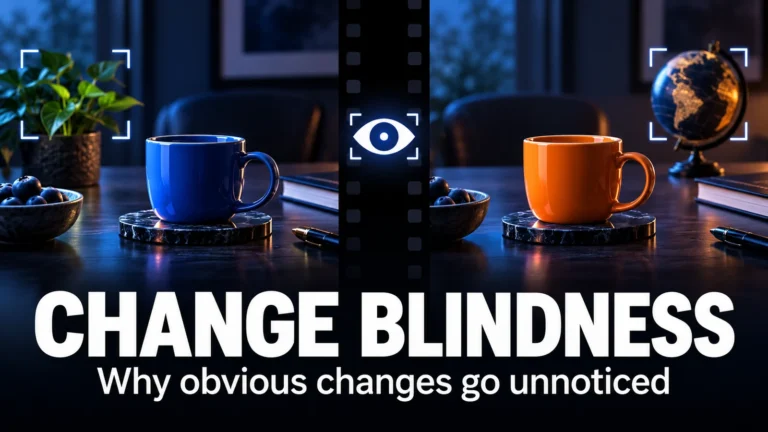
Change blindness is the failure to notice a difference between successive views of a scene. A cup changes color, an object disappears or a person is replaced, yet the viewer experiences continuity. It is especially striking when a cut, blank interval or other interruption obscures the visual signal that would normally attract attention to the change.
This is not a diagnosis of poor eyesight or a claim that people never retain visual detail. It is a warning about a familiar assumption: feeling that you have seen a scene clearly does not mean you can compare every part of it accurately with the next view. For video review, the practical challenge is to turn a vague impression into a specific, reproducible comparison.
Seeing a scene and comparing its details are different tasks
Watch a short kitchen scene and you may readily understand that someone is making coffee. That understanding does not require you to memorize the handle direction of every mug. If the next shot preserves the action but changes one background cup, the story can remain coherent while the local difference goes unnoticed.
Three questions help separate what happened. Was the item visible in the first view? Was enough about it retained to support a comparison? Did the viewer direct attention to the difference when the next view arrived? A failure to report a change does not, on its own, identify which stage was responsible.
That is why the phrase “I was looking right at it” needs care. Looking describes where the eyes were directed, not a complete inventory of information available for later comparison. Conversely, noticing a change after a cue does not mean the cue created the change. It may have directed attention toward information that was already visible.
For a reviewer, the useful response is to make the comparison explicit rather than criticize the first viewer. A person can understand the main event and still miss a background alteration. Expertise, motivation and repeated viewing do not justify claiming immunity. Nor should an ordinary lapse be treated as evidence of deception by the viewer.
What the research establishes—and what it does not
The classic 1997 study by Rensink, O’Regan and Clark alternated original and modified scenes with brief blank displays between them. Participants could have difficulty identifying substantial changes, and cues about the relevant object helped. This is evidence about attention and change detection under the study’s conditions, not a percentage prediction for every viral video.
Simons and Levin’s 1998 real-world study extended the question beyond passive viewing of flat displays to an interaction involving a change of person. The importance here is the broader research setting. Do not use a memorable demonstration to claim that any particular witness failed, or that a person in an unrelated recording must have been substituted.
The Visual Cognition Lab’s research overview explains how disruptions such as cuts can hide a change signal. It also treats questions about what people notice and retain as research questions, not a simple assertion that memory contains nothing. A careful practical guide should preserve that distinction.
None of these sources validates a special video-authentication trick. You cannot watch one demonstration and conclude that a checklist will eliminate missed changes. The procedures below are ways to organize comparisons and make findings inspectable. They are not a tested training program or a promised improvement in detection performance.
Change blindness is not inattentional blindness
Change blindness requires a difference across views or moments: something was one way and becomes another. Inattentional blindness concerns failing to notice an unexpected object or event while attention is engaged elsewhere. An unexpected object can remain present without changing identity or position in the way a change-comparison task requires.
Imagine counting passes between players. Missing an unexpected person walking through the scene illustrates an attention-to-the-unexpected problem. Now imagine an official’s jacket switching color across a camera cut while you follow the ball. The second question concerns a difference between views. Both involve attention, but they ask the observer to do different things.
The distinction matters when designing a review. Asking “Did anything unexpected enter?” will not necessarily direct attention to a missing wall sign. Asking “Did the sign change between these two shots?” establishes a comparison target, but it may narrow attention so much that unrelated events receive little scrutiny. Choose the task you actually need, and acknowledge what it leaves outside its scope.
| Question | Main task | What an answer cannot establish |
|---|---|---|
| Did that object change? | Compare a property across views | Why the change occurred |
| Did an unexpected object appear? | Notice an event outside the main task | Whether all other details stayed constant |
| Does the recording support its caption? | Verify a claim using context and sources | That a perceptual demonstration authenticates it |
Why cuts, interruptions and expectations matter
A continuous visible alteration can draw attention through local motion or a sudden appearance change. When a cut replaces the entire view, many things change at once: framing, scale, viewpoint and lighting. A small property difference is no longer the only conspicuous transition. The viewer can follow the action without selecting that property for comparison.
An interruption need not be a deliberately inserted blank frame. An object passing in front of the area, a camera switch or a moment when the relevant surface turns away can separate the available views. Do not label every such interval an attempt to hide something. Ordinary filming supplies many interruptions with no deceptive purpose.
Expectations also shape the task. If the scene appears to be one continuous conversation, a reviewer may assume stable background arrangements. That expectation is useful for following the conversation but not sufficient for checking continuity. The solution is not to distrust everything equally. It is to identify which properties matter to the claim you are evaluating.
A continuity change can itself be innocent. A film may combine takes. An interview can use an illustrative cutaway recorded at another time. The perceptual question—was a difference missed?—and the editorial question—does the edit misrepresent an event?—must be answered separately. Noticing a cup move is not a complete account of what the production intended.
A worked review: the cup beside the speaker
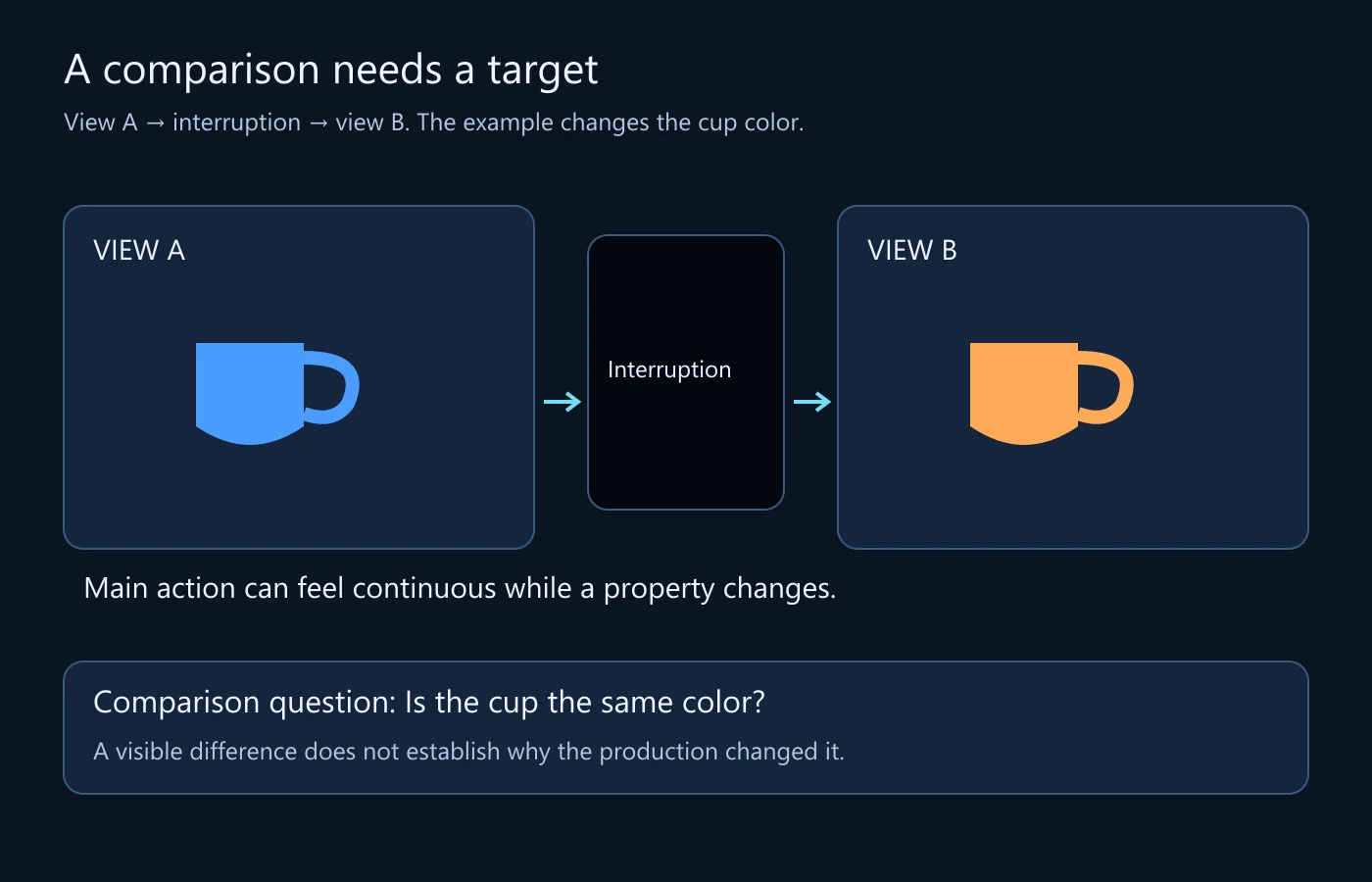
Consider a deliberately designed example. In view A, a blue cup sits beside a speaker’s notebook. A cut shows the listener. View B returns to the speaker, with an orange cup in approximately the same location. The speaker’s sentence continues smoothly. The example isolates one obvious property so you can reason about the task without inventing a real incident.
First describe what you actually observed
Watch at normal playback speed and write a short description before replaying: “Speaker continues a sentence after a listener shot; cup color may differ.” Do not begin with “the editor concealed a substitution.” That adds a cause and motive the observation does not supply. A vague uncertainty is acceptable at this stage.
Locate the last useful view of the cup before the cut and the first useful view after it. “Useful” means sufficiently visible for the property being compared, not necessarily the immediately adjacent frame. A cup partly hidden by a hand may not provide a reliable color comparison even if it is technically on screen.
Then make one controlled comparison
Use frames from the same supplied version and keep the surrounding scene visible. Compare cup identity, color, position and lighting separately. A blue-looking surface in shadow and a warm-lit surface in the next shot may require a lighting explanation rather than a substitution claim. If the views are not comparable enough, record that limitation.
If the change is clear, state it narrowly: “The cup appears blue in the selected earlier view and orange in the later view.” Retain the source positions so another reviewer can inspect the sequence. Whether this reflects a different take, a replacement prop, grading or another process remains a separate inquiry.
Finally ask whether the difference matters
A cup’s color may be irrelevant to an interview’s main claims. It may become relevant if the recording is presented as an unbroken record of a timed procedure. The same visual difference can have different significance depending on what the publisher asserts. Explain that relationship rather than escalating every continuity error into a conclusion about the entire recording.
Build a comparison task instead of rewatching aimlessly
Repeated viewing can feel productive while the question remains undefined. Choose a small interval and one property that bears on the issue: whether an item remains on a table, whether a screen shows the same text, or whether an action occurs before or after a cut. Give the task a stopping point. Otherwise, every replay can generate another unrelated suspicion.
Preserve an ordinary-speed pass before detailed inspection. It records the narrative experience that may explain why the difference escaped notice. Then use pauses or paired frames to inspect the specific property. These two views answer different questions: what a viewer encounters during playback and what the available image detail supports when compared deliberately.
Do not crop too aggressively at first. A tight crop can remove a light change, camera move or occluding object that explains the difference. Keep a contextual pair and a detailed pair if both are useful. Label their source positions and avoid adding arrows that imply a conclusion beyond the visible observation.
Ask a second reviewer a neutral question when stakes justify the effort. “What changes between these views?” is less leading than “Can you see the fake cup?” For a targeted technical comparison, naming the property can be appropriate; just record that the reviewer received a cue. An uncued first impression and a cued comparison are not interchangeable observations.
Separate uncertainty from disagreement. Two people may disagree because they selected different frames, viewed different derivatives or interpreted an indistinct color differently. Resolve those material differences before attributing the disagreement to attention or memory. Change blindness is not a convenient label for everyone who does not share your interpretation.
When the missing information is in the recording
Sometimes the source simply never shows the critical transition. A door is closed in one shot and open in the next, with an intervening cut. You can describe the states, but you cannot observe who opened it from those views alone. More concentration cannot recover an action that the supplied sequence does not contain.
Similarly, a low-resolution object may not preserve the detail you want to compare. Enlarging it can help with viewing but does not create missing information. Before discussing a viewer’s failure, ask whether the image supports the distinction at all. A noticing problem and an unavailable-detail problem require different next steps.
Request an earlier or more complete source when the transition matters. The existing video verification guide covers the broader source-and-context process. Here the goal is narrower: know whether you are comparing two visible states, investigating an unrecorded interval, or assessing a person’s report of what they noticed.
Applications that do not turn into a universal checklist
Editing and continuity review
An editor checking a dialogue scene can make separate passes for the action, props and screen direction. The purpose is to allocate attention deliberately rather than expect one viewing to cover every production concern. Keep the story’s intended continuity in mind: an intentional time jump should not be “corrected” merely because objects differ.
A continuity note should identify a shot and a property, not just say that a scene looks wrong. “Notebook closed after reverse angle” is actionable. “Something is off” forces the next person to repeat the discovery. This communication benefit does not require a claim that the method eliminates all missed changes.
Reviewing instructions or demonstrations
In a how-to video, a cut may hide an essential intermediate state. A tool appears assembled, a setting changes or an ingredient is already prepared. Ask whether the instructional step is documented, not whether the presenter looks trustworthy. A missing explanation can be a teaching defect without being evidence that the whole demonstration was fabricated.
For a safety-critical procedure, do not reconstruct missing steps from visual continuity alone. Consult the appropriate authoritative instructions or a qualified person. The ability to spot a change does not supply the technical knowledge needed to judge whether a procedure was safe or complete.
Discussing a viral clip
When sharing a comparison, show enough context to let others evaluate it. State whether you were prompted to look at a particular object. Avoid framing a missed change as proof that viewers are foolish or that any recording can fool everyone. Those claims exceed what the comparison establishes and make useful corrections harder to accept.
How to write a proportionate conclusion
Keep your first observation separate from the replay
Once someone points out a change, it can become difficult to remember how the scene looked before you knew where to look. Preserve a brief first-view note if that initial experience matters to the discussion. Do not rewrite “I did not notice the cup” as “the cup was impossible to see.” The first describes your observation; the second makes a much broader claim about the material.
A simple review record can have two columns: before the cue and after comparison. In the first, note the task you were doing and any uncertainty. In the second, record the selected views and the property you checked. This is not a psychological test. It is a way to prevent a later, more informed interpretation from silently replacing the earlier account.
Be equally careful with a group response. If the first person announces the answer, later agreement is not a series of independent discoveries. Other reviewers may still provide useful confirmation that the selected views differ, but they were checking a supplied proposition. Describe that as a cued comparison rather than a spontaneous detection rate.
Also look for disconfirming views. If the cup appears orange only during a brief lighting change but blue in the surrounding shots, the initial replacement explanation needs revision. A deliberate comparison should be able to weaken your first idea as well as support it. Otherwise, the procedure becomes a search for confirming screenshots rather than an inquiry into the sequence.
For collaboration, save frame references with a stable version name and enough timing information to find the interval. A player timestamp rounded to whole seconds may contain several different views around a cut. Identify the before-and-after event or frame positions when possible. Precise references reduce avoidable disagreement without pretending that the source supplies more temporal detail than it actually records.
A good conclusion separates four things: the property compared, the visible difference, the conditions of the comparison and its relevance to the claim. For example: “In the supplied version, the sign’s wording differs across the cut. Both selected frames are readable. The intervening interval is not shown, so the sequence does not explain when the sign changed.”
Notice what that statement leaves out. It does not infer the editor’s motive, diagnose a witness or identify a synthetic-media tool. If manipulation is still a concern, the guide to edited, staged and AI-made video addresses those broader possibilities. Keep the perceptual observation available without forcing it to settle every other question.
Change blindness teaches a useful form of humility: a coherent viewing experience is not a complete visual record in memory. Make the important comparison explicit, preserve the material that supports it, and distinguish a missed difference from an unexplained event. The aim is not to notice everything. It is to answer the relevant question more carefully.
Research references
- Rensink, O’Regan and Clark (1997), To See or Not to See — original flicker-study abstract and citation.
- Simons and Levin (1998), Failure to detect changes to people during a real-world interaction — original research abstract and citation.
- Visual Cognition Lab research overview — distinguishes change blindness from inattentional blindness.
- Visual Cognition Lab demonstrations — view at the source; demonstrations are not reproduced here.
The cup comparison and review procedure are original teaching material, not findings from a new experiment or a validated training intervention.