

Adversarial examples are inputs deliberately formed to make a machine-learning model produce an incorrect or unwanted result under specified conditions. Some research examples involve changes that people barely notice while a classifier’s answer changes. That does not make every edited, compressed or misclassified image adversarial, and it does not establish a bypass of a particular video detector.
The useful lesson is about the relationship between an input, a model and a decision. This guide explains that relationship defensively, with an original fictional review exercise and an evidence worksheet. It provides no attack instructions, perturbation settings or claimed tests against DetectVideo AI or any deployed service. A model result should inform an investigation without replacing the evidence needed to decide what happened.
Classification and decision boundaries
A classifier assigns an input to a category under its learned representation and decision rule. The categories belong to a defined task: identifying an object, sorting records or assessing a particular media property. They are not automatically categories of truth. Before interpreting an answer, establish what the model was actually asked to distinguish.
A decision boundary is the conceptual dividing surface between predictions. A drawing of two colored regions can help explain it, but it does not reveal an actual model’s hidden representation. If a diagram uses hand-placed points, treat their positions as teaching choices rather than measured image coordinates or a map of a commercial system.
The original Goodfellow, Shlens and Szegedy paper studies intentionally chosen input changes and model misclassification, including cases with high confidence. Its explanation emphasizes the effect of many small changes in a high-dimensional representation. Those are historical research findings under specified models and data, not a universal claim that every small edit fools every classifier.
For a reader, keep perceived similarity separate from equality of the model’s input. Two displayed images may seem alike while their files, dimensions or preparation differ. That observation does not tell you which difference mattered to a result. Establish what was submitted before inventing an explanation of the internal decision.
Conversely, a visibly changed picture might deserve a changed label. If an object is actually removed, a classifier’s different answer is not necessarily an error. Robustness concerns must preserve the intended task and correct reference label. Otherwise an example can confuse appropriate sensitivity to meaningful content with inappropriate sensitivity to an incidental change.
The existing AI video detection methods guide owns the wider taxonomy of video evidence families. Here the narrower question is how an inference relates to its input and evaluated conditions. This is not another list of detector architectures, nor a promise that one particular combination of signals eliminates all model errors.
Benign errors are not automatically adversarial examples
An ordinary classification mistake establishes a mismatch between a prediction and a justified reference answer. It does not establish somebody’s intention to exploit the model. An adversarial-example claim adds a deliberate input construction and a relevant failure objective. Keep those assertions distinct when reading a demonstration or describing a suspicious result.
NIST AI 100-2e2025 distinguishes learning stages, objectives, capabilities and knowledge in its adversarial-machine-learning taxonomy. It separates deployment-time evasion through testing-input changes from training-time poisoning. The taxonomy helps name the claim; it does not make an unexplained media discrepancy proof of an attack.
| Situation described | What is established | What still needs evidence |
|---|---|---|
| Prediction disagrees with a verified label | A task-specific error on the inspected input | Its cause and whether it was deliberately induced |
| Two versions receive different outputs | Different reported outcomes for those versions | Relevant input, model and processing differences |
| A version looks similar to a viewer | A limited perceptual comparison | Whether it has the same correct task label |
| An authorized study documents intentional input changes and failure | The reported result within that study’s conditions | Applicability to another task, model or deployed workflow |
A platform conversion, crop or quality loss can change the evidence available to a model without being a hostile operation. Do not attach an attack label simply because a conversion and an output change occur together. Record the observed relationship first, then ask what would support the stronger account.
Distribution mismatch is another separate possibility: the submitted material may differ from the material on which performance was evaluated. You do not need to declare an attacker to ask whether unusual inputs are covered by evaluation. Equally, an unfamiliar-looking input is not proof that the system fails on it. Keep a coverage question distinct from a measured error claim.
For images and video, production method and malicious intent are separate too. A disclosed synthetic clip can be legitimate; a recorded clip can carry a false caption. An adversarial classifier-input question does not establish either story. Avoid importing the word adversarial into a factual accusation when you have only a model warning or a visually unusual frame.
What an example transfers—and what it does not
The Goodfellow paper discusses examples that were misclassified across different studied models. That motivates taking model robustness seriously, but it does not establish that any chosen example will transfer to an unnamed current service. A paper’s model, data, task and conditions remain part of its result.
When somebody presents a demonstration, start by identifying the system named in the evidence. Was it a research classifier or the actual application being discussed? Was its prediction made from an image, a selected frame or a complete video? A slide about one category of system should not silently become a test report for another.
Separate model behavior from the surrounding pipeline. The input supplied to a service and the input presented to a component may not be the same object. The available report may explain preparation, or it may leave that relationship unknown. Record the missing information instead of guessing which transformation occurred.
A still-image result also does not automatically describe the behavior of a sequence-based system. If the claim concerns a video, ask which frames, timing and other available evidence were actually involved. Do not assume that one persuasive altered still demonstrates failure of every relevant video analysis path.
Keep historical findings historical. A paper can establish that a phenomenon existed in its evaluated setting without specifying the robustness of every later system. Conversely, a newer release date is not evidence that the problem has been solved. The useful request is for relevant current evaluation, not a contest between dates or brand names.
There is no tested attack, model run or failure rate in this article. The examples below are original reasoning exercises. They teach how to examine claims about robustness without collecting service responses, constructing adversarial media or publishing a supposed vulnerability unsupported by an authorized evaluation.
Model confidence is not certainty about a claim
A displayed confidence value needs a definition. It may describe a model’s class estimate or another scoring convention. It does not automatically mean the same thing as a probability that a caption, event or creator assertion is true. Read the reported task before attaching a larger conclusion to the number.
The original Guo and colleagues calibration paper distinguishes prediction correctness from how confidence estimates reflect correctness across evaluated samples. Its experiments show that accuracy and calibration can differ. That historical result is not evidence that a particular current detector is calibrated or uncalibrated; it explains why the two questions require separate support.
For a review, write down what the output says before paraphrasing it. A label about possible manipulation should not become “the publisher lied.” A result with limited available evidence should not become an absolute assessment of an entire recording’s history. Keeping the exact scope visible makes a confident-looking interface less likely to overtake the actual question.
False positives and false negatives also need reference answers. If the defined positive class is manipulated media, a false positive is a positive prediction for a verified negative item, while a false negative misses a verified positive item. The definitions do not tell you which class an unknown clip belongs to. Without a justified reference, call the result unresolved rather than declaring an error.
Do not count uncertainty as a successful adversarial attack. A cautious output can be appropriate when evidence is limited. A service not answering an unsupported question is different from confidently answering that question incorrectly. An evaluation should distinguish those outcomes rather than rewarding only a dramatic change in a headline label.
The deepfake detection guide provides the broader practical interpretation of synthetic-media signals. This article adds a narrower safeguard: apparent certainty, a verified error and a deliberately induced failure are three different claims. None should be substituted for another because their displays look similar.
Read a robustness claim as a bounded evaluation
A defensive evaluation needs authorization, an identified task and appropriate reference material. The following questions are a reader’s review framework, not a procedure for attacking a public model. They can be asked of an existing report without manipulating a real service or preparing inputs to evade it.
Identify the task and correct answer
Ask what the system was supposed to decide and how the evaluation established the reference label. A visual-classification example with documented object identity is different from a media-authenticity assessment of an unknown repost. If the label itself is disputed, that uncertainty affects how an apparent disagreement can be described.
Check whether a permitted modification preserved the relevant label. Changing the scene’s meaningful content can change the correct answer. A report should not call a response fragile merely because it responds to a change that matters to the task. Keep content preservation and superficial similarity as separate assertions.
Identify the evaluated system and conditions
NIST’s taxonomy makes assumptions about capability and knowledge explicit. At a non-operational level, that tells a reader to ask what access and control a study assumed rather than treating all demonstrations as equivalent. This guide does not describe how to exercise that access, generate examples or query deployed systems.
Retain model or application identity, input representation and version where the report provides them. If those details are unavailable, leave applicability unresolved. A picture of an interface with a changed label is less informative than an attributable report connecting its task, material and tested conditions.
Keep outcomes and limits separate
Look for the scope of the comparison, not only its most dramatic item. Which kinds of material were included? Which were omitted? Were the reference labels defensible? Does the conclusion describe the evaluated task or make a claim about all artificial intelligence? These questions can expose overstatement without pretending you have reproduced the study.
Do not replace an unknown failure rate with an invented percentage. If the report supports a qualitative limitation, state it qualitatively. If a rate is supplied, retain its population and method rather than applying it to another service. This article supplies no empirical counts or performance figures of its own.
Read mitigation claims within their evidence
A statement that a defense helped under one evaluation is not an all-purpose guarantee. NIST discusses limitations of mitigations in its report. For practical reading, ask which conditions the evidence covers and which remain unresolved. Do not infer that a protection was implemented, tested or defeated in DetectVideo from a general research discussion.
Keep the question proportionate to the purpose. A classroom explanation of a decision boundary can teach a concept without validating a deployment. A public allegation of a security weakness requires appropriate authorization and evidence. Useful learning does not depend on turning an illustrative exercise into a vulnerability disclosure.
A fictional archive review: a changed output is not a proven attack
Imagine an invented collection called Amber Archive. A reviewer is sorting permitted museum media into production categories for an internal catalogue. The collection has creator records for some items and incomplete records for others. No real archive was accessed and no model was run for this example.
The reviewer receives a source clip and a separately exported preview. A fictional review note says their automated labels differ. We assign that disagreement as a scenario premise; there are no measured scores, real service outputs or demonstrated adversarial changes. The task is to decide what a responsible handoff could say from this limited information.
Record the comparison before explaining it
Give the two copies separate identifiers and retain the known relationship between them. Note that one is the supplied source and the other an exported preview. Do not assume every setting is known because the filenames look connected. If the preview path is undocumented, record the missing processing description.
Next identify the model’s intended label and the archive’s actual classification question. A catalogue may need the creator’s production record, while a model evaluates visible patterns in a submitted copy. Those are different kinds of evidence. Do not let the automated label silently overwrite an attributable record, and do not assume the record answers every technical question.
Separate three possible conclusions
The first conclusion is only that the fictional notes report different outputs. The second would be that one output is wrong, requiring a justified reference label. The third would be that someone deliberately formed an adversarial input, requiring evidence of that construction and failure objective. The first does not establish the second or third.
Suppose the archive has a clear creator record disclosing a rendered scene. That can support the catalogue’s production label. It still does not identify why a model treated a preview differently. Conversely, an incomplete creator record cannot be completed by choosing whichever automated output looks reassuring. Keep the missing evidence visible.
Choose the next evidence, not another dramatic label
Ask for the relevant existing processing record and the original documented output context. Avoid generating a sequence of modified files until one receives a preferred label. That would change the task and potentially obscure the received material. The archive review concerns accountable interpretation, not an effort to induce or conceal model behavior.
If the question is whether a complete video was edited in a consequential way, use the AI video analysis guide for the wider media investigation. The fictional disagreement here cannot establish a cut, replaced voice or false caption. Those claims need their own appropriate evidence.
Write a defensible archive note
A bounded note might say: “The supplied source and exported preview have different reported classifications. Their processing relationship and the relevant reference label must be resolved before attributing an error or deliberate adversarial manipulation.” This is original example wording, not a finding about any actual file or model.
The note gives the next reviewer a useful question without accusing a creator or certifying a system. If a later authorized report establishes more, update the conclusion with that evidence and retain the original record. New information can narrow uncertainty; it does not retroactively make the earlier assumption a measured fact.
Use an evidence ladder without turning it into a truth score
The conceptual ladder below organizes a handoff: identify input and task, record the actual output, seek relevant corroboration, then select a proportionate human action. It is not a claim that more steps automatically make every answer correct. An unresolved item can remain unresolved at any step.
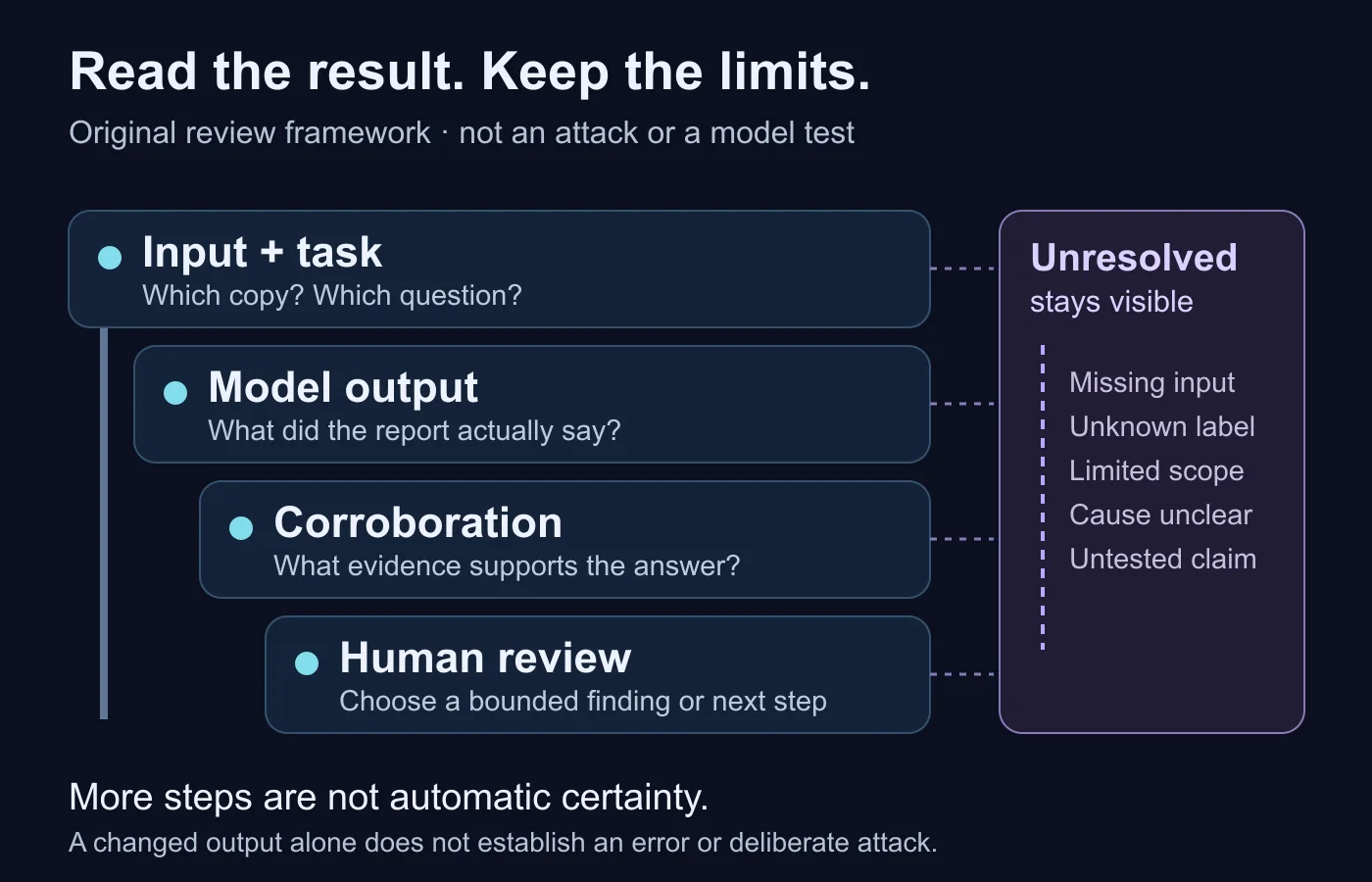
| Entry | Useful record | Do not substitute |
|---|---|---|
| Input | Exact inspected copy and known preparation | A screenshot for a verified source history |
| Task | Defined category or question | A broad true/fake verdict |
| Output | Actual label, score meaning and available context | Invented probability or hidden-reason explanation |
| Reference | Evidence supporting the appropriate answer | Perceptual similarity for a verified label |
| Explanation | Observed differences and unresolved causes | A changed output for proof of deliberate attack |
| Action | Limited finding and specific next evidence | A public accusation from one inference |
Keep correlated evidence together rather than counting it as independent confirmation. Several displays may repeat the same underlying result. A second screenshot of the same output is not another evaluation, and a rewritten explanation of that output is not another source. Ask what new information actually reduces the relevant uncertainty.
Use caution in both directions. A reassuring result does not prove that no adversarial condition or ordinary error exists; a warning does not prove that someone created one. The responsible interpretation states what the available observation supports and which claim remains untested.
- Identify the inspected input and actual task.
- Keep intended content changes distinct from label-preserving variation.
- Require a justified reference before calling an output incorrect.
- Require evidence of deliberate construction before calling an error adversarial.
- Retain the study’s model, conditions and applicability limits.
- Separate confidence display from verified correctness.
- Seek appropriate corroboration without attacking a deployed service.
- Report an unresolved result honestly when the necessary evidence is absent.
Treat detector results as evidence, not certainty.
Review the available signals and confirm important claims independently.
Questions about adversarial examples
Is every misclassified image an adversarial example?
No. An ordinary error does not establish deliberate input construction. Identify the task, correct reference and evidence for the stronger explanation.
Must an adversarial change be invisible?
No blanket rule is justified. Some studied examples involve barely noticeable changes, but the objective and evaluation conditions matter more than one visual-size description.
Does a high confidence value guarantee a correct result?
No. Read the score’s definition and relevant calibration evidence. A class estimate is not automatically a probability that an external claim is true.
Does a research example prove that DetectVideo can be bypassed?
No. This article has not tested DetectVideo or another deployed system. A study’s result must stay attached to its actual evaluated task and conditions.
What should I do when two copies receive different results?
Preserve both copies, record the known processing relationship and output context, and seek a justified reference. Do not infer an error or deliberate attack from disagreement alone.
Primary sources and scope
- Goodfellow, Shlens and Szegedy: Explaining and Harnessing Adversarial Examples — original 2015 conceptual account and transfer discussion; no generation procedure, attack parameters, source image or benchmark statistics reproduced.
- NIST AI 100-2e2025: Adversarial Machine Learning — actual predictive-taxonomy, learning-stage, capability and evasion definitions; non-operational interpretation only.
- Guo and colleagues: On Calibration of Modern Neural Networks — original 2017 confidence/correctness distinction and calibration definitions; no claim about a current named detector’s calibration.
Sources read on 14 October 2026. Amber Archive, its differing labels, tables and evidence ladder are original fictional teaching material. No model, attack, service query, detector failure rate or deployed-system vulnerability was tested or established.