
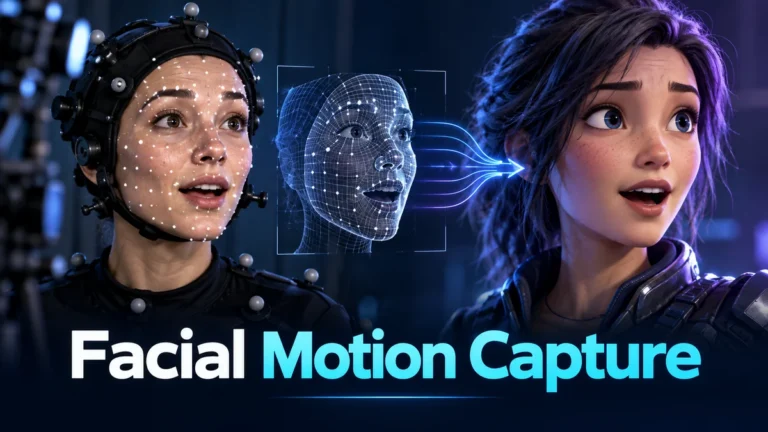
Facial motion capture records or tracks a facial performance so that its movement can inform animation. The visible result may be a clearly fictional character, a stylized avatar or a rendered humanlike face. Captured expression and final appearance are different things: real motion can drive a synthetic face without making that face a camera recording of the performer.
This guide separates performance, observation, solving, retargeting and final animation. Its original example uses an imaginary performer and a geometric character to show how a review can locate a problem without guessing a person’s identity or emotions. No performer was recorded, model was tested, or production benchmark was measured for the example.
Performance and capture are different stages
A performance is the sequence of actions a person makes. Capture is the process used to obtain information about those actions. The resulting data is then interpreted or transformed for animation. A video of a face, a set of tracked features and a finished character sequence are connected objects, not interchangeable versions of one recording.
The official MetaHuman Animator overview describes animation generated from video, depth and audio inputs through different real-time or offline workflows. That is a concrete system example, not a statement that every facial-capture pipeline uses the same devices or generates identical data.
For review, identify what was actually observed. Video-based expression tracking can use visible movement as input. Audio-driven animation is a different source relationship: sound can inform a facial animation without being a recording of the face’s original movement. Do not describe an audio-derived gesture as directly observed facial capture merely because it accompanies recorded speech.
Keep head movement separate from facial deformation as well. A turn changes the viewing direction of the head; an eyebrow raise changes a feature relative to it. The final character may include both, but a reviewer needs to know which part was captured, inferred or deliberately adjusted. A stationary-head preview may be useful for one question and misleading for another.
Start a simple record with the source performance, the processed output and the delivered animation. Give each a distinct name. That habit makes it possible to discuss a change in timing or expression without silently attributing every final gesture to the original performer.
The boundary is practical rather than moral. Animation based on a performance is an ordinary creative technique. Problems arise when an output is described inaccurately, when the source relationship is unknown, or when a viewer is asked to treat a rendered person as direct evidence of what somebody actually said or did.
Markers, cameras and software describe observation methods
Facial capture is not one universal arrangement. The original Laine and colleagues research paper discusses marker-based and markerless approaches and describes a particular controlled video-based performance pipeline. Its historical implementation illustrates the variety of methods; it does not establish the requirements or quality of every contemporary tool.
A marker can provide a visible reference for an observation system. Image-based tracking can instead estimate facial features from appearance. Multiple views, depth information and a single video view supply different kinds of input. Ask which arrangement produced the material you received rather than inferring the complete setup from a few dots on a behind-the-scenes photograph.
Software may represent movement as landmark positions, surface deformation or animation controls. Google’s Face Landmarker documentation, for example, describes landmarks, blendshape coefficients and transformation matrices as outputs. These are technical representations that can inform effects or animation, not independently verified statements about a person’s identity or inner state.
In ordinary animation vocabulary, a blendshape describes a shape change that can contribute to a posed face. Its associated weight or coefficient is a control value within a particular system. Do not compare two unnamed systems’ values as though they share a universal expression scale. Read the output convention and the receiving character’s setup first.
Orientation conventions deserve attention. A mirrored preview can make a left-side action appear on the opposite side to the viewer. Google’s documentation explicitly identifies left and right blendshape labels with the subject rather than the viewer. A review note should name the convention before accusing the animation of reversing an expression.
None of these observations is an equipment recommendation. A demonstration may show that a method is possible while saying little about an unknown project’s input quality, setup or review effort. Keep capability descriptions attached to the actual documented method and leave performance claims to an appropriate test.
Solving, retargeting and animation have different jobs
Solving turns observed input into the representation used by the pipeline. Retargeting maps usable motion or control information to a target character’s structure. Animation is the resulting movement that will be viewed, edited or rendered. Those stages can expose different problems, so treating every discrepancy as “bad capture” is not helpful.
Epic’s process-and-export documentation separates processing a performance, inspecting a result and exporting an animation with a specified target relationship. It includes retargeting choices in that workflow. The relevant lesson is stage separation, not a promise that the same options exist in another application.
| Stage | Question to inspect | Do not assume |
|---|---|---|
| Source performance | Is the relevant action visible in the supplied take? | The final character’s gesture was all recorded. |
| Tracking or solve | Does the processed representation follow that visible action? | A clean contour means every hidden feature was observed. |
| Retargeting | Does the target interpret the controls as intended? | Two rigs share identical ranges and conventions. |
| Edited animation | Was timing or expression deliberately adjusted? | Every difference is a tracking error. |
| Final rendering | Does appearance change how movement is perceived? | Realistic skin proves a direct camera performance. |
Imagine that a small brow movement becomes a large movement on a stylized character. Before changing the source interpretation, inspect the transfer and target controls. The character may have exaggerated proportions or a deliberately different expressive range. A correct observation of the original action does not require an identical-looking output on every design.
The converse also matters. If the source action is visible but the processed representation does not follow it, a later polished render may conceal the discrepancy. Compare the earlier stage rather than judging only the final shot. Rendering detail and motion fidelity are different review questions.
Do not declare one stage successful because another looks appealing. A pleasing character can still deviate from the intended performance. A faithful motion preview can look visually rough before final rendering. Report which stage you inspected and the specific relationship you found, not a blanket quality claim about the whole pipeline.
Occlusion, expression range and calibration need context
Observation depends on what the input actually shows. A hand over the mouth, hair across an eye or a head turn can make a feature difficult to see. If a system produces a continuation while that feature is hidden, do not describe the continuation as a new direct observation of the obscured movement.
The Epic video capture guidelines emphasize relevant facial visibility, stable capture, suitable lighting and unobstructed features for their workflow. These are method-specific recommendations. This article does not supply universal resolution thresholds, camera settings or accuracy guarantees.
Keep a visibility note beside a disputed moment. Was the mouth clear in the source? Did the eyelid disappear because of a turn? Did the camera or light change? These observations help distinguish an input limitation from a mapping issue without pretending you know the solver’s private implementation.
Calibration is another relationship to document rather than a magic label. Ask which baseline, device or performer setup the actual method uses and whether it changed during the relevant take. Do not assume that a control named neutral means the same thing in every application. An unexplained offset needs the method’s context before it can be diagnosed.
Expression range should remain similarly bounded. If the output handles a gentle action differently from a strong one, describe the particular mismatch. Do not infer a universal limitation from one invented example, or claim that all modern systems fail at an expression discussed in an older paper. The supplied source and actual method govern the review.
For a viewer investigating an unknown clip, these production constraints are not a permanent list of authenticity tells. Compression, editing and ordinary recording conditions can complicate appearance too. A tracking-like error may suggest a question about the workflow, but it does not identify the exact software or establish deception by itself.
Ethical use begins with an authorized performance
Use captured faces and performances only with an appropriate authorized purpose. Publicly available footage is not, by itself, a permission record for every new animation or likeness use. This guide provides no instructions for collecting somebody’s face secretly, copying their identity or constructing an unauthorized impersonation.
For a legitimate project, discuss the intended output before recording: which character will use the motion, where the animation will appear and how meaningful changes will be described. Keep that discussion separate from whether the software can process a file. Technical success does not settle authorization or presentation.
Do not collect extra personal information just to make the record look rigorous. An authorized production team can retain relevant source and approval information through its normal process without publishing a performer’s private data. The illustration here avoids that issue by using wholly fictional, geometric faces rather than an actual actor’s likeness or footage.
The same restraint applies to claims about emotion. A visible facial action or an animation coefficient should not be presented as proof of a person’s private feelings, honesty or intention. Describe movement and the artistic performance you can inspect. Do not convert an expression-control name into a psychological diagnosis.
If the final output is a fictional character driven by performance data, explain that relationship where it matters to the audience. If a real likeness or consequential representation is involved, seek the appropriate review for that use. This is a production-reading guide, not jurisdiction-specific legal advice or an automated permissions assessment.
A conceptual transfer example: one action, several review points
Imagine an invented performer, Tavi, supplying a gentle eyebrow raise for a fictional geometric character called Kite. Tavi and Kite are teaching names, not real people or a production we completed. The imaginary source contains a neutral moment, the raise and a return. No recording, inference or animation experiment accompanies this example.
Begin with the visible action
Describe the source in plain terms: the relevant brow moves upward, while the rest of the face is available for comparison. Do not begin with a numerical score or a guessed emotion. The initial observation concerns a movement that a reviewer could locate in the source.
Then note the comparison target. Kite has a clearly nonhuman face with larger brow-like panels. The aim is to convey a related action, not reproduce Tavi’s anatomy or establish their identity. This makes it easier to separate performance information from final appearance without treating a realistic likeness as the only successful output.
Compare the intermediate stages
Suppose a processed preview represents the raise at the intended moment, but Kite’s brow panels move in the opposite direction. In the fictional example, the useful next check is the mapping and orientation convention. Do not call the source recording defective simply because the rendered target is wrong.
Now imagine a different issue: a hand hides Tavi’s mouth during the return, and the processed preview supplies a smooth mouth continuation. That continuation may be useful for animation, but the reviewer should mark the visibility gap. It is not direct evidence that the hidden mouth followed exactly that path.
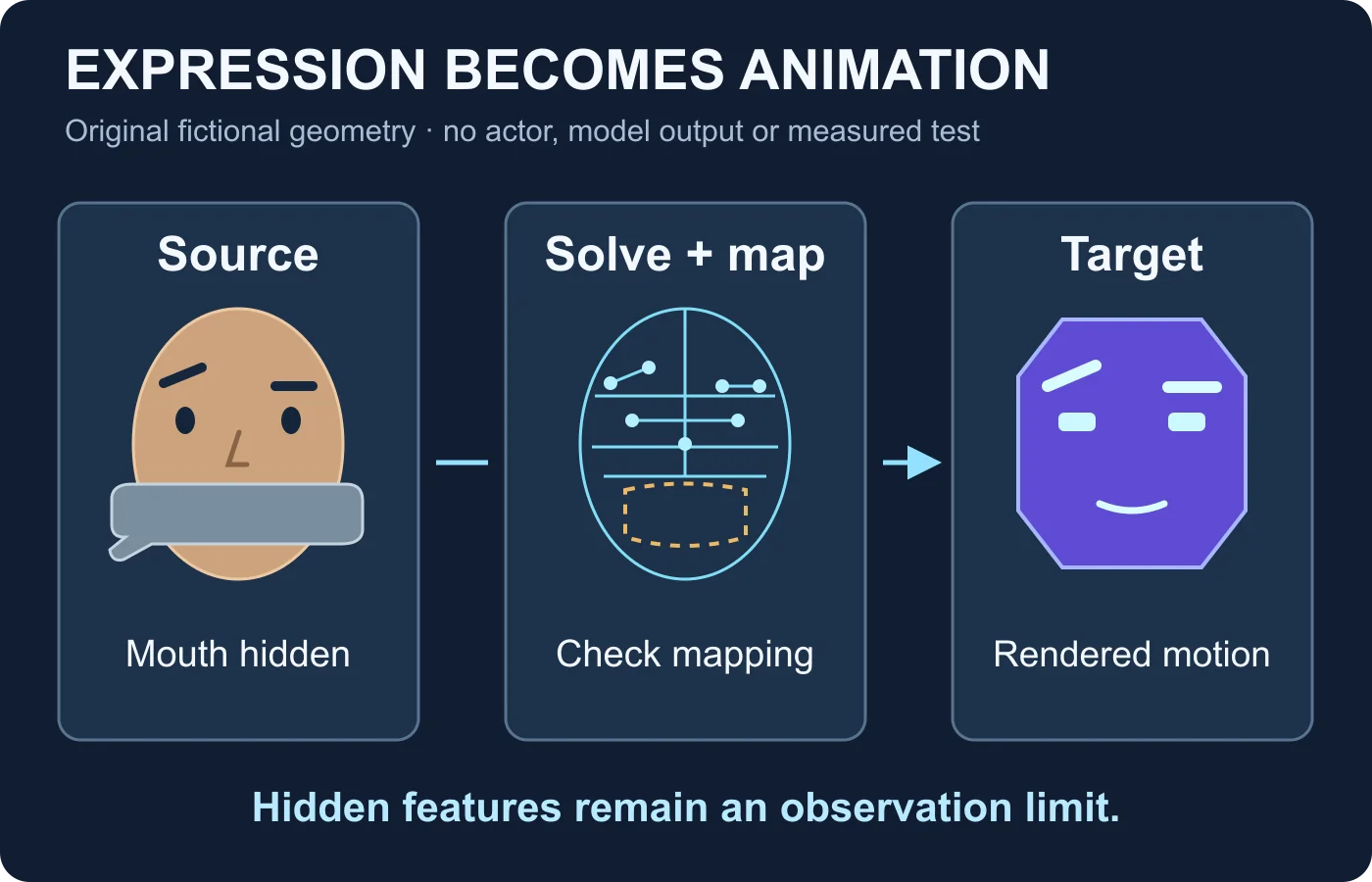
Use a stage-by-stage worksheet
| Review entry | Observation | Next question |
|---|---|---|
| Visible source | The intended brow action can be located. | Which source version is being compared? |
| Processed representation | The action appears at the intended moment. | Does its left/right convention match the source? |
| Target mapping | Kite’s panels respond differently in the hypothetical example. | Is the target control relationship intentional? |
| Visibility gap | A hand hides the mouth during part of the action. | Which continuation is inferred rather than observed? |
| Delivery | The final render combines movement with a designed face. | Does the description explain that source relationship? |
Keep observations and hypotheses in separate columns if you use the worksheet on an authorized real project. “The brow reverses direction on the target” is an observation. “The mapping sign is reversed” is a possible explanation that needs checking. Clear separation makes it possible for another reviewer to test the explanation rather than inherit it as fact.
Record deliberate edits too. If an animator changes the return timing for a shot, the final animation should not be described as an untouched transfer. That does not make it a deceptive production. It makes the relationship more specific: a captured action informed movement that was later adjusted for a fictional character.
Compare the same moment before judging timing
Give the fictional action three observable reference points: before the raise, its visible peak and the return. These are review landmarks, not measured timestamps. Locate each in the source and the target. If the animation begins after the source’s opening pause, comparing both players at their displayed start can make a correctly transferred action appear mistimed.
Ask whether the files contain the same interval and whether playback conditions are comparable. A source take, an intermediate preview and a trimmed delivery can begin at different places. Identify the relevant action instead of assuming that identical elapsed-time labels locate identical content. Preserve a clear note about any editorial trim that changes the comparison.
For a live preview, do not invent a latency value from how two windows appear on screen. Capture, processing, display and any later recording can all be part of what the reviewer sees. A quantitative timing claim needs an appropriate measurement setup. Without one, describe the observed relationship and the limits of the comparison rather than reporting an impressive or alarming delay.
Keep version relationships with the note. If the target rig was changed after the first solve, say which target version produced the reviewed output. Do not combine an older preview with a later correction and announce that the pipeline remains wrong. Equally, a successful correction in one moment does not prove that every other action in the take was reviewed. Tie the conclusion to the relevant version, interval and observable action.
A bounded closing note for this example might say that the brow action is visible, the target response needs a mapping review, and the mouth continuation is not established from the hidden source region. No recognition claim or performance percentage is necessary. The worksheet helps locate a production question, not authenticate an unknown person.
Distinguishing capture from impersonation
Facial capture concerns movement used for animation. A face swap concerns an identity transfer or replacement in footage. Lip-sync generation concerns the relationship between visible speech movement and audio. These techniques can overlap in a larger production, but they are not synonyms.
The existing face-swap video guide owns the identity-transfer problem. The AI lip-sync guide handles speech alignment and source comparison. This article stays with how observed expression can become motion data and target animation, without explaining how to impersonate somebody.
A fictional character can borrow movement from a performer without borrowing that performer’s identity. A humanlike render can also use authored or inferred motion rather than directly captured movement. For the wider generation categories, use the AI-generated video guide. Do not make one motion source describe every element of the final clip.
- Identify the actual input: visible performance, depth, audio or another source.
- Separate source observation from solving, retargeting and artistic adjustment.
- Check the conventions before judging a target movement.
- Mark hidden features as observation limits, not recovered recordings.
- Review the delivered version and its production description together.
- Keep identity, permission and factual claims outside a motion-quality verdict.
For an unknown video, source and context remain essential. Natural-looking motion does not prove that the visible person performed it, and awkward motion does not prove a particular manipulation method. If the clip warrants technical analysis, preserve the strongest available video and interpret media findings with the relevant source record.
Facial motion capture is most understandable when the stages stay visible: a performance supplies input, a system interprets movement, a target receives animation, and a final image presents it. Explaining that chain honestly preserves the creative value while limiting what the output is asked to prove.
Questions about facial performance capture
Is facial motion capture the same as a face swap?
No. Facial capture supplies motion information for animation. A face swap changes a represented facial identity in footage. They may appear in a larger workflow but answer different production questions.
Does every facial capture system need markers?
No. Methods include marker-based and image-based approaches with different inputs and representations. Check the actual pipeline rather than assuming one universal setup.
What is retargeting?
It maps usable motion or control information to a target character’s structure. Target proportions and control conventions can affect how the transferred action looks.
Does a smooth animation reveal hidden facial movement?
Not as a direct observation. If the source feature was occluded, a continuation may be inferred or artist-adjusted. Keep that distinction in the review.
Can expression tracking verify emotions or identity?
Do not treat motion controls as proof of private feelings, intentions or identity. Those claims require different evidence; a performance-quality review does not establish them.
Real motion can drive a synthetic face.
Check the video and review how the performance was created.
Sources and reading limits
- Epic: MetaHuman Animator — documented input and animation workflows, not universal pipeline requirements.
- Epic: Video Capture Guidelines — visibility and capture constraints for that workflow; no settings or thresholds are generalized here.
- Epic: Process and Export Your Animation — processing, preview, export and target relationships.
- Google: Face landmark detection guide — output types and orientation conventions, not an identity or emotion-verification claim.
- Laine and colleagues: Production-Level Facial Performance Capture — original 2017 paper introduction, problem statement and related-work context. Historical mechanism reference, not current performance promises.
Sources accessed on 14 October 2026. Tavi, Kite, the transfer scenario and diagram are original fictional teaching material. No real actor, captured performance, model run or accuracy test is represented.