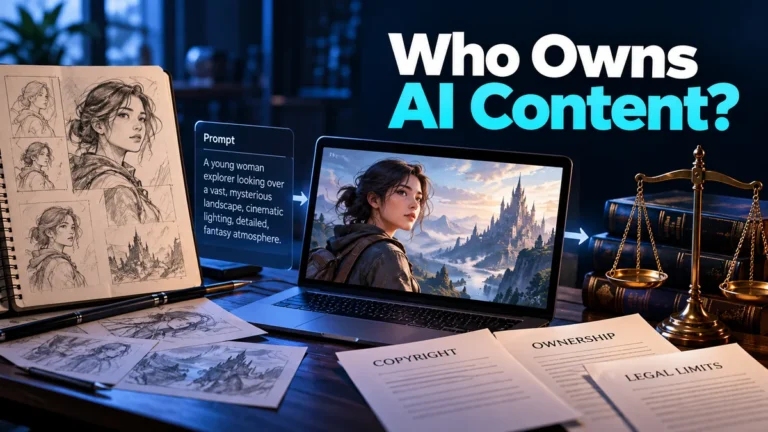
Who owns AI generated content? In the United States, first separate copyright protection, ownership of protectable human contributions, tool permissions, and rights in material used to create or publish the output. The U.S. Copyright Office says purely AI-generated material is not protected by copyright, while qualifying human expression can be. A tool’s permission to use output does not settle every other rights question.
This is general U.S.-focused education based on official sources checked on 14 October 2026, not advice for a particular project or a prediction of a court decision. Other jurisdictions may differ. Its original worksheet helps you prepare a clear record for a publisher, client, or qualified adviser. It does not certify ownership, clear a likeness, or determine whether a specific generated image infringes another work.
What do you mean by owning the content?
A creator may say “I own it” when they mean they can download the file, use it commercially, prevent copying, deliver it to a client, or control a particular human-authored contribution. Those are not interchangeable statements. Write down the actual intended use and the right you need before looking for a single yes-or-no answer about an entire AI workflow.
Possession is one layer. Having the file on your computer establishes access to a copy, not necessarily copyright in everything it contains. Title 17, section 202 expressly distinguishes copyright from ownership of the material object embodying a work. Do not translate a successful download or paid subscription into an unqualified ownership claim.
Copyrightability is another layer: whether the relevant expression qualifies for protection. Ownership comes next: who holds that protection when it exists. A contract may affect relationships between people or organizations, but you still need to identify the work and contribution being discussed. This order prevents a provider’s “commercial use” statement from answering a question it was not designed to resolve.
| Question | Relevant record | Do not substitute |
|---|---|---|
| What is protected? | Specific human-authored expression and creation history. | The file’s size, realism, or price. |
| Who holds a right? | Relevant authorship, employment, agreement, or transfer facts. | Who happened to download the output. |
| What use is permitted? | Applicable tool and source licenses for the intended use. | A generic statement about copyrightability. |
| What else needs review? | Inputs, identifiable people, third-party material, and publication context. | An AI label or a detector result. |
The table is an editorial preparation aid, not a legal test. A qualified reviewer may need more information for a specific dispute or agreement. Its value is keeping different questions visible rather than merging them into the word “own.”
Human authorship is central to the U.S. copyright question
The Copyright Office’s January 2025 Part 2 report on copyrightability distinguishes AI assistance from AI replacing human creativity. It concludes that protection can cover original human expression in a work containing generated material, but not purely generated material or expression insufficiently controlled by a human. Its analysis is case-specific, not a blanket percentage rule.
That distinction does not require rejecting every digital tool. The important question is what the human actually authored in the relevant result. Record a written passage you composed, a drawing you made, or the particular expressive changes you performed. A vague statement that you “worked hard on it” leaves the reviewer without the contribution they need to examine.
Separate production decisions from claims about the expression. Choosing a delivery date, opening a software account, or saving a preferred result may be part of the workflow. Do not assume that every necessary production step demonstrates authorship of the image or soundtrack. Explain what is perceptible in the final work and how it came from your contribution.
Also avoid treating a visible imperfection as evidence of human authorship. A generated output can be imperfect, and a human-created work can be polished. The appearance of the file is not the record of creative control. Preserve the relevant source materials rather than asking a visual classifier to answer an ownership question.
Prompts, edits, and arrangement have different roles
The Part 2 report says prompts alone, with the generally available technology it examined, do not provide sufficient expressive control. Keep that statement within its scope. It is not a numerical rule about how many prompts you may enter, and this guide does not predict how future tools or individual claims will be assessed.
A prompt record can still explain what you requested and how an output entered the project. It is useful documentation without automatically establishing authorship of every resulting detail. Do not erase the prompt history, but do not make it stand in for a description of your original text, drawing, modification, or creative arrangement.
The Office’s registration guidance for works containing AI-generated material recognizes that qualifying human selection, arrangement, or modification can be relevant while protection remains limited to human-authored aspects. A minor change is not a universal conversion of generated material into exclusively human expression. No amount or type of edit in this article is promised to guarantee registration.
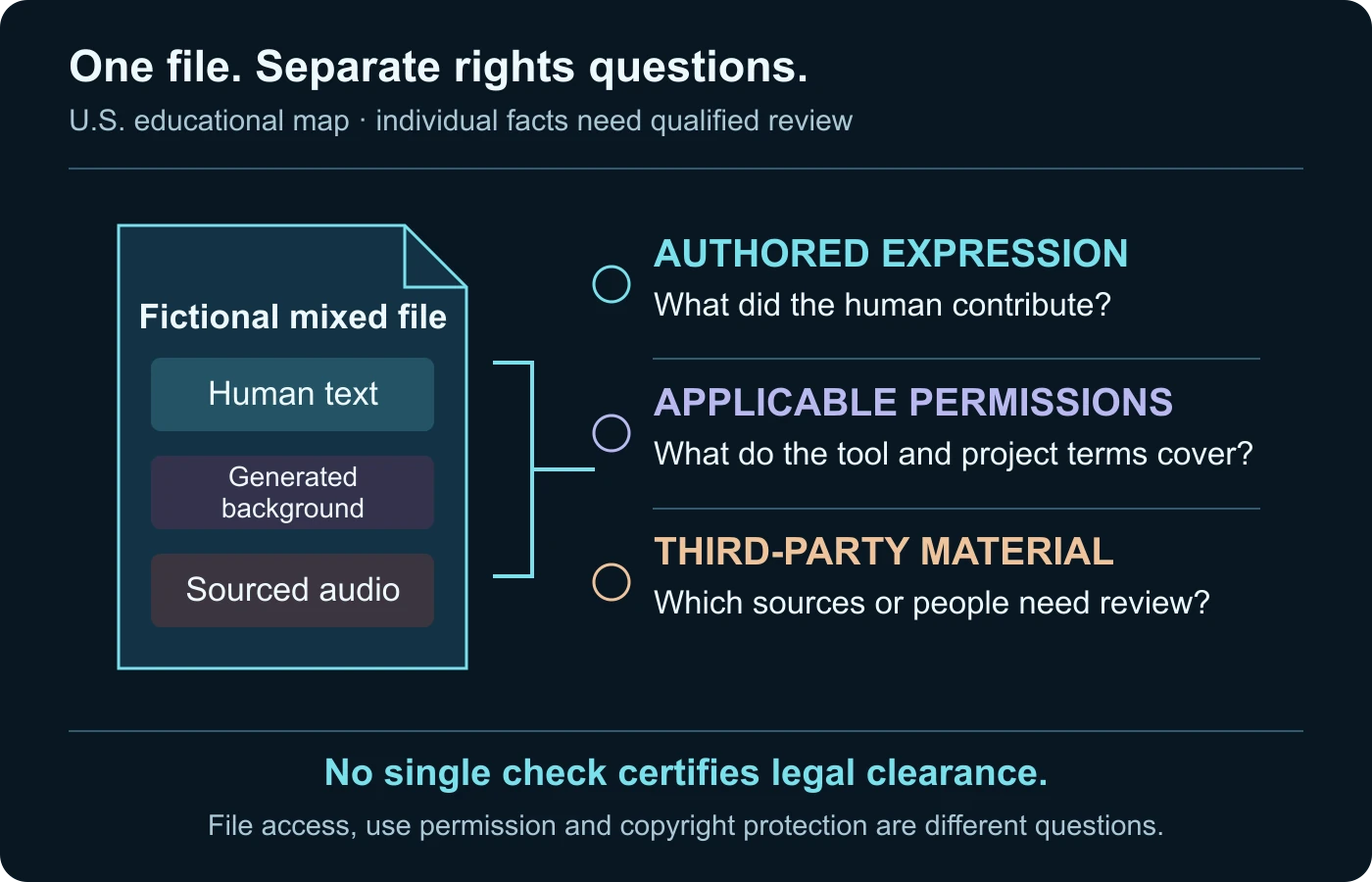
For a mixed work, identify the layers. A human-written script, generated background, and human-designed sequence can raise different contribution questions. Describe them individually. The synthetic media guide provides production categories; those labels help describe the workflow, but they are not themselves legal conclusions about protected expression.
Copyrightability and the person holding a right are separate
Section 201 of the Copyright Act addresses initial ownership, works made for hire, and transfers. These rules concern protectable work and relevant relationships. Do not assume the person typing into a tool always owns all protectable contributions, or that paying an invoice automatically resolves every authorship and assignment question.
If several people contributed, record their actual roles instead of assigning the whole work to the last editor. A project may contain material created by employees, independent contributors, a client, or preexisting sources. The legal implications depend on the relevant facts and agreements. This guide cannot decide whether a particular contributor relationship qualifies as work made for hire.
Keep the commission separate from the delivery. A client may need agreed permission to use particular materials, a defined scope of rights, or an explanation of what cannot be promised. Those questions should be addressed with the appropriate contract and legal review rather than answered by a generated image’s existence.
Do not present a workflow checklist as a replacement for an agreement. It can reveal missing information, but it cannot establish a transfer that did not occur or interpret conflicting clauses. For a meaningful assignment, licensing arrangement, or ownership dispute, obtain qualified advice using the actual documents and work.
Read tool permissions for the specific use
Use the actual terms applicable to your account, product, and relevant date. Do not rely on a screenshot from an unrelated tool or an old social post claiming all AI output is free to use. This article does not summarize any named provider’s current commercial terms. Instead, it gives you questions to take to the terms and an appropriate reviewer.
Ask what material the terms address: your inputs, generated output, the service’s own assets, or a library element. A permission concerning one category may not apply to another. Keep the exact clause or official page in a dated private record, with the product and account context needed to understand it.
Identify the intended use clearly. A personal experiment, commercial advertisement, client deliverable, and exclusive campaign license have different requirements. Do not assume a broad permission to publish also promises that no one else can receive a similar output. If exclusivity matters, make it a specific review question rather than an implication you add yourself.
Look for conditions, exclusions, and responsibilities relevant to that use. You may need to understand attribution, prohibited uses, source-material permissions, or what a provider does and does not warrant. Do not reproduce credentials or private contractual terms in a public portfolio merely to show that you performed a check.
A contractual statement about output is not a Copyright Office registration decision. Conversely, limited copyright protection does not answer every contractual obligation between you and a service or client. Keep both records without treating one as a substitute for the other.
Do not lose track of inputs and third-party material
List what you supplied or incorporated: a reference image, recorded performance, music, typography, logo, passage, or other source asset. For each, identify where it came from and what supports the intended use. An output’s copyrightability is not permission to disregard a source asset’s separate rights.
Sections 102 and 103 provide the statutory context for original expression and the limited scope of protection in compilations and derivative works. Do not infer an exclusive right in preexisting material merely because it appears inside your new arrangement. A rights review must identify both the contribution and the material it uses.
An identifiable person’s face or voice creates another question that an output-use clause alone may not resolve. This guide does not interpret any state’s likeness, publicity, or privacy law. Treat relevant permissions as a separate review item and obtain qualified advice for the actual jurisdiction and use. An AI disclosure is not a universal clearance mechanism.
Likewise, keep statements about the depicted subject separate from rights documentation. A permission to use a clip does not prove that its caption or endorsement claim is accurate. The AI UGC guide owns advertising and testimonial trust; this article focuses on a creator’s rights questions rather than repeating that publishing standard.
A fictional short-video project shows why the layers matter
Imagine a creator prepares a fictional educational video. They write the narration themselves, ask a model for a decorative background, and arrange the final sequence in an editor. They also consider adding a music track supplied by another source. No actual work is submitted for registration in this example, and no legal outcome is asserted.
The creator first records the human contribution. They preserve their narration drafts and note the sequence decisions they made. They do not call every texture in the generated background their original drawing. The record describes the relevant expression rather than inflating the human contribution to make the project sound safer.
Next they record the generated component and the applicable tool terms. They identify which background entered the final version and keep the dated official permission context. This does not certify copyright in the background; it documents the tool-use question so it can be reviewed independently.
Then they examine the proposed music source. The fact that the rest of the video contains original or generated elements does not settle permission for that track. If the relevant license cannot be established for the intended delivery, they keep that item unresolved rather than claim the entire video is ready because a model helped make it.
Suppose the client now requests exclusive rights to every visual and sound. The creator should not respond with the same generic statement used for a personal upload. They need to identify which exclusivity claims can actually be supported, which materials have separate terms, and which uncertainty needs legal review. The exercise is about asking accurate questions, not drafting a binding answer.
Finally, suppose the project changes: a real person’s recorded voice replaces the narration, or a new sourced image replaces the background. Update the record for that actual version. Earlier checks do not automatically cover newly added material. A useful handoff connects rights questions to what the recipient receives, not simply to the first idea for the project.
Prepare a contribution and permission record
Create a small asset ledger for the final version. Avoid a single checkbox labelled “AI rights cleared.” It hides which question was answered and who answered it. The following original fields support review without pretending to be a registration application or a legal determination.
| Field | What to record | Open question |
|---|---|---|
| Final component | The relevant narration, background, image, or track. | Does this record match the delivered version? |
| Human contribution | Specific original expression and supporting drafts. | What part, if any, is protectable? |
| Generated material | The tool-assisted or generated element and known process. | What control or authorship remains uncertain? |
| Permission context | Dated applicable official terms, agreement, or license. | Does the intended use fit that scope? |
| Third-party element | Source and relevant permission or unresolved status. | Is another review required before delivery? |
Keep the ledger proportionate. The reviewer needs relevant drafts, sources, and terms, not a public dump of confidential prompts or personal data. Give authorized people access to necessary evidence through an appropriate route. You can explain that records exist without publishing private agreements or unreleased client assets.
Use honest status language: permission context located, contribution described, use not yet reviewed, or ownership question unresolved. Those phrases describe preparation. They do not imply an official decision. If a qualified reviewer provides a conclusion, connect it to the specific materials and intended use rather than applying it to future outputs automatically.
Registration guidance is not a universal publication checklist
The Copyright Office’s registration policy addresses identifying human contributions and disclosing relevant AI-generated material when seeking registration. It includes excluding AI-generated material that is more than de minimis from the claim. Read the current official guidance for the application context instead of guessing that every small AI-assisted operation needs the same description.
Do not submit a declaration based only on this article or a detector score. Prepare the actual work history and ask the Office or a qualified adviser when the application facts are unclear. A project summary written for a client and the information required for a particular registration claim are different documents.
Keep registration, permission to use, and factual accuracy separate in your publication notes. A copyright claim does not prove an event happened, a likeness was authorized, or the supplied music fits a license. Similarly, choosing not to seek registration does not remove every other obligation attached to the project.
Technical provenance helps document history, not legal ownership
Preserved versions can help explain how a project developed. Compatible provenance records may describe tools, ingredients, and recorded changes. The Content Credentials guide covers inspection and limitations. Those records are evidence about history, not an automatic certificate of copyright or rights clearance.
A technical finding that media is likely generated does not identify the owner of any human contribution. A finding with no strong generation evidence does not prove permission to publish. Use media analysis for its actual question and rights records for theirs. Do not advertise a detector as a legal ownership checker.
If versions matter to the discussion, preserve their relationship and source context. The video provenance guide explains lineage separately. A clear timeline may assist a qualified review, but the earliest public upload alone does not settle every authorship, employment, or licensing issue.
Know when a qualified review is necessary
Seek qualified U.S. advice when exclusivity, a substantial commission, identifiable people, disputed source material, conflicting agreements, or a threatened claim makes the consequences important. Provide the actual components, creation history, terms, and intended use. A lawyer cannot meaningfully assess a specific project from the word “AI” alone.
Do not apply this U.S. overview globally. The relevant jurisdictions, parties, and delivery arrangements may change the analysis. Nor does this article resolve ongoing litigation about model training or decide whether any particular output is substantially similar to a protected work. Those are separate, fact-sensitive questions.
Recheck the official guidance before publication or a consequential rights decision. Preserve the date and scope of your review so an old conclusion is not mistaken for a permanent rule about every future tool. The useful answer to ownership begins with the actual contribution and permission record, not with a slogan that all AI content belongs to everyone or to the person who pressed Generate.
Questions about U.S. rights and generated media
Does paying for a tool prove that I own copyright in its output?
No. Payment, tool permission, and copyrightability are different questions. Review the applicable terms and actual human contribution.
Can a work containing AI material have copyright protection?
Qualifying human expression can be protected. That does not automatically extend protection to purely generated components.
Does a very long prompt guarantee authorship of the image?
No guarantee is provided. The Office’s report examines expressive control, not a minimum prompt length or iteration count.
Does an AI label clear third-party rights?
No. Identify relevant inputs, source assets, likenesses, and permission questions separately.
Can Content Credentials prove ownership?
They can support documented provenance in compatible workflows, but they are not an automatic legal ownership or clearance certificate.
Is this guidance the same in every country?
No. This article is general U.S.-focused education. Obtain advice for the actual jurisdiction and use, and recheck current official guidance.
Official sources and date limits
- U.S. Copyright Office: Copyright and Artificial Intelligence, Part 2: Copyrightability — January 2025 conclusions on human expression and generated material.
- U.S. Copyright Office: Copyright Registration Guidance for Works Containing Material Generated by Artificial Intelligence — human contributions and registration disclosure.
- Copyright Act, Chapter 1 — sections 102 and 103.
- Copyright Act, Chapter 2 — sections 201 and 202.
Official sources checked on 14 October 2026. U.S. scope only; legal sources should be rechecked before publication and important decisions. The worksheet and fictional project are original educational material, not individual legal advice or a decided case.
Keep a clear record of the media you use.
For suspicious video, add a technical check without treating it as legal proof.