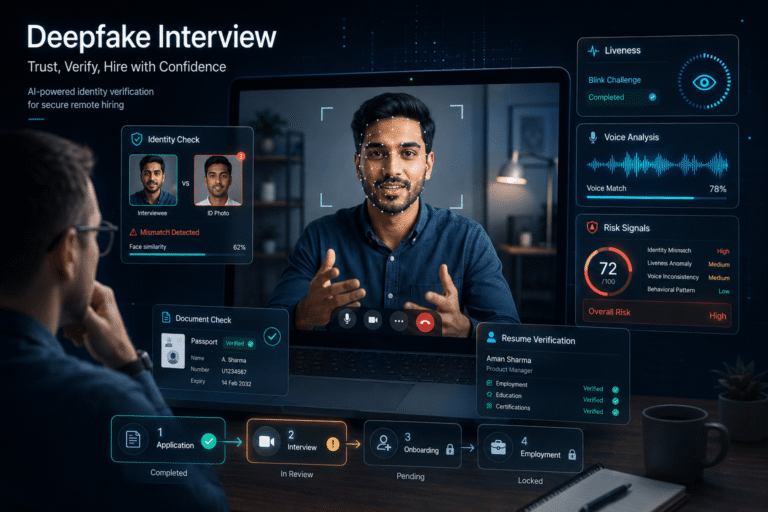
A deepfake interview is a remote hiring interaction in which AI-generated or AI-modified video, voice, identity documents, profile images, or other synthetic media are used to make a candidate appear to be someone they are not. The fraud can range from a real person wearing a face-swap overlay to a stolen identity supported by a fake resume, forged documents, voice modification, an AI-enhanced profile, and a different worker who later performs the job.
The key hiring risk is not simply whether a face looks synthetic. It is whether the employer has securely bound one real human to the identity, qualifications, location, device, payroll details, and access privileges being granted. A polished video call can create confidence while those underlying identity links remain unverified.
What Is a Deepfake Interview?
A deepfake interview is an interview in which synthetic media helps conceal or replace the candidate’s true identity.
The term can cover several different situations:
- a face-swap overlay applied during a live video call
- real-time voice modification to change accent, gender, age, or perceived identity
- AI-generated profile photos or resume headshots
- stolen identity documents altered with another person’s face
- a proxy person attending the interview while someone else will perform the work
- a fabricated employment history supported by synthetic websites, portfolios, references, or online personas
The FBI has publicly confirmed that fraudulent remote IT workers have used artificial intelligence and face-swapping technology during video job interviews to obscure their true identities. See the FBI guidance on strengthening remote hiring.
Why This Is an Identity Problem Before It Is a Video Problem
A recruiter may focus on the interview window because that is where the deception is visible. The attacker is thinking about the entire identity system.
The real objective is to make several separate records appear to describe the same person:
A deepfake can help one layer pass. Strong hiring controls make the attacker maintain consistency across all six.
Remote Hiring Fraud Can Continue After the Interview
Passing the interview is often only the beginning.
Current FBI and Justice Department cases involving fraudulent remote IT workers show a broader pattern that can include stolen identities, false websites, proxy infrastructure, U.S.-based facilitators, remotely controlled employer laptops, altered payment arrangements, and different people appearing at different stages of hiring or employment.
The Justice Department has described schemes in which overseas workers posed as U.S.-based employees, used stolen identities, and relied on U.S.-based “laptop farms” to make company devices appear to be operating domestically. One 2026 sentencing announcement involved more than 100 victim companies and at least 80 stolen U.S. identities. See the Justice Department remote worker fraud case.
The Hiring Trust Chain
Instead of asking “Did the candidate look real on Zoom?”, ask whether trust survives every gate.
Identity, resume, accounts and portfolio align.
The live person can be bound to the submitted identity.
ID, address, payroll, device delivery and background checks remain consistent.
The same verified worker continues to use company access in expected ways.
A candidate who passes Gate 2 should not automatically inherit trust through Gates 3 and 4.
How AI Makes a Fake Candidate More Convincing
Generative AI reduces the effort needed to build a coherent persona.
Microsoft Threat Intelligence reports that threat actors have used AI to:
- tailor resumes and cover letters to job descriptions
- create fake developer portfolios
- generate professional profile images
- alter identity documents
- produce realistic names and account formats
- improve language quality and remove awkward phrasing
- use real-time voice modulation and deepfake video overlays
Microsoft has also observed voice-changing software used during interviews to mask accents and help fraudulent candidates pass as the identities they claimed. See Microsoft Threat Intelligence on AI-enabled identity fabrication.
A Deepfake Candidate May Still Be Technically Skilled
This threat is different from a simple fake-resume problem.
A fraudulent candidate may be able to answer technical questions, write code, complete assignments, and perform legitimate work. The risk comes from the false identity, hidden location, sanctions exposure, unauthorized access, data theft, insider activity, extortion, or substitution of another worker.
That means technical competence cannot compensate for unresolved identity verification.
Visual Glitches Are Weak Evidence by Themselves
Real-time deepfake systems can still fail visibly, but hiring teams should avoid treating one artifact as proof.
Ordinary video calls can produce:
- soft face edges
- lip-sync delay
- frame drops
- lighting changes
- compression around the mouth or glasses
- background-segmentation errors
Those effects can come from bandwidth, webcams, virtual backgrounds, denoising, low light, browser processing, or ordinary compression.
If the visual evidence itself needs examination, the face swap video guide explains why identity continuity across time matters more than a single strange frame.
What Real-Time Deepfakes Struggle With
Current real-time face-swap systems can be stressed by situations that are harder to synthesize continuously.
Unit 42 demonstrated a synthetic interview identity created with inexpensive hardware and documented several failure opportunities, including:
- rapid head movement
- partial face occlusion
- sudden lighting changes
- audio-video synchronization pressure
The research also showed that real-time deepfakes are accessible enough that the technical barrier should not be treated as a strong defense. See Unit 42’s research on synthetic identities in remote hiring.
Challenge-Response Is Useful, but It Is Not Identity Proof
The FBI’s more recent remote-worker guidance recommends practical video checks when an in-person meeting is not possible, including asking the candidate to keep the background unobscured, point the camera toward their surroundings, answer questions about the claimed location, and wave a hand in front of the face because that can disrupt some AI-generated video.
These are useful liveness challenges. They can make a low-quality overlay fail.
But a candidate passing the challenge is not the same as identity being verified. Better systems can survive simple movements, and the person performing the challenge may still be a real proxy using someone else’s identity.
For the broader distinction between presence detection, presentation-attack detection and identity verification, use the liveness detection guide.
Use Unpredictable Questions That Bind to the Claimed Identity
A strong interview mixes technical evaluation with contextual questions that are difficult to script for a borrowed identity.
Examples include asking the candidate to explain:
- a specific project listed deep in the resume
- why a technology choice was made in that project
- a particular course, campus, city, employer or team from their claimed history
- how their current location relates to the address submitted for employment
- a portfolio commit, architecture choice or public work sample associated with the claimed identity
The FBI calls these “soft” interview questions and recommends using them to test location and educational background.
The purpose is not to interrogate candidates about trivia. It is to determine whether the person can naturally inhabit the history attached to the application.
Resume Consistency Across Applicants Can Reveal Reused Personas
Fraud operations work at scale, and scale creates repetition.
Cross-check your applicant tracking system for:
- identical resume sentences
- the same phone number on different candidates
- reused email patterns
- the same portfolio content under different names
- profile photos that appear in multiple identities
- the same home or shipping address
The FBI specifically recommends checking HR systems for repeated resume content and contact information and notes that fraudulent remote workers have reused VoIP numbers and email addresses across different applicant identities.
Verify Employment and Education Outside the Candidate’s Links
A polished portfolio, company website or reference email can be part of the synthetic persona.
Verify prior employment and education directly through independent channels when the role warrants it.
Do not rely only on:
- a phone number listed on the resume
- a reference domain provided by the candidate
- a newly created portfolio site
- a LinkedIn page as proof of legal identity
The FBI’s current business guidance recommends direct verification with previous employers and educational institutions.
Identity Documents Need Cross-Checking, Not Just Visual Inspection
A realistic ID image can be generated or altered.
Cross-check:
- name and date of birth
- photo consistency
- address
- phone number
- email address
- social profiles
- portfolio identity
- background-check records
Where legally appropriate, use a robust identity-verification provider instead of asking recruiters to become document-forensics experts.
Privacy, employment and biometric laws vary by jurisdiction. Organizations should design identity checks with legal, HR, security and privacy teams rather than collecting unnecessary biometric data ad hoc.
Candidate Identity Should Be Rechecked at Onboarding
A common failure is to perform strong interview screening and weak onboarding.
Rebind the identity when:
- the employment contract is completed
- the background check returns
- payroll is established
- company equipment is shipped
- MFA or privileged access is issued
If the address, payment account, phone number or identity changes between interview and onboarding, treat that as a new verification event rather than a routine administrative update.
The Shipping Address Can Be a Security Signal
Remote roles often require employer hardware. Fraudulent workers can exploit that step to place a company laptop at a facilitator’s location and then access it remotely.
The FBI recommends shipping equipment only to the verified address and requiring additional verification when the candidate requests a different delivery location.
Questions to resolve before shipping sensitive equipment include:
- Does the address match the verified identity?
- Was it changed after the offer?
- Is the same address being used by unrelated employees?
- Will the recipient be the verified worker?
A Clean Interview Does Not Eliminate Post-Hire Substitution
One person can pass the interview and another can perform the job.
The FBI advises employers to capture candidate images for comparison with future meetings because the individual who interviews may not be the person who later works.
Organizations should avoid intrusive surveillance, but they can maintain proportionate continuity controls, such as:
- consistent identity revalidation at sensitive access changes
- comparison of authorized employee records during onboarding
- review of unexplained changes in payment or contact information
- security monitoring of unusual access patterns
Network Behavior Can Reveal What the Interview Could Not
After hire, the identity problem becomes an access problem.
FBI guidance highlights signals such as:
- multiple logins from different countries within short periods
- unexpected remote desktop software
- remote connections to company devices
- unusual data exfiltration
- software supporting multiple audio or video calls concurrently
These signals do not prove a deepfake interview. They can reveal that the trusted employee identity is being used in ways inconsistent with the hiring story.
Third-Party Staffing Creates an Identity Control Gap
An organization may never meet the person who passed the original identity checks if a contractor or staffing company controls hiring.
The FBI warns that outsourced IT hiring creates additional vulnerability because the customer company is removed from direct vetting.
Contracts with staffing providers should define:
- identity-verification requirements
- subcontracting restrictions
- candidate substitution rules
- background-check standards
- notification requirements for address and payment changes
- audit rights
Deepfake Interview vs Job Scam: The Direction of Fraud Matters
| Scenario | Who is deceiving whom? | Main risk |
|---|---|---|
| Deepfake candidate interview | Applicant deceives employer | Identity fraud, unauthorized access, insider risk, sanctions or data theft |
| Fake recruiter interview | Scammer deceives applicant | Credential theft, money theft, malware or identity theft |
| Proxy interview | One person interviews for another | Candidate substitution and false qualification |
| AI-assisted legitimate interview | No deception if use is authorized and transparent | Policy, fairness or disclosure issues rather than identity fraud |
This article focuses on the first and third cases: fraudulent candidate identity in remote hiring.
Do Not Confuse Accent, Language or Video Quality With Fraud
Hiring controls must be evidence-based.
An accent, nationality, poor webcam, unusual room, disability, nervous behavior or slow answer is not evidence of identity fraud.
Likewise, aggressive challenge-response techniques can create accessibility and discrimination problems if recruiters improvise them inconsistently.
Use the same documented risk-based process for comparable roles. Escalate on evidence such as identity inconsistency, unverifiable history, document mismatch, suspicious account reuse, unexplained address changes or technical signals, not protected characteristics or subjective impressions.
A Safer Remote Interview Protocol
- Pre-bind the application. Record the identity, contact, resume, portfolio and source account that will be verified.
- Verify high-risk identity fields independently. Do not use candidate-supplied links as the sole source.
- Use live video for high-risk remote roles. Keep the background unobscured where proportionate and lawful.
- Ask identity-binding questions. Test specific employment, education, project and location claims.
- Add a short dynamic liveness challenge if risk warrants it. Treat success as supporting evidence only.
- Compare the interviewee to verified identity records.
- Reverify at onboarding. Check address, payroll, background results and equipment destination.
- Do not grant sensitive access before required checks complete.
- Maintain post-hire identity continuity controls. Investigate unexplained changes and anomalous access.
What a Recruiter Should Do When a Deepfake Is Suspected
Do not accuse the candidate during the call based on a visual glitch.
Instead:
- document the specific inconsistency
- preserve relevant application and interview records according to company policy
- pause progression to sensitive onboarding steps
- route the case to HR, security, legal or fraud teams
- reverify identity through an independent process
- check for reused applicant data across the hiring system
If the suspicious video itself needs technical review, the deepfake detection guide explains how detector evidence should be interpreted without treating one score as proof.
What If the Candidate Has Already Been Hired?
Treat the issue as a potential identity and access incident, not simply an HR discrepancy.
Depending on the evidence and organizational policy, appropriate actions may include:
- preserving relevant logs
- reviewing account and endpoint activity
- checking code repositories and cloud storage access
- reviewing remote access software
- restricting privileges while the identity is revalidated
- reviewing payment and device-shipping records
- involving legal and incident-response teams
The FBI advises companies that suspect fraudulent remote-worker activity to evaluate network activity and preserve evidence of suspicious device behavior.
Deepfake Interview Detection Is Not the Same as Candidate Verification
This distinction should guide the entire hiring architecture.
| Control | Question it answers |
|---|---|
| Deepfake detector | Does the media contain signals consistent with synthetic manipulation? |
| Liveness check | Is a responsive human or presentation present now? |
| ID verification | Does the presented identity document correspond to a valid identity and the person? |
| Background verification | Do employment, education and other claimed records exist? |
| Post-hire security monitoring | Is trusted access being used consistently with the verified employee and role? |
No single row replaces the others.
Where DetectVideo AI Fits
DetectVideo AI can contribute a technical media-analysis layer when an interview recording or supported video needs examination for possible AI generation, face manipulation, temporal inconsistency or other forensic signals.
It does not verify employment history, legal identity, sanctions status, physical location, payroll ownership or who ultimately controls a company laptop.
The correct question for a detector is:
“Does this interview media contain evidence consistent with AI manipulation?”
The hiring team must separately answer:
“Have we securely verified the person to whom we are granting employment and access?”
If the fraud extends beyond the interview into a broader fabricated identity, the AI impersonation guide covers identity misuse across voice, video, accounts and messages.
Use Precise Hiring Verdicts
| Verdict | Meaning |
|---|---|
| Candidate identity verified | Independent identity checks and hiring records consistently bind the interviewee to the claimed person |
| Synthetic interview evidence supported | Multiple technical or behavioral signals support AI-mediated identity concealment |
| Proxy interview suspected | The person interviewing may differ from the person whose identity or work is being represented |
| Identity inconsistency detected | Documents, contact details, history, payment, address or live identity do not align |
| Media inconclusive, identity unverified | No strong deepfake determination can be made, but the hiring identity has not been securely established |
| Post-hire identity continuity failed | The identity or access pattern after onboarding is inconsistent with the verified worker |
Key Takeaway
The safest defense against a deepfake interview is not becoming better at spotting fake faces. It is designing a hiring process in which one video call cannot establish identity by itself.
Bind the candidate across legal identity, career history, digital accounts, live presence, location, payment details and company access. Use real-time challenges as one supporting control, verify important records independently, recheck identity during onboarding, and keep post-hire access tied to the same verified person.
Deepfake technology can make a fraudulent candidate look real. It cannot make independent identity records, employer history, device custody and access behavior automatically agree. That is where a robust remote hiring process creates friction for identity fraud.
FAQ About Deepfake Interviews
What is a deepfake interview?
A deepfake interview is a remote hiring interview in which AI-generated or AI-modified video, voice or identity media is used to conceal or replace the candidate’s true identity.
Are deepfake job interviews actually happening?
Yes. The FBI has reported fraudulent remote IT workers using artificial intelligence and face-swapping technology during video job interviews to obscure their identities.
How can recruiters detect a deepfake interview?
Use layered checks rather than one visual clue: independent identity verification, resume and account cross-checking, unpredictable identity-binding questions, appropriate live challenge-response, and revalidation during onboarding.
Does waving a hand in front of the face detect deepfakes?
It can disrupt some real-time face-swap systems and is included in current FBI remote-hiring guidance, but passing the test does not prove identity. More capable systems or a real proxy person may pass it.
Can a deepfake candidate pass technical interview questions?
Yes. Identity fraud does not imply lack of technical skill. A fraudulent worker may be competent while still concealing identity, location, employer relationship or access risk.
What is the difference between a deepfake interview and a proxy interview?
A deepfake interview uses synthetic media to alter identity presentation. A proxy interview uses a different real person to interview on behalf of the applicant. The two methods can also be combined.
Should employers use deepfake detection software in hiring?
It can be one useful signal for appropriate roles and workflows, but it should not replace identity proofing, liveness checks, background verification, onboarding controls or post-hire security monitoring.
Why should identity be reverified after the interview?
The interviewee, person completing onboarding, person receiving company equipment and person performing the job may not always be the same. Reverification helps maintain identity continuity.
What should a company do after discovering a suspected fake remote worker?
Preserve relevant records, pause sensitive access changes, involve HR and security teams, revalidate identity, review endpoint and network activity, and follow applicable legal and incident-response procedures.
Can DetectVideo AI verify a job candidate’s identity?
No. DetectVideo AI can contribute technical analysis of supported media for possible AI manipulation. Candidate identity requires separate verification of documents, history, live person, location, employment records and access ownership.