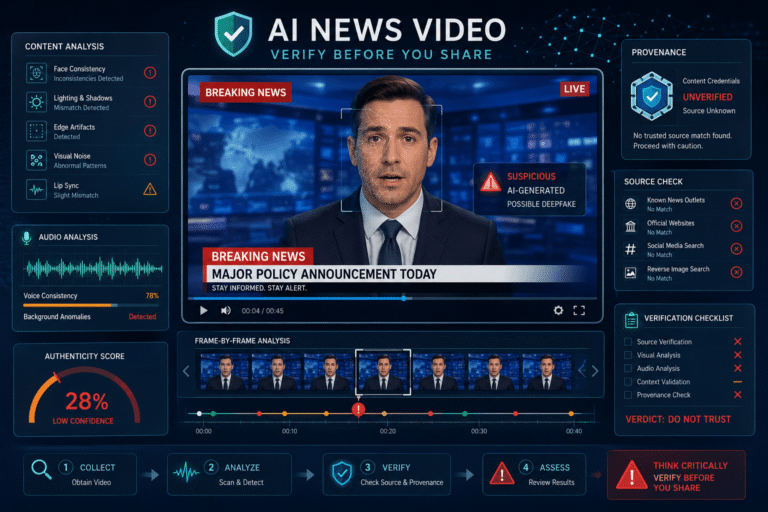
An AI news video can look credible before it is credible. A synthetic anchor can read a real headline. Real disaster footage can be mixed with generated scenes. A genuine interview can receive cloned audio. A completely fictional event can be packaged with a logo, ticker, location tag, and “breaking news” banner that makes it feel like journalism.
That is why checking an AI news video requires more than searching for strange faces or bad text. The key question is not simply whether AI was used. It is whether the source, footage, audio, provenance, and news claim all support the same story.
What Is an AI News Video?
An AI news video is news-style video in which artificial intelligence generates or materially alters some part of the presentation, footage, voice, presenter, or scene.
The term does not automatically mean misinformation. A legitimate newsroom can use a disclosed synthetic presenter, translated voice, generated visualization, or AI-assisted production tool. The risk appears when synthetic media is presented in a way that falsely suggests a person, place, event, or recording is authentic.
A fifth category is easy to confuse with AI news: real video with false context. An old flood, protest, explosion, or speech may be entirely genuine but falsely described as a current event. That is misinformation, but it is not necessarily AI-generated.
For generic claim verification beyond synthetic media, use the separate news verification guide.
Why AI News Is Harder to Judge Than a Normal Deepfake
News-style content can borrow credibility from elements that have nothing to do with authenticity. Viewers are used to trusting studio framing, lower-thirds, confident narration, maps, urgent music, and network-style branding. Generative tools can reproduce that visual grammar without reproducing the editorial process behind real journalism.
The result is a dangerous shortcut:
“It looks like news” becomes “it must have been reported.”
But a realistic news package may contain no reporting at all. It can be assembled from a synthetic presenter, stock or recycled footage, AI-generated B-roll, a fabricated quote, and a domain or account designed to resemble a legitimate outlet.
So the most durable verification strategy is to look for evidence of journalism, not merely the appearance of journalism.
The AI News Evidence Ladder
This order is important. A fake tornado video can be disproved because no such storm occurred at the claimed place and time. A synthetic political speech can be exposed by finding the authentic original. A provider watermark can directly identify AI involvement. In those situations, staring at a face frame by frame is unnecessary.
Step 1: Turn the Clip Into a Testable News Claim
Before checking the media, write the claim in one sentence.
For example:
- “This video shows flooding in Mumbai this morning.”
- “This politician announced a new policy today.”
- “This airline flew through the eye of this storm.”
- “This celebrity endorsed this investment platform on television.”
- “This anchor reports that a military attack has started.”
Now separate what the video visibly shows from what the caption or narrator adds.
A clip might show soldiers, but not prove the country. It might show a storm, but not prove the date. It might show a recognizable public figure, but not prove the speech is authentic.
This one step prevents a common mistake: verifying the pixels while leaving the actual news claim untested.
Step 2: Verify the Newsroom or Publisher Before the Presenter
If a clip claims to be journalism, investigate the publication chain.
Look for a real article or broadcast page on the outlet’s official domain. Check whether the segment appears in the outlet’s own video feed, transcript, live coverage, or social accounts. Search the anchor or reporter name independently. If the clip names a correspondent, location, or program, those details should fit the outlet’s normal publishing history.
| Signal | What it means | How much trust it deserves |
|---|---|---|
| Story exists on the outlet’s official domain | The claimed newsroom has actually published the story | Strong source signal |
| Named reporter or anchor has a traceable history | The presenter is connected to a real journalistic identity | Useful supporting signal |
| Other independent outlets confirm the same core facts | The event does not depend on one viral upload | Strong corroboration |
| Professional logo, studio, ticker, or lower-third | The clip imitates a news format | Weak by itself |
| Large follower count or many reposts | The clip is popular | Not authenticity evidence |
A fake account can copy a logo. A synthetic anchor can wear the visual identity of a newsroom. A genuine publication trail is harder to fake consistently.
Step 3: Trace the Footage, Not Just the Post
Many false AI news videos are hybrids. The headline may be fabricated while some visual material comes from a real older event. Or a real source clip may be extended or altered with AI.
Extract several distinctive keyframes and search them individually. Good frames contain buildings, vehicles, signs, uniforms, landscape features, banners, or unusual objects.
If source discovery is the main challenge, use the reverse video search workflow to trace earlier versions and longer source material.
When a matching source appears, compare the viral version with the earlier recording. Look for changed audio, added objects, missing sequences, altered faces, new captions, or synthetic extensions.
Step 4: Corroborate the Event Outside the Video
High-impact news rarely exists as one isolated video.
For a major disaster, attack, protest, arrest, election event, or public statement, look for evidence that does not originate from the same viral upload:
- independent news organizations
- official agencies or institutions involved
- local reporters or eyewitnesses
- multiple camera angles
- event schedules, public records, or official statements
- weather, transport, aviation, seismic, or other domain-specific data where relevant
Be careful with circular confirmation. Ten websites embedding the same unverified social post are still one source.
Real 2026 Case File: A Convincing Video With an Authentic Base
AI-altered Trump motorcade clip
In July 2026, a viral video appeared to show Donald Trump collapsing near his presidential limousine. AFP traced the visible TikTok handle back to the creator, who disclosed that the clip was AI-generated. AFP also found the authentic source footage, in which Trump approached the vehicle but did not collapse. Technical AI analysis supported the manipulation finding.
Why this case matters: the strongest verification did not come from one facial glitch. It came from three independent layers agreeing: creator disclosure, authentic source comparison, and technical analysis.
This is the model to follow for high-confidence verification: source + comparison + technical evidence.
Step 5: Read AI Labels Correctly
AI disclosure systems are becoming more common, but they do not all mean the same thing.
YouTube altered or synthetic content labels
YouTube requires creators to disclose realistic content that is meaningfully altered or synthetically generated, including media that makes a real person appear to say or do something they did not, alters a real event or place, or depicts a realistic event that did not happen. YouTube can also apply labels in some cases through its own systems or available provenance signals.
For sensitive topics such as elections, conflicts, natural disasters, finance, and health, YouTube may display a more prominent label. See YouTube’s official AI disclosure guidance.
Interpretation: a reliable AI label is meaningful evidence of synthetic involvement. The absence of a label is not proof that a video is real.
Google SynthID
Google embeds SynthID watermarks into media created by its generative AI products. Signed-in users can upload supported media to Gemini and ask whether it was created or edited by Google AI. For video, Gemini can identify portions where a SynthID watermark is detected.
The current limitations matter: if SynthID is not detected, that does not rule out content created by another AI provider. Google’s Gemini verification documentation explains the result states and limitations.
Content Credentials
Content Credentials can provide cryptographically verifiable information about compatible media’s origin and edit history. They may indicate camera capture, AI generation, AI editing, ingredients, or recorded actions depending on the workflow.
But provenance is not fact-checking. C2PA explicitly separates technical provenance from judgments about whether the represented claim is true. For practical interpretation, use the Content Credentials guide.
What AI News Labels Mean in Europe in 2026
The regulatory environment also changed in 2026. Article 50 of the EU AI Act applies from 2 August 2026 and introduces transparency obligations around AI-generated and manipulated content.
Among other requirements, providers of covered generative AI systems must support machine-readable marking of synthetic content, while covered deployers must disclose deepfakes. The European Commission’s current guidance also addresses AI-generated public-interest content and the distinction between machine-readable marking and visible disclosure.
The official European Commission Article 50 guidance contains the current scope and exceptions.
This is a transparency framework, not a guarantee that every AI-generated news clip encountered online will carry a visible label.
Step 6: Analyze the Video Only After Source and Context
If source tracing and corroboration do not resolve the case, examine the media itself.
Do not use a fixed checklist such as “AI has six fingers” or “AI cannot create readable text.” Modern generators improve quickly. Instead, test whether the scene stays coherent through time.
A repeated inconsistency is more informative than one bad frame. Compression, stabilization, low light, network errors, and normal post-production can all create isolated glitches.
The technical methods behind current detectors are covered in the AI video detection methods guide.
AI Anchors Need Identity Verification, Not Just Face Inspection
An AI news anchor may be completely fictional, may imitate a real journalist, or may be an authorized synthetic presenter used transparently by a publisher.
Before inspecting facial artifacts, search the presenter name. Check the newsroom staff page, author archive, previous broadcasts, professional profile, and whether the outlet acknowledges using a synthetic presenter.
If a real journalist’s likeness or voice appears to have been cloned, compare the clip with known recordings and the outlet’s official channels.
When the voice is the main uncertainty, use the voice deepfake guide rather than assuming that a visually convincing face proves authentic speech.
Newsroom Graphics Are Authentication Theater Unless the Source Matches
Lower-thirds, logos, tickers, breaking-news animations, and studio backgrounds can create an impression of institutional authority. They are easy to imitate and should be treated as presentation, not proof.
| Looks convincing | Actually useful for verification |
|---|---|
| News logo in the corner | The same segment exists on the outlet’s official domain or channel |
| Professional lower-third | The headline matches the outlet’s published reporting |
| Studio background | The presenter and program are traceable to the outlet |
| Urgent ticker | Independent sources confirm the event |
| Millions of views | A credible source chain exists |
Four High-Risk AI News Scenarios
The higher the potential harm, the less appropriate a one-tool verdict becomes. Use primary sources and domain-specific evidence before publication or redistribution.
When AI Detection Helps, and When It Does Not
AI detectors are useful when the question is about the media itself: whether frames, motion, audio, or other signals are consistent with synthetic generation or manipulation.
They are not designed to answer every news-verification question.
| Question | Can an AI detector answer it? |
|---|---|
| Does this clip contain synthetic-media signals? | Potentially, as probabilistic evidence |
| Was this video recorded in the claimed city? | No |
| Did the event happen today? | No |
| Is the caption accurate? | No |
| Was a real video reused from an older event? | Not reliably without source research |
| Does another independent source confirm the event? | No |
This matters because a technically authentic clip can still be false news, and an openly synthetic clip can still be a legitimate visualization.
Where DetectVideo AI Fits
DetectVideo AI is most useful after you have defined the claim and checked the source.
For supported media, available analysis can examine visual, temporal, audio-video, compression, metadata, source, and manipulation evidence. The result can add a technical layer to a verification case, especially when the clip is suspected of containing generated or altered media.
Use the result to ask:
- Which evidence groups were actually available?
- Do several independent technical signals agree?
- Is the suspicious behavior localized or persistent?
- Could compression or normal editing explain the same signal?
- Does the technical evidence agree with the source and provenance evidence?
A detector should strengthen or challenge a hypothesis. It should not replace the reporting needed to verify a news event.
The AI News Verification Decision Flow
Use Better Verdicts Than “Real” or “Fake”
A reference-quality verification should state exactly what has been established.
This vocabulary is more accurate than reducing every case to a binary answer.
How to Report or Correct an AI News Video
If you determine that a viral news clip is misleading, document the evidence rather than repeating the claim without context.
A concise correction should identify:
- the false or unverified claim
- the strongest source evidence
- the key comparison or provenance finding
- the limitation of any technical detector result
- the corrected conclusion
If the platform provides a reporting mechanism for synthetic or impersonation content, use it. Avoid reposting harmful media merely to warn people when a link, still frame, or written explanation is enough.
What Makes This Page Different From General Video Verification?
Generic video verification asks whether a clip’s source, time, place, integrity, and claim can be established. AI news verification adds another layer: the news presentation itself may be synthetic.
That means you may need to verify the newsroom identity, presenter, AI disclosure, generator provenance, audio, and visual scene in addition to the underlying event.
For the broader source-to-verdict investigation process, use the video verification guide.
Key Takeaway
An AI news video should be verified as journalism first and synthetic media second.
Do not let a realistic anchor, newsroom graphic, platform badge, or AI detector score carry more weight than the underlying evidence. Define the claim, identify the publisher, trace the footage, corroborate the event, inspect AI labels and provenance, and only then use technical media analysis when necessary.
The most reliable conclusion is the one supported by several independent layers. If those layers do not converge, the correct news label is not “real” or “fake.” It is unverified.
FAQ About AI News Video Verification
What is an AI news video?
An AI news video is news-style media in which AI generates or materially alters a presenter, voice, footage, scene, or other part of the production. It can be legitimate and disclosed, or it can be used to make false information look like real journalism.
How can I tell if a news video is AI-generated?
Start with the source rather than visual artifacts. Check whether the claimed newsroom published the story, whether independent sources confirm the event, whether AI labels or provenance exist, and whether the video remains visually and audibly consistent across time.
Can a real news anchor be deepfaked?
Yes. A real journalist’s face, voice, or existing broadcast footage can be altered to create a statement they never made. Compare suspicious clips with the outlet’s official publication and known recordings.
Can an AI news anchor report real news?
Yes. A synthetic presenter can read factually accurate and editorially reviewed reporting. The important questions are whether the AI use is transparent and whether the underlying journalism is trustworthy.
Does a YouTube AI label prove a video is fake?
No. The label indicates meaningful synthetic or altered content, not whether the story is false. A disclosed AI visualization can be legitimate, while a real unlabeled video can still be miscaptioned.
Does no AI label mean a video is real?
No. Labels can be missing, incorrect, unavailable, or removed by reposting. Treat the absence of a label as absence of that evidence, not proof of camera capture.
Can Google SynthID verify an AI news video?
SynthID can identify compatible media created or edited with Google AI when its watermark is detectable. A negative SynthID result does not rule out AI content made with another provider.
Can Content Credentials prove that a news event happened?
No. Content Credentials can provide verifiable provenance about compatible media’s creation and edit history. They do not independently prove that the event, caption, or spoken claim is factually true.
What is the fastest way to verify a viral AI news clip?
Check whether the claimed publisher has the story, search for independent confirmation, trace the earliest credible source or original footage, then inspect labels, provenance, and media evidence if the case remains unresolved.
Are newsroom graphics useful for detecting fake news videos?
They can reveal inconsistencies, but they are weak evidence by themselves. Logos, tickers, and lower-thirds are easy to imitate. A matching publication on the official outlet and independent corroboration are much stronger.
Can an AI detector prove that a news video is fake?
No. It can provide evidence about synthetic or manipulated media, but it cannot determine whether the location, date, caption, or real-world news claim is correct.
What should I do if an AI news video cannot be verified?
Label it unverified, avoid sharing it as fact, preserve the source, and continue searching for independent evidence. Lack of proof should not be converted into either an authentic or fake verdict.