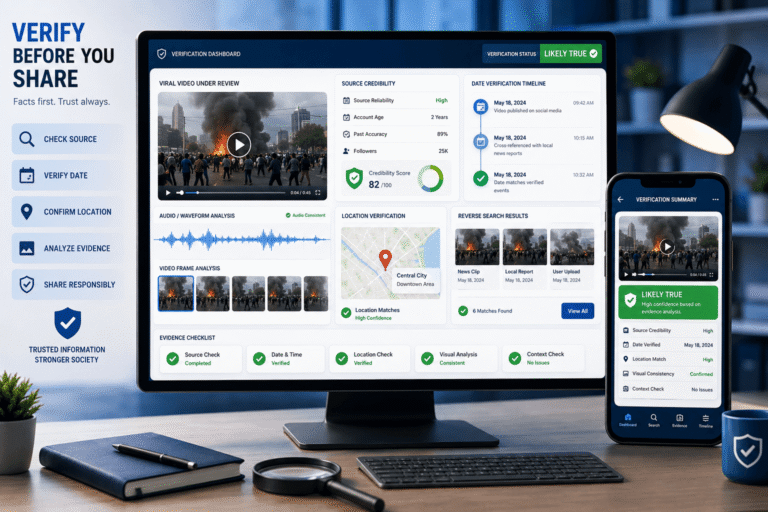
News verification is the process of testing whether a news claim is supported by reliable evidence before you accept, publish, or share it. The claim may arrive as a headline, social post, screenshot, eyewitness video, audio recording, image, or breaking-news alert. The verification problem is the same: Who is making the claim, what is the original evidence, when and where does it belong, and what independent information confirms it?
A viral video can be completely real and still support a false news story. An established news outlet can publish a developing claim that later changes. A source can be credible in one field and unqualified in another. And a clip can have millions of views without providing a single piece of independent evidence.
What News Verification Actually Checks
Good verification separates questions that are easy to mix together.
This page owns that broader news-verification problem. If the main question is how to investigate one video file from source to final verdict, use the separate video verification guide. If the news presentation itself may have been generated or altered with AI, use the AI news video guide.
Start With the Claim, Not With the Website
Before opening tools, rewrite the story as one or more testable claims.
For example, a post saying “Breaking: this happened today” may actually contain four separate claims:
- the event happened
- it happened in the stated location
- it happened on the stated date
- the attached image or video shows that event
Each claim may need different evidence. A police statement might confirm that an incident occurred but not authenticate a viral video. A reverse search might identify the video but tell you nothing about the cause of the event. A reliable news article may establish the date while quoting a claim that is still under investigation.
The more precisely you define the claim, the less likely you are to verify the wrong thing.
News Source Credibility: Read Laterally, Not Just Vertically
One of the strongest news source credibility verification methods is lateral reading. Instead of spending several minutes studying the design, About page, or wording of an unfamiliar site, leave the site and investigate what independent sources say about it.
Research on professional fact-checking has repeatedly found lateral reading useful for evaluating online credibility. Stanford’s Social Media Lab describes it as opening other sources to verify evidence, understand context, and identify weaknesses in the source being assessed. See its Digital Strength guidance on lateral reading.
Ask five questions about the source
| Question | Strong signal | Reason for caution |
|---|---|---|
| Who is behind it? | Named publisher, organization, author, ownership and contact information | Anonymous or unclear ownership presented as an authority |
| Can they know this? | Firsthand access, relevant expertise, direct records or documented reporting | Source repeats claims outside its expertise without original evidence |
| Do they show their evidence? | Primary documents, raw data, named sources, original media or transparent methodology | Assertions rely only on screenshots, unnamed reposts or circular citations |
| Are they transparent? | Clear authorship, dates, corrections, updates and sourcing | Silent edits, missing dates, fake bylines or copied material |
| Why are they publishing it? | Purpose is clear and evidence remains separable from opinion | Strong commercial, political or emotional pressure substitutes for evidence |
Credibility is not a permanent badge. A respected outlet can make an error, and a small local source can have the best firsthand evidence. Evaluate both the source and the evidence behind the specific claim.
How Professional Newsrooms Verify User-Generated Content
Professional verification is usually a chain of checks rather than one score.
The Associated Press says its UGC verification process includes reverse-image search and geolocation, comparison of landmarks, signs, weather and language with reporting, frame-level checks for manipulation, and contact with the original filmer to confirm authorship and permission. AP also checks metadata, timing and location as part of visual verification. See Verification at AP.
The lesson for ordinary users is useful: do not ask one tool to do every job. Source verification, event verification, date verification and media authentication are separate tasks that strengthen one another.
How to Verify the Date of a Viral Video
The query “how to verify date of viral video” sounds simple, but there are several different dates you might be trying to establish.
| Date | What it means | Common mistake |
|---|---|---|
| Recording date | When the camera or generation process created the media | Assuming the social post date is the recording date |
| First known publication date | The earliest version you can currently locate online | Calling it the original capture date |
| Current repost date | When the version in front of you was uploaded | Treating a fresh repost as fresh footage |
| Claimed event date | The date stated or implied by the caption | Accepting it without comparing the media timeline |
The date evidence ladder
Important: the earliest online copy proves that the media existed by that date. It does not automatically prove that the recording was created on that date.
1. Search for an earlier version
Extract a distinctive frame and search for older appearances. Search exact caption phrases, usernames, visible signs and memorable details. If a version from 2024 exists, a post claiming the footage was recorded for the first time in 2026 is already contradicted.
If you need a deeper source-tracing method, use the reverse video search guide.
2. Compare the media with the claimed event
Look for details that should fit the date: event banners, public schedules, construction changes, sports fixtures, weather, seasonal vegetation, clothing, daylight and other time-sensitive features.
A date should emerge from several clues, not from one shadow or one on-screen timestamp.
3. Treat metadata as supporting evidence
An original file may contain useful creation or modification timestamps. A social-media download may not. Ordinary metadata can also be changed, and platforms often strip it.
If cryptographically verifiable provenance is available, it can strengthen the media-history layer. The Content Credentials guide explains how to interpret that information.
2026 Case File: An Old Flood Video Presented as New
Bangladesh flood footage recirculated with a false 2026 date and location
In July 2026, a viral video was shared as footage from deadly monsoon floods in Chattogram, Bangladesh. AFP used reverse image search on video keyframes and found a longer version published in August 2024. The original uploader also confirmed that the video was recorded in a different city.
What solved the case: the clip did not need a sophisticated AI detector. An earlier publication, a longer source version and confirmation from the filmer disproved the new date and location claim.
This pattern is extremely common in breaking news: real footage, new caption, false context.
Check a Viral Video by Turning It Into Searchable Evidence
A viral video is difficult to search as one moving file. Keyframes make it searchable.
Choose frames that contain useful identifiers rather than only dramatic close-ups:
- street names and signs
- storefronts or company logos
- landmarks and buildings
- vehicles and transit markings
- uniforms
- event banners
- distinctive objects or scenery
The InVID Verification Plugin can extract representative keyframes from supported videos, perform reverse-image-search workflows, expose contextual information and read available metadata.
For a frame-focused workflow, see the reverse image search for video guide.
Use Google Fact Check Explorer Before Starting From Zero
A viral claim may already have been investigated by professional fact-checkers.
Google Fact Check Explorer lets users search by keywords and, for supported workflows, by image. Results can surface matching claims, ratings and the organizations that published the fact checks. Google’s Fact Check Tools documentation explains how the system works.
Use it for:
- names and exact quotes
- viral political claims
- recurring health or financial misinformation
- screenshots or extracted frames
- claims that appear to have circulated in several countries or languages
A previous fact check is not a substitute for reading the evidence. Open the fact-check article and see whether it addresses the same claim, same media and same context.
How to Tell Whether Sources Are Actually Independent
Five articles do not equal five confirmations if all five repeat the same wire story, social post or anonymous source.
For each source, ask where the key fact came from.
News verification becomes stronger when the evidence paths are genuinely independent.
Primary Sources Are Powerful, but Not Automatically Neutral
A primary source has direct access to an event or record, but direct access does not guarantee complete or unbiased interpretation.
Examples include:
- an original eyewitness recording
- a court filing
- an official election result
- a company financial report
- a government statement
- a full interview or speech
Use primary sources to establish what they can directly show. Then use independent reporting or expert analysis when the claim requires interpretation.
For example, a company’s own announcement can prove what the company announced. It does not independently prove that every performance claim in the announcement is accurate.
Viral Video Authenticity Check: Source Before Pixels
A viral video authenticity check should begin with source and context. Pixel-level analysis becomes important when those checks leave the media itself unresolved.
| Finding | Best next step |
|---|---|
| Same clip exists years earlier | Investigate false date or false context |
| Original source says the event was staged | Document the source evidence |
| Authentic source exists but viral version has different audio | Compare the versions and investigate audio manipulation |
| No original source and media shows unusual temporal behavior | Escalate to technical media analysis |
| Media appears authentic but the caption conflicts with the event | Treat it as a context-verification problem |
For the deeper distinction between source, integrity and context, the video authenticity guide covers the media-authenticity layer separately.
Do Not Use Views, Likes or Reposts as Evidence
Search Console sometimes records queries that mix “viral” with view checking. Popularity can tell you that a claim spread. It does not tell you that the claim is true.
These are distribution signals, not verification signals:
- view count
- likes
- repost count
- comments saying “confirmed”
- multiple accounts repeating the same caption
- a platform verification badge
A false claim can be viral. A true eyewitness account can have twelve views. Verification depends on evidence, not reach.
What to Do When Credible Sources Disagree
Breaking news changes. Two reputable outlets can publish different numbers or descriptions because they have different access, different update times or genuinely conflicting sources.
Do not resolve that conflict by choosing the source you prefer.
Instead:
- Check timestamps. Is one report newer?
- Trace each claim to its evidence. Are both citing the same official statement?
- Compare specificity. Is one outlet reporting a confirmed fact while another is reporting an estimate?
- Look for corrections and updates. Responsible outlets often revise developing information.
- Preserve uncertainty. If evidence is still conflicting, report the disagreement rather than inventing certainty.
“Unconfirmed” is a valid status in breaking news.
When AI Becomes Part of News Verification
AI is one possible source of manipulation, not the definition of misinformation.
If the claim survives the source, date and context checks but the media itself remains suspicious, investigate whether a face, voice, scene or object may have been generated or altered.
That is where DetectVideo AI can add a technical evidence layer for supported video. Use the analysis to examine available visual, temporal, audio-video, compression, metadata, source and manipulation signals.
Keep the interpretation narrow. A detector can support a media-manipulation hypothesis. It cannot independently prove the news event, date, location or caption.
A News Verification Record You Can Audit Later
This format makes the verification reproducible. Another person can see what evidence you used and where uncertainty remains.
Use Evidence-Based Status Labels, Not a Green-Yellow-Red Score
A simple color score can hide why a claim was accepted or rejected. News verification benefits from descriptive outcomes.
Use the narrowest status the evidence supports. If you verified the date but not the location, say that. If you proved the video is old but cannot identify where it was recorded, say that. Precision is more useful than confidence theater.
Common News Verification Mistakes
Trusting the page because it looks professional
Design can be copied. Investigate reputation and evidence outside the page.
Assuming the earliest Google result is the original
Search ranking is not a publication timeline. Trace dates and source relationships directly.
Confusing upload date with recording date
A video posted today may have been recorded years ago.
Counting reposts as independent confirmation
Many accounts may repeat one source.
Using metadata as a final verdict
Ordinary metadata can be stripped, changed or inherited from an export workflow.
Using an AI detector to verify a news claim
Technical detection addresses media characteristics, not whether the real-world claim is true.
Calling missing evidence proof of falsehood
If you cannot confirm a claim, the correct result may be unverified rather than false.
When to Stop Checking
Verification does not require endless searching.
You can usually stop when:
- reliable evidence clearly confirms the claim
- reliable evidence clearly contradicts the claim
- the key source or evidence cannot be recovered and further searching is unlikely to change the result
In the last case, keep the status unverified. Uncertainty is not a failure. It is information.
Key Takeaway
News verification is not a hunt for one trustworthy website or one magic tool. It is a process for connecting a specific claim to independent evidence.
Start with the claim. Investigate the source laterally. Trace the earliest credible evidence. Verify recording date, publication date and claimed event date separately. Check whether multiple sources are truly independent. Use fact-check databases and reverse search to avoid repeating work. Only move into AI or forensic analysis when the media itself remains uncertain.
If the evidence does not converge, do not force a verdict. Mark the claim unverified and explain what is still missing.
FAQ About News Verification
What is news verification?
News verification is the process of checking whether a news claim is supported by credible sources, original evidence, correct date and location, independent corroboration and, when relevant, authentic media.
How do I verify a news source’s credibility?
Use lateral reading. Leave the source and investigate its ownership, authors, expertise, history, corrections and reputation through independent sources. Then evaluate the evidence behind the specific claim rather than relying on reputation alone.
How do I verify the date of a viral video?
Find the earliest credible publication, compare the footage with the claimed event, check visible time clues, examine original-file metadata or provenance when available, and search for older versions. Remember that upload date and recording date are not the same.
Does the earliest upload prove when a video was recorded?
No. It proves that the video existed by that publication date. The recording may be older, and an earlier copy may exist outside the platforms or search results you can access.
How can I check whether a viral video is old?
Extract distinctive frames, run reverse-image searches, search exact caption phrases and usernames, and look for earlier articles or social posts containing the same footage. A longer earlier version can also reveal the original context.
What is the best method for checking news source credibility?
No single signal is enough. Strong methods combine lateral reading, authorship and ownership checks, relevant expertise, source transparency, evidence quality, corrections history, purpose and comparison with independent sources.
Can Fact Check Explorer verify viral claims?
Google Fact Check Explorer can help you discover existing fact checks by keywords and images. You still need to read the underlying fact check and confirm that it addresses the same claim and media.
Do many views make a viral video more credible?
No. Views, likes and reposts measure distribution, not truth. A misleading clip can receive millions of views while relying on one unverified source.
Can a real video still support fake news?
Yes. Authentic footage can be recaptioned with the wrong date, location, identity or event. Real pixels do not guarantee correct news context.
Should I trust a verified social media account?
A verified account can help establish account identity, but it does not prove every post is accurate. Check the evidence behind the specific claim.
Can an AI detector verify news?
No. An AI detector can provide evidence about whether media may be generated or manipulated. It cannot independently verify the event, source, date, location or factual claim.
What should I do when reputable news sources disagree?
Compare timestamps, trace each claim to its underlying evidence, check whether the sources are independent, review corrections and updates, and preserve uncertainty when the facts are still developing.
What does unverified mean?
Unverified means the available evidence is not sufficient to confirm or contradict the claim responsibly. It should not be used as a synonym for false.