
Digital humans are computer-created representations of people, used as characters, presenters, doubles or interactive interfaces. Their appearance, voice and movement can come from different sources, including an artist, an actor, recorded performance and generated material. A convincing digital person does not by itself establish a real identity, a genuine statement or permission to represent somebody.
This guide helps you describe how a virtual person was assembled and what viewers should understand about it. The practical contribution is a component-and-permissions worksheet, followed by a fictional production example. It is not a tool ranking, likeness-authentication service or claim that a realistic character can replace every human role.
Start with the role, not the realism
A character in a game, a recorded presenter and a conversational avatar can all be called digital humans, but they do different jobs. The game character may follow animation chosen by a player. The presenter may deliver a fixed script in an exported video. The conversational interface may generate a reply during interaction. Before describing any capability, decide which of these situations you are actually observing.
Epic’s authored explanation describes digital humans as computer-generated people with stylized or realistic appearances, offline or real-time rendering, and motion controlled by humans or AI. That is a useful broad definition, not a guarantee that every product has all those abilities. Its older product-entry instructions are not a current installation guide. Epic: How do you create a digital human?
Write the role in one sentence: “A fictional guide delivers an approved introduction in a recorded museum video.” That description establishes more than “an AI person.” It identifies the fictional status, task and delivery mode without implying independent knowledge. If the same guide later answers visitors live, that is a different configuration requiring its own review. The visual asset may be unchanged while the communication risks become quite different.
Distinguish an avatar, a double and an invented presenter
An avatar represents a user or character within an interface. It may be a stylized drawing rather than a detailed human likeness. A digital double represents an identifiable person. An invented presenter has a designed identity that is not intended to be a recording of a particular individual. These descriptions concern representation; they do not specify how the speech or animation was made.
Keep the word “twin” precise. A character resembling an actor is not automatically a model of that actor’s knowledge, opinions or decisions. A synthetic voice resembling somebody does not establish that the person approved the new words. The likeness relationship and the message relationship need separate descriptions. This matters even when the production team has permission to create a character: permission for one use should not be silently treated as permission for every later context.
A face replacement is another distinct case. Existing footage can retain a real performance while showing a changed facial identity. The face-swap guide explains that identity-transfer problem. A fully rendered character need not be a swap, and a swap need not produce a complete digital body. Using the correct label prevents a general virtual-character explanation from becoming a misleading account of how a particular clip was made.
Appearance supplies a visible identity, not a verified person
The appearance component determines the face, body, clothing and surface detail viewers see. A production might use an artist-built model, a customized character or captured information from a consenting performer. Shape, material and lighting all influence the final picture. The output is also affected by the viewing camera, rendering choices and compression. A screenshot is therefore not a complete record of the asset or its origin.
For a creator, the useful question is what identity the design communicates. If the character is fictional, avoid introducing it as a real employee or independent expert. If it is a double, record whose likeness is represented and where the approved source material came from. Preserve that production information privately as appropriate; an audience disclosure does not require publishing a person’s documents or a full capture dataset.
For a viewer, realistic detail is not independent identification. A name tag, attractive headshot and believable skin do not confirm a biography. Nor does an obviously stylized character imply that its factual narration is unreliable. Evaluate the represented role and the message separately. A fictional presenter can read accurate material, while a genuine recorded person can make an inaccurate claim.
Voice and words are different components
The voice component is the audible delivery. It can be recorded narration or synthesized speech, including an authorized voice representation where appropriate. The words are a separate editorial object: who wrote them, which version was approved and what factual claims they make. A natural sounding performance should not conceal that distinction. An expressive delivery does not turn a script into an unscripted personal opinion.
Record the relationship in ordinary language. “Original actor narration, edited for timing” differs from “synthetic delivery of an approved script.” Neither phrase needs to disclose proprietary production settings. Both help reviewers avoid claiming that a person spontaneously said words that were assembled later. If the voice source is uncertain, keep it uncertain rather than inferring a named speaker from resemblance alone.
A translated version deserves a separate review of meaning as well as pronunciation. Compare names, qualifications, warnings and instructions, not just fluency. If an approved narration says the guide cannot answer individual questions, the translated delivery should not imply that it can. Keep a text transcript alongside each release so that a reviewer can inspect the actual message without judging it solely through a convincing voice.
Animation connects expression to a performance source
Animation controls how the character moves. A rig is a system of controls used to pose and animate a model; retargeting transfers motion to a different character structure. Motion can be authored manually, selected from existing sequences or derived from a recorded performer. Epic describes hand animation and motion-capture approaches in its creation explainer. Those examples show possible production paths, not universal capabilities of every avatar service. Epic’s animation explanation
The character’s visible smile and the actor’s original expression are not necessarily identical. Animation may be adjusted to fit the model, timing or shot. Describe the source and meaningful edits rather than calling every final gesture a direct recording. A performer can supply movement for a fictional person without supplying that person’s identity, voice or factual authority.
Review motion in its intended context. Watch the complete sentence, transitions into and out of it, and interactions with visible objects. The purpose is quality control, not a universal detector checklist. If a hand movement looks awkward, record that observation. Do not jump from awkward animation to a claim about fraud, an exact generator or absence of permission. Those require different evidence.
Interaction adds a response system behind the face
A prerecorded character repeats prepared material; an interactive character has a system deciding what to say or do next. Appearance alone does not tell you which mode is running. An interface might use a fixed menu, scripted branches, retrieved information or a language model. Ask which responses are possible, who maintains the information and what happens when the request falls outside the intended task.
The ETH Zurich Interactive Avatars project provides one concrete research example combining face scans, retargeted performance, speech synthesis and dialogue conditioned on a curated biography. The team describes its project as ongoing. This supports the possibility of a composed pipeline, not a claim that all commercial digital humans have the same implementation or reproduce a person’s actual mind. ETH Zurich: Interactive Avatars
Define an escalation path before adding interaction. A museum guide could direct an unanswered accessibility question to staff rather than improvise a facility guarantee. Record what the interface is not authorized to decide. Keep that boundary visible in the interaction, not only in an internal specification that visitors cannot read. A friendly face can otherwise make a limited system seem more authoritative than intended.
Use a component-and-permissions worksheet
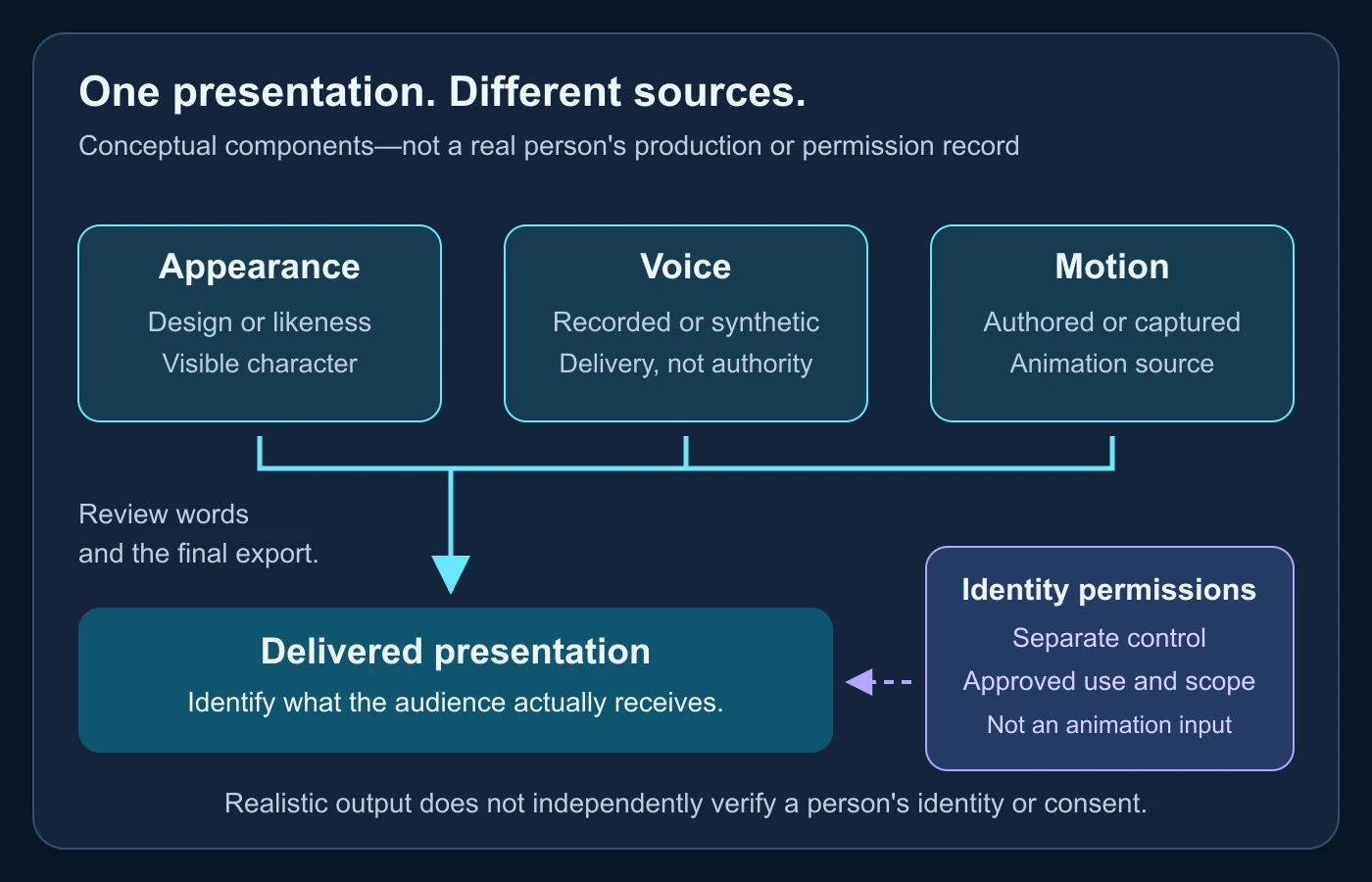
Review one intended release at a time. The following worksheet separates technical ingredients from their permitted presentation. It is an editorial planning tool, not a legal determination or automated approval score. Fill missing entries with “unknown” and a next action instead of treating an empty cell as permission. Keep source records appropriate to their sensitivity and avoid gathering personal information merely to complete a template.
| Component | Record for this release | Question before use |
|---|---|---|
| Appearance | Fictional design or identified likeness; asset version | Who will viewers think this represents? |
| Voice | Recorded or synthetic delivery; source and approved use | Does the description imply a real speaker? |
| Motion | Authored or captured performance; meaningful adjustments | Which performance is actually attributable? |
| Words | Approved script or response configuration | Who supports the message’s factual claims? |
| Permissions | Relevant scope, destination and reviewer | Is this particular use covered, not merely the original asset? |
The permissions row is not another animation input. It is a separate control over how the components may be used. A technically functional export does not settle authorization. Equally, a permission record does not prove that the rendered clip meets the approved specification. Review both: the intended use and the actual output that will reach viewers.
A fictional museum guide shows why the layers matter
Imagine a small museum commissions Rin, a fictional virtual presenter for a recorded introduction. This is a planning example, not a completed deployment or measured experiment. An artist designs Rin without representing an actual staff member. A performer supplies recorded narration and gestures. An editor prepares a short script describing the exhibition’s layout. These are separate contributions even though the visitor sees one coherent character.
Prepare the first release
The team records Rin’s role as “fictional exhibition guide in a prerecorded welcome video.” Its worksheet identifies the character asset, narration take, gesture source and approved script. A curator checks exhibition facts; the production reviewer checks that the visible output matches the script. Neither person is assumed to have approved every future use simply because they reviewed this welcome.
One sentence states that a display contains a reproduction rather than the original object. It is easy to lose that qualification when tightening narration. The editor keeps the distinction in the final words and captions. This is a more useful quality gate than asking only whether Rin looks human: the guide’s value depends on conveying the correct museum information.
Review a proposed reuse
Later, another department wants to reuse Rin in a fundraising video. The character model is already available, but the new request changes the message and destination. The team checks the relevant permissions and prepares a new approval record. It does not infer fundraising authorization from an exhibition welcome. If the proposed narration uses a synthetic voice rather than the original recording, that change is recorded too.
A line such as “I personally restored this collection” would imply an experience Rin cannot have as a fictional persona. The reviewer replaces it with an attributable statement about the actual restoration team. This is a writing correction, not a demand to abandon virtual presentation. The character can communicate real work without pretending to be the human who performed it.
Keep interactive expansion separate
If Rin becomes a live question-answering interface, the team writes a new task boundary. It identifies the information source, response review process and staff handoff. The recorded welcome is not evidence that this new system can safely answer every visitor question. The same face now fronts a different communication process, so the release record must describe that process rather than relying on familiarity with the old video.
Disclosure should explain the meaningful representation
A useful disclosure tells viewers what matters for interpreting the content. “Fictional virtual presenter; narration based on curator-approved text” is more informative in the museum example than an unexplained “AI” badge. If a real person’s double speaks synthesized words, describe that relationship accurately. Do not imply spontaneous testimony when the content is an edited or generated presentation.
Placement matters for comprehension. Put the explanation where a visitor encounters the character and keep relevant context with a downloadable or reposted clip where practical. Review title cards, captions and descriptions as parts of the same release. A transparent main video can become confusing when a shorter excerpt removes the introduction that explained the virtual speaker.
This is a communication workflow, not jurisdiction-specific legal advice. Applicable permissions and disclosure obligations depend on the use. Seek appropriate review for a real likeness or sensitive setting. For the broader production vocabulary, the synthetic-media guide explains captured, generated and hybrid content. That umbrella does not replace the component record needed for a particular virtual person.
Review the exported version, not only the project
Give each release a short record that connects the approved message to the delivered file. In the fictional Rin example, the project can contain several discarded scripts, narration alternatives and gesture sequences. Looking at the project folder is not enough to know which combination visitors will see. The reviewer should watch the exported version with its final captions, title card and description before recording approval.
A practical handoff note identifies the character version, script version, relevant audio source, presentation destination and reviewer. It also records meaningful changes since the previous release. This is not an invitation to publish private performer information. The public description can remain concise while the internal team retains enough information to explain the production accurately later.
Check a short promotional extract as its own communication. If an editor removes “fictional guide” from the introduction, the extract may imply a real staff interview even though the underlying character asset has not changed. Restore the necessary context rather than assuming the audience saw the full welcome first. Conversely, do not label a human actor’s unrelated recorded interview synthetic merely because it shares a campaign with Rin. The record belongs to a particular media version, not every file in the folder.
Human expectations are not an authenticity test
A realistic face can create expectations about gaze, timing and expression. Masahiro Mori’s authorized original essay presents the uncanny valley as a hypothesis about affinity toward humanlike entities, including the influence of movement. It is not a universal psychological law or a method for authenticating a video. Mori: The Uncanny Valley
During production review, ask what felt unclear: an expression contradicting the line, an abrupt pause or a gesture that implies a different intention. That produces an actionable note without declaring that all viewers will react identically. A stylized guide may fit a fictional explanation better than photorealism, but the appropriate choice depends on the task, audience and actual review—not a promised effect of one design style.
Offer alternative access to important information. A readable transcript allows people to check a statement without depending on voice delivery or facial cues. Controls should make it clear whether content is recorded or interactive. An attractive character should not become the only route to a fact, instruction or human contact.
Check the claim before trusting the speaker
For viewers, separate three questions: what the media represents, who stands behind the message and what the message asks you to believe or do. A disclosed fictional guide may be an ordinary presentation format. An alleged executive directing a transaction raises a different identity and authority question. Do not let the realism of the visible person substitute for independent confirmation.
If the content is advertising, personal experience and sponsorship require their own review. The AI UGC guide handles creator-style advertising and testimonial claims in depth. This article’s worksheet concerns the assembled virtual person; it does not certify a product endorsement or turn a fictional speaker into a real customer.
- Identify whether the speaker is fictional, a double or still unknown.
- Read the production description and preserve the version being reviewed.
- Separate voice, words, motion and appearance instead of assigning them one origin.
- Confirm important identity or authority claims through an independent appropriate source.
- Check whether an excerpt omits the original representation disclosure.
- State what remains unresolved; do not convert realism or awkwardness into proof.
Technical video review can contribute evidence about generation or manipulation when the clip itself is uncertain. It cannot supply the missing permission record, establish a person’s employment or approve the narrator’s claim. Keep the production worksheet and the claim check connected, but do not ask either to answer a question outside its scope.
A digital person can look convincing.
Review a video’s signals and independently verify the speaker’s identity claim.
Questions about digital people
Does every digital human use a language model?
No. A character can deliver a fixed recording or use human-controlled animation without generating conversation. Describe the actual response system.
Is a digital double the same as a face swap?
No. A double represents an identifiable person; a face swap transfers a facial identity into a performance. They can overlap in a workflow but are not identical definitions.
Does captured motion mean the final character is a recording?
The motion may derive from a recorded performer while the final visible character is rendered and adjusted. Keep the source performance and output separately described.
Can a fictional presenter communicate accurate information?
Yes. Check the script and responsible source. Fictional appearance does not determine whether a factual statement is supported.
Can a detector verify likeness permission?
No. Analysis of a supported video is different from examining authorization, identity and approved usage records.
Primary sources used
- Epic: How do you create a digital human? — character representations and animation paths, not current licensing or installation instructions.
- ETH Zurich Game Technology Center: Interactive Avatars — a specific ongoing composite-avatar research project.
- Masahiro Mori: The Uncanny Valley, authorized English translation — original hypothesis, not an authenticity test.