

Engagement farming describes posting or interaction tactics designed mainly to harvest likes, replies, shares, or similar attention signals. It can include engagement bait, like farming, recycled emotional stories, or manufactured interaction. Popularity does not prove that a post is false, and an ordinary invitation to discuss a useful topic is not automatically manipulation.
The practical question is what the post asks you to do and what value or evidence it supplies in return. This guide provides a fictional feed review and a short decision worksheet. They help you distinguish a legitimate conversation, a manipulative prompt, an unsupported claim, and a possible transaction risk without pretending you can read the publisher’s private motives.
What engagement farming seeks
An engagement metric records an interaction with a platform feature. A reply indicates that someone replied; it does not establish agreement, careful reading, expertise, or independent confirmation. A share may express approval, alarm, criticism, or a request for verification. Treating all these actions as evidence for the claim creates a category error.
For this article, engagement farming is a practical description of a pattern: the interaction request dominates the useful purpose of the post, or the apparent response is artificially manipulated. It is not a diagnosis of every successful creator. A publisher can want an audience and still provide original reporting, helpful explanations, or entertainment honestly.
Separate the post from the account and the distribution around it. One awkward caption may be an isolated mistake. Repeated near-identical requests across unrelated material may establish a stronger pattern. Coordinated or purchased activity would be another question again, requiring evidence beyond your dislike of the writing style.
Do not assume a precise algorithmic reward. Platforms rank and distribute material using changing systems, and the visible counter does not reveal the entire mechanism. The relevant incentive is simpler: someone is asking for an action that can increase a visible metric or attention to an account. Whether it will actually improve reach or revenue in that case remains a separate empirical question.
Engagement bait, like farming, and fake engagement
Engagement bait describes a prompt that pushes interaction without a proportionate informational purpose. Like farming emphasizes collecting reactions. Fake engagement concerns artificial or inauthentic activity. These terms overlap, but they should not be treated as three independent content subjects or as interchangeable accusations.
A bait post might ask you to type an unrelated word to demonstrate loyalty, withhold a promised answer until people reply, or frame an obvious error to invite corrections. None of those descriptions by itself proves that bots were used. Automated activity, coordinated exchange, and purchased metrics are different behaviors, not properties you can infer from a single provocative sentence.
Facebook’s 2017 engagement-bait announcement described demotion of posts that goad people into likes, shares, and comments for greater reach, while distinguishing genuine requests for help or recommendations. That announcement supplies a historical definition and platform context; it is not proof of how every current Instagram or Facebook surface handles a particular post. Read the original Facebook announcement.
Use precise wording when reviewing a feed. “The post requests an unrelated comment before providing the promised source” describes what is visible. “This person runs a bot farm” alleges another behavior that needs independent evidence. Keeping those statements apart protects both the usefulness of the review and the people involved.
Common patterns to recognize
Patterns are prompts for inspection, not an automatic verdict. The same surface format can serve different purposes. A request to share missing-person information and a demand to share a vague miracle story should not receive the same treatment solely because both contain the word share.
| Visible pattern | Reason to pause | Useful next question |
|---|---|---|
| Unrelated loyalty test | Reaction becomes a substitute for evidence or discussion. | What information does the requested action help establish? |
| A promised answer withheld | The reader may be asked to interact before seeing whether the claim is useful. | Can the answer or source be accessed directly? |
| Emotional story with no source | A reaction is requested before the event is verified. | Who recorded or documented the story? |
| Repeated template across unrelated topics | The interaction pattern may be more consistent than the editorial purpose. | Does each post add specific evidence or useful context? |
Another pattern is the false choice: react one way to show that you are caring, intelligent, patriotic, or loyal, and another way to accept an insulting identity. That framing can pressure a response without adding evidence to the underlying claim. You can decline the choice and investigate the claim separately.
Deliberately ambiguous puzzles and opinion questions require context. An openly playful puzzle can be legitimate entertainment. A supposedly factual announcement that never supplies the promised explanation raises a different issue. Judge whether the post honestly delivers the experience it advertises, rather than classifying every question as a trap.
How recycled or synthetic clips can fit
A clip can carry an engagement prompt regardless of how it was made. An authentic animal video, a staged skit, a generated rescue scene, and an old news extract can all be paired with a demand for reactions. The attention tactic and the media’s production method are separate questions.
Recycling becomes relevant when context changes. If a post presents an old clip as a new event, the misleading part may be its caption rather than its pixels. Finding an earlier version can resolve that particular claim without proving anything about the publisher’s entire operation. Record the version and date evidence rather than extrapolating beyond the case.
Synthetic production can make it easier to create fictional scenes, but a disclosed illustration is not automatically engagement farming. The useful concern is whether the material is presented honestly and whether the requested interaction has a substantive purpose. A clearly labeled fantasy story may seek reactions as entertainment; a fabricated documentary claim requires source checking.
The existing AI slop guide owns the broader question of low-value synthetic publishing and scale. This article stays with the reader’s interaction decision: identify the request, assess the evidence, and choose whether to react or share. Avoid turning every bait review into a general label for all AI-assisted content.
Useful posts versus manipulative framing
A useful request makes its purpose understandable. A teacher can ask learners to explain their reasoning. A creator can invite experience related to the topic. A community organizer can ask for relevant local information. The response itself can contribute value rather than merely inflate a counter.
Look for proportionality. Is the action closely connected to the information the reader needs? Can the reader understand the offer without completing arbitrary public steps? Does the publisher supply enough context to make an informed decision? A meaningful conversation does not require that every comment become a source, but it should have a purpose beyond demonstrating compliance.
A post can also be annoying without being deceptive. Repetitive self-promotion, an unsubtle headline, or a banal opinion might be a reason to mute an account. They do not establish a factual error, fake identity, or financial scam. Your feed preference and the public evidence against a claim should remain distinct.
If you create content, ask what a reader gains from the prompt. “Which part of this explanation needs clarification?” is connected to the material. “Comment a random letter to prove you support the truth” is not. An honest call to action can be direct, relevant, and optional without pretending the action verifies the post.
What current platform rules do and do not tell you
YouTube’s fake-engagement policy prohibits artificial increases in views, likes, comments, and other metrics and gives examples such as promoting metric-inflation services or subscription exchanges. It also explicitly allows ordinary encouragement to subscribe, like, share, or comment. That distinction prevents a blanket claim that every creator call to action violates platform rules. Read YouTube’s current policy.
X’s authenticity policy separately addresses engagement spam, coordinated engagement exchanges, compensated metric inflation, and certain aggressive or automated interactions. It also differentiates authentic coordination from inauthentic manipulation. A reader should apply the policy’s actual scope rather than assume that all organized communities or repeated viewpoints are prohibited. See X’s authenticity rules.
Policy text describes rules and possible enforcement, not a guaranteed outcome for the post you saw. Platforms may lack evidence, interpret context differently, or change their systems. A post remaining online does not prove that its claims are accurate. A removal or reduction in distribution likewise is not a complete fact-check of every statement it contained.
Do not import rules from one platform into another without checking. The Facebook announcement cited above is historical and Facebook-specific; current Meta transparency pages were not fully accessible during this research. No universal Instagram penalty, exact reach reduction, or current monetization result is asserted here. Recheck the relevant official policy before relying on a platform-specific publishing decision.
Check source and context before reacting
First extract the factual claim, if there is one. A post might make a claim about an event, a person, a date, or a product while surrounding it with an interaction prompt. Put the prompt aside and write the claim in one sentence. If it is only entertainment or opinion, say that instead of inventing a factual issue to verify.
Look for the earliest credible source and a longer version of any clip. The current upload date does not automatically describe when a scene was recorded. A repost account can be the place you encountered a clip without being its creator. If the post supplies no source, search independently rather than assuming that a popular comment has filled the gap.
Inspect references directly. A screenshot of a headline may omit the article’s date or qualifications. A link may lead to a different claim. Several sites may repeat one source, so their number is not necessarily independent corroboration. The news verification guide provides the deeper source-and-context workflow when the factual question deserves investigation.
For reused footage, distinctive frames can help locate prior versions. The reverse video search guide covers that specific discovery task. The goal is to determine what the footage actually supports, not to accumulate reasons to dislike the account.
A sample feed review with fictional posts
The following four posts are invented. They are not screenshots of real users, a measured dataset, or evidence that a specific algorithm rewards a tactic. They illustrate how the same reader can make different decisions without assigning a blanket “fake” label to the whole feed.
Post A: a genuine request for relevant experience
A local cycling group posts a photograph of a damaged path, names the location, and asks whether anyone knows when repairs will occur. The requested comments could supply relevant local information. The image and location still need confirmation if you intend to publish a claim, but the interaction has an intelligible purpose.
A proportionate response is to provide information you actually know, or to refer the group to an official update. Avoid repeating uncertain dates as established facts. This is not automatically engagement bait because the publisher wants replies; replies may be the useful content.
Post B: an unrelated loyalty prompt
A page posts an emotional animal illustration and asks readers to type a word to prove they care. It supplies no source or concrete action. You can describe the caption as a loyalty-based interaction prompt without deciding whether the image is generated or the account is fraudulent.
If no real-world claim is made, you may simply continue scrolling or mute the page. If the caption claims a rescue happened yesterday, the event needs a source. Your ability to care about animals does not depend on adding a public comment to an unverified story.
Post C: old footage presented as breaking news
A short clip is captioned as a current emergency and asks readers to share immediately. A source check finds the same footage in an earlier publication. The earlier copy establishes that the new-date claim is inconsistent with the footage’s known history. That is a contextual finding, even if the video itself is camera-recorded.
A useful correction cites the earlier source and explains the date mismatch. Do not claim that you proved the recording location, identified the uploader’s motives, or discovered a bot network unless additional evidence establishes those things. One resolved contradiction is enough to explain why this version should not be shared as current footage.
Post D: a reaction prompt leading to a transaction
A supposed prize announcement asks users to comment, then sends them to an unfamiliar payment page. The important risk has moved beyond feed quality. The identity of the organizer, the offer, and the destination need independent verification. Do not let the surrounding likes or apparent winners substitute for that work.
The scam-video guide addresses this transaction layer. You do not need to determine whether the presenter is synthetic before declining an unverified payment or credential request. Technical media analysis and transaction legitimacy answer different questions.
The four outcomes should remain different: useful conversation, unnecessary pressure, false context supported by an earlier source, and an unverified transaction risk. This is more informative than awarding every post one suspiciousness score. It also makes your next action explicit: participate, ignore, correct, or pause the transaction.
What to do before sharing
Use the following checklist when the post asks you to spread a factual claim:
- Separate the factual statement from the reaction prompt.
- Identify the original or strongest source, not merely the account currently reposting it.
- Check whether the date, location, and accompanying caption match that source.
- Read any cited material and confirm it addresses the same claim.
- Determine whether apparent corroboration comes from independent evidence or repeated copies.
- Inspect any requested payment, login, download, or private conversation separately.
- Choose a narrow outcome: supported, contradicted, unverified, or simply not useful to you.
- Share a correction with evidence instead of amplifying the original bait or harmful destination.
If you need to preserve the post for a report, save its URL, account reference, date seen, caption, and relevant evidence. Avoid adding unnecessary personal information about commenters. A snapshot can document the post you saw; it does not establish that all visible interactions were real people or independent judgments.
When reporting through a platform, describe the applicable behavior and evidence. Do not coordinate mass reporting because you dislike a viewpoint, and do not label unfamiliar accounts as bots without proof. An honest report is narrower than a campaign to punish a creator. For ordinary feed management, mute and unfollow controls may be the appropriate response.
A short decision worksheet
Record five fields: the action requested, the useful purpose, the factual claim, the best supporting source, and the decision before sharing. This worksheet avoids guessing intention and forces the evidence question into view. It can be used on a genuine community post as readily as on an obvious bait caption.
For fictional post B, the requested action is an unrelated comment, the useful purpose is unclear, and the event claim has no source. The decision can be “do not amplify; event unverified.” That does not say the publisher is a criminal. For post C, the supporting earlier source changes the result to “current-date claim contradicted.” The evidence, not the emotional intensity, determines the difference.
If the media remains uncertain after source checks, inspect the strongest authorized video with available technical analysis. Keep the result attached to the clip’s production question. A detector cannot measure a publisher’s private motivation, decide whether an entire audience is artificial, or certify that an offer is legitimate.
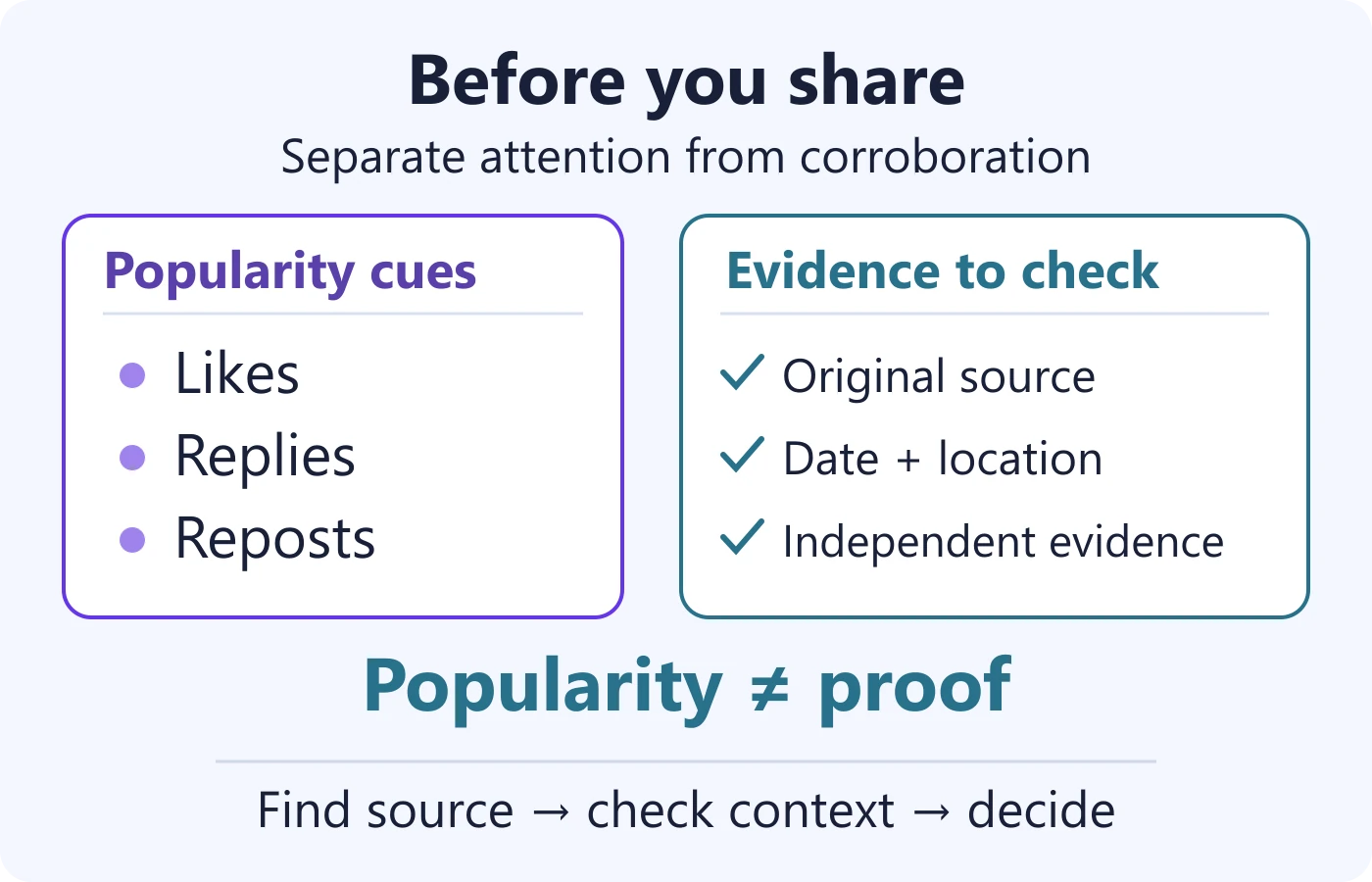
The durable habit is to ask what the interaction proves. A like proves an interaction; a source comparison can establish a history; independent documentation can support a claim. When those roles remain separate, a viral post can be interesting without becoming automatic evidence, and a quiet firsthand source can be valuable without impressive counters.
Viral is not the same as verified.
Check a suspicious clip and confirm its source before sharing it. Use technical media findings alongside the evidence for the actual claim.
Questions about engagement farming
Is asking for comments always engagement bait?
No. A relevant question can help readers learn or contribute useful information. Inspect the purpose and evidence rather than treating the existence of a prompt as a violation.
Does a popular post become a credible source?
Not automatically. Counters show distribution or interaction, not independent confirmation of the underlying claim.
Are engagement bait and bots the same thing?
No. Bait concerns a prompt or framing. Artificial accounts and coordinated metric inflation require separate evidence.
Can a genuine video be used for engagement farming?
Yes. Its caption or distribution context can request arbitrary interaction even when the footage is authentic.
Can a detector identify a creator’s motive?
No. Technical video analysis can address available media signals. The reason for publishing and the authenticity of engagement require other evidence.
Sources used
- Meta/Facebook, Fighting Engagement Bait on Facebook, 2017 with subsequent updates. Historical definition and Facebook-specific approach, not a universal current penalty claim.
- YouTube, Fake engagement policy. Current artificial-metric rules and distinction from ordinary audience calls to action.
- X, Authenticity policy. Current engagement-spam and coordination rules, with context-dependent enforcement.