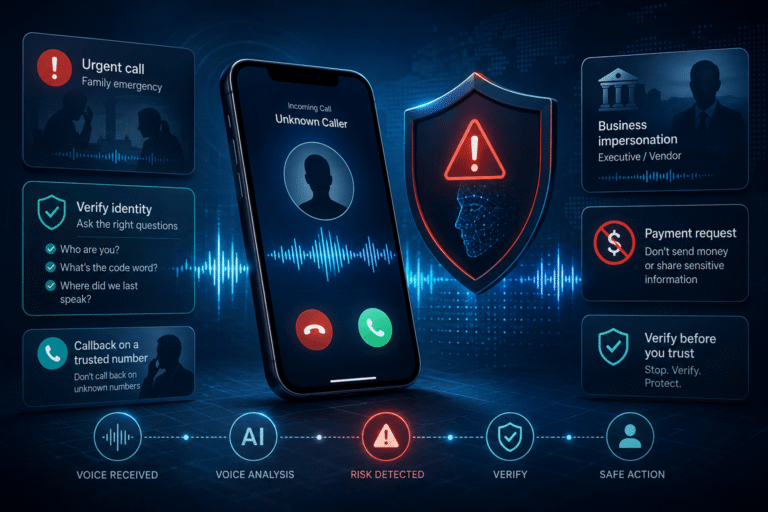
A voice clone scam succeeds when a familiar voice makes you act before you verify. The caller may sound like your child, manager, bank representative, government official, or someone you recognize from online videos. The audio may be AI-generated, but the fraud usually depends on something much older: urgency, authority, fear, secrecy, and a request that is difficult to reverse.
This is why trying to decide whether a voice “sounds fake” is not the best first defense. High-quality synthetic speech can be convincing, while genuine calls can sound strange because of compression, poor reception, stress, illness, or background noise. The safer strategy is to verify the identity and request through a channel the suspicious message does not control.
What Is a Voice Clone Scam?
A voice clone scam is an impersonation fraud in which synthetic or AI-altered speech is used to make a message sound as if it came from a real person.
The cloned voice is not necessarily the entire scam. It is usually one trust-building layer inside a broader social-engineering sequence.
The underlying synthetic-audio technology is covered separately in the voice deepfake guide. This page focuses on the fraud workflow and how to interrupt it.
Voice Clone Scam vs Voice Deepfake
The terms overlap, but they describe different things.
| Term | Main meaning | Main question |
|---|---|---|
| Voice deepfake | Synthetic or altered speech that imitates a person’s vocal identity | Is this audio synthetic or impersonating someone? |
| Voice clone scam | Fraud that uses cloned or synthetic speech to manipulate a target | Is someone using a trusted identity to make me take a harmful action? |
| AI voice | Any machine-generated speech, including legitimate narration or accessibility uses | Was the speech generated by AI? |
| Impersonation scam | Fraud that pretends to be another person or organization, with or without AI | Is the claimed identity genuine? |
A generic AI narrator is not a voice clone scam. A scammer pretending to be your bank can commit impersonation fraud without AI. The voice clone makes impersonation more persuasive, but the fraud is defined by the deceptive request.
Why Voice Scams Are Dangerous Even When the Audio Is Imperfect
The target rarely listens like a forensic examiner. They listen like a parent, employee, customer, voter, fan, or account holder who has been given a reason to react.
Three psychological advantages make voice impersonation especially effective.
Familiarity lowers skepticism
A known voice can function like an informal password. If the caller sounds like someone you recognize, you may skip checks you would perform for an unknown caller.
Urgency reduces verification
Scammers often create a narrow decision window: an arrest, medical emergency, expiring account, suspicious bank transfer, confidential acquisition, or payment that “must happen now.”
Authority changes normal behavior
A request that would seem suspicious from a stranger can feel legitimate when it appears to come from a manager, police officer, bank employee, government official, or family member.
The FBI has warned that AI-generated content can make fraud more believable and that criminals use cloned audio to impersonate relatives and public figures, request urgent payments, or help gain access to accounts. See the FBI/IC3 warning on generative AI and financial fraud.
The Anatomy of a Voice Clone Scam
Voice cloning is strongest at stages two and three. Your defense should target stage four: never let a convincing voice authorize a sensitive action by itself.
The Most Common Voice Clone Scam Scenarios
Family emergency scams
A caller sounds like a child, grandchild, partner, sibling, or parent and claims to be injured, arrested, kidnapped, stranded, or in immediate financial trouble.
The story may include another person pretending to be a lawyer, police officer, doctor, or intermediary. The target is pushed toward an urgent payment before they can independently reach the family member.
CEO and manager impersonation
An employee receives a call or voice message that appears to come from an executive, finance lead, supplier contact, or colleague. The request may involve a wire transfer, gift cards, a new bank account, payroll details, credentials, or confidential documents.
The voice is especially dangerous when the request is plausible within the employee’s normal role.
Bank and support impersonation
The caller claims suspicious activity has been detected and asks the customer to “secure” the account by moving money, reading a one-time code, approving a login, installing software, or sharing credentials.
The FTC says some of the costliest impersonation fraud begins with fake security alerts and convinces victims to move money supposedly to protect it.
Government and law-enforcement impersonation
The scammer uses authority and fear: a warrant, tax problem, immigration issue, investigation, fine, or account freeze. AI voice can make the official persona more convincing, but the payment or information request remains the central fraud signal.
Celebrity and influencer endorsements
A cloned voice can be attached to real or manipulated video to promote investments, giveaways, health products, trading platforms, or other offers. The face may be authentic footage while the endorsement itself is synthetic.
These campaigns overlap with broader AI impersonation and synthetic-video fraud.
Romance and relationship scams
A synthetic voice note or video call can help a fake online identity appear more real. The impersonation may be used to deepen trust before requests for money, travel fees, investments, or emergency help begin.
Real-World Scale: Impersonation Fraud Is Already Expensive
Voice cloning is only one part of impersonation fraud, so it is important not to attribute every loss to AI.
Still, the overall numbers show why attackers invest in trusted identities. FTC data released in June 2026 show that consumers reported losing $3.5 billion to imposter scams in 2025, nearly three times the reported losses in 2020. Nearly one in three fraud reports in 2025 involved an imposter scam.
The FTC also reported nearly $1 billion in losses to business impersonators and about $920 million to government impersonators during 2025. See the FTC’s 2026 imposter scam data.
These totals are not “voice clone losses.” They measure the wider impersonation environment in which AI-generated voices can operate.
Documented AI Voice Impersonation Campaigns
Senior U.S. officials impersonated with AI-generated voice messages
In May 2025, the FBI warned about a malicious messaging campaign that used AI-generated voice messages to impersonate senior U.S. officials. The attackers attempted to establish trust and then move targets to another messaging platform, where access to accounts, contacts, information, or funds could become the next objective.
Why this example matters: the attack was not simply “fake audio.” The cloned identity was used to move the victim into a communication environment controlled by the attacker.
This is a useful model for recognizing modern voice scams: watch what the message asks you to do next.
How to Spot an AI Voice Without Overtrusting Audio Clues
The Search Console query “how to spot AI voice” deserves a direct answer, but the safest answer is not a checklist of supposedly universal sound defects.
AI-generated speech may still contain audible anomalies. The problem is that none of them is reliable enough to authenticate a person.
| Possible clue | Why it may raise suspicion | Why it is not proof |
|---|---|---|
| Odd rhythm or emphasis | The sentence cadence may not fit the speaker or situation | Stress, scripts, bad connections and editing can change natural speech |
| Unusual pronunciation | Names, acronyms or uncommon words may sound wrong | People mispronounce words, change accents and read unfamiliar terms |
| Emotion mismatch | The delivery may feel disconnected from an alleged emergency | Real people respond to stress differently |
| Warble, clipping or digital artifacts | Synthesis or processing may introduce audible defects | Phone codecs, compression and noise reduction can create similar artifacts |
| Audio does not fit the room or video | The voice may have been inserted or replaced | Dubbing and normal post-production can also separate audio from the original scene |
The FBI noted in its 2025 warning that AI-generated voices can sound nearly identical to known contacts. That is why the strongest test is not “does this sound artificial?” but “can I independently confirm the sender?”
The Strongest Red Flags Are in the Request, Not the Voice
Even if the audio sounds perfect, treat these behaviors as high-risk:
- unexpected request for money, cryptocurrency, gift cards, wire transfer, payment app, or new bank details
- request for a one-time password, login code, recovery code, or authentication approval
- request to install remote-access software
- pressure to keep the matter secret
- request to move immediately to a new messaging platform or phone number
- refusal or inability to verify through a known channel
- new payment destination combined with urgency
- authority-based threats or extreme consequences for delay
A legitimate person can make an unusual request. The point is not to declare every unusual call fraudulent. The point is to require stronger verification before taking a sensitive action.
The 60-Second Voice Scam Interruption Rule
This is more reliable than trying to diagnose AI audio while the scammer is still controlling the conversation.
The FTC’s consumer guidance on harmful voice cloning recommends contacting the person who supposedly called through a phone number you know belongs to them. If you cannot reach the person directly, verify through another trusted contact. See the FTC voice cloning safety guidance.
Do Not Call Back the Number That Contacted You
This detail matters.
If the message claims to come from a bank, government agency, family member, executive, or supplier, the suspicious message should not provide the only route to verification.
Instead:
- use a family member’s number already stored in your contacts
- use the official phone number on a bank card or official website
- use your company’s internal directory or established chat account
- contact a supplier through previously verified account details
A scammer may control the incoming number, a spoofed caller ID, a newly created account, or a fake support page. Independent verification means leaving that channel.
Family Protection: A Simple Protocol Beats Perfect AI Detection
Families do not need forensic software to stop most emergency voice scams. They need an agreed response process.
The FBI has also recommended a private family word or phrase as one possible identity-verification measure. It should be a backup layer, not the only layer, because personal information can leak or be socially engineered.
Business Protection: Treat Voice as Context, Not Authorization
Businesses are especially exposed when a cloned voice is paired with a believable operational request.
The strongest control is procedural:
No unusual payment, bank-detail change, credential reset, or sensitive-data release should be approved by voice alone.
Use dual approval for high-risk payments
A second authorized person should approve new beneficiaries, unusually large transfers, or urgent changes. The second reviewer should verify independently rather than relying on the same message thread.
Verify bank-detail changes out of band
If a supplier or executive requests a new account number, call a previously verified contact. Do not verify the new bank details using the contact information inside the change request.
Separate identity from authority
Even if the person is genuinely the CEO, the payment still needs to follow the organization’s approval policy. This makes impersonation harder because the attacker must defeat the process, not just imitate one person.
Log exceptions
Fraud frequently enters through “this is urgent, skip the normal process.” Require a documented exception path rather than informal bypasses.
WhatsApp, Voice Notes and Messaging Apps
Voice notes are effective scam tools because they feel informal and personal. A forwarded audio message may also hide the true source.
On WhatsApp or another messaging app:
- be cautious when a known person suddenly contacts you from a new number
- do not treat a profile photo as identity proof
- verify requests for money or codes through an existing contact channel
- do not move to another platform just because the sender insists
For the broader messaging-platform fraud patterns, use the WhatsApp scams guide.
Video Calls and Voice Clone Scam Videos
A video call can feel stronger than a phone call, but it should not become a high-value authentication factor by itself.
A scammer can use:
- real video with replaced audio
- a prerecorded clip
- AI lip synchronization
- face replacement or real-time synthetic video
- low resolution, poor lighting, captions, or short camera exposure to hide inconsistencies
If a video itself appears manipulated, use a broader scam video verification workflow instead of relying on the audio alone.
When Technical Detection Is Useful
Technical detection is valuable when you need to investigate the media after the immediate risk has been interrupted.
For example:
- a brand wants to document a fake celebrity endorsement
- a fraud team needs to preserve evidence from a suspicious video
- a journalist needs to evaluate whether a public statement was altered
- a company needs to investigate an impersonation incident
DetectVideo AI can add technical evidence for supported video by examining available visual, temporal, audio-video, compression, metadata, source, and manipulation signals.
That analysis should come after the scam interruption step. If someone is asking you to transfer money right now, the correct action is to stop and independently verify. You do not need to wait for a forensic score before refusing an unverified payment request.
If You Already Sent Money or Shared Information
Speed matters. The exact recovery path depends on what you shared and how you paid.
If you sent money
Contact the bank, card issuer, transfer service, payment app, or cryptocurrency service immediately and ask whether the transaction can be stopped, recalled, reversed, or flagged for fraud.
If you shared credentials or approved a login
Change the affected password, terminate unknown sessions, review recovery methods, enable or reset multi-factor authentication, and contact the account provider if takeover is possible.
If you shared a one-time code
Treat the associated account as potentially compromised. Secure the account immediately and review recent login or transaction activity.
If the scam targeted your employer
Notify security, finance, legal, or fraud teams quickly. Preserve the original audio, message thread, phone number, payment details, timestamps, and account identifiers.
Report the scam
Use the relevant platform reporting tools and your country’s fraud or cybercrime reporting channels. In the United States, FTC and FBI/IC3 reporting can help authorities identify recurring fraud infrastructure.
AI-Generated Robocalls: A U.S. Legal Note
In February 2024, the U.S. Federal Communications Commission ruled that AI-generated voices fall under the Telephone Consumer Protection Act’s restrictions on artificial or prerecorded voice calls. That decision expanded the tools available against illegal voice-cloning robocalls.
The FCC action does not mean every legitimate use of synthetic speech is prohibited. It addresses how AI-generated voices fit within existing robocall rules. See the FCC announcement on AI-generated robocalls.
What Legitimate Synthetic Voice Usually Looks Like
AI speech has many legitimate uses: accessibility, consent-based voice restoration, narration, localization, creative production, and dubbing.
Legitimate use is more likely to include:
- clear disclosure or production context
- no false claim that a different real person authorized the message
- no attempt to bypass payment or account-security procedures
- consistent publisher or creator identity
- a normal route to independent verification when the message is important
Do not label a voice fraudulent simply because it is synthetic. The scam is defined by deception and harmful action, not by AI generation alone.
A Better Way to Classify a Suspicious Voice Message
| Status | What it means |
|---|---|
| Verified genuine request | The identity and specific request were independently confirmed through a trusted channel |
| Synthetic voice, legitimate use | AI speech is disclosed or authorized and the surrounding request is legitimate |
| Impersonation scam confirmed | The claimed sender denies the request or other evidence establishes fraudulent impersonation |
| Voice manipulation supported | Technical or provenance evidence supports synthetic or altered audio, but the broader fraud case may still require investigation |
| Suspicious, unverified | The sender or request cannot be independently confirmed |
This avoids a dangerous mistake: treating “I cannot prove the voice is AI” as permission to trust the request.
Voice Clone Scam Checklist
Key Takeaway
The best defense against a voice clone scam is not perfect AI detection. It is refusing to let a voice authorize a high-risk action by itself.
A scammer may imitate your child, manager, bank, government official, or public figure. The voice may contain obvious defects or sound nearly identical to the real person. Either way, the response is the same when money, credentials, access, secrecy, or urgency is involved: stop, leave the suspicious channel, and independently verify the identity and request.
Use audio and video analysis when you need to investigate what happened. Use process controls to prevent the loss from happening in the first place.
FAQ About Voice Clone Scams
What is a voice clone scam?
A voice clone scam is an impersonation fraud that uses AI-generated or altered speech to sound like a trusted person and pressure the target into sending money, sharing information, approving access, or taking another harmful action.
How can I spot an AI voice scam?
Do not rely only on sound quality. Look for an unexpected identity, urgency, secrecy, requests for money or codes, a new communication channel, or refusal to verify independently. End the interaction and contact the person through a trusted channel.
Can AI voice sound exactly like someone I know?
High-quality synthetic speech can be very convincing, especially in short messages or noisy calls. The FBI has warned that AI-generated voice cloning can sound nearly identical to known contacts, so voice alone should not authenticate a sensitive request.
What should I do if my child or parent calls asking for emergency money?
End the call and contact them through a phone number or account you already know. If they do not respond, verify the story through another trusted family member or contact before sending money.
Should families use a secret word?
A private family word or phrase can be a useful extra layer if it is truly private, but it should not replace callback verification. Personal details and phrases can sometimes be exposed or socially engineered.
How should a business verify a voice request from a CEO?
Follow the normal approval process regardless of how convincing the voice sounds. Verify unusual payments or bank-detail changes through a known internal channel and require an independent second approval for high-risk transactions.
Can caller ID prove who is calling?
No. Caller ID can be spoofed. Use a phone number or account you already trust instead of relying on the number displayed by the incoming call.
Are voice clone scams only phone calls?
No. They can arrive as voice notes, video messages, video calls, social media content, messaging-app conversations, robocalls, or synthetic audio placed over real footage.
Can an AI detector stop a voice clone scam?
A detector can help investigate suspicious media, but it should not be your first or only defense. If the request is high risk, independently verify the sender before acting even if no detector is available.
What should I do if I already paid a voice scammer?
Contact the payment provider immediately and ask whether the transaction can be stopped or reversed. Secure any affected accounts, preserve the evidence, notify relevant organizations, and report the fraud through appropriate local channels.
Is every synthetic voice a scam?
No. AI voices are legitimately used for accessibility, narration, dubbing, localization, and creative production. A voice clone scam involves deceptive identity or a fraudulent request, not simply the use of synthetic speech.
Can a real video contain a fake voice?
Yes. Authentic video can be paired with cloned or replaced audio, which is why a familiar face does not prove the spoken words are genuine.