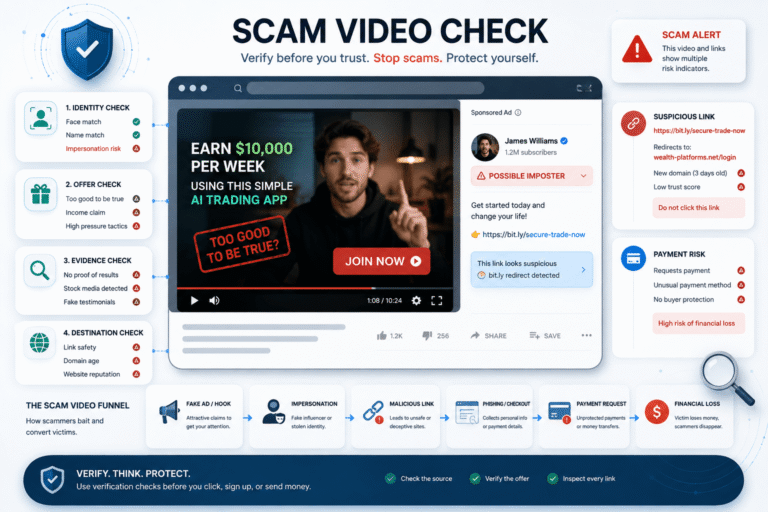
A scam video is usually not the scam itself. It is the trust-building layer that gets you to the scam. The clip may look like a product review, celebrity endorsement, breaking-news segment, customer success story, investment tutorial, giveaway, job offer, or support warning. What matters is what happens next: you are pushed toward a website, private chat, payment method, login page, app download, wallet, or person who controls the next step.
This is why judging a scam video by facial glitches or strange audio is no longer enough. The video can be completely authentic and the offer can still be fraudulent. A real influencer clip can be stolen. A genuine celebrity interview can receive a new voice-over. A legitimate brand logo can lead to a lookalike store. A polished paid advertisement can still come from a scammer.
What Is a Scam Video?
A scam video is video content used to persuade someone into a fraudulent or deceptive action. The video may itself be fake, partly manipulated, AI-generated, stolen, miscaptioned, or completely genuine.
The defining feature is not the pixels. It is the role the video plays in the fraud.
A useful definition is:
A scam video is a video used to create trust, urgency, authority, desire, or fear so the viewer is more likely to enter a fraudulent transaction or communication path.
That action might be:
- buying from a fake or misleading store
- sending money to a fraudulent investment platform
- sharing a password or one-time code
- installing remote-access or malicious software
- moving to WhatsApp, Telegram, or another private channel
- sending identity documents or personal information
- paying an upfront fee for a prize, job, loan, or recovery service
The Scam Video Funnel: Follow the Money, Not the Pixels
The most useful verification question is therefore not:
“Does this video look fake?”
It is:
“What is this video trying to make me trust, and where does that trust lead?”
A Real Video Can Still Be a Scam
This is the single most important distinction on this page.
| Video | Offer or destination | Possible result |
|---|---|---|
| Authentic influencer video | Stolen and reposted with a fake shop link | Scam |
| Authentic celebrity footage | New cloned voice promotes a fake investment | AI-assisted scam |
| Fully AI-generated presenter | Clearly disclosed advertisement for a legitimate business | Not automatically a scam |
| Authentic product demonstration | Lookalike website steals card details | Scam |
| Real news clip | Reposted with a fake “claim your compensation” link | Scam |
| Manipulated deepfake | No financial or deceptive action, clearly labeled parody | Not necessarily fraud |
This is why media authenticity and fraud legitimacy must be verified separately.
Why Scam Videos Work So Well on Social Media
Video compresses several trust signals into a few seconds: a human face, confident speech, product demonstration, comments, logos, screenshots, and a visible call to action. Social platforms then make that package easy to distribute, target, duplicate, and test.
Current FTC data show how economically important that distribution channel has become. In 2025, nearly 30% of people who reported losing money to scams said the scam started on social media, with reported losses of about $2.1 billion. Shopping scams were the most commonly reported social-media scam, while investment scams produced the largest reported losses. The FTC also notes that scammers can use paid advertising and the same targeting tools legitimate businesses use. See the FTC social media fraud data.
Those numbers measure social-media scams broadly, not scam videos alone. But video, Reels, Shorts, livestreams, and video ads are now common ways to build the trust that moves users into those fraud funnels.
A Paid Ad Is Not Proof That the Advertiser Was Vetted
One of the most dangerous assumptions is:
“The platform showed me this as an ad, so the business must have been checked.”
That is not a safe assumption.
The FTC explicitly warns that social-media platforms do not always thoroughly vet every ad or advertiser. Scammers can pay for placement, impersonate real brands, advertise counterfeit or nonexistent products, or promote fraudulent investment programs. The FTC recommends researching the company independently before buying from an ad. See its consumer guidance on scammy social-media ads.
Paid placement is distribution, not authentication.
The Four-Part Scam Video Test
Instead of memorizing dozens of visual red flags, test four independent parts of the pitch.
A scam only needs one of these layers to fail.
The person might be real, but the offer is fake. The offer might exist, but the link is a phishing copy. The website may belong to the real company, but the supposed “investment adviser” contacting you privately may not.
The Destination Test: Where Does the Video Send You?
For scam prevention, the destination is often more informative than the video.
Website
Do not judge a domain only by how professional the page looks. Compare the exact domain with the organization’s known official site. Look for extra words, misspellings, unrelated subdomains, strange top-level domains, or a domain that has no clear relationship to the brand in the video.
If you are unsure, do not follow the supplied link. Navigate to the official company or creator independently and look for the same offer.
Private message
Moving from a public ad or video into a DM gives the scammer more control and reduces outside scrutiny. This is especially common with investment pitches, fake support, romance scams, influencer impersonation, and account-recovery fraud.
If the conversation moves to WhatsApp, the broader WhatsApp scams guide covers the identity and account risks of that channel.
Payment destination
The important question is not whether the seller sounds trustworthy. It is whether the beneficiary, merchant, wallet, bank account, or payment processor matches the verified business.
A last-minute change in bank details should trigger independent confirmation through previously known contact information.
App or download
Do not install an app, browser extension, remote-access tool, or file simply because a video says it is necessary to claim a prize, protect an account, receive a refund, start an investment, or prove your identity.
Six Scam Video Patterns Worth Recognizing
1. Fake shopping and product ads
The video shows an impressive product, dramatic discount, unboxing, before-and-after result, or emotional creator story. The destination may be a fake store, a brand impersonation site, a low-quality dropshipping page, or a subscription trap.
FTC data show that shopping scams are the most commonly reported type of social-media scam, and many begin with an ad for a product that never arrives, arrives as a counterfeit, or is materially different from what was advertised.
2. Investment and trading videos
The video shows profits, luxury purchases, trading dashboards, testimonials, a “mentor,” or a supposedly exclusive strategy. The destination may be a fake investment platform where balances and returns are simulated to encourage larger deposits.
Promises of high or guaranteed returns with little or no risk are a major warning sign. The FTC reported more than $7.9 billion in reported investment-scam losses for 2025 across contact methods. Its investment scam guidance warns that apparent profits shown inside a platform may be fabricated.
3. Celebrity and influencer impersonation
A recognized person appears to recommend a product, cryptocurrency, investment platform, giveaway, or service. The video may be a deepfake, cloned voice, stolen real footage, or an authentic clip attached to a fraudulent landing page.
The correct first question is not whether the celebrity’s face has artifacts. Check whether the person’s official channels or legitimate partners confirm the endorsement.
The broader identity problem is covered in the AI impersonation guide.
4. Account security and support videos
A clip or ad claims your bank, social account, device, tax profile, subscription, or payment account has a problem. You are told to click, call, install something, approve a login, read out a code, or move money to “protect” it.
Do not use the contact route inside the warning. Open the official app or independently find the organization’s known website or phone number.
5. Job and business-opportunity videos
The pitch promises unusually easy work, high income, remote employment, automated business revenue, or an expensive training system with predictable results. The next step may require a fee, cryptocurrency payment, purchase of equipment, personal documents, or banking information.
The video can use real success stories, actors, paid testimonials, AI presenters, or fabricated earnings screenshots. Verify the employer, legal business identity, compensation structure, and real job opening independently.
6. Recovery scams
After someone loses money, another video, ad, account, or “investigator” promises to recover the funds for an upfront payment.
This is especially dangerous because the victim is already motivated and emotionally invested. A second scam can target the same person using information from the first fraud.
AI Makes Scam Videos More Convincing, Not Automatically More Effective
Generative AI gives scammers cheaper ways to create faces, voices, video scenes, testimonials, translations, and variations of the same pitch. But the fraud still depends on persuading a person to take an action.
The FBI has documented fraud schemes in which AI-generated videos are used to depict public figures, company executives, law-enforcement figures, or other identities in believable ways. It specifically warns that synthetic video may be used in real-time video chats or private communication to “prove” that an online contact is a real person. See the FBI/IC3 warning on AI-assisted impersonation fraud.
The useful lesson is:
AI can strengthen the trust layer, but independent verification can still break the scam funnel.
When to Analyze the Video Itself
Media analysis becomes important when the legitimacy of the person, statement, demonstration, or event depends on whether the video was manipulated.
Examples:
- a celebrity appears to endorse an investment that is not mentioned anywhere else
- a CEO appears in a video approving an unusual transaction
- a product demonstration seems physically impossible
- a public figure appears to announce a giveaway or compensation program
- a real video may have received cloned speech or AI lip synchronization
If the media itself is the unresolved question, the deepfake video guide explains the main manipulation types, while the video verification guide covers source, date, context, provenance, and technical evidence.
Do Not Use “Looks AI” as a Scam Verdict
A glossy synthetic presenter can advertise a legitimate company. A real human influencer can promote a fraudulent scheme. A genuine customer video can be stolen and placed above a malicious link.
So these are different conclusions:
| Conclusion | What it actually tells you |
|---|---|
| This video is AI-generated | Something about the media’s production |
| This identity is impersonated | The claimed person or authorization is false |
| This offer is deceptive | The commercial or factual promise is not supported |
| This destination is fraudulent | The website, wallet, payment account, app, or communication route is unsafe or unauthorized |
| This is a scam | The overall interaction is designed to obtain money, data, access, or another benefit through deception |
Keeping these claims separate prevents both false accusations and false reassurance.
The Hard-Stop List: Requests That Deserve Immediate Verification
You do not need to prove that the video is synthetic before refusing an unverified high-risk request.
How to Verify an Influencer or Celebrity Endorsement
Scammers borrow reputation because reputation converts.
Use three independent checks:
Check the person’s real publishing history
Does the endorsement appear on the creator’s established channels, website, newsletter, management page, or other normal publishing route?
Check the brand’s side of the relationship
Does the company mention the partnership on its own official channels? Is the product sold through a known store? Is the promotion consistent with the brand’s normal campaigns?
Check the destination separately
Even when an endorsement is genuine, a scammer can copy it and attach a different link. Confirm that the landing page belongs to the same verified company.
If the issue is specifically a fake public figure or celebrity video, use the celebrity deepfake guide.
Comments, Likes and Testimonials Are Not Independent Evidence
A convincing scam video often surrounds itself with social proof: enthusiastic comments, earnings screenshots, customer stories, review clips, follower counts, or apparent success.
None of those should be treated as independent verification when they are controlled by the seller, uploader, affiliate network, compromised account, or coordinated group.
Ask whether the evidence exists outside the conversion funnel.
A testimonial hosted by the seller proves that the seller published a testimonial. It does not independently prove the result.
Scam Video or Misinformation? The Difference Matters
A false or misleading video is not always a financial scam.
Misinformation may aim to change beliefs, political attitudes, reputations, or understanding of an event. Scam content typically tries to extract something from the target: money, credentials, data, access, labor, ongoing contact, or another economic benefit.
The categories can overlap. A fake news-style video can create credibility for an investment scam. A fabricated government announcement can direct users to a phishing page.
If the central question is whether the news claim itself is true, the news verification guide is the better workflow.
What to Do Before Clicking a Scam Video Link
You do not need to inspect the link with advanced tools to make several strong checks.
- Read the exact domain. Ignore the page design for a moment.
- Navigate independently. Search for or type the official company site rather than following the ad.
- Look for the same offer. If a promotion is real, the verified organization should normally know about it.
- Check the payment path. Make sure the merchant or beneficiary belongs to the same entity.
- Do not let urgency shorten the process. A legitimate offer should survive a few minutes of verification.
If You Already Clicked, Paid or Shared Information
Once you have interacted with a suspected scam, the priority changes from verification to containment.
| What happened | Priority response |
|---|---|
| You only opened the page | Close it. Do not download files, approve notifications, enter credentials, or grant permissions. |
| You entered a password | Change it from a trusted device, review active sessions and recovery settings, and secure any account that reused the password. |
| You shared a one-time code or approved a login | Treat the account as potentially compromised and contact the provider promptly. |
| You entered card or banking details | Contact the financial institution, monitor transactions, and ask what protective or dispute actions are appropriate. |
| You sent money | Contact the bank, card issuer, payment service, or transfer provider immediately and ask whether the transaction can be stopped, recalled, or disputed. |
| You installed software or granted remote access | Disconnect the session, secure sensitive accounts from a trusted device, and follow appropriate device-security procedures. |
| You sent identity documents | Record exactly what was exposed and consider the identity-protection and reporting options appropriate to your country. |
Watch for the Second Scam: “We Can Recover Your Money”
People who have already lost money are attractive targets because scammers know they want a fast solution.
Be suspicious of unsolicited people or services that claim they:
- found your stolen cryptocurrency
- can unlock frozen investment funds
- work with law enforcement or a regulator
- can trace a scammer for an upfront fee
- need another payment before recovered money can be released
A recovery offer should be independently verified just like the original offer.
How to Preserve Evidence Without Amplifying the Scam
If you want to report or document a scam video, save enough evidence to reconstruct what happened without unnecessarily sending more users into the funnel.
Preserve:
- the original post or ad URL
- account name and profile URL
- date and time seen
- screenshot or copy of the video when appropriate
- caption and visible claims
- destination URL
- phone numbers, usernames, wallet addresses, or payment details
- receipts and transaction references if money moved
When warning others, a screenshot and explanation can be safer than reposting the original video with its live scam link.
For Brands and Creators: Make Real Offers Easy to Verify
Scam prevention is not only the viewer’s responsibility. Brands and creators can make impersonation less effective by reducing ambiguity.
Where DetectVideo AI Fits in a Scam Investigation
DetectVideo AI is useful when the video itself is an unresolved part of the scam investigation.
For supported media, technical analysis can contribute evidence about visual, temporal, audio-video, compression, metadata, source, and manipulation signals.
Examples where that matters:
- a public figure appears to endorse a fraudulent investment
- an executive appears in a suspicious payment-approval video
- a video call may use a real-time synthetic identity
- authentic footage may have received cloned audio or altered speech
But technical video analysis cannot tell you whether a website will ship the product, whether an investment is licensed, whether a beneficiary account belongs to the real business, or whether a login page is authorized.
Use media analysis for the media question. Use independent fraud verification for the transaction question.
A Better Scam Video Verdict
| Verdict | Meaning |
|---|---|
| Verified legitimate offer | Identity, offer, evidence, and destination have been independently confirmed |
| Authentic video, fraudulent destination | The media may be genuine but the attached site, payment path, or account is not |
| Impersonation scam | The person, brand, organization, or authorization is falsely represented |
| Deceptive or unsupported offer | The claims, returns, results, or testimonials are not adequately supported |
| AI-manipulated scam media | Synthetic or altered media is used as part of the fraudulent trust layer |
| Suspicious, unverified | The offer or identity cannot be independently confirmed |
This wording is more useful than simply saying “fake video” because it tells the reader which part of the fraud chain failed.
Scam Video Checklist
Key Takeaway
The strongest scam-video skill is not spotting fake faces. It is following the trust from the video to the transaction.
Verify who is speaking, whether the offer exists, whether the evidence stands up outside the seller’s own funnel, and where the link or payment actually leads. Treat paid ads as ads, not background checks. Treat familiar faces and voices as context, not authorization. And do not let a “real video” result turn an unverified website, investment, account, or payment request into a safe one.
If the media itself remains suspicious, analyze it. If the transaction is suspicious, stop it first.
FAQ About Scam Videos
What is a scam video?
A scam video is video content used to build enough trust, urgency, authority, or desire to move a viewer into a fraudulent action such as paying, clicking, installing software, sharing credentials, or entering a private conversation.
Are scam videos always fake or AI-generated?
No. A scam can use authentic footage, stolen influencer content, real news clips, or genuine product video. The fraudulent part may be the caption, offer, account, website, payment destination, or request.
How can I tell if a video ad is a scam?
Verify the advertiser and offer outside the ad, check the exact destination domain, confirm the payment recipient, research the company independently, and treat urgency or guaranteed outcomes as reasons to slow down.
Are social media ads checked for scams before they appear?
Not always. The FTC warns that social platforms do not necessarily thoroughly vet every ad or advertiser. Paid placement should not be treated as proof that an offer is legitimate.
How do I verify an influencer promotion?
Check the influencer’s established channels, confirm the partnership from the brand’s side, and verify that the landing page and payment destination belong to the same legitimate business.
Are celebrity scam videos usually deepfakes?
Not necessarily. They can use deepfakes, cloned voices, stolen authentic footage, false subtitles, edited interviews, or genuine videos attached to fraudulent links.
What are the biggest red flags in a scam video?
The strongest red flags are often behavioral: urgent payment requests, guaranteed returns, secrecy, unexpected bank changes, one-time code requests, remote-access software, gift cards, cryptocurrency-only payment, or movement to an unverified private channel.
Can a real video lead to a phishing site?
Yes. A scammer can reuse authentic content and attach a fraudulent link, QR code, advertisement, profile, or payment destination. Media authenticity does not prove destination safety.
What should I do if I clicked a scam video link?
If you only opened the page and did not enter information or grant permissions, close it. If you entered credentials, approved a login, installed software, or sent money, take the appropriate account, device, and financial-security actions immediately.
What should I do if I already paid a scammer?
Contact the bank, card issuer, transfer service, or payment provider as quickly as possible and ask whether the payment can be stopped, recalled, disputed, or flagged as fraud. Preserve the evidence and watch for recovery scams.
Can DetectVideo AI tell whether a website or investment is legitimate?
No. DetectVideo AI can contribute technical evidence about supported video. Website legitimacy, investment authorization, payment ownership, product delivery, and account identity require separate verification.
Should I share a scam video to warn other people?
Avoid amplifying the original scam funnel when possible. Save evidence and warn others with screenshots, verified information, and a description of the fraud pattern rather than redistributing a live malicious link.